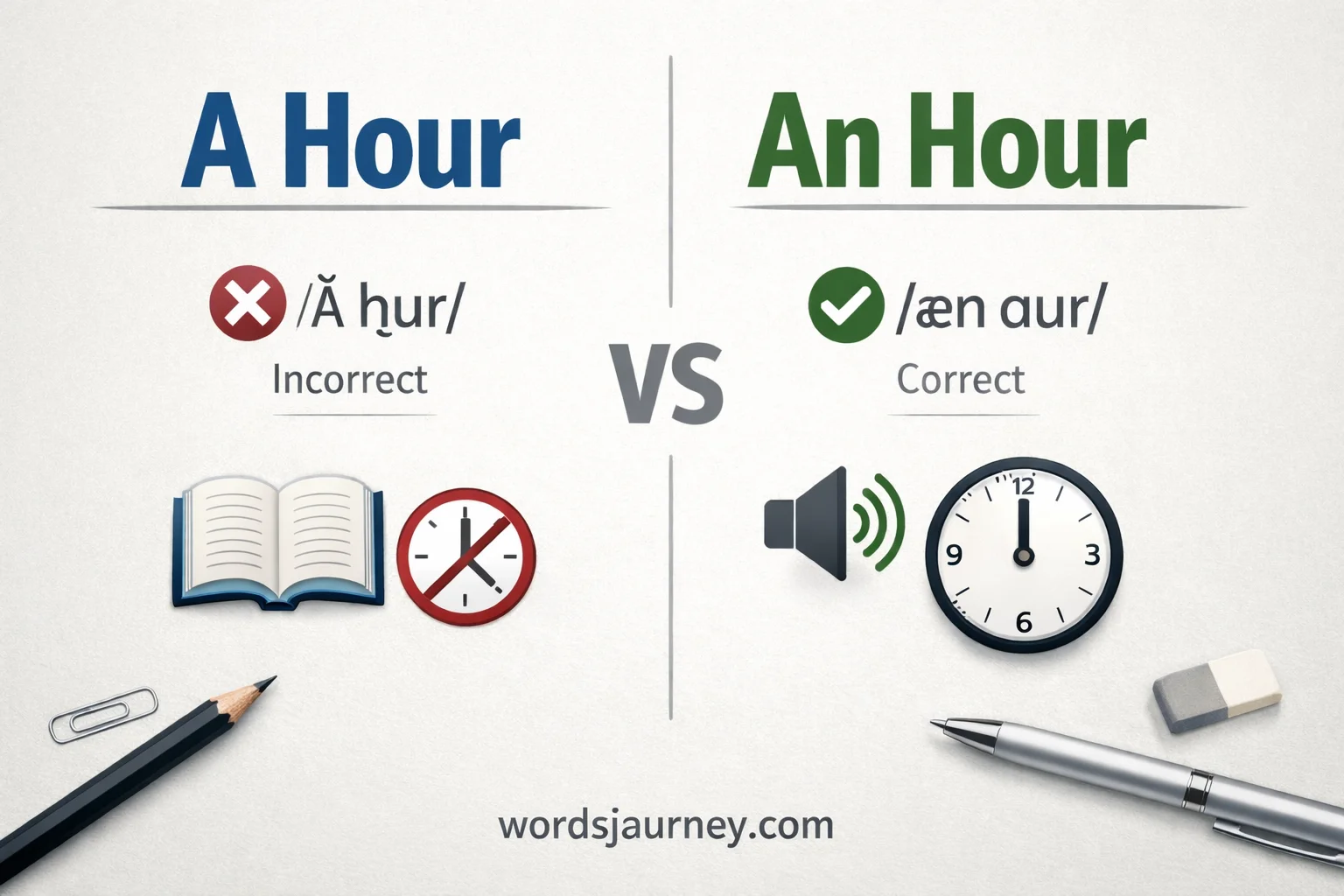
Have you ever paused before writing “a hour” or “an hour” and wondered which sounds right? This common dilemma, “A Hour or An Hour,” trips up students, professionals, and even experienced writers. Whether you’re drafting emails, planning presentations, or updating a calendar, small grammar choices shape how clearly your message lands. Understanding this rule improves English usage, strengthens formal writing, and helps you communicate with confidence in everyday and professional situations.
In modern workplaces filled with meetings, online booking systems, and fast-paced project management, clarity matters more than ever. From business communication to broadcasting schedules, accurate article usage supports smooth time management and consistent messaging. Many learners assume grammar depends on spelling alone, yet pronunciation plays the decisive role here. This article explains why sound—not letters—determines correctness, helping you maintain grammatical consistency across emails, reports, and collaborative workflows.
You’ll discover the linguistic reason behind choosing the correct article, practical examples for real-world writing, and quick memory tricks you can apply instantly. We’ll also touch on guidance reflected in major style traditions, including general preferences found in both US and UK English usage. By the end, you’ll confidently know when to write “an hour”, avoid common mistakes, and apply this rule seamlessly across professional communication, academic writing, and everyday conversation.
Why “A Hour or An Hour” Confuses So Many Writers
English spelling often tells only half the story.
You see the letter H at the beginning of hour, so instinct tells you to write a hour. After all, we naturally say:
- a house
- a hero
- a hotel
So why does English suddenly change direction?
Because English cares more about how words sound than how they look.
Many learners never receive this explanation. They memorize rules without understanding pronunciation. As a result, mistakes keep repeating in essays, business emails, blog posts, and even professional publications.
Places Where This Error Commonly Appears
- Academic writing
- IELTS and TOEFL essays
- Workplace communication
- Journalism and blogging
- Social media captions
- Spoken introductions
Understanding the logic behind the rule removes uncertainty instantly.
The Quick Answer: A Hour or An Hour
Let’s settle the question immediately.
✅ Correct: an hour
❌ Incorrect: a hour
The Core Rule
Use an before vowel sounds.
Use a before consonant sounds.
The keyword here is sounds.
Instant Reference Table
| Phrase | Correct? | Explanation |
| an hour | ✅ Yes | Starts with vowel sound |
| a hour | ❌ No | Silent H removes consonant sound |
| a house | ✅ Yes | H is pronounced |
| an honest person | ✅ Yes | Silent H |
One rule explains everything.
Understanding Articles: A vs An Made Simple
Before going deeper, it helps to understand what articles actually do.
What Are Articles?
Articles are small words placed before nouns to clarify meaning.
English uses two indefinite articles:
- A
- An
They introduce something general rather than specific.
Examples
- I saw a dog outside.
- She waited an hour.
Without articles, English speech sounds incomplete or abrupt.
Why English Needs Two Versions
The difference exists purely for pronunciation comfort.
Try saying:
a apple
Your speech pauses awkwardly.
Now say:
an apple
It flows naturally.
Languages evolve toward smoother pronunciation. Articles exist to prevent sound collisions between words.
Why “Hour” Uses AN: The Silent H Explained
The word hour begins with the letter H. However, the H is silent.
Pronunciation Breakdown
hour → pronounced “our”
Phonetic sound: /aʊər/
Because the first sound is a vowel sound, English requires an.
an hour
The Historical Reason Behind Silent H Words
English absorbed thousands of French words after the Norman Conquest of England in 1066. French pronunciation often dropped the H sound completely.
Words like hour entered English spelling systems while keeping French pronunciation habits.
That historical influence explains why modern English contains silent letters that confuse learners.
Common Silent H Words
| Word | Correct Phrase |
| hour | an hour |
| honest | an honest reply |
| honor | an honor |
| heir | an heir |
| honorary | an honorary award |
If the H isn’t pronounced, treat the word as beginning with a vowel.
Pronunciation vs Spelling: The Rule That Solves Most Article Mistakes
Many grammar problems happen because writers trust spelling instead of sound.
English spelling reflects history. Pronunciation reflects real speech.
The Golden Writing Habit
Say the word aloud before choosing the article.
If the word sounds like it begins with a vowel → use an.
If it sounds like a consonant → use a.
Comparison Examples
| Word | Starting Sound | Correct Article |
| hour | vowel | an hour |
| house | consonant | a house |
| university | consonant “yoo” | a university |
| umbrella | vowel | an umbrella |
| European | consonant “yoo” | a European trip |
Notice something surprising.
Some vowel letters still use a.
That happens because the pronunciation begins with a consonant sound.
Words That Break Expectations (But Follow the Rule Perfectly)
English appears inconsistent until you listen carefully.
Silent H Words → Always Use AN
- an hour
- an honest mistake
- an honorable leader
- an heir to the estate
Words Beginning With “U” That Use A
Many learners assume vowels always require an. That’s incorrect.
Words like university start with a “yoo” sound, which is a consonant sound.
Correct examples:
- a university
- a user account
- a unique opportunity
- a European country
The spelling begins with a vowel letter. The sound begins with a consonant.
Sound wins every time.
Also Read More: A Unique or An Unique: The Complete Grammar Guide
Why Native Speakers Still Make This Mistake
Even fluent English speakers sometimes hesitate.
Several psychological factors explain this.
Common Reasons
- Writing faster than speaking
- Overthinking spelling rules
- Lack of phonetic awareness
- Autocorrect errors
- Influence of regional accents
Many people learned grammar visually instead of aurally. They trust letters more than sound patterns.
Memory Tricks That Actually Work
Forget complicated grammar mnemonics. Use strategies that match real speech.
The Sound Test
Ask yourself:
Does the next word start with a vowel sound?
If yes → an
If no → a
Practical Shortcut
Hear first. Write second.
Say the phrase aloud before typing. Your ear rarely lies.
Quick Mental Formula
Vowel sound → AN
Consonant sound → A
That single rule solves nearly all article questions.
Real-World Usage Examples of “An Hour”
Everyday Sentences
- I waited an hour for the bus.
- The movie lasted an hour.
- She studied for an hour before dinner.
- We talked for an hour without noticing the time pass.
Professional Writing Examples
- The meeting will take an hour.
- Please arrive an hour early.
- The interview lasted an hour exactly.
Correct article usage instantly makes writing appear more polished and professional.
A Hour vs An Hour in Spoken English
Here’s an interesting observation.
If someone says “a hour” aloud, it immediately sounds unnatural. Native listeners recognize the mistake instantly because speech rhythm breaks.
Language prioritizes smooth airflow between words.
Saying an hour allows your voice to glide naturally from one sound to the next.
Grammar Deep Dive: Why English Articles Depend on Sound
English belongs to the Germanic language family yet absorbed heavy French and Latin influence. That blend created complex spelling traditions.
Linguists distinguish between:
- Orthography → spelling system
- Phonetics → sound system
Articles belong to phonetics. They help speech flow efficiently.
Linguistic Principle
Languages avoid difficult sound transitions. Articles act like bridges between words.
Instead of stopping speech abruptly, an provides a smooth vowel connection.
Common Article Mistakes Similar to “An Hour”
Mastering this rule helps you avoid many other errors.
Abbreviations That Use AN
Some abbreviations begin with vowel sounds when spoken.
| Abbreviation | Spoken Sound | Correct Usage |
| FBI | ef-bee-eye | an FBI agent |
| MBA | em-bee-ay | an MBA graduate |
| LCD | el-see-dee | an LCD screen |
Even though the letters are consonants, pronunciation starts with vowels.
The “Historic” Debate
You may see both:
- a historic event
- an historic event
Modern American English strongly prefers a historic event because the H sound is pronounced.
Case Study: How One Grammar Rule Improves Professional Writing
Consider two email examples.
Incorrect
We waited an hour before starting the presentation.
Correct
We waited an hour before starting the presentation.
The difference seems small yet readers subconsciously judge professionalism through grammar accuracy.
Studies in business communication consistently show that small grammar mistakes reduce perceived credibility.
Clear language builds trust.
Quick Practice Quiz
Choose the correct option.
- ___ hour passed quickly.
- ___ university lecture begins soon.
- ___ honest review matters.
- ___ European vacation sounds exciting.
Answers
- an hour
- a university
- an honest review
- a European vacation
Expert Writing Tips to Avoid Article Errors Forever
Strong writers rely on habits, not memorization.
Proven Techniques
- Read sentences aloud during editing
- Learn pronunciation alongside vocabulary
- Use online dictionaries with audio playback
- Proofread slowly instead of scanning quickly
Key Takeaways: A Hour or An Hour Simplified
- Articles depend on sound, not spelling
- Hour begins with a vowel sound
- The H in hour is silent
- Therefore the correct phrase is an hour
- Saying the sentence aloud prevents mistakes
- Pronunciation awareness improves overall writing quality
Frequently Asked Questions (FAQs)
1. Is it correct to say “a hour” or “an hour”?
The correct phrase is “an hour.” Although hour begins with the letter H, the H is silent, so the word starts with a vowel sound. In English grammar, articles depend on pronunciation, not spelling.
2. Why do we use “an” before “hour”?
We use “an” before words that begin with a vowel sound. Since hour sounds like “our,” it follows the same rule as an apple or an idea. This principle ensures smoother pronunciation and natural speech flow.
3. Are there other words like “hour”?
Yes. Several English words have a silent H, including:
- an honest person
- an honor
- an heir
- an herbal remedy (common in American English)
These examples follow the same pronunciation-based rule.
4. Does pronunciation matter more than spelling in English articles?
Absolutely. Correct English usage focuses on sound, not letters. Even in formal writing, business communication, or broadcasting, writers choose articles based on how words are spoken.
5. Is there a difference between US and UK English?
Both US and UK English agree on “an hour.” However, pronunciation differences can affect other words. For example, herb is pronounced with a silent H in American English (an herb) but with an audible H in British English (a herb).
6. Why is correct article usage important in professional writing?
Proper grammar improves clarity, credibility, and consistency. Whether scheduling meetings, managing a calendar, or handling online booking, accurate language strengthens professional communication.
7. How can I remember the rule easily?
Use this quick tip:
Listen first, then write. If the word sounds like it begins with a vowel, use “an.” If it sounds like a consonant, use “a.”
Conclusion
Choosing between “A Hour or An Hour” may seem like a tiny grammar decision, yet it reflects a deeper rule of English pronunciation and structure. The correct form “an hour” exists because English articles follow sound patterns, not spelling conventions. Once you understand this concept, many similar grammar questions become easier to solve.
In today’s world of fast time management, structured project management, and constant business communication, precise language helps ideas move smoothly. Correct article usage supports professional consistency, improves readability, and enhances confidence in formal writing, emails, reports, and presentations.
Master this simple rule and you’ll avoid a surprisingly common mistake. More importantly, you’ll communicate with clarity whether you’re scheduling a meeting, planning an event, or writing polished content for a global audience. Grammar isn’t just about rules, it’s about making every word work effortlessly for you.

Emma Brook is a dedicated writer and language enthusiast at WordsJourney. She’s passionate about helping readers understand words better and use them with confidence in everyday conversations. Her work focuses on alternative phrases, clear meanings, and practical examples that make language feel simple and approachable.
With a friendly, reader-first writing style, Emma breaks down common expressions and explores smarter ways to say things without sounding forced or complicated. Her goal is to make learning words enjoyable, useful, and easy for everyone.