Have you ever paused mid-sentence wondering whether to write “a unique” or “an unique”? This small hesitation happens more often than you think, especially in professional emails, academic papers, and digital content. The confusion around “A Unique or An Unique” isn’t just a grammar issue—it reflects how pronunciation, English usage, and clarity shape effective communication. Whether you’re drafting business communication, organizing meetings, or managing an online booking calendar, choosing the correct article strengthens credibility and keeps your writing polished.
In today’s fast-moving world of scheduling, time management, and project management, precise language matters more than ever. From broadcasting announcements to coordinating calendar updates, professionals rely on clear formal writing to avoid misunderstandings. This article explores how pronunciation—not spelling—determines the correct choice between “a” and “an.” You’ll learn practical grammar rules supported by real examples used in business communication, meetings, and everyday professional contexts, helping you maintain linguistic consistency across written and spoken English.
We’ll also examine how major style guides and regional preferences influence usage, including subtle differences between US and UK English standards. By the end, you’ll understand why “a unique” is correct, when exceptions may appear, and how mastering this rule improves grammar accuracy, readability, and professional authority. If you want confident English usage that supports clear messaging across emails, reports, and collaborative platforms, this guide will give you a simple, memorable framework to follow.
A Unique or An Unique — The Short Answer
Let’s solve the question immediately.
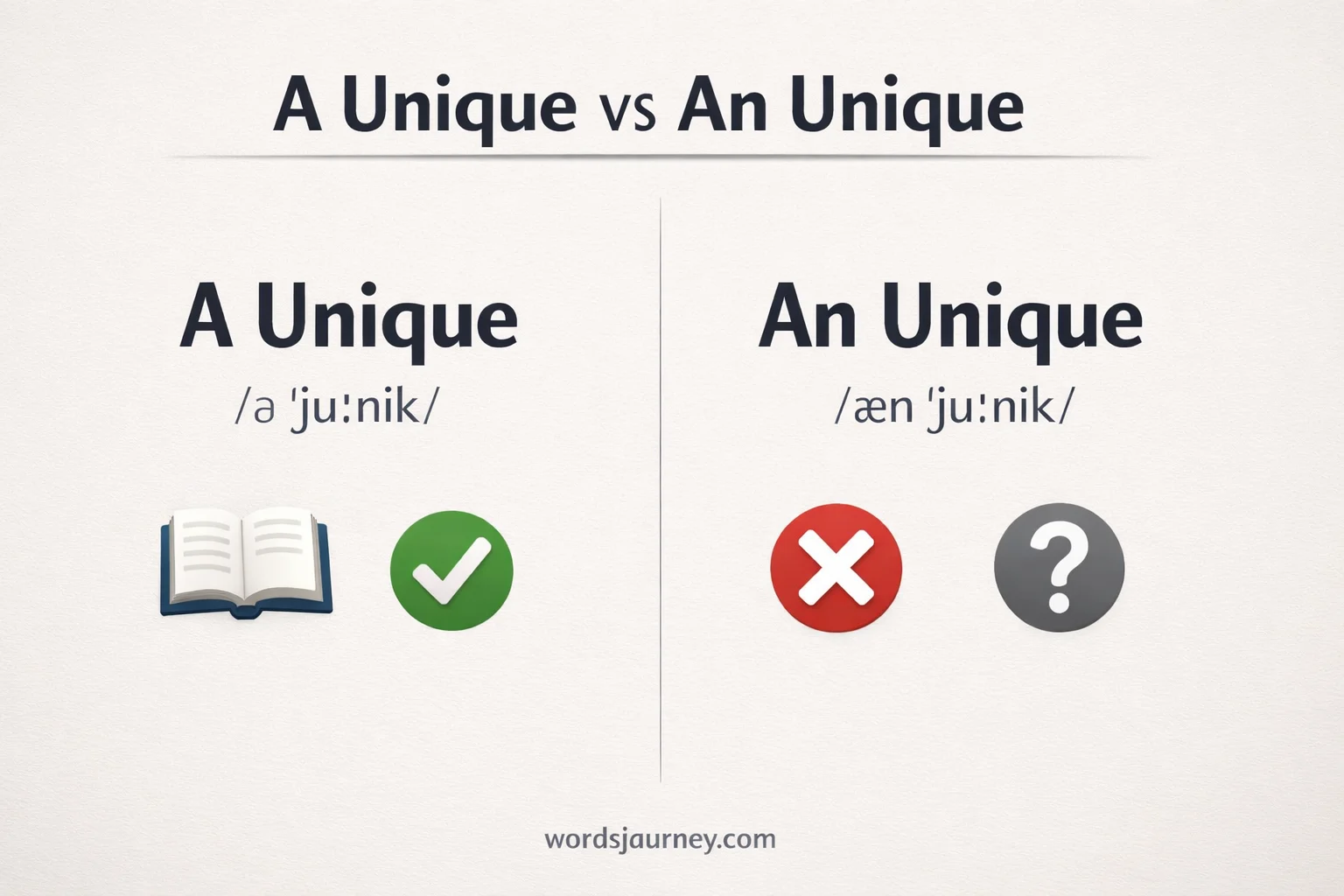
✅ Correct: a unique idea
❌ Incorrect: an unique idea
The correct phrase is A UNIQUE.
Why? Because unique begins with a consonant sound, even though it starts with a vowel letter.
Quick pronunciation test:
unique → yoo-neek
That “yoo” sound behaves like the consonant Y.
So the rule becomes simple:
- Consonant sound → A
- Vowel sound → AN
Easy once you know it. Powerful once you remember it.
The Real Rule Behind A Unique or An Unique
Many grammar mistakes happen because writers memorize letters instead of understanding speech patterns.
Articles Follow Sound, Not Spelling
English articles depend entirely on how a word sounds when spoken.
Core Rule
| Beginning Sound | Article Used | Example |
| Vowel sound | AN | an apple |
| Consonant sound | A | a book |
Notice something important.
The rule says sound, not letter.
That distinction explains why a unique is correct.
Why English Uses Sound Instead of Letters
English evolved through centuries of spoken communication before standardized spelling existed. People naturally adjusted words to make speech smoother.
Imagine saying:
an yoo-neek idea
It feels awkward. Your mouth slows down.
Now say:
a yoo-neek idea
It flows effortlessly.
Language prefers ease of pronunciation. Articles exist mainly to make speech rhythm natural.
Why “Unique” Always Takes “A”
Let’s analyze the word step by step.
Pronunciation Breakdown
Unique is pronounced:
/juːˈniːk/
The first sound is “yoo.”
That sound equals the consonant Y.
Even though U is technically a vowel letter, the sound acts like a consonant.
Therefore:
✅ a unique opportunity
✅ a unique solution
❌ an unique opportunity
Sound Comparison Table
| Word | First Sound | Article |
| unique | yoo | a |
| university | yoo | a |
| user | yoo | a |
| umbrella | uh | an |
| uncle | uh | an |
You can already see the pattern forming.
The Biggest Mistake Writers Make
Most learners were taught a simplified rule:
Use an before vowels.
Unfortunately, that rule is incomplete.
The accurate version is:
Use an before vowel sounds.
The difference seems tiny. The impact is huge.
Why the Mistake Happens
People rely on spelling because it feels logical. English, however, often separates spelling from pronunciation.
Examples that confuse writers:
- unique
- European
- one-time
- honest
- hour
Each word breaks the “letter rule” in a different way.
Words Similar to “Unique”
Understanding patterns helps you internalize grammar faster.
Words That Use A (Consonant Sound)
- a unique design
- a university campus
- a European country
- a user profile
- a one-time offer
- a useful tool
All begin with consonant sounds despite starting with vowels or vowel-looking letters.
Words That Use AN (Vowel Sound)
- an umbrella
- an uncle
- an honest person
- an hour
- an MBA graduate
Notice something fascinating.
In honest and hour, the H is silent. The word begins with a vowel sound instead.
Silent Letters Change Everything
English loves silent letters. Articles react to sound, not spelling.
Silent H Rule
| Word | Spoken Start | Correct Form |
| hour | our | an hour |
| honest | on-est | an honest answer |
| honor | on-or | an honor |
| house | h-ouse | a house |
When H disappears, the vowel sound takes control.
The Pronunciation Test
Editors use a simple mental shortcut.
The 3-Step Article Test
- Say the word out loud.
- Listen to the first sound.
- Choose article based on sound.
That’s it.
No memorization required.
Quick Practice
Try it yourself:
- ___ unique idea
- ___ umbrella
- ___ honest mistake
- ___ university student
Answers:
- a unique idea
- an umbrella
- an honest mistake
- a university student
Real-World Examples of A Unique vs An Unique
Learning grammar works best through context.
Correct Usage
- She presented a unique perspective during the meeting.
- This artist has a unique style.
- They developed a unique marketing strategy.
Incorrect Usage
- ❌ an unique solution
- ❌ an unique product
- ❌ an unique experience
Each incorrect example ignores pronunciation.
Case Study: Why Professional Writers Rarely Make This Error
Experienced writers rely heavily on spoken intuition.
They read sentences mentally as if speaking to someone. Because the phrase an unique sounds unnatural, they instantly recognize the mistake.
Professional Editing Habit
Editors often ask:
“Would I say this aloud?”
If the answer feels awkward, the article is wrong.
Memory Hacks That Make the Rule Permanent
Grammar sticks better when tied to memorable ideas.
The “YOU” Trick
Replace unique with you.
- a you-nique idea ✅
- an you-nique idea ❌
Instant clarity.
The Y Sound Rule
If the word begins with:
- yoo
- you
- yu
Use A.
Examples:
- a unicorn
- a unit
- a university
- a unique approach
British vs American English: Is There Any Difference?
Good news.
There is no difference between American and British English here.
Both forms agree:
✅ a unique
❌ an unique
Pronunciation remains consistent across major English accents worldwide.
For More Please Visit: Practices or Practises: Which One Is Correct?
Where You’ll See This Grammar Rule Tested
Understanding A Unique or An Unique matters more than many realize.
Academic Writing
Essays and research papers require precise grammar.
English Exams
Commonly tested in:
- IELTS
- TOEFL
- SAT Writing
- Cambridge Exams
Professional Communication
Incorrect articles weaken credibility in:
- Emails
- Proposals
- Blog content
- Marketing copy
Small grammar choices influence how professional you appear.
Advanced Insight: Why Articles Exist in English
Articles help listeners process information quickly.
They act like linguistic signals.
- A introduces something general.
- AN smooths pronunciation before vowel sounds.
- THE specifies something known.
Think of articles as traffic signals for speech rhythm.
Without them, English would sound abrupt and mechanical.
Common Article Confusion Examples
Many words challenge writers for the same reason as unique.
Tricky Words List
| Word | Correct Usage | Reason |
| one-time | a one-time event | starts with w sound |
| MBA | an MBA graduate | vowel sound |
| historic | a historic moment | pronounced h |
| honor | an honor | silent h |
| European | a European trip | “yoo” sound |
Notice how pronunciation always decides.
Quick Cheat Sheet: A Unique or An Unique
Golden Rule Summary
A → consonant SOUND
AN → vowel SOUND
Unique → yoo → consonant sound → A UNIQUE
Print it. Save it. Remember it forever.
Why Native Speakers Learn This Naturally
Children don’t memorize grammar rules. They learn through listening.
After hearing thousands of sentences like:
- a unique idea
- a university
their brains recognize natural patterns automatically.
Grammar intuition develops through exposure, not memorization.
Expert Writing Tip: Read Your Sentences Aloud
Reading silently hides mistakes.
Reading aloud exposes them instantly.
Try this comparison:
- an unique solution ❌
- a unique solution ✅
Your ear detects the error faster than your eyes.
Common Myths About A Unique or An Unique
Myth: Use AN Before All Vowels
False. Sound matters more than letters.
Myth: Grammar Rules Are Arbitrary
Incorrect. Most exist to improve pronunciation flow.
Myth: Accent Changes the Rule
No major English accent changes unique into a vowel sound.
Mini Grammar Exercise
Choose the correct article.
- ___ unique experience
- ___ honest reply
- ___ university lecture
- ___ unusual event
Answers
- a unique experience
- an honest reply
- a university lecture
- an unusual event
Practice builds instinct quickly.
Linguistic Insight: The Role of Phonetics
Phonetics studies how speech sounds form.
English distinguishes between:
- orthography → spelling
- phonology → sound system
Articles belong to phonology.
That explains why spelling rules often fail beginners.
Quote From Linguistic Research
“Articles in English are governed primarily by phonetic context rather than orthographic form.”
This principle explains hundreds of grammar decisions beyond unique.
How This Rule Improves Your Writing Instantly
Correct article usage creates:
- smoother sentence rhythm
- stronger credibility
- professional tone
- easier readability
Readers rarely notice correct grammar. They instantly notice mistakes.
The One Rule You Should Remember Forever
If you forget everything else, remember this:
👉 Listen to the sound, not the letter.
That single mindset solves:
- a unique vs an unique
- a university vs an university
- an hour vs a hour
Grammar suddenly becomes logical.
FAQs About “A Unique or An Unique”
1. Which is correct: “a unique” or “an unique”?
The correct form is “a unique.” Although unique starts with the vowel letter U, its pronunciation begins with the consonant sound /y/ (“you-neek”). In English usage, articles depend on sound, not spelling.
2. Why do people mistakenly write “an unique”?
Many learners follow the rule “an before vowels.” However, grammar actually follows phonetics. Since unique sounds like it starts with Y, the correct article remains a, ensuring accuracy in formal writing and business communication.
3. Does pronunciation always decide between “a” and “an”?
Yes. The rule is simple:
- Use a before consonant sounds → a unique idea, a university, a user account
- Use an before vowel sounds → an hour, an honest reply, an email
Understanding pronunciation improves clarity in meetings, broadcasting, and professional writing contexts.
4. Is the rule different in US and UK English?
No. Both US and UK style guides follow the same pronunciation-based rule. Whether you’re writing academic papers, managing online booking systems, or updating a project management calendar, “a unique” remains standard across regions.
5. Why does correct article usage matter in professional settings?
Small grammar choices influence credibility. Correct articles help maintain consistency, especially in:
- Business communication
- Scheduling and time management
- Project documentation
- Formal emails and reports
- Calendar invitations and meetings
Clear grammar signals professionalism and attention to detail.
6. How can I quickly remember the rule?
Think: Listen first, then write. If the word sounds like it starts with “you,” use a, not an.
Conclusion
Choosing between “A Unique or An Unique” may seem minor, yet it reflects a deeper understanding of English grammar, pronunciation, and professional communication. The correct phrase—“a unique”—follows the core principle that articles depend on sound rather than spelling. Once you understand this rule, similar decisions become effortless.
In modern workplaces driven by time management, online booking, project management, and structured calendar scheduling, clear language supports efficiency and trust. Accurate article usage strengthens formal writing, improves readability, and ensures consistency across emails, reports, presentations, and broadcasting content.Mastering small grammar rules creates a big impact. When your writing is precise, your message becomes stronger, your communication smoother, and your professional voice more confident. Keep focusing on pronunciation, follow trusted style guides, and you’ll never hesitate again when writing “a unique opportunity.”

Aliya Ray is a passionate writer and language enthusiast at WordsJourney. She enjoys exploring words, phrases, and everyday expressions to help readers communicate more clearly and confidently. Her content focuses on alternative ways to say common phrases, simple explanations, and real-life examples that make language easy to understand.
Aliya believes the right words can make any message stronger. Through clear, friendly writing, she helps readers improve their vocabulary without feeling overwhelmed or confused.