Have you ever paused mid-email and wondered which spelling looks more professional: All Right or Alright? It seems like a small detail, yet in business communication, formal writing, and even quick Slack messages, word choice shapes credibility. The debate around “All Right or Alright” isn’t just about preference. It’s about English usage, clarity, and the impression you leave in meetings, reports, and client conversations.
In today’s world of tight scheduling, packed calendar invites, and nonstop project management, language moves fast. You confirm meetings, approve tasks, respond to online booking requests, and send updates during broadcasting or virtual meetings. In those moments, consistency matters. Is “alright” acceptable in professional emails? Does “all right” look more polished in contracts or proposals? And how do regional preferences in the US and UK influence what’s considered correct?
This article breaks it all down. You’ll learn the historical background, what major style guides recommend, and when each form works best. We’ll explore how context, tone, and audience affect your choice, especially in formal writing versus casual communication. By the end, you’ll know exactly when to use all right, when “alright” may pass, and how to maintain consistency across your writing without second-guessing yourself.
All Right or Alright: The Quick, No-Risk Answer
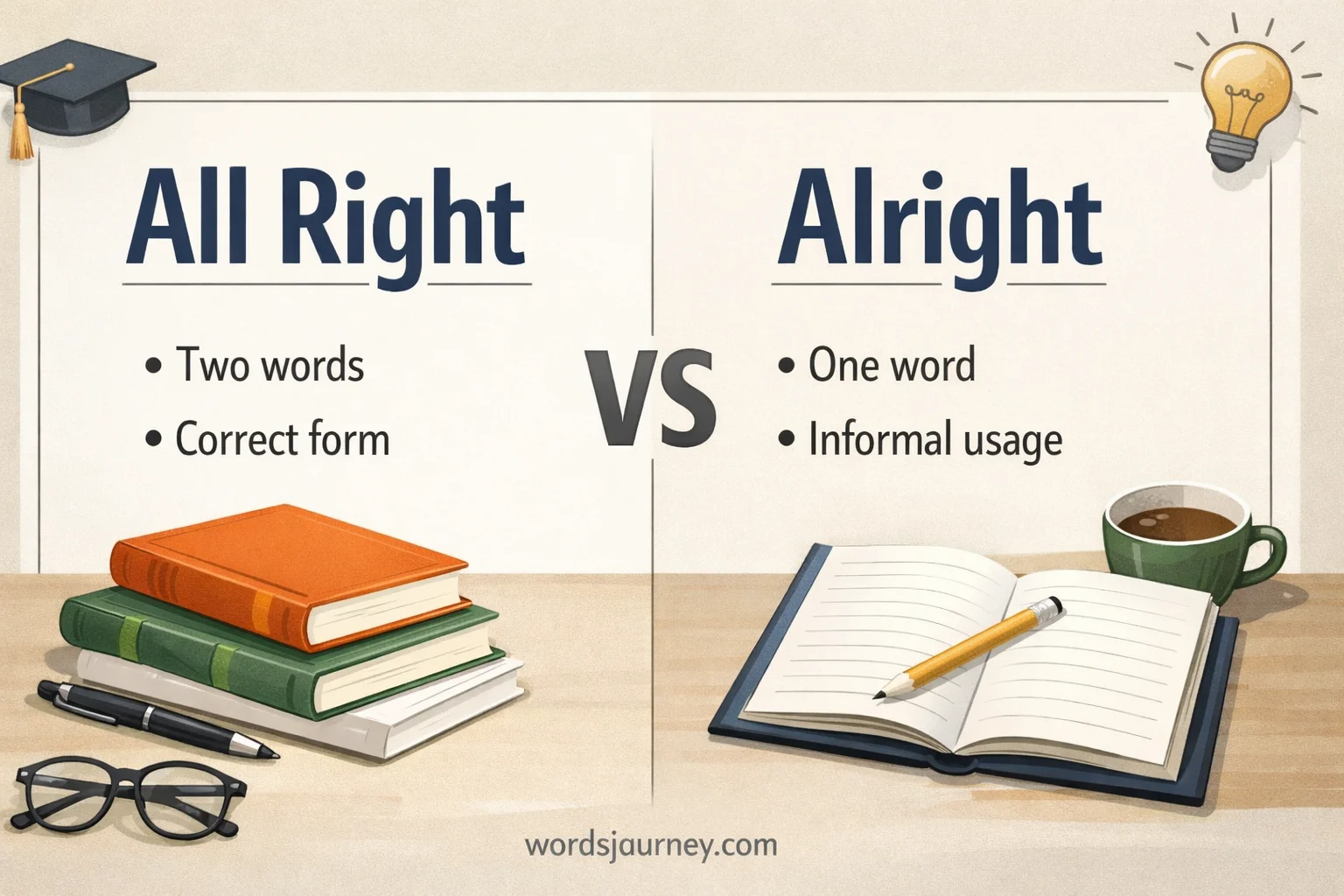
If you want the safest option in any context, use all right.
That’s it.
But language isn’t always black and white. So here’s a sharper breakdown:
| Context | Recommended Form | Why |
| Academic papers | All right | Required by most formal style guides |
| Professional emails | All right | Safest and widely accepted |
| Journalism | All right | Preferred by editorial standards |
| Fiction dialogue | Either | Depends on tone |
| Casual texting | Alright | Informal and conversational |
If credibility matters, stick with the two-word form. If tone matters more than tradition, the single-word version might fit.
Now let’s unpack why.
What Does “All Right” Actually Mean?
“All right” is the traditional spelling. It dates back centuries and functions in several ways.
It can mean:
- Correct — “You’re all right about that.”
- Satisfactory — “The food was all right.”
- Safe or unharmed — “Is everyone all right?”
- Agreement — “All right, let’s go.”
Notice something important. The phrase breaks down logically:
- “All” = completely
- “Right” = correct or acceptable
That structure made sense historically. Writers didn’t feel pressure to merge the words because the meaning stayed clear.
For hundreds of years, educated English favored this spelling. It appeared consistently in literature, journalism, and formal documents.
That consistency matters.
What Does “Alright” Mean?
“Alright” carries the same meaning as “all right.” No semantic difference exists.
The only difference? Form and tone.
Writers began merging the words in the late 19th and early 20th centuries. Language often compresses phrases over time. Consider these transformations:
| Original Form | Modern Form |
| All ready | Already |
| All together | Altogether |
| All though | Although |
So why not “alright”?
Because standardization moves slowly. Some word combinations gain acceptance. Others face resistance.
“Alright” feels natural in casual speech. It looks streamlined. It mirrors “already.” That symmetry makes it tempting.
Yet many traditionalists still reject it in formal writing.
The History Behind All Right vs Alright
Early English used “all right” exclusively. You’ll find it in classic literature, letters, and early newspapers.
By the early 1900s, “alright” started appearing in fiction and informal contexts. Writers sought brevity and conversational tone.
However, grammar authorities pushed back. They labeled “alright” nonstandard. That label stuck for decades.
Language evolution rarely follows neat rules. Some compound forms gain approval quickly. Others remain controversial for generations.
Even today, this debate continues.
What Major Style Guides Say About All Right or Alright
When credibility matters, style guides decide the outcome. Here’s where leading authorities stand.
The Chicago Manual of Style
Chicago recommends all right in formal writing. It considers “alright” nonstandard.
This guide influences academic publishing, book editors, and scholarly writers across the United States.
Associated Press Stylebook
AP style also prefers all right.
Newsrooms follow AP closely. If you’re writing journalism or press releases, choose the two-word form.
Merriam-Webster
Here’s where nuance enters.
Merriam-Webster lists “alright” as a nonstandard variant. That means it exists and appears in usage, yet it isn’t preferred in formal writing.
The dictionary reflects language trends. It doesn’t always endorse them.
Cambridge University Press
Cambridge dictionaries recognize “alright” as informal. Academic publications under Cambridge still prefer “all right.”
Authority Summary Table
| Authority | Position on “Alright” | Recommended Form |
| Chicago Manual | Nonstandard | All right |
| AP Stylebook | Avoid in formal writing | All right |
| Merriam-Webster | Informal variant | All right preferred |
| Cambridge | Informal | All right |
Clear pattern. Formal writing favors the traditional form.
Is “Alright” Grammatically Wrong?
Not exactly.
It’s better described as informal or nonstandard, not incorrect.
That distinction matters.
Nonstandard forms appear in everyday usage. They often gain traction through speech before dictionaries formalize them.
Teachers discourage “alright” because educational systems emphasize standardized grammar. Standardization reduces ambiguity. It creates consistency.
However, language evolves through usage, not authority alone.
Also Read: Alot or A Lot: The Ultimate Guide for Perfect Usage
Tone Matters More Than You Think
Imagine you’re drafting two sentences:
- “Alright, I’ll review the report.”
- “All right, I’ll review the report.”
The first feels casual. The second feels professional.
Tone influences perception instantly.
Here’s a breakdown:
| Situation | Best Choice | Why |
| Cover letter | All right | Signals professionalism |
| Research paper | All right | Academic standard |
| Blog post | Depends on brand voice | Conversational tone may allow “alright” |
| Novel dialogue | Alright | Mirrors speech naturally |
Writing isn’t only about correctness. It’s about audience expectations.
Why Spell-Checkers Flag “Alright”
Most word processors follow standardized dictionaries and academic norms.
Since “alright” remains labeled nonstandard in many references, spell-check tools flag it.
That doesn’t mean it’s banned. It simply means it’s not the safest choice.
Real-World Usage Examples
Let’s look at how context shapes the decision.
Professional Email
“All right, I’ve attached the finalized proposal.”
Clean. Safe. No distractions.
Academic Writing
“The results were all right within acceptable parameters.”
Standard usage maintains credibility.
Casual Text Message
“Alright, see you at 8.”
Perfectly natural.
Fiction Dialogue
“Alright, fine,” she sighed. “You win.”
Here, the single-word version matches spoken rhythm.
Also Read: Alot or A Lot: The Ultimate Guide for Perfect Usage
Why This Debate Persists
English thrives on contraction and compression. People prefer efficiency.
Consider how speech patterns influence spelling. When spoken quickly, “all right” blends into a single sound. Writers mirror that sound in text.
However, institutional writing values stability over convenience.
That tension fuels the debate.
Linguistic Pattern Comparison
Some compound forms succeeded. Others stalled.
| Phrase | Combined Form Accepted? |
| All ready → Already | Yes |
| All together → Altogether | Yes |
| All though → Although | Yes |
| All right → Alright | Partially |
Notice the pattern. Acceptance depends on long-term standardized adoption. “Alright” hasn’t fully crossed that threshold.
Case Study: Publishing Industry Standards
Major publishing houses rely on style manuals. Editors enforce consistency aggressively.
If you submit a manuscript using “alright,” most editors will revise it to “all right.”
Why?
Because consistency protects brand reputation and readability.
In journalism, even small deviations create credibility friction. Readers expect precision.
Common Mistakes to Avoid
Writers often slip in predictable ways.
Avoid these:
- Mixing “all right” and “alright” in the same document
- Using “alright” in formal academic work
- Assuming popularity equals correctness
- Overcorrecting informal dialogue unnecessarily
Consistency builds trust.
Quick Decision Flowchart
Are you writing something formal?
→ Yes → Use all right
→ No → Is tone casual? → “Alright” works
When unsure, default to tradition.
Key Differences in Perception
Even if meanings match, perception differs.
“All right” signals:
- Precision
- Professionalism
- Awareness of standard English
“Alright” signals:
- Casual tone
- Modern informality
- Conversational voice
Readers judge quickly. Often subconsciously.
Key Takeaways
- All right is the traditional and safest form
- Alright is informal and widely used in casual writing
- Style guides prefer the two-word version
- Tone and audience determine the best choice
- Consistency matters more than personal preference
Small details shape strong writing. Mastering nuances like All Right or Alright strengthens clarity and credibility.
Frequently Asked Questions (FAQs)
1. Is “alright” grammatically correct?
Yes, “alright” is widely used and accepted in informal contexts. However, many traditional grammar authorities and major style guides still prefer “all right” in formal writing and academic work. If you want to play it safe in professional documents, choose all right.
2. Which form should I use in business communication?
In business communication, especially emails to clients, reports, contracts, or proposals, “all right” is the safer and more polished option. It reflects attention to detail and aligns with expectations in professional environments.
3. Do US and UK style guides treat them differently?
Both US and UK style traditions historically favor “all right.” While “alright” appears more frequently in modern media and creative writing, conservative publications and institutions in both regions still recommend the two-word form for formal writing.
4. Can I use “alright” in creative or casual content?
Absolutely. In dialogue, blog posts, marketing copy, or informal messaging, “alright” often sounds natural and conversational. It fits well in relaxed tones, especially on social media or internal team chats.
5. Does using the wrong form affect credibility?
It can. In contexts like project management updates, official meetings, client emails, or broadcasting scripts, small language details influence perception. Consistency and correctness build trust, particularly when managing tight scheduling or coordinating through a shared calendar.
6. Is there a difference in meaning between “all right” and “alright”?
No. The meaning is the same. Both express agreement, adequacy, or confirmation. The difference lies in formality, tone, and consistency, not definition.
Conclusion
At first glance, the choice between All Right or Alright feels minor. In reality, it reflects your understanding of English usage, audience expectations, and professional tone. Language shapes perception, especially in environments driven by time management, structured meetings, and precise communication.
If you’re writing formally, stick with all right. It aligns with traditional style guidance and keeps your writing safe in contracts, reports, and high-stakes correspondence. If you’re crafting conversational content or informal updates, “alright” can sound natural and approachable.
Ultimately, the key isn’t just correctness. It’s consistent. Choose the form that fits your audience, region, and purpose. Then use it consistently across your emails, documents, and digital platforms. When your language is clear and deliberate, everything else tends to go well all right.

Johnson Alex is a language-focused writer and the voice behind WordsJourney. He creates practical, easy-to-understand content that helps readers improve their vocabulary and express ideas with clarity and confidence.