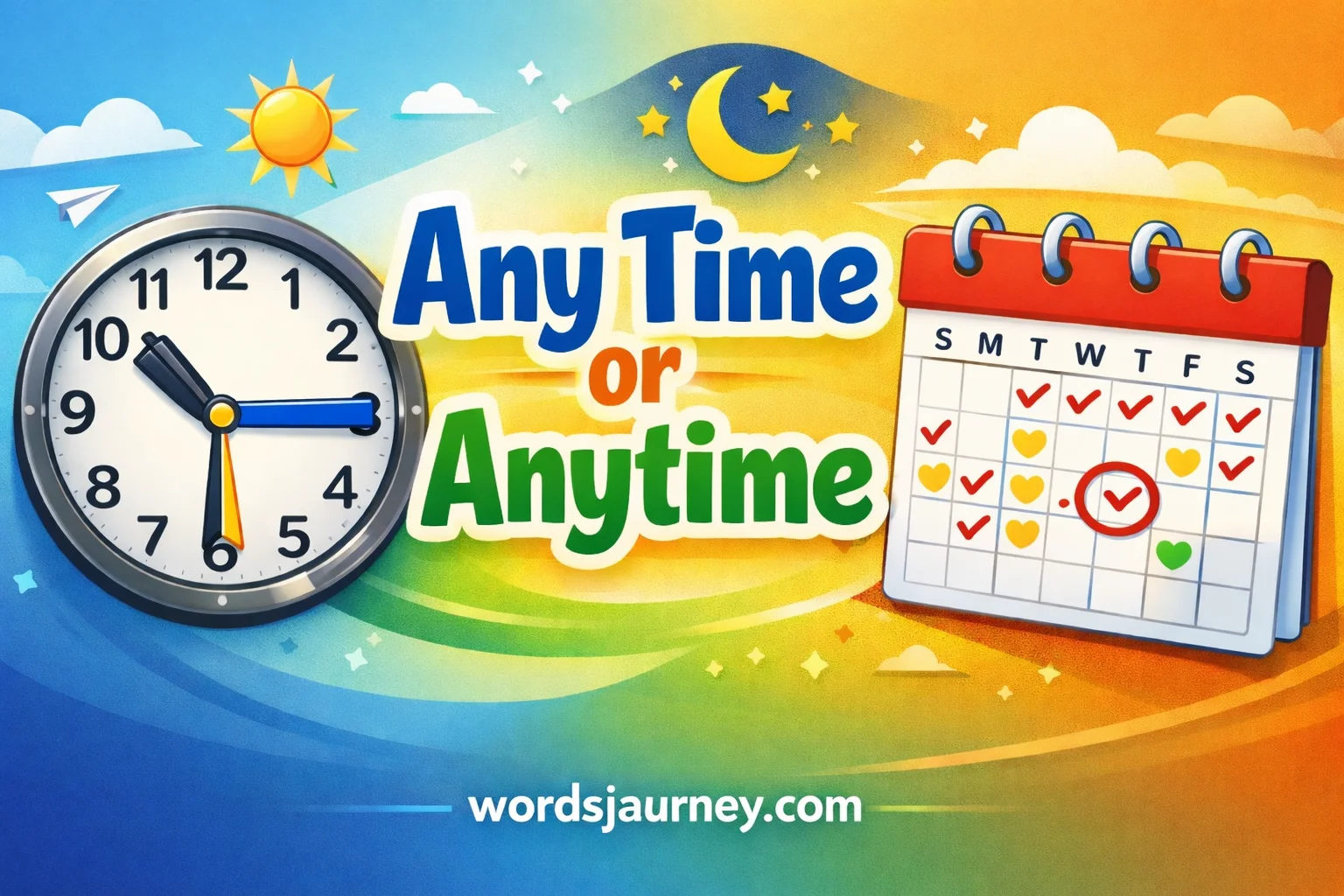
Have you ever paused before typing “any time” or anytime” in an email or calendar invite? Many English speakers face this small but surprisingly tricky choice. Whether you’re scheduling a meeting, managing project deadlines, or setting up online bookings, understanding the difference between Any Time or Anytime can save confusion and keep your communication professional.
This distinction matters in formal writing, business communication, and even everyday time management.
In this article, we’ll explore the nuances of Any Time or Anytime and clarify when each form is correct. You’ll learn how context affects grammar and consistency, from writing broadcasting schedules to marking events in your calendar.
We’ll also touch on style guides and regional preferences, including US vs. UK English, to ensure your writing meets professional standards and reads naturally across audiences.
By the end, you’ll confidently choose between any time and anytime in emails, reports, and project planning tools. Along the way, we’ll highlight practical examples for meetings, online booking systems, and other everyday scenarios.
Whether for English usage mastery or improving your business communication, this guide makes a subtle difference in clarity and professionalism.
Understanding “Any Time”
The phrase “any time” consists of two words and acts as a noun phrase. Essentially, it refers to any amount or specific portion of time. When the focus is on the word time itself, this is the correct choice.
For example:
- “Do you have any time to discuss the project today?”
- “I can spare any time this afternoon for a quick call.”
Here, time is the subject. It’s something measurable and countable. This distinction matters because if you replace any time with any moment or any duration, the sentence still makes sense, which is a simple trick to check correctness.
Usage Notes for “Any Time”
- Always treat any time as a noun phrase.
- Works best in formal writing, business emails, and academic contexts.
- Often paired with verbs like have, spend, allocate, or take:
- “She didn’t have any time to finish her homework.”
- “We’ll need any time left in the schedule for Q&A.”
Understanding “Anytime”
On the other hand, “anytime” is a single word that functions as an adverb. It denotes flexibility and refers to when something can happen, often synonymous with “whenever”.
Examples:
- “You can call me anytime.”
- “Feel free to drop by anytime this week.”
Notice that anytime modifies the verb and focuses on the timing of an action, not the amount of time itself. This distinction is subtle but important.
Usage Notes for “Anytime”
- Use anytime when referring to flexibility in timing.
- Common in casual, friendly, or conversational writing.
- Works well with invitations or instructions:
- “Visit us anytime during office hours.”
- “You can reach out anytime via email.”
A simple test: if you can replace it with whenever, then anytime is almost always correct.
Comparing “Any Time” vs “Anytime”
To clarify at a glance, here’s a handy comparison table:
| Feature | Any Time (two words) | Anytime (one word) |
| Part of speech | Noun phrase | Adverb |
| Meaning | Any amount or portion of time | Whenever / at any moment |
| Usage tip | Focus on “time” as a noun | Focus on flexibility/action |
| Example | “Do you have any time today?” | “Call me anytime.” |
Quick takeaway: Think of any time as quantifiable time and anytime as flexible moments.
Common Mistakes and Misconceptions
Even seasoned writers sometimes slip up. Here are the most frequent errors:
- Using anytime in formal or academic writing where any time is correct.
- ❌ Wrong: “Do you have anytime to review this report?”
- ✅ Correct: “Do you have any time to review this report?”
- Confusing noun vs adverb usage in casual emails.
- ❌ Wrong: “You can meet me at any time.” (If intended to mean whenever, it should be anytime.)
- ✅ Correct: “You can meet me anytime.”
- Misplacing anytime as an adjective (it’s not). Only use it to modify verbs.
By understanding these patterns, you’ll avoid awkward or incorrect phrasing.
Grammar Rules & Quick Checks
Here are practical tips to instantly verify which form to use:
Step 1: Identify the part of speech
- Is “time” the subject or object of the sentence? → any time
- Does it answer “when?” → anytime
Step 2: Try a substitution test
- Replace with whenever → if it fits, use anytime.
- Replace with any duration/moment → if it fits, use any time.
Step 3: Formal vs casual context
- Formal writing (essays, professional emails): prefer any time.
- Casual communication (text, blog, informal email): anytime is fine.
Professional & Casual Usage Examples
Let’s break it down by tone:
Professional / Formal Writing
- Correct: “Please let me know if you have any time to meet this week.”
- Correct: “We don’t have any time left to complete the project before the deadline.”
Casual / Conversational Writing
- Correct: “You can call me anytime, I’m free this evening.”
- Correct: “Drop by anytime for coffee; my door is always open.”
Notice how the formality of context determines the preferred choice.
Memory Tricks to Remember
Here are some mnemonics to keep them straight:
- Any Time = 2 words → two units of time. Focus on the amount or period of time.
- Anytime = 1 word → flexible moment. Focus on when something can happen.
Visual cue: imagine a clock.
- For any time, you measure the hours.
- For anytime, the clock points anywhere—flexible, unrestricted.
For More: Upmost vs Utmost Learn the Real Difference and Use
Case Studies: Real-World Examples
1. Business Email:
- ❌ “I’ll be available anytime to review the report.”
- ✅ “I’ll be available at any time to review the report.”
Reason: the focus is on the specific time available, formal tone.
2. Social Media Post:
- ✅ “Come by our office anytime for a free consultation!”
Reason: casual, friendly, flexible timing, adverbial usage.
3. Academic Paper:
- ❌ “Students can submit anytime within the semester.”
- ✅ “Students can submit at any time within the semester.”
Reason: formal, structured context. Focus on amount of time, not flexibility.
Quick Reference Checklist
Use this cheat sheet to quickly decide which form fits:
- Is time a noun or the focus? → any time
- Can you replace it with whenever? → anytime
- Writing formal? → any time
- Writing casual? → anytime
FAQs About Any Time or Anytime
1. What is the difference between “any time” and “anytime”?
- Any time (two words) is usually a noun phrase meaning “an amount of time” or “whenever needed”. Example: “Do you have any time to meet this week?”
- Anytime (one word) is an adverb meaning “whenever” or “at any moment”. Example: “You can call me anytime.”
2. Which form is correct in formal writing?
Both are correct, but context matters. Any time is often preferred in formal writing and business communication, especially in reports, schedules, and documentation. Anytime is more common in casual writing or informal emails.
3. Are there regional differences in usage?
Yes. US English accepts both forms, but many style guides like AP and Chicago recommend two words for formal contexts. UK English follows similar rules but often prefers two words in professional or academic writing.
4. Can “anytime” be used in scheduling or calendar invites?
Yes, but clarity is key. In online booking systems or calendar invites, any time may be better for specifying available hours, while anytime works when offering general flexibility.
5. How can I remember which one to use?
A simple tip: If you can replace it with “whenever”, anytime is usually correct. If it refers to a period of time, use any time.
Conclusion
Mastering the difference between Any Time or Anytime enhances your grammar, time management communication, and overall professionalism. Using the right form ensures clarity in meetings, project management, calendar entries, and business correspondence.
By applying these simple rules, you can write confidently across formal writing, emails, and online systems without second-guessing. Remember: consistency matters, and even small details like this strengthen your credibility in English usage.
With this guide, choosing between any time and anytime becomes intuitive, saving you from awkward misunderstandings and keeping your communication sharp, clear, and professional.

Aliya Ray is a passionate writer and language enthusiast at WordsJourney. She enjoys exploring words, phrases, and everyday expressions to help readers communicate more clearly and confidently. Her content focuses on alternative ways to say common phrases, simple explanations, and real-life examples that make language easy to understand.
Aliya believes the right words can make any message stronger. Through clear, friendly writing, she helps readers improve their vocabulary without feeling overwhelmed or confused.