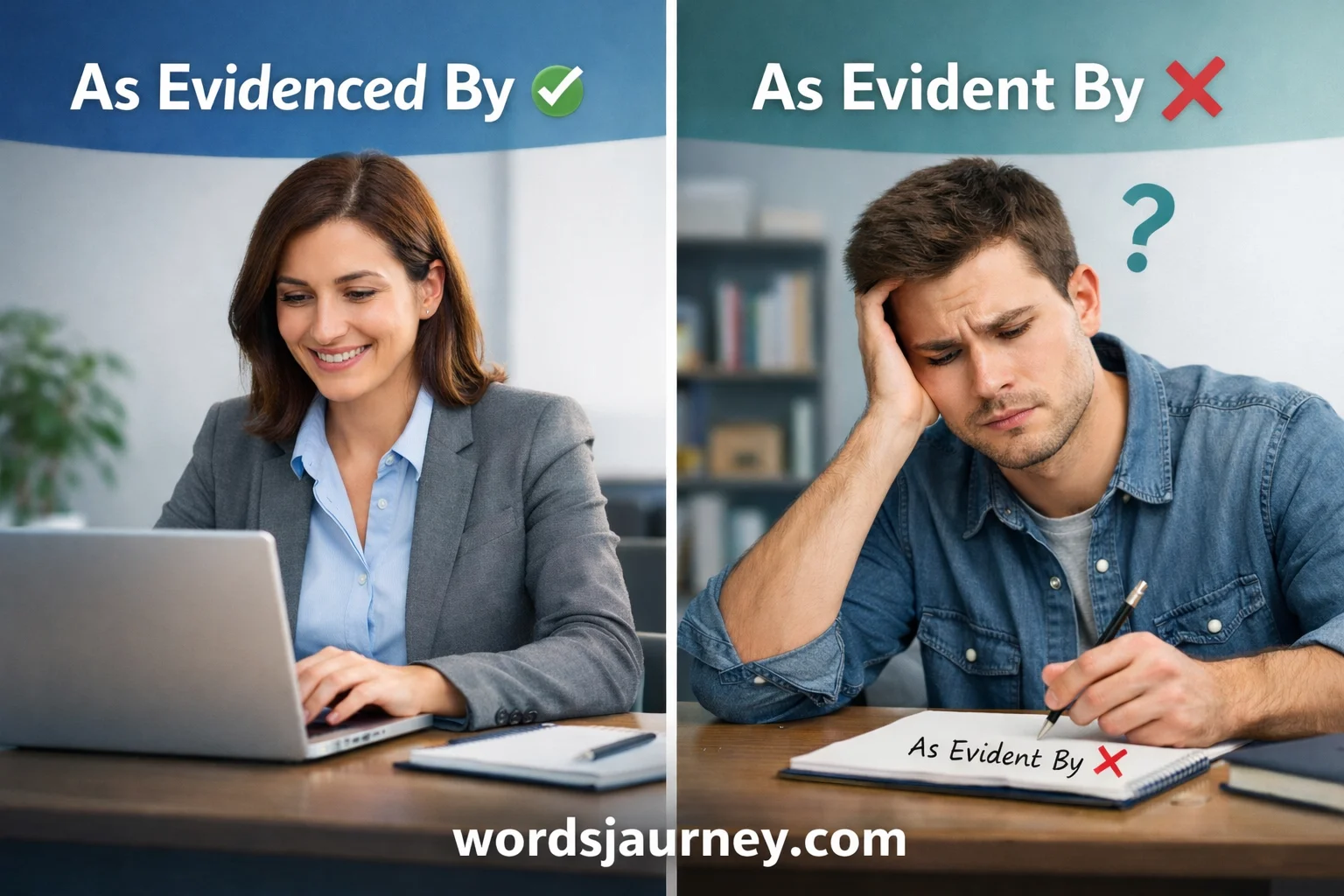
Have you ever paused mid-sentence, unsure whether to write “As Evidenced By” or “As Evident By”? You’re not alone. This subtle distinction often trips up even experienced writers, especially in formal writing, business communication, and professional contexts like project management, meetings, and broadcasting. The confusion matters because clear English usage directly impacts your credibility—whether you’re drafting emails, managing a calendar, or handling online booking systems where precision is key.
In this article, you’ll learn the exact difference between “As Evidenced By” and “As Evident By”, including when each phrase is grammatically correct and contextually appropriate. We’ll break down the rules in simple terms, supported by real-world examples from time management, scheduling, and workplace communication. You’ll also discover how consistency in grammar improves clarity across tasks like writing reports, organizing meetings, and communicating updates in collaborative environments.
We’ll also touch on how major style guides and regional preferences—such as US vs. UK English standards—influence usage, giving you a well-rounded understanding of both forms. By the end, you’ll confidently choose the right phrase every time, ensuring your writing stays polished, professional, and aligned with modern expectations of grammar, consistency, and effective communication.
As Evidenced By vs As Evident By: The Correct Form
Let’s get straight to the point.
- ✅ Correct: As evidenced by
- ❌ Incorrect (in most cases): As evident by
Why “As Evidenced By” Works
The phrase “as evidenced by” uses the past participle evidenced, which acts like a passive construction. It means:
“As shown by” or “as demonstrated by.”
That structure fits naturally in English because you’re pointing to proof or support.
Why “As Evident By” Doesn’t Work
“Evident” is an adjective. It describes something. It doesn’t function well in this structure.
So when you write:
- ❌ As evident by the data…
It sounds incomplete. You’re missing a proper grammatical link.
What Does “As Evidenced By” Mean?
At its core, “as evidenced by” introduces proof.
Think of it like saying:
- “You can see this clearly from…”
- “This is proven by…”
- “The evidence shows…”
Simple Breakdown
| Phrase | Meaning | Function |
| As evidenced by | Supported by evidence | Introduces proof |
| As evident by | Grammatically weak | Incorrect usage |
How to Use “As Evidenced By” Correctly
You’ll usually place it before the evidence.
Basic Sentence Structure
Claim + as evidenced by + supporting detail
Examples That Sound Natural
- The strategy worked well, as evidenced by the 40% increase in sales.
- Her confidence has grown, as evidenced by her public speaking skills.
- The product is reliable, as evidenced by thousands of positive reviews.
Notice something?
Each sentence flows smoothly because the phrase connects a claim with proof.
Real-World Examples
Let’s make this practical.
Academic Writing
- The theory remains valid, as evidenced by decades of supporting research.
Business Communication
- Customer satisfaction has improved, as evidenced by recent survey results.
Everyday Writing
- He’s clearly dedicated, as evidenced by his consistent effort.
Common Mistakes You Should Avoid
Even experienced writers slip up here.
Mistake 1: Using “As Evident By”
- ❌ The results are impressive, as evident by the numbers.
✔ Fix it:
- ✅ The results are impressive, as evidenced by the numbers.
Mistake 2: Overusing the Phrase
Yes, it’s useful. Still, repeating it too often makes your writing sound stiff.
Better Alternatives
- As shown by
- As demonstrated by
- As reflected in
- As seen in
Mistake 3: Redundant Writing
Avoid doubling your meaning.
- ❌ Clearly obvious, as evidenced by…
- ✅ Clear, as evidenced by…
Keep it tight.
“As Evidenced By” vs Similar Phrases
You don’t have to rely on just one phrase.
Here’s how it compares:
| Phrase | Tone | Best Use Case |
| As evidenced by | Formal | Academic, professional |
| As shown by | Neutral | General writing |
| As demonstrated by | Strong | Arguments, reports |
| As seen in | Casual | Blogs, storytelling |
When Should You Use “As Evidenced By”?
Use it when:
- You’re making a claim
- You want to prove something
- You need a clear connection between idea and evidence
Quick Checklist
Ask yourself:
- Am I supporting a statement?
- Do I have clear proof?
- Does the sentence flow naturally?
If yes, you’re good to go.
When You Should Avoid It
Sometimes, less is more.
Avoid the phrase when:
- The evidence is already obvious
- You’re writing casually
- It makes the sentence feel heavy
Example
- ❌ She is tired, as evidenced by her yawning.
- ✅ She is tired. She keeps yawning.
Short. Clear. Human.
Mini Case Study: Before vs After
Let’s improve a paragraph.
Before
The company is growing rapidly, as evident by its increased revenue and expanding customer base, and it is becoming more competitive in the market.
After
The company is growing rapidly, as evidenced by rising revenue and a larger customer base. It’s also becoming more competitive.
What Changed?
- Fixed grammar
- Improved clarity
- Better rhythm
Also Read More: To Fast or Too Fast Which One Is Correct?
Pro Writing Tips for Using “As Evidenced By”
Want your writing to feel sharp and confident? Follow these.
Use It Sparingly
Once per paragraph is often enough.
Pair It With Strong Data
Weak evidence weakens your sentence.
- ✅ As evidenced by a 52% increase in conversions
- ❌ As evidenced by some improvements
Keep It Close to the Claim
Don’t separate the phrase from what it supports.
Mix It With Other Phrases
Variety keeps your writing fresh.
Quick Reference Guide
| Do This | Avoid This |
| Use as evidenced by | Use as evident by |
| Support claims with proof | Make vague statements |
| Keep sentences concise | Overload with words |
| Vary your phrasing | Repeat the same structure |
Frequently Asked Questions (FAQs)
1. Is “As Evidenced By” grammatically correct?
Yes, “As Evidenced By” is grammatically correct and widely accepted in formal writing. It functions as a past participle phrase, meaning “as shown by” or “as demonstrated by.” You’ll often see it in business communication, reports, and project management documents where clarity and evidence matter.
2. Is “As Evident By” ever correct?
Generally, “As Evident By” is considered incorrect in standard English usage. The correct form is “As Evident From” because “evident” is an adjective and pairs naturally with “from,” not “by.” Using the wrong preposition can weaken your professional tone and reduce clarity.
3. Which phrase should I use in professional contexts?
In most cases, choose “As Evidenced By” for formal writing, especially in meetings, calendar updates, online booking systems, and business communication. It sounds more polished and aligns with expectations in professional environments.
4. Does this distinction matter in everyday writing?
Yes, it does. Even in casual contexts like emails or scheduling notes, correct grammar improves consistency and readability. Clear language helps avoid confusion, particularly when managing time management tasks or coordinating projects.
5. Are there differences between US and UK usage?
Both US and UK English generally follow the same rule:
- “As Evidenced By” → correct and widely used
- “As Evident From” → also correct
- “As Evident By” → typically avoided
However, some stylistic preferences may vary slightly depending on the guide you follow, such as APA, Chicago, or Oxford style.
6. Can I replace these phrases with simpler alternatives?
Absolutely. For better clarity in broadcasting, business communication, or project management, you can use:
- “As shown by”
- “As demonstrated by”
- “As indicated by”
These alternatives are often clearer and more concise, especially in fast-paced contexts like meetings or calendar planning.
Conclusion
Choosing between “As Evidenced By” or “As Evident By” may seem like a small detail, but it plays a big role in maintaining professional, consistent, and clear communication. The correct usage—“As Evidenced By” or alternatively “As Evident From”—ensures your writing aligns with accepted standards in formal writing, business communication, and everyday professional tasks like scheduling, online booking, and project management. Strong grammar isn’t just about rules; it’s about building trust and clarity. Whether you’re writing reports, organizing meetings, or managing a busy calendar, precise language helps you communicate ideas effectively. By applying these simple distinctions, you’ll elevate your English usage, improve readability, and present yourself with confidence in any setting.

Aliya Ray is a passionate writer and language enthusiast at WordsJourney. She enjoys exploring words, phrases, and everyday expressions to help readers communicate more clearly and confidently. Her content focuses on alternative ways to say common phrases, simple explanations, and real-life examples that make language easy to understand.
Aliya believes the right words can make any message stronger. Through clear, friendly writing, she helps readers improve their vocabulary without feeling overwhelmed or confused.