Have you ever paused mid-sentence and wondered whether to say “At the House or In the House”?
It’s a small choice, yet it can quietly shape how your message sounds in business communication, casual conversations, or even formal writing. These subtle differences often appear in everyday contexts like meetings, online booking, or setting a calendar reminder. Getting them right improves not just clarity but also your overall English usage and professional tone.
In modern workflows driven by scheduling, time management, and project management, precision in language matters more than ever. Whether you’re broadcasting an announcement, writing emails, or organizing team updates, choosing the correct phrase helps maintain consistency and avoids confusion. The distinction between these two expressions may seem minor, but it plays a key role in delivering clear, polished communication that aligns with real-world usage.
This guide breaks down the exact difference between “At the House” and “In the House”, with practical examples you can apply instantly. You’ll also learn how regional preferences especially US vs. UK usage and established style guides influence these choices. By the end, you’ll feel confident using both phrases correctly in any context, from casual speech to professional writing.
At the House or In the House: Quick Answer
If you only remember one thing, make it this:
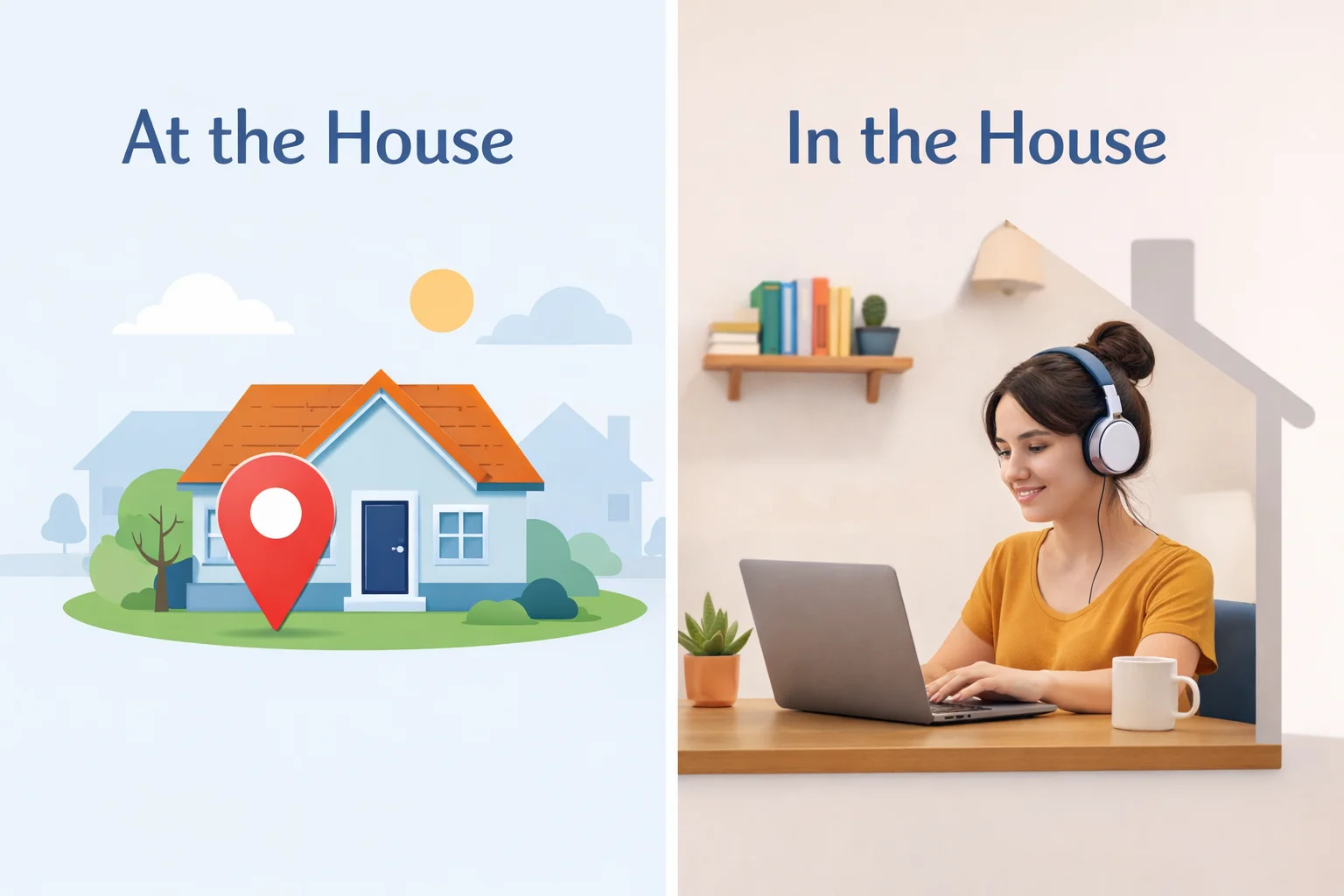
- “At the house” = general location
- “In the house” = physically inside
Quick Examples
- “I’m at the house.” → You’re at that location (inside or outside)
- “I’m in the house.” → You’re inside the building
That’s the core difference. Simple. But there’s more nuance when you dig deeper.
Understanding “At” vs “In” (The Foundation You Need)
Before focusing on houses, let’s zoom out. These two prepositions follow broader rules in English.
What “At” Really Means
Think of “at” as a point on a map.
You’re not describing details. You’re just identifying a place.
Use “at” when:
- The exact position doesn’t matter
- You’re talking about a meeting spot
- You want to sound natural in casual speech
Examples:
- “I’m at the office.”
- “She’s at the restaurant.”
- “We’re at the house.”
Notice something? None of these tell you where exactly inside.
What “In” Really Means
Now picture “in” as being inside a container or space.
It’s more specific. More visual. More precise.
Use “in” when:
- You want to show physical presence inside something
- The enclosure matters
- You need clarity
Examples:
- “I’m in the office.”
- “She’s in the car.”
- “He’s in the house.”
Now you can almost see the person inside.
At the House: Meaning, Usage, and Real Examples
Let’s zoom in.
What Does “At the House” Mean?
When you say “at the house”, you’re referring to the location as a whole.
You could be:
- Inside the house
- In the yard
- At the front door
- Parked outside
The sentence doesn’t specify. And that’s the point.
When You Should Use “At the House”
Use this phrase when:
- You’re talking about arriving or being somewhere
- You’re describing a meeting place
- The exact position isn’t important
Examples That Sound Natural
- “I’m at the house, I’ll call you later.”
- “We’re meeting at the house before dinner.”
- “He’s already at the house waiting for us.”
Each sentence focuses on location, not position.
Subtle Meaning Behind It
Here’s where it gets interesting.
When you say “at the house,” you’re often:
- Thinking socially (meeting, visiting)
- Speaking casually
- Leaving details out on purpose
It’s flexible. That’s why native speakers use it so often.
Read More: Ensure vs Insure: When to Use Each Word Correctly
In the House: Meaning, Usage, and Real Examples
Now let’s tighten things up.
What Does “In the House” Mean?
When you say “in the house”, you mean inside the building. No ambiguity.
You’re not in the yard. Not outside. Not in the driveway.
You’re inside.
When You Should Use “In the House”
Use this phrase when:
- You want to emphasize physical presence indoors
- You’re describing actions happening inside
- Clarity matters
Examples That Feel Precise
- “She’s in the house watching TV.”
- “Stay in the house during the storm.”
- “There’s someone in the house.”
These sentences create a clear mental image.
Why It Feels Stronger
“In the house” adds certainty.
It answers the unspoken question:
Exactly where are you?
At the House vs In the House: Side-by-Side Comparison
Here’s the difference in one clean table:
| Feature | At the House | In the House |
| Meaning | General location | Inside physically |
| Precision | Low | High |
| Focus | Where you are | Where exactly inside |
| Flexibility | Very flexible | Specific |
| Common Usage | Casual, social | Descriptive, precise |
| Example | I’m at the house | I’m in the house |
Real-Life Scenarios Where People Get Confused
Let’s bring this into everyday situations.
Phone Conversations
Imagine this:
- “Hey, where are you?”
- “I’m at the house.”
This works perfectly. You’re giving a general answer.
Now compare:
- “I’m in the house.”
This sounds more specific. Almost like clarification.
Visiting vs Living Context
Here’s a subtle twist.
- “I’m at the house.” → Could mean you’re visiting
- “I’m in the house.” → Suggests you’re already inside
It changes the tone slightly.
Emergency Situations
Now clarity becomes critical.
- “There’s someone in the house.”
This is urgent. Precise. Clear.
If you said:
- “There’s someone at the house.”
That could mean outside. Big difference.
Common Mistakes (And How to Avoid Them)
Even advanced learners slip up here.
Mistake 1: Using “In” for Everything
❌ “I’m in the house” (when you mean location only)
Fix: Use “at” when details don’t matter.
Mistake 2: Using “At” When Precision Matters
❌ “The kids are at the house” (during a safety situation)
Fix: Use “in” when clarity is important.
Mistake 3: Overthinking Simple Sentences
Sometimes both are technically correct.
Don’t freeze. Choose based on intent.
Pro Tip: The Native Speaker Shortcut
Here’s a quick mental trick that works almost every time:
- If you can replace it with “inside” → use “in”
- If you can replace it with “at that location” → use “at”
Example
- “I’m inside the house” → ✅ “I’m in the house”
- “I’m at that location” → ✅ “I’m at the house”
Fast. Reliable. Practical.
Related Phrases You Should Know
This pattern shows up everywhere.
At Home vs In the House
- “At home” = general state
- “In the house” = physical position
At the Building vs In the Building
- “At the building” → outside or inside
- “In the building” → definitely inside
At School vs In School
- “At school” → location
- “In school” → enrolled as a student
Context shifts meaning. Always.
Mini Quiz: Test Your Understanding
Try this quickly.
Fill in the blanks:
- I’m ___ the house, come over.
- She’s ___ the house cleaning.
- We’re waiting ___ the house.
- Stay ___ the house during the storm.
Answers
- at
- in
- at
- in
If you got these right, you’ve nailed the concept.
Case Study: Why Context Changes Everything
Imagine two people texting.
Person A:
“I’m at the house.”
Person B (thinking):
Okay, they’ve arrived. Might still be outside.
Person A (second message):
“I’m in the house.”
Now it’s clear. They’re inside.
That tiny switch removes ambiguity.
Expert Insight (Simple but Powerful)
“Prepositions don’t just describe location—they shape meaning.”
That’s why “at” and “in” matter more than they seem.
They control:
- Clarity
- Tone
- Precision
Frequently Asked Questions (FAQs)
1. What is the main difference between “At the House” and “In the House”?
The difference comes down to location vs. position.
- “At the house” refers to a general location or destination.
- “In the house” means being physically inside the building.
Use the first for plans, scheduling, or meetings, and the second for exact presence indoors.
2. Which phrase is better for business communication?
In business communication, “at the house” is more common when discussing appointments, online booking, or calendar events.
For example: “The meeting is scheduled at the house at 3 PM.”
However, if you want to emphasize physical presence, use “in the house.”
3. Is “In the House” informal or formal?
“In the house” works in both contexts but feels slightly more descriptive and situational.
In formal writing, it’s used when clarity about physical presence matters.
In casual or even broadcasting, it can add emphasis, like: “The guest speaker is in the house!”
4. Do US and UK English use these phrases differently?
Both US and UK English follow similar grammar rules for these phrases.
The difference is minimal and mostly depends on context, tone, and style guides, not region.
Consistency matters more than regional variation.
5. Can I use both phrases interchangeably?
Not always. While they may seem similar, using them interchangeably can reduce clarity and consistency.
- Use “at the house” for general location or planning.
- Use “in the house” for specific physical presence inside.
6. Which phrase is better for scheduling and time management?
For scheduling, time management, and project management, “at the house” is usually better.
It fits naturally in calendars, meetings, and organized plans without over-explaining.
Conclusion
Choosing between “At the House” and “In the House” may seem like a small detail, but it has a real impact on your English usage, clarity, and professionalism. The key difference is simple: one focuses on general location, while the other highlights being physically inside. Once you understand this, your communication becomes sharper and more precise.
In everyday situations—whether you’re handling business communication, setting up meetings, managing a calendar, or working on formal writing—using the right phrase helps maintain consistency and avoids confusion. It also shows attention to detail, which matters in both professional and academic settings.Mastering these subtle distinctions strengthens your overall grammar skills and builds confidence in real-world communication. Stick with the context, follow common usage patterns, and you’ll always know which phrase fits naturally.

Aliya Ray is a passionate writer and language enthusiast at WordsJourney. She enjoys exploring words, phrases, and everyday expressions to help readers communicate more clearly and confidently. Her content focuses on alternative ways to say common phrases, simple explanations, and real-life examples that make language easy to understand.
Aliya believes the right words can make any message stronger. Through clear, friendly writing, she helps readers improve their vocabulary without feeling overwhelmed or confused.