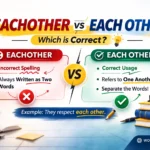
Have you ever paused mid-email, wondering which form looks professional—“Atleast or At Least”? This small spelling choice appears everywhere, from business communication and formal writing to casual messages about scheduling and meetings.
Yet many writers still feel unsure. Understanding Atleast or At Least is more than a grammar detail; it affects clarity, tone, and credibility in everyday English usage.
In this article, you’ll learn the exact difference, why one form is accepted in modern grammar, and how the choice influences real-world contexts like time management, project management, online booking, and calendar planning. We’ll explore how this tiny phrase shows up in broadcasting, professional emails, and workplace discussions, where consistency and precision matter. Clear language helps your message land correctly, whether you’re setting deadlines or confirming availability.
By the end, you’ll feel confident using the correct form in formal writing and everyday communication. If you value accuracy, professionalism, and readable writing, this guide will give you the clarity you need—at least once and for all.
The Short Answer (If You’re in a Hurry)
- Correct form: At least
- Incorrect form: Atleast
- Rule to remember: If the words at and least still make sense on their own, they stay separate.
Simple. Reliable. Done.
Now let’s go deeper, because English rarely stops at simple.
What “At Least” Really Means in English
The phrase at least is more flexible than most people realize. It isn’t just about numbers. It carries tone, emphasis, and sometimes even emotion.
At its core, at least expresses a minimum. But context shapes how that minimum works.
Common Meanings of “At Least”
- A minimum quantity or amount
Bring at least three copies of the form. - Reassurance or consolation
At least we tried. - Emphasis on something positive
At least she called to explain. - Correction or clarification
It wasn’t five miles, at least six.
That flexibility explains why writers use it so often. It also explains why the spelling mistake spreads so easily.
Is “Atleast” Ever a Real Word?
No. Not now. Not before. Not in any major dictionary.
Search Merriam-Webster, Cambridge, or Oxford, and you’ll find at least listed as a phrase. You won’t find atleast at all. That’s because it doesn’t exist in standard English.
So Why Does “Atleast” Look Right?
A few reasons:
- Many English words are formed by combining smaller ones
(already, almost, altogether) - Autocorrect often fails to flag “atleast”
- Informal texting removes spaces
- Fast typing makes spacing easy to miss
The brain loves shortcuts. Unfortunately, English doesn’t always cooperate.
The Grammar Rule Behind “At Least”
Grammatically, at least is a prepositional phrase.
- At → preposition
- Least → superlative adjective
Together, they function as a unit, but they do not merge into one word.
Similar Phrases That Stay Separate
English has many phrases that look like they should be one word but aren’t:
- At all
- In fact
- In spite of
- At once
- By far
Trying to combine these breaks standard grammar rules. At least follows the same pattern.
Atleast or At Least: Side-by-Side Comparison
| Feature | At Least | Atleast |
| Grammatically correct | ✅ Yes | ❌ No |
| Found in dictionaries | ✅ Yes | ❌ No |
| Accepted in formal writing | ✅ Yes | ❌ No |
| Acceptable in casual writing | ✅ Yes | ❌ No |
| Safe for SEO and publishing | ✅ Yes | ❌ No |
There’s no gray area here. One is correct everywhere. The other isn’t correct anywhere.
Why People Keep Making This Mistake
If atleast is always wrong, why does it appear so often?
Real Reasons Behind the Error
- English has inconsistent spacing rules
- Writers rely on sound instead of structure
- Spellcheck doesn’t always help
- Social media normalizes incorrect forms
When spoken aloud, at least sounds like one word. Writing, however, demands precision.
Correct Examples of “At Least” in Everyday Writing
Seeing proper usage in context helps the rule stick.
Casual Conversation
- I need at least ten minutes.
- At least tell me what happened.
Professional Writing
- Applicants must have at least three years of experience.
- The report will take at least two weeks to complete.
Academic Writing
- The study sampled at least 500 participants.
- At least one variable showed significant change.
In every case, the space stays.
Incorrect Examples and Their Corrections
Mistakes feel less abstract when you see them clearly.
- ❌ I need atleast one more day.
✅ I need at least one more day. - ❌ Atleast try to understand.
✅ At least try to understand. - ❌ She has atleast five certificates.
✅ She has at least five certificates.
Once you train your eye, the wrong version jumps out immediately.
Why This Small Mistake Hurts Your Writing
One typo won’t ruin a friendship. But repeated errors chip away at credibility.
Real Consequences of Using “Atleast”
- Readers question attention to detail
- Editors flag your work instantly
- Employers notice mistakes in resumes
- Search engines favor correctly spelled content
In professional and published writing, small errors act like loose threads. Pull one, and the whole thing starts to unravel.
Simple Memory Tricks to Never Write “Atleast” Again
You don’t need complex grammar rules. Just use one of these quick checks.
The Swap Test
Replace at least with a minimum of.
- I need a minimum of five minutes.
If it works, keep the space.
The Pause Test
Say it slowly.
At… least.
Two beats. Two words.
The Visual Trick
If you can insert another word between them, they’re separate.
- At the very least
You can’t do that with a single word.
“At Least” vs Similar Expressions
Confusion often comes from nearby phrases.
At Least vs At Most
- At least → minimum
- At most → maximum
Read More: Etc or Ect: The Correct Spelling, and Usage Explained Clearly
Example:
The trip will take at least two hours, at most four.
At Least vs Barely
- At least suggests sufficiency
- Barely suggests struggle
They feel similar emotionally but mean different things.
How Style Guides Treat “At Least”
Every major style guide agrees.
- AP Stylebook: Uses at least as a phrase
- Chicago Manual of Style: No combined form
- MLA and APA: Consistent two-word usage
Editors don’t debate this one. The rule is settled.
Frequently Asked Questions (FAQs)
1. Is “atleast” a correct word in English?
No. “Atleast” is not considered correct in standard modern English. Most dictionaries and grammar authorities recognize only “at least” as the correct form.
2. Why do people still write “atleast”?
Many people write “atleast” by mistake because it sounds like a single word when spoken. Fast typing, autocorrect habits, and informal online writing also contribute to this error.
3. Which form should I use in formal writing and business communication?
You should always use “at least” in formal writing, business communication, emails, reports, contracts, and professional documents. It aligns with accepted grammar rules and style guides.
4. Is “at least” correct in both US and UK English?
Yes. “At least” is correct in both American and British English. There is no regional variation here, making it a safe and consistent choice for global audiences.
5. Can “at least” be used in scheduling and time management contexts?
Absolutely. Phrases like “at least 30 minutes,” “at least two meetings,” or “at least one calendar update” are common in scheduling, time management, and workplace communication.
6. How can I avoid making this mistake in the future?
Remember this rule: if in doubt, always separate the words. Writing “at least” will never be wrong in standard English usage.
Conclusion
The confusion between “Atleast or At Least” may seem minor, but it carries real importance in clear and professional communication. While “atleast” appears frequently online, it remains grammatically incorrect and unsupported by major dictionaries or style guides. The correct and universally accepted form is “at least.”
Whether you’re writing for business communication, managing meetings, coordinating a calendar, or creating content for online booking and broadcasting, accuracy matters. Using “at least” ensures clarity, consistency, and professionalism across all forms of formal writing and everyday English usage.
In short, there’s no debate in modern grammar. If you want your writing to sound polished, credible, and correct—always choose “at least.”

Johnson Alex is a language-focused writer and the voice behind WordsJourney. He creates practical, easy-to-understand content that helps readers improve their vocabulary and express ideas with clarity and confidence.