Ever paused mid-email and wondered which phrase is right “bear with me” or “bare with me”? You’re not alone. The confusion around Bear vs Bare With Me trips up smart writers every day, especially when messages move fast and attention is split across screens. One tiny word swap can change meaning, tone, and credibility in seconds, which is why getting this right matters in real-world business communication.
In this guide, you’ll learn the clear difference between the two phrases and how to use each one with confidence. We’ll ground the explanation in everyday contexts like meetings, calendar updates, scheduling, and time management the moments when you’re asking for patience during online booking, broadcasting, or active project management. Along the way, you’ll see practical examples that fit modern workflows and help maintain consistency across emails, chats, and formal documents.
We’ll also touch on best practices for English usage, grammar, and formal writing, with brief notes on style guides and regional preferences in US vs. UK English.
If you care about clarity, professionalism, and writing that reads well to people and search engines alike, you’re in the right place. By the end, you’ll know exactly which phrase to choose and why—and you’ll never second-guess it again.
Why “Bear vs Bare With Me” Trips Up Smart Writers
English loves to play tricks with sound-alike words. Bear and bare sound the same. That single phonetic overlap causes endless mistakes. Add speed, multitasking, and tiny screens, and errors slip through.
Here’s why the confusion spreads:
- Homophones fool spellcheck.
- Fast writing favors sound over meaning.
- Social media habits normalize casual errors.
- Copy-paste culture spreads mistakes at scale.
A small error can carry a big cost. Readers judge clarity fast. Brands lose trust over tiny slips. Support teams look less polished. Clean language builds credibility. Sloppy phrasing chips away at it.
Quote: “Precision in language signals respect for the reader’s time.”
— Editorial maxim in professional publishing
What “Bear” Means and How It Works in Real Writing
Bear works as a verb and a noun. The phrase bear with me uses the verb form.
Bear as a Verb
Bear means to carry, endure, support, or tolerate. That meaning fits perfectly with patience.
Common verb forms:
- Present: bear
- Past: bore
- Past participle: borne (or born in birth contexts)
Everyday examples:
- “I can’t bear the noise today.”
- “Please bear with me while I load the report.”
- “She bore the cost of repairs.”
- “The bridge has borne heavy traffic for decades.”
Bear as a Noun
Yes, the animal. Cute. Fuzzy. Not helpful for this phrase. The animal meaning adds noise to memory. Many writers picture a bear and drift toward bare by mistake.
Key takeaway: In bear with me, bear means tolerate or be patient. No animals involved.
What “Bare” Means and Why It Changes the Message
Bare means uncovered, minimal, or exposed. It works as an adjective and a verb.
Bare as an Adjective
- “He walked on bare feet.”
- “The room looked bare after the move.”
- “The report gave the bare facts.”
Bare as a Verb
- “They bared the truth.”
- “The storm bared the coastline.”
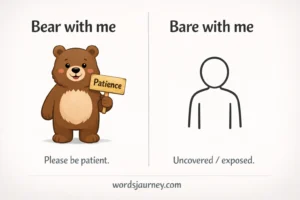
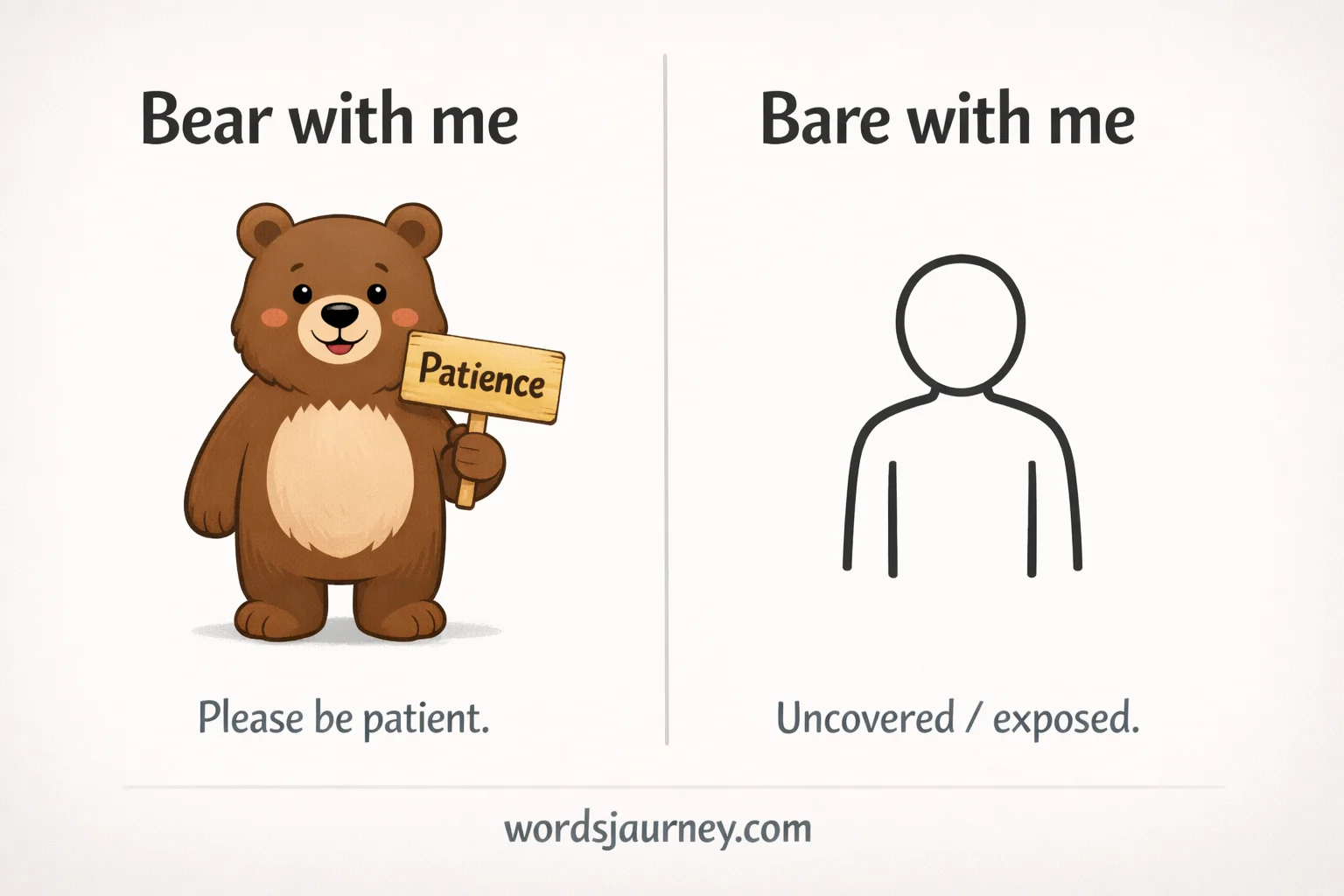
Now imagine bare with me. Literally, it suggests undressing together or exposing something. That’s not what you mean in professional writing. The phrase lands awkwardly. Sometimes it lands funny. Either way, it derails your message.
Key takeaway: Bare deals with exposure. It does not mean patience.
The Correct Phrase Explained: “Bear With Me”
Bear with me means please be patient. It asks for time, grace, or understanding.
You’ll see it in:
- Customer support
- Technical walkthroughs
- Meetings and presentations
- Live demos
- Email follow-ups
Natural examples:
- “Bear with me while I pull the numbers.”
- “Bear with me for a moment. The page is loading.”
- “Bear with me as I explain the process.”
Tone and Register
- Professional: “Bear with me while I review your ticket.”
- Casual: “Bear with me, this might take a second.”
- Polite: “Thanks for bearing with me today.”
The phrase stays polite and human. It softens delays. It keeps readers on your side.
Why “Bare With Me” Is Almost Always Wrong
Let’s be blunt. Bare with me almost never fits the context. The literal meaning clashes with what writers intend. That mismatch creates confusion or unintentional humor.
Why the mistake spreads:
- Spellcheck won’t flag it.
- Both words sound identical.
- Writers rely on phonetics when tired.
- Errors get copied across posts and emails.
When could “bare with me” be correct?
Only in rare, literal contexts about exposure. Even then, the phrase sounds clunky. Writers usually choose clearer wording.
Professional impact:
- Emails look careless.
- Brand voice weakens.
- Trust erodes in support content.
- Editors flag avoidable errors.
Bear vs Bare With Me: Side-by-Side Comparison
| Phrase | Correct Usage | Meaning | Typical Context | Example |
| Bear with me | Yes | Be patient, tolerate delay | Emails, support, presentations | “Bear with me while I check.” |
| Bare with me | No (usually) | Expose or undress together | Rare, literal contexts | “This phrasing caused confusion.” |
Bottom line: If you want patience, choose bear.
Real-World Examples That Show the Difference
Short, real examples help the rule stick.
Correct usage:
- “Bear with me while the dashboard refreshes.”
- “Thanks for bearing with me during the outage.”
- “Bear with me as I outline the steps.”
Incorrect usage:
- “Bare with me while the file uploads.”
- “Thanks for baring with me today.”
Why the wrong examples fail:
They signal exposure. Readers stumble. The message loses focus.
Memory Tricks That Actually Work
You don’t need a grammar book. You need a quick mental hook.
Simple cues:
- Bear = bear a burden. You carry patience.
- Bear = tolerate. You ask someone to tolerate a delay.
- Bare = bare skin. Exposure, not patience.
Visual trick:
Picture a pack mule carrying weight. That’s bear. It carries your request for patience.
One-line rule:
If you mean patience, choose bear.
Related Word Pairs People Confuse
This mistake sits in a family of homophone errors. Spot the pattern and you’ll catch them faster.
- Their / There / They’re
- Accept / Except
- Compliment / Complement
- Affect / Effect
- Then / Than
Why these errors happen:
- Sound-based writing
- Speed over precision
- Overreliance on autocorrect
Fix the pattern:
Slow down at phrases you use often. Build a short “watch list” of your common errors.
How This Mistake Affects Branding, and Trust
Brand impact:
- Professional tone signals reliability.
- Support content feels competent.
- Marketing copy sounds polished.
Reader trust:
- Precision builds confidence.
- Errors create friction.
- Clarity keeps attention.
Case insight: A SaaS help center audited its top 50 articles and corrected homophone errors. Support ticket resolution time dropped after clarity improved. Clean language removed confusion in step-by-step guides.
Quick Self-Test: Choose Bear or Bare
Pick the right word. Answers follow.
- “___ with me while I load the report.”
- “Thanks for ___ with me during the delay.”
- “Please ___ with me as I double-check.”
- “He walked on ___ feet across the sand.”
- “They decided to ___ the truth.”
Answers:
- Bear
- Bearing
- Bear
- Bare
- Bare
Why this works:
Context reveals meaning. Patience uses bear. Exposure uses bare.
Read More: Fourth vs Forth: The Real Difference and Correct Usage
Common Myths and Misconceptions
Myth: Language changes so both forms work.
Reality: Meaning still matters. Clarity wins.
Myth: Spellcheck will catch it.
Reality: Homophones pass spellcheck.
Myth: Casual writing doesn’t need precision.
Reality: Casual still benefits from clarity.
Practical Editing Tips to Avoid This Error Forever
You don’t need heavy tools. You need smart habits.
Fast fixes:
- Add bear/bare to your personal watch list.
- Read key lines out loud.
- Scan for homophones before publishing.
- Use grammar tools that flag context errors.
Team workflows:
- Keep a shared style guide.
- Add a pre-publish checklist.
- Train reviewers to spot homophones.
Personal habit:
Pause at phrases you type on autopilot. That pause catches most errors.
FAQs: Bear vs Bare With Me
1) What does “bear with me” actually mean?
“Bear with me” means be patient with me or please wait a moment. It comes from the verb bear, meaning to تحمل (tolerate or endure). You’ll see it often in meetings, business communication, and everyday formal writing when someone needs time to check a calendar, confirm scheduling, or update project management details.
2) Is “bare with me” ever correct?
Almost never in normal writing. “Bare with me” literally means to get undressed with me, because bare means naked or uncovered. Unless you’re intentionally being humorous or writing fiction, avoid it in professional English usage, broadcasting, and client-facing messages.
3) Which phrase should I use in emails and formal writing?
Use “bear with me.” It’s the accepted form in formal writing, business communication, and style guides. This keeps your tone professional and your message clear during online booking issues, time management updates, or rescheduled meetings.
4) Do US and UK style guides treat this differently?
No. Both US and UK usage agree on “bear with me” as the correct phrase. Major style guides prioritize consistency and clarity, especially in professional contexts like project management documentation and client communications.
5) How can I remember the difference?
Think: you “bear” a burden you (endure) a delay. If you’re asking for patience, choose bear. If the sentence would sound awkward or inappropriate with “naked,” you know bare is wrong.
6) Can using the wrong phrase hurt credibility?
Yes. Small grammar errors can weaken trust in business communication, especially in high-stakes contexts like proposals, broadcasting, or public announcements. Clear English usage signals professionalism and attention to detail.
Conclusion
Getting Bear vs Bare With Me right is a small change with big impact. In fast-moving workdays filled with scheduling, calendar updates, and shifting priorities, the phrase “bear with me” helps you ask for patience without confusion. It keeps your tone professional across meetings, online booking flows, and project management updates.Strong grammar, clear English usage, and steady consistency build credibility in every message you send. Whether you follow US or UK style preferences, the rule stays the same: choose bear when you mean patience. Nail this detail, and your writing sounds confident, polished, and trustworthy exactly what effective business communication demands.

Aliya Ray is a passionate writer and language enthusiast at WordsJourney. She enjoys exploring words, phrases, and everyday expressions to help readers communicate more clearly and confidently. Her content focuses on alternative ways to say common phrases, simple explanations, and real-life examples that make language easy to understand.
Aliya believes the right words can make any message stronger. Through clear, friendly writing, she helps readers improve their vocabulary without feeling overwhelmed or confused.