Have you ever paused mid-sentence, unsure whether to write “better then” or than”? This common English usage question can trip up writers, professionals, and students alike. In contexts ranging from business communication to project management emails, using the wrong form can subtly undermine clarity.
Whether you’re scheduling meetings, sending online booking confirmations, or managing a calendar, mastering this distinction ensures your writing remains precise and professional.
Understanding Better Then or Than is more than a grammar lesson—it’s about consistency and effective communication. While “than” is used for comparisons, “then” relates to time sequencing or broadcasting instructions. Small errors in formal writing, whether in English usage guides or style manuals, can create confusion in time management documents or business correspondence. Recognizing the difference also helps maintain credibility across US and UK English conventions, where usage preferences may slightly vary.
In this article, we’ll break down the rules, highlight practical examples, and explore real-world applications in emails, reports, and everyday writing. From understanding subtle nuances to applying them in formal writing or project management updates, you’ll gain confidence in choosing correctly every time.
By the end, you’ll navigate Better Then or Than with ease, improving both clarity and professional impact.
Quick Answer: Better Then or Than
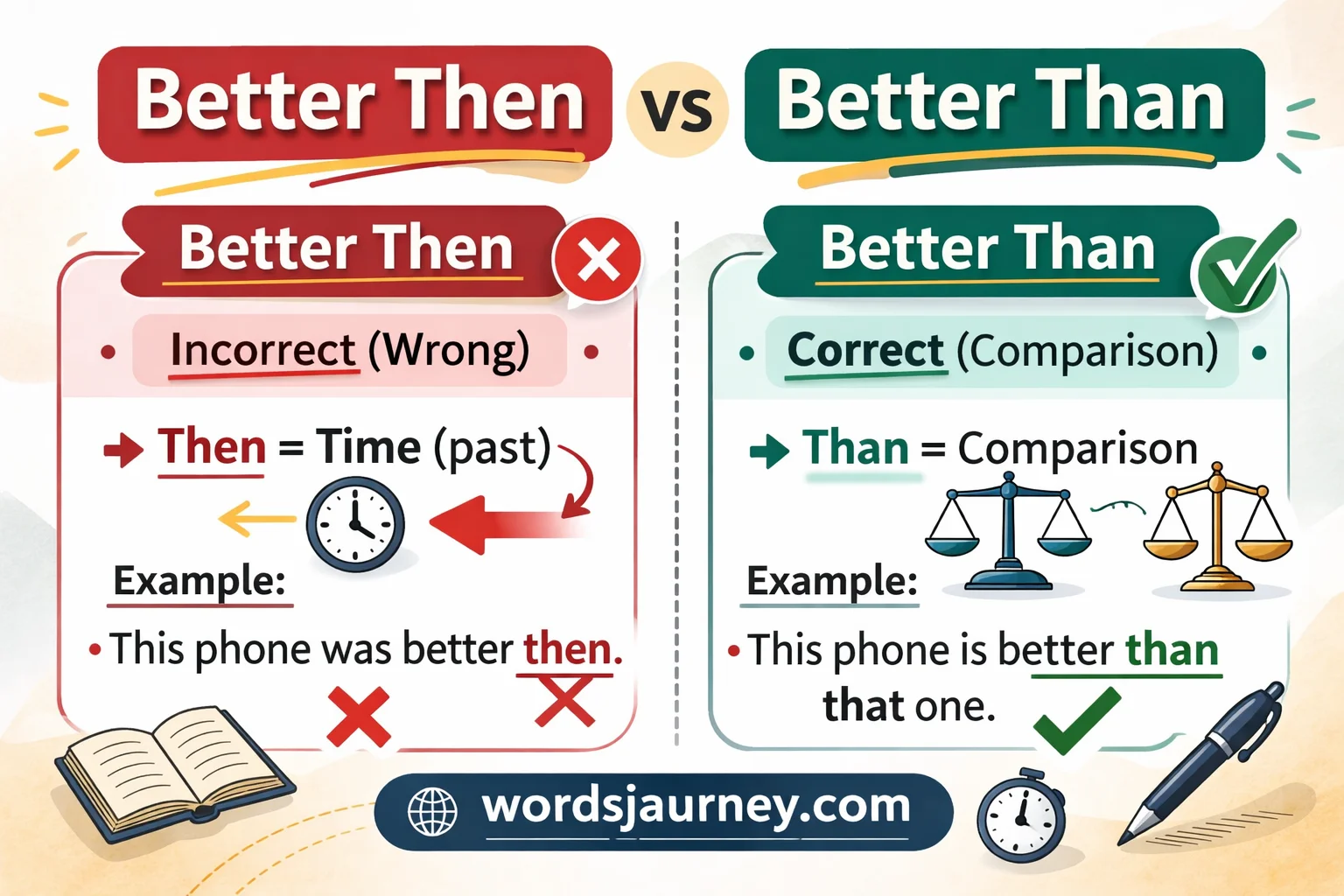
If you want the fastest answer: “better than” is correct when comparing. Then is about time, sequence, or consequence.
| Word | Meaning | Correct Usage |
| than | Comparison | “Better than expected,” “Faster than him” |
| then | Time / Sequence | “Do this, then that,” “Back then, it was simpler” |
Takeaway: Always use than for comparisons, and then when you refer to time, order, or consequences.
Why People Confuse Then and Than
Many people confuse these words because they sound identical in speech. In casual writing, typing errors or autocorrect can worsen the problem. Some writers assume either word works in comparisons, which isn’t true. Misusing them can change the meaning of a sentence entirely. For example:
- ❌ “She is better then I thought.”
- ✅ “She is better than I thought.”
Using then in a comparison implies time instead of evaluation, confusing the reader.
This confusion affects students, bloggers, journalists, and professionals who aim for precise writing. Even experienced editors see mistakes slip through because the words sound the same.
Grammar Rule: When to Use Than
Than is the word you use whenever you make a comparison. It links two elements that are being measured or contrasted.
Examples include:
- “He runs faster than his brother.”
- “This plan is better than the last one.”
- “I value honesty more than wealth.”
You can also use than with implied words:
- “She is smarter than I [am].”
- “The project was longer than expected [it would be].”
Key point: If your sentence compares qualities, amounts, or actions, than is your go-to word.
Grammar Rule: When to Use Then
Then doesn’t compare. It tells when something happens, in what order, or what consequence follows.
Examples:
- “Finish your homework, then you can play.”
- “Back then, people mailed letters every week.”
- “If it rains, then we will stay indoors.”
Other uses include:
- Consequence: “If you train harder, then you’ll improve.”
- Time: “We moved to New York in 2010. Before that, we lived in Boston. Back then, it was rainy.”
A good test: replace the word with “next” or “after that”. If it works, then is correct.
Common Mistakes Writers Make
Even fluent English speakers fall into traps with these two words. The most common mistakes include:
- Writing better then instead of better than
- Using then when comparing in essays or reports
- Confusing autocorrect in informal typing
- Switching randomly between than and then in the same text
Examples of incorrect vs correct sentences:
| Incorrect | Correct |
| She is better then I expected. | She is better than I expected. |
| Back than, people sent letters by hand. | Back then, people sent letters by hand. |
| This is stronger then that one. | This is stronger than that one. |
Tips to Avoid Confusion
Here are practical strategies to stop mixing them up:
- Memory trick:
- Comparison → than
- Time/sequence → then
- Read sentences aloud to see if it implies comparison or sequence.
- Use visual mnemonics: the letter “n” in than can remind you of comparison (think of “n” as “note the difference”).
- Always proofread formal writing.
With consistent practice, choosing the right word becomes instinctive.
Real-World Examples
Literature and Journalism:
- “Better than fiction, the story reveals real human struggles.” – Example from literary review
- “He scored higher than any other player in the season.” – Sports report
Social Media and Casual Writing:
- Many users mistakenly type better then on platforms like Twitter. Content editors often correct this because casual errors affect clarity.
Business and Professional Communication:
- Emails and reports: “The new software is better than the previous version” is the only professional choice. Using then here would confuse recipients.
These examples show that context determines which word fits.
Advanced Usage Notes
Than with implied words:
- “She’s taller than I [am].”
- “The outcome was more surprising than expected [it would be].”
Then in conditional statements:
- “If you submit your report on time, then you’ll get early approval.”
- “Work hard, and then results will follow.”
Professional editors check carefully for these subtleties to maintain clarity and precision.
Style Guide Recommendations
Most major style guides follow this rule:
- AP Style: favors than for comparisons, then for sequence or time
- Chicago Manual of Style: consistent with AP, recommends hyphen-free writing but same usage
- MLA Style: adheres to the same rule, especially in academic papers
Tip: Consistency beats preference. Choose your form and stick to it across your document, especially in professional or published writing.
Comparison Table of Usage
| Word | Function | Example | Common Mistake |
| than | Comparison | “Better than expected” | “Better then expected” |
| then | Time / Sequence | “Do this, then that” | “Do this, than that” |
This table makes it easy to remember which word belongs where.
Also Read: Neither Nor vs Neither Or: The Complete Grammar Guide
Frequently Asked Questions (FAQs)
1. What is the difference between “then” and “than”?
“Then” refers to time or sequence, such as scheduling events or project management tasks, while “than” is used for comparisons, like in business communication or performance evaluations.
2. Can “better then” ever be correct?
In most cases, “better then” is incorrect in English usage. You should use “better than” for comparisons. However, “then” could appear correctly if referring to a specific time, e.g., “It would be better, then, to attend the meeting at 3 PM.”
3. Does this rule differ in US and UK English?
The distinction between then and than is consistent across US and UK English, though punctuation and style guides may vary slightly. Formal writing standards in both regions emphasize proper usage for clarity and consistency.
4. How can I remember which one to use?
A simple tip: if you’re comparing, use than. If you’re sequencing events or discussing timing, use then. Visualizing a calendar, schedule, or timeline often helps.
5. Why does proper usage matter in professional contexts?
Correct usage improves readability in emails, reports, broadcasting notes, and online bookings, reinforcing credibility in formal writing and project management communication.
Conclusion
Mastering Better Then or Than is essential for anyone aiming for clear, professional, and effective communication. By distinguishing comparisons (than) from sequences or timing (then), you can avoid common mistakes in business correspondence, time management documents, and everyday writing.
Whether you’re managing meetings, scheduling tasks in a calendar, or preparing formal reports, applying these rules enhances consistency and readability. Keeping US and UK style guides in mind ensures your writing meets professional standards globally.
Ultimately, understanding this simple yet critical distinction boosts both confidence and credibility, making your writing sharper, more polished, and easier for readers to follow. Clear communication isn’t just grammar—it’s an essential tool in any project management or professional setting.

Johnson Alex is a language-focused writer and the voice behind WordsJourney. He creates practical, easy-to-understand content that helps readers improve their vocabulary and express ideas with clarity and confidence.