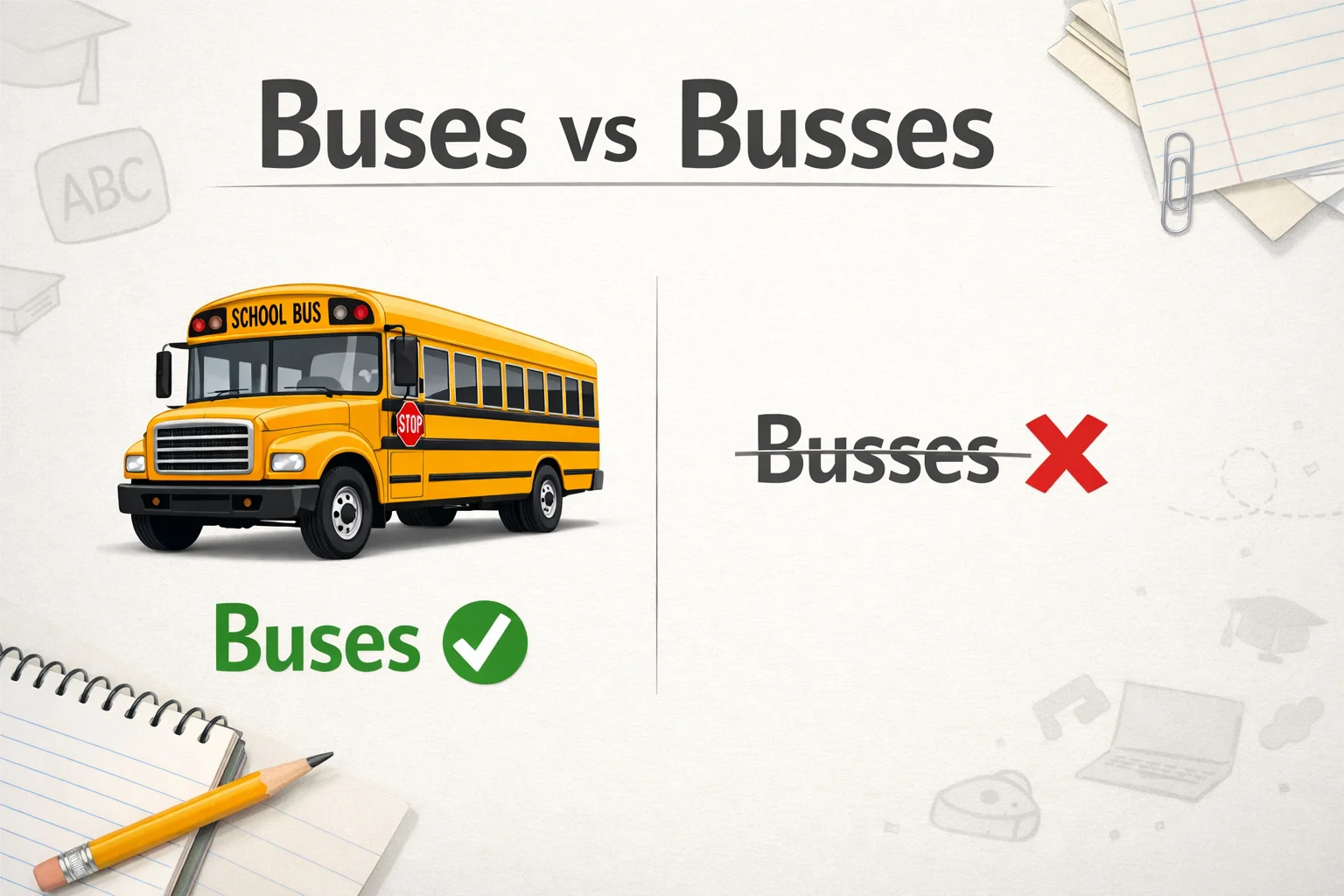
Ever paused mid-sentence and wondered which spelling is correct “Buses or Busses”? You’re not alone. This small detail often trips people up, especially when writing emails, reports, or even quick notes tied to business communication or project management. In this guide, we’ll break down the difference between “Buses or Busses”, so your English usage stays sharp and your writing feels polished every time.
In today’s fast-paced world of scheduling, meetings, and calendar coordination, clarity matters more than ever. Whether you’re handling online booking, drafting professional messages, or discussing logistics in formal writing, the correct plural form can impact how credible your message appears. We’ll explore how context like transportation versus broadcasting signals or actions affects meaning, and why consistency plays a key role in effective communication.
You’ll also learn how major style guides and regional preferences—especially US vs. UK English influence the use of these spellings. By the end, you’ll confidently choose the right form in any context, improve your time management through clearer writing, and maintain strong grammar standards across all your content.
Buses vs Busses The Quick Answer You Need
If you’re in a hurry, here’s the simple breakdown:
| Word | Meaning | Correct Usage |
| Buses | Plural of bus (vehicle) | ✅ Always correct |
| Busses | Means “kisses” (rare) | ⚠️ Context-specific |
Bottom line:
Use buses when you’re talking about transportation.
Use busses only if you’re writing about… well, kissing. And even then, it’s rarely used.
Why “Buses” Is the Correct Plural of Bus
English spelling may feel chaotic at times, but this rule is actually predictable.
When a word ends in -s, you typically form the plural by adding -es. That’s exactly what happens with bus → buses.
Here’s the pattern in action:
| Singular | Plural |
| Bus | Buses |
| Class | Classes |
| Glass | Glasses |
| Kiss | Kisses |
Notice something? You don’t double the “s” again before adding -es unless it already exists in the root word.
So:
- “Bus” → one “s” → becomes buses
- Not “buss” → so busses doesn’t follow the correct structure
This isn’t random. It follows a standard pluralization rule in English grammar.
So Why Do People Write “Busses”?
Good question. The mistake doesn’t come out of nowhere.
Several things cause this confusion:
Pronunciation Tricks Your Brain
When you say “buses,” it sounds like “bus-iz.”
Your brain hears that extra syllable and assumes another “s” belongs there.
Pattern Confusion
You’ve seen words like:
- boss → bosses
- mess → messes
So your brain thinks:
“Bus → busses must be right too.”
It feels logical. It just isn’t correct.
Visual Symmetry Bias
Double letters often look “balanced” in English.
But grammar doesn’t care about visual comfort.
Autocorrect Isn’t Perfect
Some tools don’t flag “busses” as incorrect because it is technically a word. That makes the mistake harder to catch.
For More Please Visit: Donut vs Doughnut: The Real Difference between These Two
What Does “Busses” Actually Mean?
Here’s where things get interesting.
“Busses” is the plural or verb form of “buss,” which means “to kiss.”
Yes. Seriously.
Example Usage
- “She busses her child goodnight.”
- “He leaned in and bussed her cheek.”
Sounds a bit old-fashioned, right? That’s because it is.
Key Facts About “Busses”
- Rare in modern writing
- Mostly found in older literature
- Not used in everyday conversation
- Completely unrelated to transportation
👉 So if you write:
“The school busses arrived late”
You’ve accidentally turned buses into… kisses.
Real-World Examples (Correct vs Incorrect Usage)
Let’s make this practical.
Correct Usage
- “The city buses run every 10 minutes.”
- “All school buses must pass inspection.”
- “Electric buses are becoming more common.”
Incorrect Usage
- “The city busses run every 10 minutes.” ❌
- “We waited for the school busses.” ❌
Rare but Technically Correct
- “She busses her baby before bed.”
If you’re writing about transport, always stick with buses.
American vs British English Is There a Difference?
This is where many grammar myths creep in.
You might assume:
- Americans use “buses”
- Brits use “busses”
That’s not true.
Both American and British English Agree:
- ✅ buses = correct
- ❌ busses = incorrect (for vehicles)
There’s zero regional variation here. This isn’t like “color vs colour.” The rule stays the same everywhere.
Grammar Rule Breakdown (Simple and Memorable)
Let’s simplify the rule so you can recall it instantly.
Plural Rule
If a word ends in:
- -s
- -ss
- -sh
- -ch
- -x
- -z
Add -es to form the plural.
Examples Table
| Ending | Example | Plural |
| -s | Bus | Buses |
| -ss | Class | Classes |
| -sh | Dish | Dishes |
| -ch | Match | Matches |
| -x | Box | Boxes |
That’s it. Once you see the pattern, “buses vs busses” becomes obvious.
Common Mistakes You Should Avoid
Even confident writers slip up here. Watch out for these traps:
Mixing Up Meaning
Using “busses” when you mean vehicles instantly weakens your writing.
Overthinking Pronunciation
Spelling isn’t always phonetic. Trust the rule, not the sound.
Relying on Guesswork
If you’re unsure, default to:
👉 buses = safe choice
Ignoring Context
Always ask:
- Am I talking about transportation?
- Or something entirely different?
Memory Tricks That Actually Work
You don’t need to memorize rules forever. Use a shortcut instead.
Trick #1: The Passenger Rule
A bus carries people, so it needs extra letters → buses
Trick #2: One S Rule
“Bus” has one “s,” so don’t add another → buses
Trick #3: Visual Anchor
Think:
- BUS → add ES → BUSES
Simple. Clean. Reliable.
Quick Practice (Test Yourself)
Fill in the blanks:
- The city ______ run all night.
- She ______ her child before sleep.
- The school ______ arrived late.
Answers
- buses
- busses
- buses
👉 If you got them right, you’ve locked in the concept.
Why This Small Mistake Actually Matters
At first glance, this feels like a minor detail. It’s not.
It Affects Credibility
Readers notice spelling errors instantly. Even small ones reduce trust.
A repeated mistake like “busses” instead of “buses” can quietly hurt performance.
It Signals Writing Skill
Correct spelling shows attention to detail. That matters in:
- Blogs
- Academic writing
- Business communication
Case Study: How One Word Changes Perception
Imagine two blog headlines:
- ❌ “Top Electric Busses in 2026”
- ✅ “Top Electric Buses in 2026”
Which one feels more professional?
That single letter shift affects:
- Click-through rate
- Reader trust
- Brand authority
Small detail. Big impact.
Expert Insight (Why Rules Like This Exist)
Language evolves, but structure still matters.
As linguists often point out:
“Consistency in spelling supports clarity in communication.”
When readers don’t have to pause and question a word, your message flows better. That’s the real goal.
Frequently Asked Questions (FAQs)
1. What is the difference between “buses” and “busses”?
“Buses” is the standard plural of bus in both US and UK English when referring to vehicles that carry passengers. “Busses” is less common and is often used to mean kisses or, rarely, as an alternative plural in older texts. Using “buses” is safest for modern, formal writing.
2. Which spelling is preferred in professional communication?
For business communication, project management documents, online booking platforms, or formal writing, always use “buses”. It aligns with style guides like AP and Chicago Manual of Style and avoids confusion with other meanings.
3. Does UK English differ from US English in this case?
No significant difference exists. Both US and UK English favor “buses” as the plural for the vehicle. Using “busses” may appear outdated or informal.
4. Can “busses” ever be correct?
Yes, when referring to multiple kisses (e.g., “She gave him three busses on the cheek”), or in historical texts where the spelling was more flexible. But for transportation or scheduling, stick with “buses”.
5. How does this affect scheduling and online booking?
Correct spelling ensures clarity in time management, calendar planning, and online booking systems. Misusing “busses” may confuse readers or clients in professional contexts.
Conclusion
Understanding the difference between “buses or busses” is simpler than it seems. For any discussion related to transportation, scheduling, or professional writing, always use “buses” to maintain clarity and consistency. “Busses” has niche uses but can create confusion in formal contexts.
By keeping these distinctions in mind, you’ll improve your English usage, enhance business communication, and strengthen grammar standards across emails, reports, and online content. Whether you’re managing meetings, handling online bookings, or coordinating project timelines, choosing the right spelling ensures your message is professional, precise, and readable.

Emma Brook is a dedicated writer and language enthusiast at WordsJourney. She’s passionate about helping readers understand words better and use them with confidence in everyday conversations. Her work focuses on alternative phrases, clear meanings, and practical examples that make language feel simple and approachable.
With a friendly, reader-first writing style, Emma breaks down common expressions and explores smarter ways to say things without sounding forced or complicated. Her goal is to make learning words enjoyable, useful, and easy for everyone.