Have you ever paused mid-sentence, wondering whether to use coarse or course? It’s a common question in English usage that trips up even seasoned writers. While these words sound similar, their meanings are worlds apart, and using them incorrectly can impact everything from formal writing to business communication.
Understanding the difference ensures your messages, emails, and reports remain clear and professional.
In today’s fast-paced world of scheduling, project management, and online booking, precision in language matters. Misusing coarse or course can subtly confuse readers, whether you’re drafting a calendar invite, preparing broadcasting content, or leading a meeting.
This article will break down the nuances of each word, giving you actionable guidance for grammar, style consistency, and polished communication.
We’ll also touch on regional preferences—how American and British English treat these words differently—and offer tips for writing confidently across contexts.
By the end, you’ll clearly know when to use coarse or course, helping you navigate time management, formal writing, and professional correspondence with clarity and style.
Understanding the Basics: Coarse vs Course
The confusion between coarse and course is common because they sound almost identical. However, their meanings and uses differ completely.
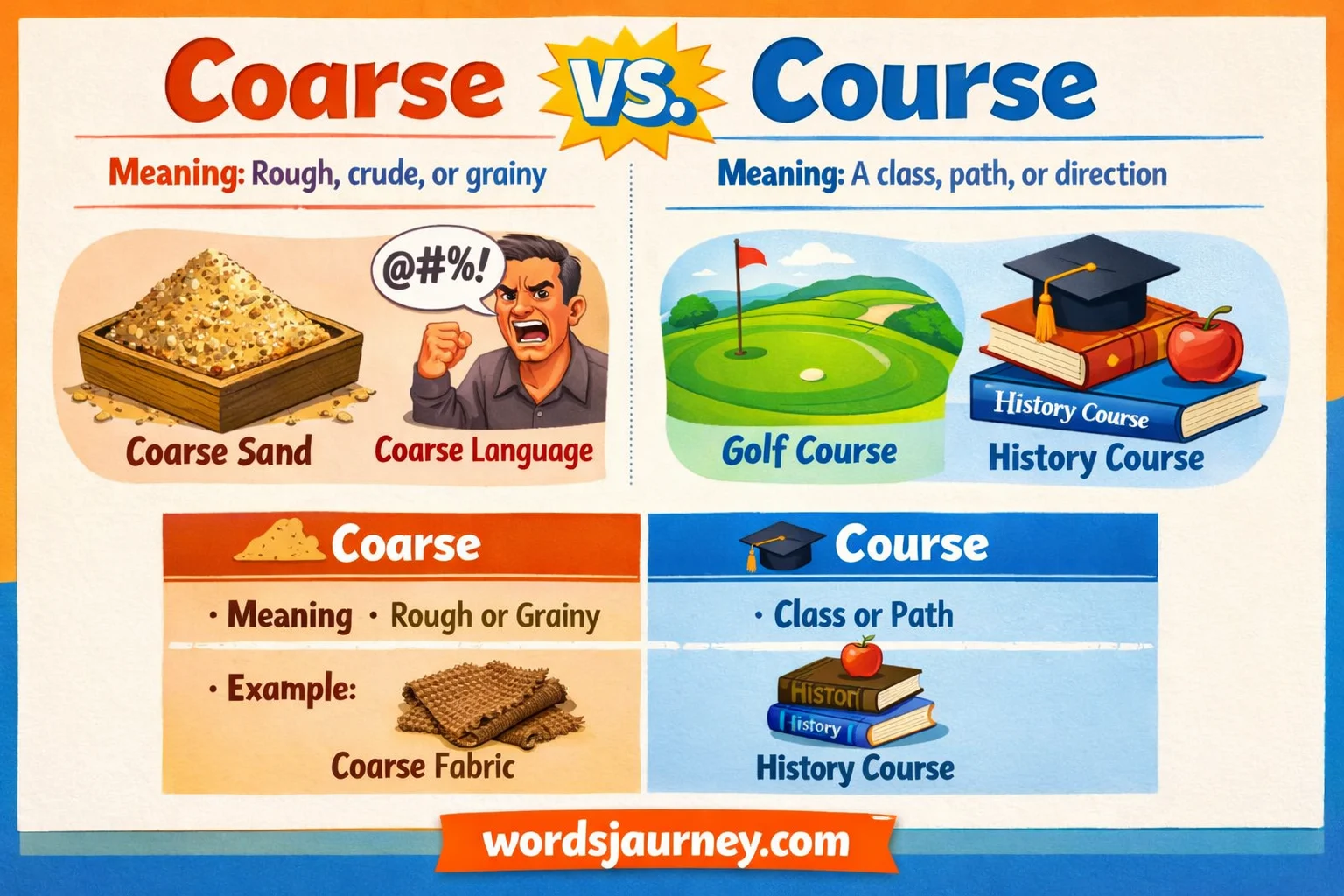
Coarse is typically an adjective describing something rough, crude, or low-quality. It often applies to textures, manners, or materials.
Course, on the other hand, is a noun (sometimes a verb) referring to a path, direction, series, or class. It’s broader and shows movement or progression.
Here’s a quick comparison table:
| Word | Part of Speech | Meaning | Example Sentence |
| Coarse | Adjective | Rough in texture, crude, or low-quality | The fabric felt coarse against my skin. |
| Course | Noun/Verb | Path, direction, series, or class | She enrolled in a cooking course last summer. |
This simple table alone can help you avoid the most common mix-ups between these two words.
Common Usage of Coarse
Coarse is primarily about texture, quality, or behavior. It often describes things that are rough, unrefined, or harsh.
Here are some real-world examples:
- Texture: “The sand on the beach was coarse, cutting into my feet as I walked.”
- Language: “He used coarse language during the argument, which offended everyone.”
- Behavior: “Her manners were a little coarse for such a formal dinner party.”
Common Mistakes
Many people mistakenly write course when they mean coarse. For example:
Incorrect: The sandpaper was too course for the delicate wood.
Correct: The sandpaper was too coarse for the delicate wood.
Always remember: coarse = rough, crude, or low-quality.
Common Usage of Course
Course has several meanings depending on the context:
- Path or Direction: “The river changed its course after the heavy rains.”
- Series or Progression: “He’s following a strict diet course to lose weight.”
- Education/Class: “She’s taking a Python programming course online.”
- Verb Use: “Energy coursed through his body as he ran.”
Notice that course often conveys movement, progression, or a structured series of events.
Examples in Context
- Noun: “The golf course was beautifully maintained.”
- Verb: “Adrenaline coursed through her veins before the presentation.”
- Series: “The meal was served in three courses: appetizer, main, and dessert.”
The versatility of course makes it easy to misuse. Keep in mind that it never describes roughness or texture.
For More: Setup or Set Up The Real Difference and Clear Rules
How to Remember the Difference
Struggling to keep them straight? Here are some proven memory tricks:
- Coarse = Rough: Both words contain an “o” after “c”. Think of “coarse sand.”
- Course = Path or Class: Think of a racecourse or an educational course.
Quick Checklist:
- If it describes texture, quality, or crudeness → coarse
- If it describes path, direction, series, or class → course
Common Mistakes and How to Avoid Them
Even experienced writers sometimes slip up. Here are the top five mistakes with corrections:
- Mixing coarse with course
- ❌ Incorrect: The sandpaper was too course.
- ✅ Correct: The sandpaper was too coarse.
- Using coarse for a direction or path
- ❌ Incorrect: The river’s coarse turned sharply.
- ✅ Correct: The river’s course turned sharply.
- Confusing coarse with a meal course
- ❌ Incorrect: The chef served a coarse of three dishes.
- ✅ Correct: The chef served a course of three dishes.
- Misusing coarse in professional writing
- ❌ Incorrect: Your report’s arguments are coarse.
- ✅ Correct: Your report’s arguments are coarse (if intentionally critical) or better: “The arguments are rough and need refinement.”
- Using course as an adjective
- ❌ Incorrect: The fabric felt course.
- ✅ Correct: The fabric felt coarse.
Tip: Always read your sentence aloud. It’s easier to spot if something “feels rough” (coarse) or “flows along a path” (course).
Quiz / Practice Examples
Test your understanding with these fill-in-the-blank sentences:
- The sandpaper was too ______ for the delicate wood. (coarse)
- He signed up for a night school ______ in photography. (course)
- The river changed its ______ after the storm. (course)
- His jokes were ______ and offended some people. (coarse)
- The dinner was served in three ______. (courses)
- Adrenaline ______ through her veins as she stepped on stage. (coursed)
Tip: Practicing like this will help you stop confusing these words in writing forever.
Fun Facts & Etymology
Understanding the origins can make remembering the words easier:
- Coarse comes from Middle English, from French cors, meaning rough or hard. This ties directly to its modern sense of roughness or crudeness.
- Course comes from Latin cursus, meaning “run” or “path.” This explains its modern meanings related to direction, sequence, or flow.
Interesting tidbit: In old English literature, you may find “course” used to mean running water or “a path through the forest,” which is still accurate today.
FAQs About Coarse or Course
Q1: What is the difference between “coarse” and “course”?
A: Coarse describes texture, roughness, or crudeness, like “coarse sand” or “coarse language.” Course, on the other hand, refers to a direction, route, or structured program, such as “a golf course,” “a training course,” or “the ship changed course.”
Q2: Can “coarse” be used in formal writing?
A: Yes, but with caution. Coarse often conveys a negative tone, like roughness or lack of refinement. It’s suitable in descriptive writing but should be used carefully in professional or formal communication.
Q3: Is “course” used differently in US and UK English?
A: Slightly. In general, both follow the same rules, but regional variations exist. For example, “course” in US English is more common in academic or training contexts, while UK English may use it more in culinary or educational references.
Q4: How do I remember which to use?
A: Think texture vs. direction/training. If it’s rough or crude, it’s coarse. If it’s a path, program, or sequence, it’s course. Using context clues in sentences helps prevent mistakes.
Conclusion
Understanding the difference between coarse or course is essential for clear, professional, and precise writing. These two words may sound alike, but their meanings impact everything from grammar and formal writing to business communication, scheduling, and project management. By paying attention to context and regional preferences, you can confidently choose the correct term every time.
Mastering this small but important distinction ensures your emails, reports, and documents reflect competence and polish. Whether describing textures, directions, or educational programs, using coarse and course correctly strengthens your English usage, consistency, and professional credibility.

Johnson Alex is a language-focused writer and the voice behind WordsJourney. He creates practical, easy-to-understand content that helps readers improve their vocabulary and express ideas with clarity and confidence.