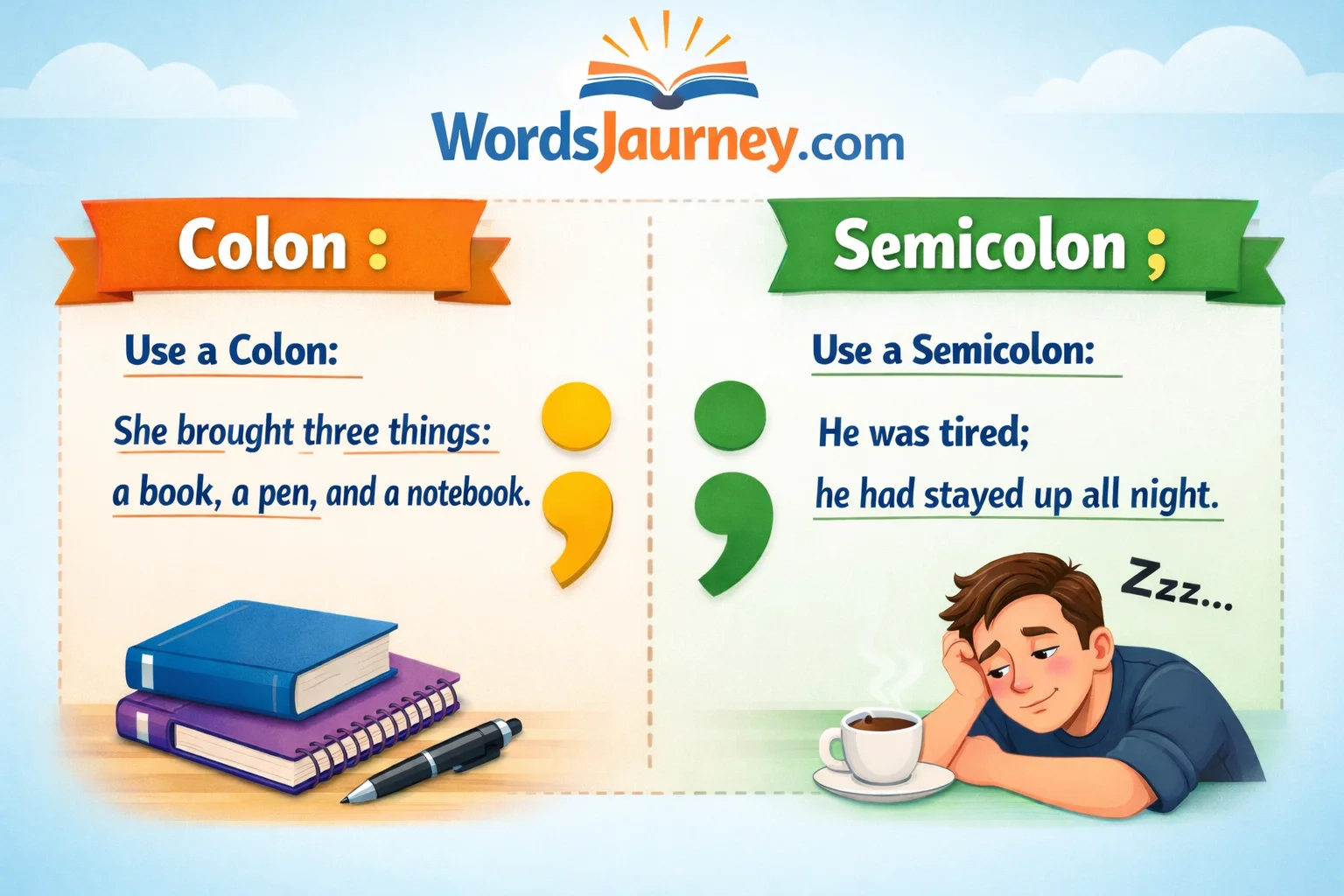
Ever paused while writing and wondered whether a colon or semicolon fits best? Understanding Colon vs Semicolon is more than a grammar exercise—it can shape business communication, clarify project management schedules, and even streamline online booking or calendar entries. These punctuation marks guide readers through complex information, helping you convey time management, meetings, and broadcasting details with precision and style.
While both symbols look similar, their usage differs significantly. A colon often introduces lists, explanations, or formal statements, whereas a semicolon connects closely related independent clauses. Mastering this distinction improves English usage, formal writing, and consistency across style guides, whether you follow US or UK conventions. Clear punctuation also ensures your project plans, meetings, and scheduling notes are instantly readable.
In this article, we’ll break down the rules, highlight common mistakes, and offer practical examples for both punctuation marks. You’ll learn when to use a colon versus a semicolon in calendar entries, broadcasting scripts, or any professional writing. By the end, you’ll write with clarity, confidence, and grammatical precision, making your communications polished and effective.
What Is a Colon (:) and When to Use It
A colon is more than just a fancy dot-and-line; it signals attention. Think of it as saying, “Here’s what comes next.” The colon introduces information that elaborates, explains, or emphasizes what came before.
Primary Uses of a Colon
- Introducing Lists
Example:
“For breakfast, I need three essentials: eggs, toast, and orange juice.”
Tip: Avoid putting a colon directly after a verb or preposition in casual writing. - Introducing Explanations or Elaborations
Example:
“She had only one option left: to apologize.”
Here, the second clause explains the first. - Emphasis Before a Concluding Statement
Example:
“There was one thing he feared more than anything else: failure.”
This usage creates a dramatic punch. - Formal Writing Uses
Colons appear in references, ratios, and times.- Time: 3:45 PM
- References: Chapter 5: Case Studies
- Ratios: Mix water and syrup at 2:1
Quick Tips for Colons
- The part before the colon should be a complete sentence.
- Don’t use a colon between two unrelated clauses.
What Is a Semicolon (;) and When to Use It
A semicolon links ideas that could stand alone but are better together. Think of it as a gentle bridge between sentences. It’s stronger than a comma but softer than a period.
Primary Uses of a Semicolon
- Linking Closely Related Independent Clauses
Example:
“I have a big presentation tomorrow; I can’t stay out late tonight.”
Both clauses are complete, but the semicolon shows they are connected. - Separating Items in Complex Lists
Example:
“On our trip, we visited Paris, France; Rome, Italy; and Berlin, Germany.”
Semicolons prevent confusion when items contain commas. - Connecting Clauses with Conjunctive Adverbs
Example:
“I wanted to join the team; however, it was already full.”
Words like however, therefore, and moreover often follow semicolons.
Quick Tip
Semicolons allow your sentences to flow smoothly without splitting ideas unnecessarily.
Colon vs Semicolon: Key Differences
Understanding the difference between a colon and a semicolon is essential. Here’s a clear comparison:
| Feature | Colon (:) | Semicolon (;) |
| Connects | Clause to list/explanation | Independent clauses |
| Introduces | Lists, explanations, emphasis | Closely related sentences |
| Tone | Formal, anticipatory | Smooth, linking, moderately formal |
| Example | “She bought one thing: courage.” | “She bought courage; she left fear behind.” |
Common Mistakes
- Using a semicolon to introduce a list: ❌ “I bought; apples, bananas, and oranges.”
- Using a colon to separate unrelated clauses: ❌ “I went out: it was raining heavily.”
Practical Examples in Writing
Seeing examples in context makes the rules stick. Let’s look at some real-world usage:
Correct Colon Usage
- “He had three hobbies: painting, writing, and hiking.”
- “Remember the golden rule: treat others as you wish to be treated.”
Correct Semicolon Usage
- “She studied hard; she earned top marks.”
- “The meeting included John, the manager; Sarah, the designer; and Lee, the intern.”
Mini Exercise
Correct this sentence:
“He bought: apples, bananas, and oranges.”
✅ Corrected: “He bought three fruits: apples, bananas, and oranges.”
Another:
“I love coffee; and I love tea.”
✅ Corrected: “I love coffee; I also love tea.”
For More Please Visit: Thru or Through: Which One Is Correct?
Tips for Remembering When to Use Each
Sometimes, remembering rules feels tricky. Here are memory hacks:
- Colon = “Here comes the list/explanation”
- Semicolon = “I could make two sentences, but I’ll link them”
Visual cues can also help: colons often signal anticipation, while semicolons signal connection. Practicing with real sentences is the fastest way to internalize these differences.
Advanced Usage and Style Considerations
Semicolons in Complex Sentences
Semicolons shine when sentences are long or contain commas:
“The conference had speakers from New York, USA; London, UK; and Sydney, Australia.”
Colons in Formal Writing
- Introduce subtitles: “Python Programming: A Beginner’s Guide”
- Academic references: Smith, J. (2020): Methods and Results
Style Guide Variations
Different style guides have nuanced rules:
- APA: Colons before lists and in references
- Chicago: Emphasis and formal usage in literature
- MLA: Typically fewer colons, more flexible semicolons
Knowing these differences is essential for professional or academic writing.
Common Mistakes and How to Avoid Them
Even experienced writers slip up. Here’s what to watch for:
Colon Mistakes
- ❌ Using after a verb in a list: “My favorite fruits are: apples, oranges.”
- ✅ Correct: “My favorite fruits are apples, oranges, and bananas.”
Semicolon Mistakes
- ❌ Using before coordinating conjunctions: “I went home; and slept.”
- ✅ Correct: “I went home; I slept immediately.”
Proofreading Tip: Read aloud. If a sentence feels awkward or too long, check your colons and semicolons.
Quick Reference Cheatsheet
| Symbol | Use Case | Example |
| Colon : | Introduce list/explanation | “You need three items: pen, paper, notebook.” |
| Semicolon ; | Link independent clauses | “It’s raining; I’ll stay indoors.” |
| Colon : | Emphasize conclusion | “He knew one thing: he couldn’t fail.” |
| Semicolon ; | Complex lists with commas | “Guests: John, the manager; Sarah, the designer; Lee, the intern.” |
Download this table as a quick-reference guide for your writing.
Frequently Asked Questions (FAQs) about Colon vs Semicolon
Q1: What is the main difference between a colon and a semicolon?
A colon (:) introduces lists, explanations, or formal statements, while a semicolon (;) links closely related independent clauses. Understanding this distinction improves clarity in formal writing, business communication, and project management notes.
Q2: Can I use a semicolon before a list instead of a colon?
No. A semicolon is not meant to introduce lists. Use it to separate complex clauses, especially when those clauses already contain commas. For lists, a colon ensures readability and consistency.
Q3: Are there regional differences in colon and semicolon usage?
Yes. US English tends to place punctuation differently with quotations and lists compared to UK English, though the core rules for colons and semicolons remain consistent.
Q4: How does proper colon and semicolon usage help in scheduling or calendar entries?
Correct punctuation ensures time, meeting, and broadcasting details are clear. For example:
- Meeting agenda: budget review, project updates, team assignments.
- Team meeting at 10 a.m.; project kickoff at 11 a.m.
Q5: Can using colons and semicolons improve professional writing?
Absolutely. Proper usage enhances formal writing, grammar accuracy, and readability, making documents like reports, schedules, and business emails appear polished and professional.
Conclusion
Mastering Colon vs Semicolon is more than a grammar lesson—it’s a tool for clarity, precision, and professionalism in both writing and communication. Whether you’re drafting project plans, online booking instructions, or broadcasting scripts, understanding the distinction helps convey information cleanly and consistently.
By following style guides, respecting US and UK conventions, and applying punctuation thoughtfully, your writing will become more engaging, readable, and authoritative. Remember, a colon introduces and explains, while a semicolon connects related ideas. With these simple rules, you can elevate your business communication, time management notes, and formal writing with confidence.

Aliya Ray is a passionate writer and language enthusiast at WordsJourney. She enjoys exploring words, phrases, and everyday expressions to help readers communicate more clearly and confidently. Her content focuses on alternative ways to say common phrases, simple explanations, and real-life examples that make language easy to understand.
Aliya believes the right words can make any message stronger. Through clear, friendly writing, she helps readers improve their vocabulary without feeling overwhelmed or confused.