Ever paused mid-email or meeting and wondered whether to write “complement” or “compliment”? Many professionals face this small yet crucial challenge in business communication, where clarity and precision matter.
Understanding the difference between Complement vs Compliment can save awkward missteps in formal writing, calendar invitations, or even online booking confirmations.
In project management and time management, word choice impacts perceived professionalism. A compliment expresses praise, while a complement indicates something that completes or enhances.
Mixing them up can confuse your audience, whether you’re drafting meeting notes, scheduling tasks, or broadcasting updates. Even subtle variations between US and UK English influence spelling and usage, making consistency essential.
This guide will break down Complement vs Compliment clearly, with examples, tips, and contextual cues for everyday English usage.
You’ll learn how to apply the right term across emails, scheduling tools, online calendars, and formal documents. By the end, you’ll write with confidence, ensuring your language always aligns with professional standards and style guides.
Understanding the Basics
Before diving into examples, let’s break down the meanings of these two commonly confused words.
What “Complement” Means
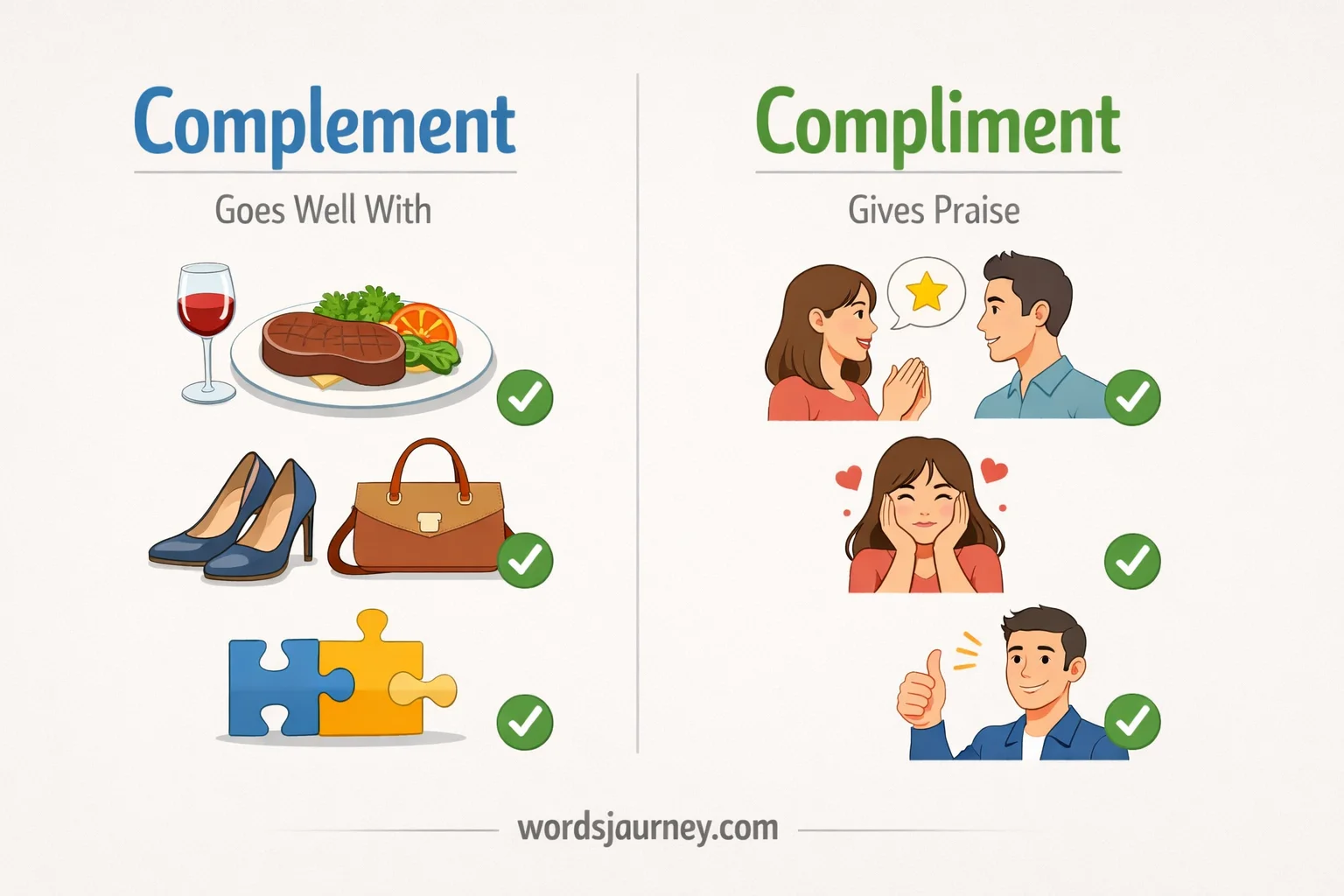
A complement is something that completes, enhances, or improves another thing. Think of it as a missing piece that fits perfectly. It can be a noun or a verb.
Examples:
- The wine complements the cheese perfectly.
- Her skills complement the team’s needs.
- These colors complement each other beautifully.
Quick Memory Tip: “Complements complete.” If it makes something whole or better, use complement.
Part of Speech Table: Complement
| Form | Example |
| Noun | “The scarf is a perfect complement to her dress.” |
| Verb | “Her experience complements the team’s skill set.” |
What “Compliment” Means
A compliment is an expression of praise, admiration, or approval. Like flattery, it can make someone feel appreciated. It can also be a noun or a verb.
Examples:
- He complimented her on her presentation.
- She received many compliments on her outfit.
- Always accept a sincere compliment graciously.
Quick Memory Tip: “Compliments flatter.” If it’s praise, it’s a compliment.
Part of Speech Table: Compliment
| Form | Example |
| Noun | “She gave me a kind compliment about my work.” |
| Verb | “I want to compliment you on your excellent report.” |
Why People Confuse Them
The confusion comes mainly from pronunciation—both words sound almost identical. In addition, they appear in similar contexts like conversation or writing, which makes it easy to slip up. For instance:
- “That hat complements your dress” (correct: enhances).
- “That hat is a nice compliment” (incorrect: should praise the style instead).
Most errors happen in emails, text messages, and social media, where quick typing leads to guesswork.
Detailed Examples and Usage
Understanding theory is one thing; seeing real-life examples makes it stick. Let’s break it down with practical scenarios.
Complement Usage in Context
1. Food and Drink
- “The red wine complements the rich flavors of the steak.”
- “Lemon zest complements the sweetness of the cake.”
2. Fashion and Style
- “The scarf complements her dress perfectly.”
- “These shoes complement the overall outfit.”
3. Work and Skills
- “His analytical skills complement her creative thinking.”
- “Team diversity complements problem-solving abilities.”
4. Science and Nature
- “Day and night cycles complement each other in maintaining ecosystems.”
Complement Usage Table
| Context | Example |
| Food | “The spices complement the dish beautifully.” |
| Fashion | “The accessories complement her outfit.” |
| Work | “His skill set complements the team’s needs.” |
| Nature | “Predators and prey complement the balance of nature.” |
Compliment Usage in Context
1. Personal Praise
- “I must compliment you on your hard work.”
- “She gave me a lovely compliment about my haircut.”
2. Professional Praise
- “The manager complimented the team for meeting the deadline.”
- “Employees appreciate genuine compliments on their performance.”
3. Social Interactions
- “Giving a sincere compliment can improve social bonds.”
- “Even a small compliment like ‘great job’ matters.”
Compliment Usage Table
| Context | Example |
| Personal | “He complimented her on her kindness.” |
| Professional | “The supervisor complimented the team’s presentation.” |
| Social | “She complimented her friend’s cooking skills.” |
Common Mistakes and How to Avoid Them
Even native speakers make mistakes with complement vs compliment. Here’s what to watch for.
Mistakes to Avoid
- Using compliment when you mean enhance
- ❌ “The sauce compliments the pasta.” → ✔ “The sauce complements the pasta.”
- Using complement when you mean praise
- ❌ “I want to complement your dress.” → ✔ “I want to compliment your dress.”
- Overusing one form in emails or writing without checking context.
Quick Fixes
- Ask yourself: Am I praising, or am I enhancing/completing?
- Use the mnemonic trick:
- Compliment = praise (think i for admiration).
- Complement = complete (think e for enhance).
Tips, Tricks, and Memory Hacks
You can never go wrong with a few smart memory aids.
- Mnemonic sentence: “A compliment flatters, a complement completes.”
- Visual aid: Picture puzzle pieces fitting together → complement. Picture someone handing flowers → compliment.
- Daily exercise: Try writing one sentence a day using each word correctly.
Also Read: Premise or Premises: Ultimate Guide to Use Each Word
Related Words and Phrases
Knowing related words helps avoid accidental confusion.
- Compliment-related words: praise, admiration, flattery, kudos, accolades.
- Complement-related words: enhance, complete, balance, support, match.
Common tricky phrases:
| Phrase | Correct Use |
| Complementary colors | Colors that enhance each other in design |
| Pay a compliment | Giving praise politely |
| Complement a dish | Enhance the flavor of food |
| Compliment someone | Express admiration or approval |
Case Studies: Real-World Usage
Corporate Emails
Wrong: “Your presentation compliments the data report.”
Correct: “Your presentation complements the data report.”
Social Media
Wrong: “I compliment my outfit with matching shoes.”
Correct: “I complement my outfit with matching shoes.”
Food Blogging
Wrong: “This sauce compliments the pasta.”
Correct: “This sauce complements the pasta.”
Visual Comparison Table: Complement vs Compliment
| Feature | Complement | Compliment |
| Meaning | Completes or enhances | Praises or admires |
| Part of Speech | Noun / Verb | Noun / Verb |
| Example Sentence | “The wine complements the meal.” | “She complimented his cooking.” |
| Memory Trick | “Complements complete” | “Compliments flatter” |
| Common Mistake | Used as praise | Used as enhancement |
Frequently Asked Questions (FAQs)
1. What is the difference between “complement” and “compliment”?
A compliment is praise or admiration, like “She received a lovely compliment on her presentation.” A complement means something that completes or enhances, such as “The new software complements our existing workflow.”
2. Can I use “compliment” when I mean “complete”?
No. Using compliment to mean “complete” is incorrect in formal writing, business communication, and project management contexts. Always use complement for completion or enhancement.
3. Does US and UK English differ in using these words?
The spelling and usage of complement vs compliment are consistent in both US and UK English, but some style guides emphasize precision in formal writing and professional emails.
4. How do I remember which one to use?
Think of compliment as praise (someone says something nice), and complement as something that completes or pairs well. Visual associations with clocks, calendars, or tasks can help in scheduling and time management contexts.
5. Are there common mistakes in emails and meetings?
Yes. Many confuse them in meeting notes, online bookings, or broadcasting announcements. Double-check your word choice to maintain professionalism and consistency in all business communication.
Conclusion
Understanding the difference between Complement vs Compliment is essential for clear and professional communication. Whether you’re drafting emails, scheduling meetings, or managing projects, choosing the correct word prevents misunderstandings and reflects attention to detail.
By remembering that a compliment praises while a complement completes, you can confidently write in any formal writing or business communication setting. Incorporating these terms correctly enhances your clarity, credibility, and overall English usage, keeping your calendar, project plans, and broadcasts precise and polished.Mastering this distinction also ensures consistency across style guides, whether you follow US or UK English standards. With practice, choosing the right term will become second nature, letting your writing shine in professionalism and accuracy.

Johnson Alex is a language-focused writer and the voice behind WordsJourney. He creates practical, easy-to-understand content that helps readers improve their vocabulary and express ideas with clarity and confidence.