Have you ever paused, unsure whether to write “cue or queue” in a sentence? These two words sound nearly identical but serve distinct purposes in English usage. From business communication to broadcasting cues, misusing them can subtly undermine clarity and professionalism. Whether you’re managing meetings, calendar schedules, or project management timelines, understanding the difference ensures smooth time management and consistent formal writing.
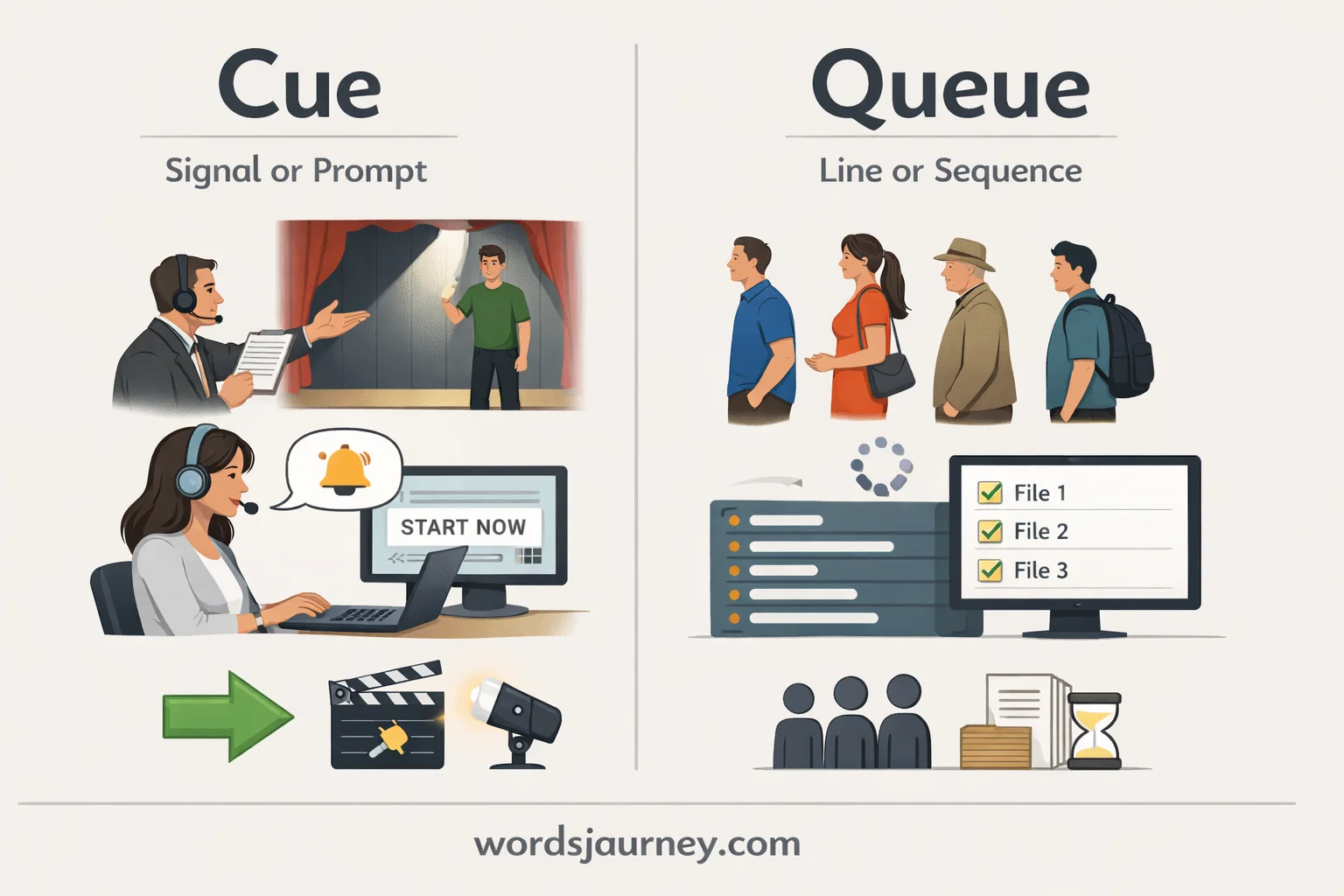
In everyday English, a cue typically signals an action or prompt, such as a speaker’s line or a stage direction, while a queue refers to a line or sequence of people, tasks, or events waiting their turn.
This distinction matters in online booking systems, broadcast scheduling, and even project workflows, where precision prevents confusion. Additionally, regional style guides US vs. UK sometimes influences preferred usage, making awareness critical for grammar consistency across professional documents.
This article will explore cue or queue in depth, highlighting practical examples and expert tips.
You’ll learn how to choose the right term, maintain formal writing standards, and apply the correct word in contexts like time management, scheduling, and business communication. By the end, you’ll confidently avoid common mistakes and enhance both clarity and credibility in your writing.
Definitions and Core Differences
Understanding the distinction starts with definitions. The simplest way to remember is:
- Cue is a signal or prompt.
- Queue is a line of people or things waiting for their turn.
Cue
A cue can be a noun or a verb. It signals someone to take action, speak, or perform.
Examples of cue in real life:
- Theater: “The actor waited for her cue to enter the stage.”
- Sports: “The runner took his cue from the starting pistol.”
- Everyday conversation: “His nervous glance was my cue to change the topic.”
Queue
A queue can also be a noun or verb, but it always relates to order, lines, or sequences.
Examples of queue in real life:
- Public spaces: “We queued for over an hour to buy concert tickets.”
- Technology: “The printer is busy because several documents are queued.”
- Customer service: “The online support system queued all requests automatically.”
Quick Comparison Table
| Word | Part of Speech | Meaning | Common Usage | Example |
| Cue | Noun/Verb | Signal, prompt | Theater, sports, communication | “He took his cue from her expression.” |
| Queue | Noun/Verb | Line, sequence | Waiting lines, computing, services | “We queued for the concert tickets.” |
This table alone can save you from mixing them up—keep it handy!
Pronunciation and Spelling Tips
Interestingly, cue and queue are pronounced the same way: /kjuː/. This is why they’re often confused, especially in writing and typing.
Mnemonics to Remember
- Cue = “signal → short word, fast action.” Think of a short, sharp nudge.
- Queue = “line → multiple letters like people in a line.” The long word reflects the long line.
Another tip: visualize the letters. Cue is quick, queue is long and lined up, just like the letters “u-e-u-e” waiting behind each other.
Common Mistakes and How to Avoid Them
Even experienced writers slip up. Here are the most frequent mistakes:
- Using “cue” when referring to a line or sequence.
- ❌ “We took our cue at the bank.”
- ✅ “We queued at the bank.”
- Using “queue” when referring to a signal or prompt.
- ❌ “He queued me to start speaking.”
- ✅ “He gave me a cue to start speaking.”
- Confusion in digital contexts, like task queues, music playlists, or video streaming.
Tips to Avoid Mistakes
- Ask yourself: “Is this a signal or a line?”
- Check the context: Theater? Tech? Sports? Social life?
- Practice with examples: The more you see both words in context, the easier it is to remember.
Cue vs Queue in Popular Contexts
The difference isn’t just academic; it shows up in daily life, technology, and entertainment.
Entertainment
- Cue in acting: Actors take their lines or stage moves based on cues.
- Film and television: Directors signal actors using visual or verbal cues.
- Music: Musicians start playing at a cue from the conductor.
Daily Life
- Queue in public spaces: People queue in supermarkets, banks, airports, and theme parks.
- Social etiquette: Learning to queue politely reflects cultural norms in many countries.
Technology
- Queue in computing: Tasks can be queued in operating systems, print jobs, or online processes.
- Example: Spotify queues songs; your computer queues downloads automatically.
Sports
- Cue in performance: A tennis player might take a swing cue from an opponent’s serve.
- Queue in organization: Competitors might queue in line for equipment or registration.
Fun Facts and Etymology
Knowing a word’s history can make it easier to remember.
- Cue: Comes from the French word queue, meaning tail. Historically, a “cue” was a “tail” or hint that prompted action.
- Queue: Also comes from French queue, meaning tail, but evolved to refer to a line of people or things.
Interesting fact: In the 19th century, theater actors relied heavily on cues from other performers or stage managers, making “cue” a core part of theatrical vocabulary. Meanwhile, queueing as we know it today became common with organized train stations and ticket lines in the 1800s.
Exercises to Master Cue vs Queue
Practicing makes perfect. Try these exercises:
Fill-in-the-blank:
- The actor waited for her ___ before entering the stage.
- Fans ___ for hours to get concert tickets.
- His raised eyebrow was my ___ to speak.
- The print jobs were ___ in the order they were received.
Multiple-choice:
- Which sentence is correct?
a) We queued the signal to start the show.
b) We queued in line for the tickets. ✅ - Which word fits? “The director gave the actor a ___ to begin.”
a) Queue
b) Cue ✅
For More Please visit: Loosing or Losing: Master the Difference
FAQs About “Cue or Queue”
1. What is the difference between “cue” and “queue”?
A cue is a signal or prompt to take action, often in performing arts or broadcasting. A queue is a line or sequence of people, tasks, or events waiting their turn, commonly used in scheduling and project management.
2. Can “cue” and “queue” be used interchangeably?
No. Using them interchangeably can confuse readers. Cue emphasizes timing or signals, while queue emphasizes order or sequence. Context matters—especially in formal writing and business communication.
3. Which style guide should I follow? US or UK?
Both the US and UK English recognize “cue” and “queue,” but minor spelling preferences or usage patterns exist. For instance, queue is more frequent in UK contexts for lines of people, while US English often uses “line” in casual contexts. Always maintain consistency in documents.
4. How is “queue” used in digital tools?
In online booking systems, broadcast scheduling, or task management apps, queue refers to items waiting their turn. For example, video editors might add clips to a rendering queue, and customer support uses ticket queues to organize requests.
5. How do I remember the difference?
Think “cue = signal/action” and “queue = line/sequence”. Visualizing a stage prompt vs. a line of people or tasks can make it easier to recall.
Conclusion
Understanding the difference between cue or queue is essential for clear communication, accurate scheduling, and professional writing. Whether you’re managing meetings, projects, or broadcasting events, using the correct word prevents confusion and enhances credibility. Remember: cue signals action, while queue organizes order.By keeping regional style guides and grammar consistency in mind, you can confidently apply these terms across formal writing, online tools, and daily communications. Mastering this subtle distinction not only improves your English usage but also reinforces precision in time management, business correspondence, and project planning.

Aliya Ray is a passionate writer and language enthusiast at WordsJourney. She enjoys exploring words, phrases, and everyday expressions to help readers communicate more clearly and confidently. Her content focuses on alternative ways to say common phrases, simple explanations, and real-life examples that make language easy to understand.
Aliya believes the right words can make any message stronger. Through clear, friendly writing, she helps readers improve their vocabulary without feeling overwhelmed or confused.