Have you ever paused mid-sentence, unsure whether to write elude or allude? Understanding the distinction is crucial, especially in formal writing or business communication, where precision reflects professionalism. The debate of Elude vs Allude: isn’t just about spelling—it affects clarity in project management updates, meeting notes, and even online booking confirmations. Misusing these words can subtly confuse readers, undermining your message’s authority.
In fast-paced environments where scheduling and time management are critical, consistent English usage matters more than ever. Whether you’re broadcasting reminders, organizing calendar events, or drafting emails, knowing the proper context ensures your audience interprets your meaning correctly. Style guides—both US and UK conventions—offer subtle cues, but the practical application in professional writing is what truly counts.
This article will demystify Elude vs Allude: by breaking down their meanings, providing clear examples, and highlighting common mistakes. You’ll gain actionable insights for grammar accuracy, formal communication, and maintaining consistency across documents. By the end, distinguishing between these often-confused words will feel intuitive, helping you write with confidence in every meeting agenda, broadcast message, or project update.
Understanding the Basics
What Does Elude Mean?
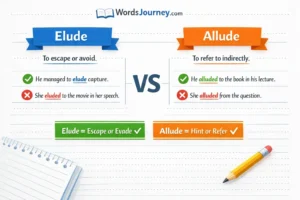
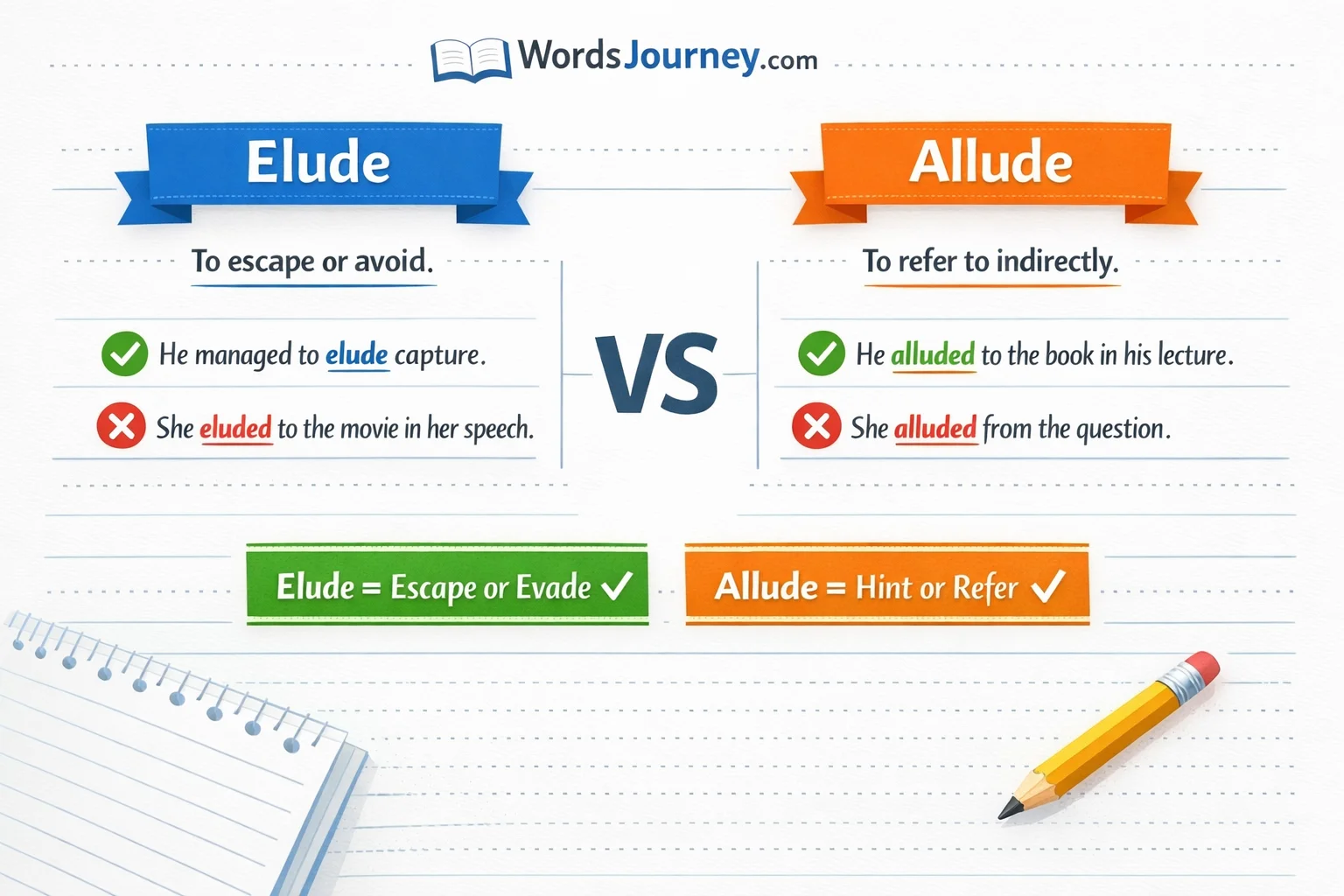
The word elude generally means to escape or avoid, either physically or figuratively. It often conveys a sense of something slipping away or evading grasp.
Key points about elude:
- Can be literal (someone escaping a chase).
- Can be figurative (an idea or solution remaining just out of reach).
- Often used in negative contexts: something challenging, elusive, or frustrating.
Examples:
- “The thief eluded the police by hiding in an abandoned warehouse.”
- “Despite hours of studying, the solution eluded me.”
- “Happiness can sometimes elude those who chase it desperately.”
Notice how elude conveys avoidance or escape in every scenario.
What Does Allude Mean?
On the other hand, allude means to refer to something indirectly or hint at it without explicitly mentioning it. Unlike elude, allude never involves escaping; it’s about subtle reference.
Key points about allude:
- Always involves indirect reference.
- Can be used in formal or informal contexts.
- Often signals nuance, clever hints, or literary references.
Examples:
- “In her speech, she alluded to the struggles her team overcame.”
- “The novel alludes to classical mythology without stating it outright.”
- “He alluded to a past mistake but didn’t go into details.”
With allude, the emphasis is on hinting or referencing rather than escaping.
Elude vs Allude – Quick Reference Table
| Word | Meaning | Usage Example | Common Confusion |
| Elude | Escape, avoid, or evade | “The suspect eluded capture again.” | Not for indirect hints |
| Allude | Refer to indirectly or hint | “She alluded to her achievements subtly.” | Not for escaping or avoiding |
This table makes the difference crystal clear: elude escapes, allude hints.
Common Mistakes People Make
Even skilled writers stumble over these words. Here’s a breakdown of typical errors:
- Writing “He alluded the police” instead of “He eluded the police.”
- Saying “She eluded to her past experiences” instead of “She alluded to her past experiences.”
- Confusing them in academic or professional writing, leading to ambiguity.
Tips to avoid mistakes:
- Remember the simple mnemonic: Escape = Elude, Allude = A hint.
- Ask yourself: Am I talking about escaping or hinting? The answer will guide the choice.
- Read your sentence aloud: does it sound like a chase (elude) or a reference (allude)?
Usage in Context
Formal Writing
In essays, reports, or articles, using these words correctly enhances precision and credibility.
Elude in formal writing:
- “Despite rigorous testing, a solution to the problem eluded researchers.”
Allude in formal writing:
- “The author subtly alludes to post-war themes in her novel.”
Notice the formal tone, with elude conveying a challenge and allude hinting at an idea without stating it.
Informal Writing & Conversation
In casual writing or conversation, these words are still used, but context helps.
Examples:
- “I tried to solve the puzzle all morning, but the answer kept eluding me.”
- “He alluded to a surprise party but didn’t give away any details.”
Casual usage often leans on figurative meanings rather than literal escape or hinting.
Idiomatic Expressions
Some common expressions make usage easier to remember:
- Elude capture – literally escaping someone or something.
- Elude comprehension – something difficult to understand.
- Allude to a story – hinting at an event indirectly.
- Allude to a famous person – subtly mentioning someone without naming them.
These phrases provide clear contextual clues for choosing the right word.
Tips to Remember the Difference
Visual and mnemonic tricks help solidify the difference:
- Mnemonic 1:
- Elude = Escape (think of a thief escaping police)
- Allude = A hint (think of pointing without saying)
- Mnemonic 2:
Imagine a cat trying to elude a dog (escape).
Imagine a teacher pointing to a mountain to allude to a famous poem (hint/reference). - Tip 3: Read examples aloud: the tone often signals whether you’re escaping (elude) or referencing (allude).
Quiz / Practice Section
Choose the correct word to complete each sentence:
- The solution to the math problem __________ me despite hours of effort.
- During his speech, he __________ to the hardships he faced in childhood.
- The spy managed to __________ detection by the guards.
- The article subtly __________ to Shakespearean themes.
- A clear answer continued to __________ from her understanding.
Answer Key:
- eluded
- alluded
- eluded
- alluded
- elude
These exercises help reinforce the practical usage of each word.
Why Correct Usage Matters
Using elude vs allude properly isn’t just academic—it affects clarity, professionalism, and perception:
- In professional writing, mixing them up can appear careless.
- In creative writing, misusing them can confuse readers.
- In academic work, precision strengthens credibility.
Example:
- Incorrect: “He alluded the suspect easily.” → Confusing, illogical.
- Correct: “He eluded the suspect easily.” → Clear and precise.
Precision in word choice reflects thoughtfulness and mastery of language.
Also Read: Herd or Heard: What’s the Real Difference?
Frequently Asked Questions (FAQs)
1. What is the main difference between elude and allude?
Elude means to escape or avoid something, often cleverly or skillfully. Allude means to indirectly reference or hint at something. Remember: elude = escape, allude = refer.
2. Can I use elude and allude interchangeably?
No. Using one in place of the other can confuse readers. For example, saying “She eluded to the report” is incorrect—it should be alluded.
3. Are there common contexts for each word?
Yes. Elude appears in discussions of avoidance, such as escaping a deadline or evading responsibility. Allude fits in formal writing, business communication, and broadcasting, where subtle references or hints are made.
4. Does regional English affect usage?
Minor differences exist between US and UK English in style and frequency, but the core meanings remain the same. Both regions emphasize proper context to maintain clarity.
5. How can I remember the difference easily?
Think: elude escapes (both have “e”) and allude refers (both have “a”). Using this trick ensures correct grammar and consistency in your writing.
Conclusion
Mastering Elude vs Allude: elevates your formal writing, business communication, and daily English usage. While these words may seem similar, their contexts are distinct—one about escaping, the other about referencing indirectly. Applying them correctly improves clarity in project management, meeting notes, calendar communications, and even online broadcasting.With consistent practice, remembering the difference becomes second nature. By paying attention to style guides, regional preferences, and context, you ensure your writing is precise, professional, and persuasive. Use these tips to confidently tackle future emails, reports, or presentations, and eliminate confusion between these commonly misused words.

Johnson Alex is a language-focused writer and the voice behind WordsJourney. He creates practical, easy-to-understand content that helps readers improve their vocabulary and express ideas with clarity and confidence.