Have you ever paused mid-sentence wondering whether to write “Emigrate or Immigrate” correctly? You’re not alone. Even confident English speakers hesitate when discussing moving abroad, relocation, or international migration. These two words look similar yet carry opposite perspectives, which makes them a common challenge in English usage, grammar, and formal writing.
Understanding the difference strengthens business communication, improves consistency, and helps your writing sound precise across emails, reports, and global conversations.
In today’s connected world of online booking, virtual meetings, digital broadcasting, and cross-border careers, language accuracy matters more than ever. Whether you’re managing travel plans, updating a professional calendar, handling project management documentation, or practicing better time management while scheduling relocation tasks, choosing the right term reflects clarity and professionalism. Writers, students, and professionals alike benefit from mastering subtle vocabulary distinctions that support clearer communication in both casual and corporate settings.
This guide will clearly explain the difference between emigrate and immigrate, including meanings, usage rules, memory tips, and real-world examples. We’ll also explore how style guides, including US vs. UK regional preferences, approach migration terminology to maintain linguistic accuracy.
By the end, you’ll confidently know when to use each word, improve grammatical precision, and strengthen overall writing clarity—whether you’re drafting academic content, professional documents, or everyday communication.
Emigrate or Immigrate: The Quick Difference
Let’s make this simple first.
| Word | Meaning | Perspective |
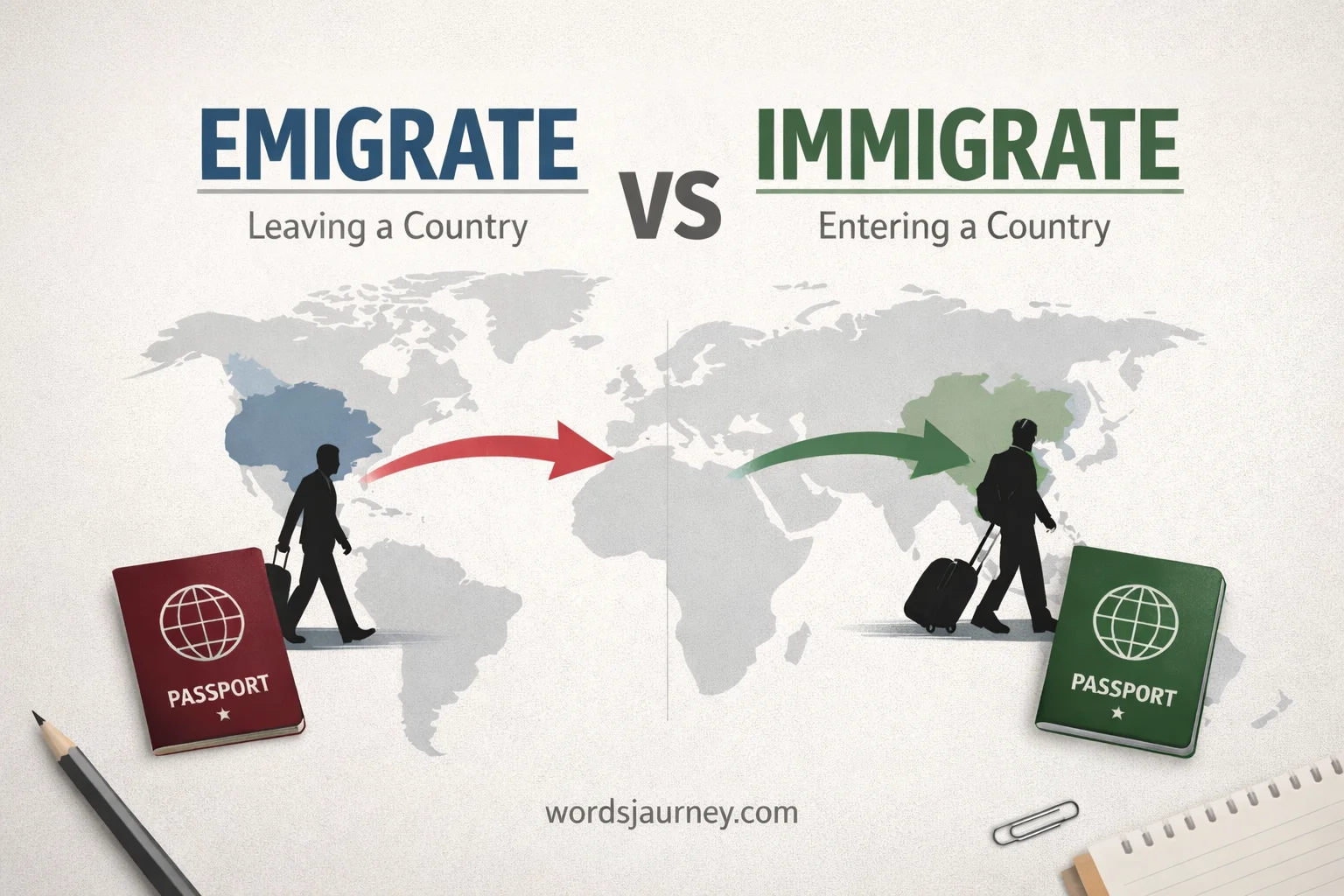
| Emigrate | Leave a country | Focus on departure |
| Immigrate | Enter a new country | Focus on arrival |
Think about a plane journey:
- When people leave, they emigrate.
- When they arrive, they immigrate.
The Golden Rule
You emigrate FROM a country.
You immigrate TO a country.
That single idea solves most mistakes instantly.
What Does Emigrate Mean?
Simple Definition
Emigrate means leaving your home country to live permanently somewhere else.
The word comes from Latin:
- e- = out
- migrare = move
So emigrate literally means move out.
How Native Speakers Use “Emigrate”
Native speakers use emigrate when the conversation focuses on where someone left.
Examples:
- My grandparents emigrated from Italy in 1965.
- Thousands emigrated from Ireland during the potato famine.
- Skilled workers often emigrate from developing economies.
Notice the emphasis. The origin country matters most.
Common Situations Where “Emigrate” Appears
You’ll often see this word in:
- History books
- Family ancestry stories
- Academic research
- Population studies
- Demographic statistics
Historical fact: Between 1820 and 1920, more than 33 million Europeans emigrated to North America, shaping modern migration patterns.
Correct Prepositions With Emigrate
| Correct | Incorrect |
| Emigrate from Pakistan | Emigrate to Pakistan |
| Emigrate from Germany | Emigrate at Germany |
Always remember: Emigrate FROM.
Real Example
Imagine Sara leaves Pakistan and settles in Canada.
From Pakistan’s viewpoint:
Sara emigrated from Pakistan.
The story highlights departure.
What Does Immigrate Mean?
Definition Explained Clearly
Immigrate means entering another country to live there permanently.
Latin roots:
- im- = into
- migrare = move
Literal meaning: move into.
How Native Speakers Use “Immigrate”
Speakers choose immigrate when emphasizing the destination country.
Examples:
- She immigrated to Canada for higher education.
- Engineers often immigrate to Germany for job opportunities.
- Many families immigrate to Australia each year.
Now the focus shifts toward arrival.
Where You Commonly Hear Immigration
You’ll hear this word frequently in:
- Government policies
- Visa applications
- Citizenship discussions
- Economic reports
- News coverage
Countries discuss people entering their borders, so media usage favors immigrate.
Correct Prepositions With Immigrate
| Correct | Incorrect |
| Immigrate to Canada | Immigrate from Canada |
| Immigrate to the USA | Immigrate at USA |
Rule: Immigrate TO.
Same Journey, Different Perspective
Using the same example:
Sara immigrated to Canada.
Nothing changed except the viewpoint.
Emigrate vs Immigrate: The Core Difference
The difference isn’t movement.
It’s perspective.
HOME COUNTRY → EMIGRATE → TRAVEL → IMMIGRATE → NEW COUNTRY
Ask yourself one question:
Are you talking about leaving or arriving?
- Leaving → Emigrate
- Arriving → Immigrate
Easy Memory Trick
Think of a doorway.
- Walking out = Emigrate
- Walking in = Immigrate
Simple visuals create lasting memory.
Read More: Whoa or Woah: Which Spelling Is Correct?
Emigrate or Immigrate in Real-Life Situations
Grammar makes more sense when applied to real scenarios.
| Situation | Correct Word |
| Leaving India permanently | Emigrate |
| Entering Canada on PR visa | Immigrate |
| Talking about destination country | Immigrate |
| Talking about origin country | Emigrate |
Case Study: International Worker Relocation
A software developer moves from India to Canada.
- India’s view: He emigrated from India.
- Canada’s view: He immigrated to Canada.
Both sentences are correct.
Context controls the word choice.
Why People Confuse Emigrate and Immigrate
Several linguistic reasons explain the confusion.
Major Causes
- Nearly identical spelling
- Same root word
- Similar pronunciation
- Poor grammar explanations in school
- Incorrect media usage online
Humans naturally think about movement rather than perspective. Language demands precision. That mismatch creates uncertainty.
Grammar Rules You Must Know
Once you learn these patterns, mistakes disappear.
Verb Forms
| Base Verb | Past | Continuous |
| Emigrate | Emigrated | Emigrating |
| Immigrate | Immigrated | Immigrating |
Noun Forms
| Word | Meaning |
| Emigrant | Person leaving |
| Immigrant | Person arriving |
| Emigration | Act of leaving |
| Immigration | Act of entering |
Sentence Patterns
Emigrate Pattern
Subject + Emigrate + From + Country
Example: They emigrated from Spain.
Immigrate Pattern
Subject + Immigrate + To + Country
Example: They immigrated to Argentina.
Emigrant vs Immigrant Explained
Many writers confuse the noun versions.
| Term | Meaning |
| Emigrant | Someone leaving a country |
| Immigrant | Someone arriving in a country |
One individual can hold both identities.
Maria was an emigrant from Mexico and an immigrant to the United States.
Same person. Two viewpoints.
Migration, Immigration, and Emigration
Migration: The Umbrella Term
Migration means movement from one place to another.
It includes:
- Human relocation
- Seasonal movement
- Internal migration
- Animal migration
Relationship between terms:
Migration
→ Emigration (leaving)
→ Immigration (arriving)
Real Examples From History and Modern Data
Real context strengthens understanding.
Historical Migration
Between 1880 and 1914, millions of Europeans crossed the Atlantic.
- Europeans emigrated from Europe.
- They immigrated to the United States and Canada.
Modern Migration Statistics
According to the United Nations, more than 281 million people live outside their birth country today.
Key drivers include:
- Employment opportunities
- Education access
- Political stability
- Climate change pressures
Modern Immigration Example
Canada admitted approximately 471,000 immigrants in 2023, one of the highest numbers in its history.
Immigration now plays a central role in economic growth and workforce expansion.
Common Mistakes Writers Make
Even experienced writers slip up.
Frequent Errors
- Using emigrate and immigrate interchangeably
- Mixing up prepositions
- Confusing noun and verb forms
- Using “migrate” when direction matters
Correction Examples
Incorrect:
He immigrated from France.
Correct:
He emigrated from France.
Incorrect:
She emigrated to Canada.
Correct:
She immigrated to Canada.
Memory Tricks That Actually Work
Forget complicated grammar charts.
Airport Method
- Departure board → Emigrate
- Arrival board → Immigrate
Letter Method
- E = Exit → Emigrate
- I = In → Immigrate
Story Perspective Trick
Your homeland tells the emigration story.
Your new country tells the immigration story.
Practice Section
Fill in the Blank
- She ______ from Brazil in 2015.
- They ______ to Australia for university.
Answers:
- Emigrated
- Immigrated
Choose the Correct Word
- Many workers ______ to Germany yearly.
- Families ______ from rural areas.
Answers:
Immigrate
Emigrate
Practice creates automatic confidence.
When You Should Use “Migrate” Instead
Sometimes neither word fits perfectly.
Use migrate when direction isn’t important.
Examples:
- Birds migrate seasonally.
- Humans migrate for economic opportunity.
Quick Comparison
| Word | Best Use |
| Emigrate | Leaving focus |
| Immigrate | Arrival focus |
| Migrate | Neutral movement |
Cultural and Legal Contexts of Immigration
Immigration language often overlaps with law.
Immigration Does Not Equal Citizenship
Typical pathway:
- Immigration visa
- Temporary residence
- Permanent residence
- Naturalization
- Citizenship
Each stage carries different legal rights.
Why Governments Emphasize Immigration
Countries track incoming populations because immigration affects:
- Labor markets
- Housing demand
- Economic productivity
- Cultural diversity
That’s why news discussions focus more on immigration than emigration.
Quick Summary Cheat Sheet
Leaving a country → EMIGRATE
Entering a country → IMMIGRATE
General movement → MIGRATE
Perspective decides the correct word.
FAQs About Emigrate or Immigrate
1. What is the main difference between emigrate and immigrate?
The difference depends on point of view.
- Emigrate means leaving your home country.
- Immigrate means entering a new country to live.
Example:
- She emigrated from Pakistan.
- She immigrated to Canada.
Both describe the same move but from opposite perspectives.
2. Can emigrate and immigrate be used interchangeably?
No. They are not interchangeable because each word focuses on a different direction of movement. Using the wrong term can confuse readers, especially in formal writing, business communication, or academic contexts.
3. Which word should I use in professional or business writing?
Choose the word based on context:
- Use emigrate when discussing departure.
- Use immigrate when discussing arrival.
Accurate usage improves clarity, strengthens grammar accuracy, and maintains consistency in professional documents, reports, or international project discussions.
4. Do US and UK style guides treat these words differently?
Both US and UK English follow the same grammatical distinction. Major style guides emphasize precision of viewpoint, not regional spelling differences. The meaning remains consistent across global English standards.
5. Is there an easy memory trick?
Yes. Try this simple rule:
WordMemory TipMeaningEmigrateE = ExitLeaving a countryImmigrateI = InEntering a country
This quick association helps during writing, meetings, or even when updating relocation information in a calendar or official document.
6. Why do people often confuse these terms?
They look and sound similar, and both relate to migration. Many writers focus on the action itself rather than the direction of movement. Careful attention to perspective solves the problem.
Conclusion
Understanding “Emigrate or Immigrate” is more than a vocabulary exercise—it’s about communicating ideas with accuracy and confidence. In modern communication environments shaped by global work, online scheduling, international project management, and cross-border collaboration, precise language strengthens credibility. Correct word choice supports smoother business communication, clearer documentation, and stronger professional writing.
Remember the core idea: emigrate = leaving, immigrate = arriving. Once you recognize the perspective, the confusion disappears. Consistent usage improves English grammar, enhances formal writing, and aligns with both US and UK style expectations.
Mastering small distinctions like this builds long-term language fluency. And when your words are clear, your message travels just as successfully as the people it describes.

Aliya Ray is a passionate writer and language enthusiast at WordsJourney. She enjoys exploring words, phrases, and everyday expressions to help readers communicate more clearly and confidently. Her content focuses on alternative ways to say common phrases, simple explanations, and real-life examples that make language easy to understand.
Aliya believes the right words can make any message stronger. Through clear, friendly writing, she helps readers improve their vocabulary without feeling overwhelmed or confused.