Have you ever paused mid-email or while updating a calendar to wonder which form is correct—every day or everyday? That tiny space can quietly change meaning, tone, and clarity.
The confusion around Every Day or Everyday is one of the most common slip-ups in modern English usage, especially in fast-paced business communication, online booking, and daily messaging where speed often beats precision.
This article breaks down the difference between every day (a phrase meaning each day) and everyday (an adjective meaning ordinary or routine). You’ll see how the choice affects formal writing, grammar, and consistency in real-world contexts like meetings, broadcasting, project management, and professional emails.
With clear explanations and practical examples, we’ll show how correct usage supports better time management, cleaner scheduling, and more confident communication.
We’ll also touch briefly on style guides and regional preferences, including US vs. UK conventions, to help you write with authority no matter your audience.
Whether you’re managing a team, writing polished reports, or refining everyday content, understanding Every Day or Everyday will sharpen your writing and eliminate a surprisingly common source of confusion—once and for all.
Every Day or Everyday: The One-Sentence Rule
Let’s cut straight to the heart of it.
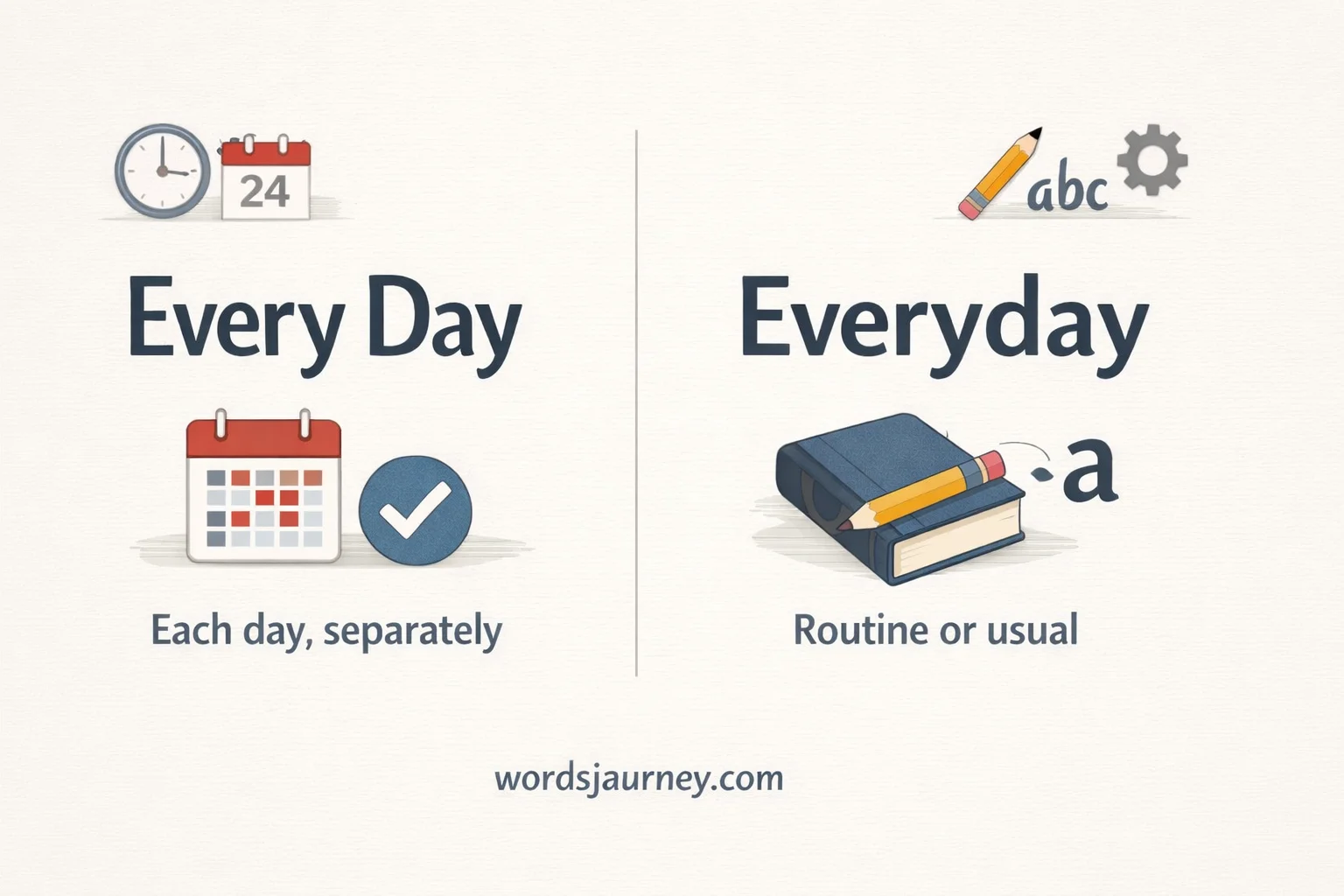
- Every day (two words) means each day. It answers when something happens.
- Everyday (one word) means ordinary, usual, or routine. It describes a noun.
That’s it. Everything else builds from this idea.
If you remember nothing else, remember this:
👉 If you can replace it with “each day,” use every day.
👉 If it describes a noun, use everyday.
Now let’s unpack why this works so reliably.
What Does “Every Day” Mean?
Definition and Function
Every day is a two-word phrase that acts like an adverb. It tells you how often something happens. Specifically, it means each day without exception.
You’ll usually see it answering questions like:
- When does this happen?
- How often does this occur?
Think of every day as a time marker. It’s about frequency, repetition, and habit.
Correct Usage Examples
Here are clean, natural examples that show every day in action:
- I drink water every day.
- She checks her email every day before work.
- They practice pronunciation every day to improve fluency.
- He writes at least 500 words every day, no excuses.
Notice something important. In each sentence, every day modifies the verb. It explains when the action happens.
Professional and Formal Contexts
You’ll often see every day in professional writing where precision matters:
- The system processes new data every day at midnight.
- Employees log their hours every day using the internal portal.
- Our support team handles customer requests every day, including holidays.
Using everyday here would be incorrect and potentially confusing.
Common Mistakes With “Every Day”
The most frequent error happens when writers use every day to describe a noun. For example:
❌ This is my every day routine.
✅ This is my everyday routine.
Why does this happen? Because spoken English blurs the difference. On the page, though, meaning matters.
Another reason is autocorrect. Many writing tools won’t flag the mistake, so it slips through unnoticed.
What Does “Everyday” Mean?
Definition and Function
Everyday is a single word that functions as an adjective. It means ordinary, typical, common, or routine. It always modifies a noun.
If every day answers when, everyday answers what kind.
Correct Usage Examples
Here’s how everyday looks in real sentences:
- These are my everyday shoes.
- She prefers everyday language in her writing.
- Stress has become an everyday issue for many workers.
- This phone handles everyday tasks well.
In each case, everyday directly describes a noun. Remove the noun and the sentence breaks.
When “Everyday” Sounds Wrong
If you try to use everyday to describe an action, it falls apart:
❌ I exercise everyday.
✅ I exercise every day.
The first sentence sounds casual but it’s grammatically wrong. You’re talking about frequency, not description.
A quick check saves you every time.
Every Day vs Everyday: Side-by-Side Comparison
| Feature | Every Day | Everyday |
| Word Form | Two words | One word |
| Part of Speech | Adverbial phrase | Adjective |
| Meaning | Each day | Ordinary or routine |
| Modifies | Verbs | Nouns |
| Example | I study every day | My everyday routine |
| Common Error | Used as adjective | Used for frequency |
This table alone clears up most confusion.
The 3-Second Test to Choose the Right One
When you’re stuck, don’t analyze. Test.
The “Each Day” Test
Replace the phrase with each day.
- I walk ___ → I walk each day ✔️ → every day
- My ___ clothes → my each day clothes ❌ → everyday
The Noun Check
Ask yourself one question: Is there a noun right after it?
- Everyday almost always sits in front of a noun.
- Every day never does.
The Meaning Check
If you mean routine or ordinary, use everyday.
If you mean frequency, use every day.
Simple beats are complicated every time.
Real-World Usage: Context Changes Everything
In Emails and Workplace Writing
Small grammar mistakes can quietly undermine professionalism.
Compare these two sentences:
- I review reports everyday before meetings.
- I review reports every day before meetings.
Only one is correct. The second shows clarity and care. The first suggests haste.
In client communication, these details matter. According to the Harvard Business Review, clarity and correctness in writing directly affect trust and perceived competence.
In Casual Conversation vs Writing
In speech, both forms sound identical. That’s why mistakes happen. Writing doesn’t have a tone of voice to save you. Precision does the heavy lifting.
Why Even Native Speakers Get This Wrong
Several forces work against accuracy:
- Spoken English hides the difference
- Autocorrect doesn’t flag it
- Compound words confuse people
- Fast typing encourages shortcuts
This isn’t about intelligence. It’s about awareness. Once you see the pattern, you won’t unsee it.
Similar Word Pairs That Follow the Same Pattern
Understanding every day vs everyday helps you master other tricky pairs.
| Two Words (Time/Condition) | One Word (Meaning Change) |
| Some time | Sometime |
| Any time | Anytime |
| All right | Alright |
| No one | Noone (incorrect) |
| Each day | Everyday (different meaning) |
Spot the pattern. Two words often deal with time or condition. One word shifts meaning.
For More: Setup or Set Up The Real Difference and Clear Rules
Quick Practice: Lock It In
Try these. Don’t overthink.
- She wears her ___ jacket to work.
- He studies English ___ after dinner.
- This app handles ___ tasks easily.
- They walk their dog ___ without fail.
Answers
- everyday
- every day
- everyday
- every day
If you got them right, you’ve internalized the rule.
Frequently Asked Questions (FAQs)
1. What is the main difference between every day and everyday?
The difference is grammatical and semantic. Every day is an adverbial phrase meaning each day or daily, while everyday is an adjective meaning ordinary, routine, or common. Mixing them up can change the meaning of a sentence entirely.
2. Is everyday one word or two?
It depends on usage. Everyday is one word when it describes a noun, such as everyday tasks or everyday meetings. Every day is always two words when it refers to frequency, like We meet every day.
3. Which form should I use in formal writing or business communication?
Both forms are correct in formal writing if used properly. In business communication, reports, emails, and project management documents, accuracy matters. Use every day for schedules and routines, and everyday to describe typical or routine activities.
4. Does US vs. UK English affect the usage of every day or everyday?
No major differences exist between US and UK English for these terms. Most style guides, including American and British standards, agree on the same grammatical rules. Consistency and clarity matter more than regional preference.
5. Why does this distinction matter in scheduling and time management?
Clear language supports better scheduling, calendar planning, and time management. Writing meetings happen everyday instead of every day may confuse readers, especially in professional or online booking contexts.
6. How can I quickly check which one is correct?
Try this simple test: if you can replace the phrase with each day, use every day. If it describes a noun and means ordinary, use it everyday. This quick check works in most situations.
Conclusion
The difference between every day and everyday may seem small, but its impact is anything but minor. One extra space can shift meaning, affect tone, and influence how professional your writing appears. In areas like meetings, project management, scheduling, and formal writing, precision builds credibility and ensures your message lands exactly as intended.
By understanding how every day expresses frequency and everyday describes routine or normalcy, you gain more control over your language. This clarity supports stronger business communication, smoother calendar planning, and better overall consistency across emails, reports, and digital content. Mastering Every Day or Everyday is not just about grammar. It’s about writing with confidence, accuracy, and purpose skills that matter whether you’re managing teams, publishing content, or simply communicating clearly in everyday life.

Aliya Ray is a passionate writer and language enthusiast at WordsJourney. She enjoys exploring words, phrases, and everyday expressions to help readers communicate more clearly and confidently. Her content focuses on alternative ways to say common phrases, simple explanations, and real-life examples that make language easy to understand.
Aliya believes the right words can make any message stronger. Through clear, friendly writing, she helps readers improve their vocabulary without feeling overwhelmed or confused.