Have you ever paused before typing “Follow Up or Follow-Up” in an email or calendar note? Choosing the correct form can feel surprisingly tricky, especially in formal writing or business communication. Whether you’re scheduling meetings, managing projects, or sending a timely reminder, consistency and clarity are key. Understanding the subtle difference ensures your messages remain professional and your time management stays on point.
In everyday contexts like online booking, broadcasting, or tracking meetings on a calendar, the distinction between a follow-up as a noun or adjective and a follow up as a verb matters more than you might think. Even small grammatical choices can influence project management efficiency and how colleagues perceive your English usage. Recognizing these patterns also aligns with style guides and regional preferences, whether you’re following US or UK conventions.
This article dives into the nuanced world of Follow Up or Follow-Up, offering clear examples and actionable tips. We’ll explore grammar rules, professional writing standards, and practical usage scenarios, from emails to scheduling tools. By the end, you’ll confidently choose the right form every time, enhancing your business communication and ensuring your writing is both precise and polished.
Understanding the Core Difference Between Follow Up and Follow-Up
Before diving into examples, you need one clear rule.
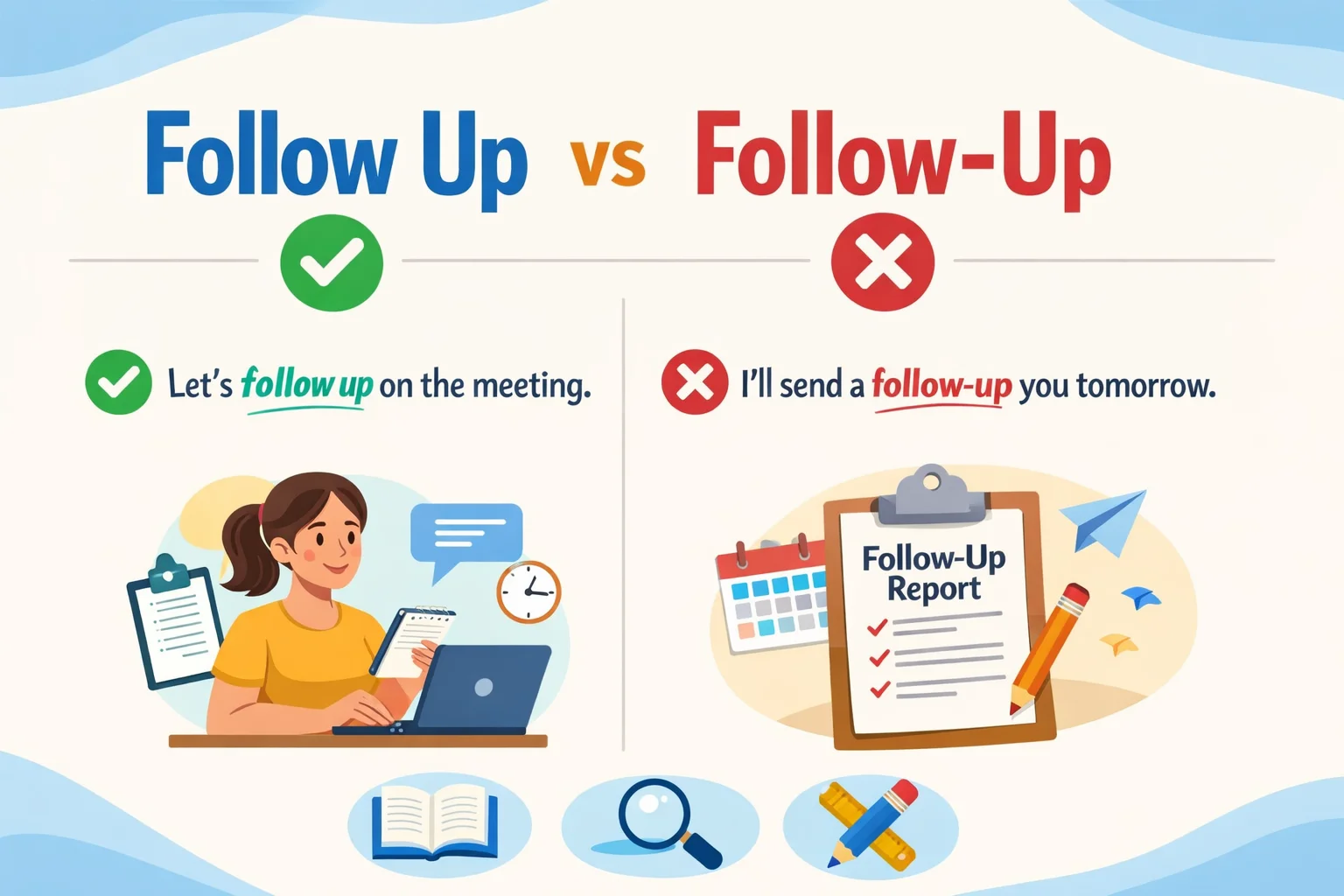
Follow up = Verb (an action)
Follow-up = Noun or adjective (a thing or description)
The hyphen transforms the phrase from an action into an object or modifier. Once you recognize the grammar role in your sentence, the correct version becomes obvious.
Quick Grammar Comparison
| Form | Grammar Role | Example |
| Follow up | Verb phrase | I will follow up tomorrow. |
| Follow-up | Noun | She sent a follow-up. |
| Follow-up | Adjective | He scheduled a follow-up meeting. |
Think of it this way.
If someone does something, use follow up.
If someone sends or schedules something, use follow-up.
This pattern appears throughout professional writing.
What Does “Follow Up” Mean? (Verb Form)
The phrase follow up acts as a phrasal verb. It describes the act of checking back, continuing communication, or taking another step after an earlier action.
In simple terms, it means to pursue something further.
Real Situations Where “Follow Up” Appears
You will see the verb phrase used in many professional settings.
Business Communication
Managers often ask employees to follow up after a meeting.
Example:
- “Please follow up with marketing regarding the campaign data.”
Customer Support
Support teams follow up to confirm issues were solved.
Example:
- “Our team will follow up within 24 hours.”
Healthcare
Doctors follow up with patients to monitor recovery.
Example:
- “The nurse will follow up next week.”
Academic Research
Researchers follow up on earlier findings.
Example:
- “The study will follow up on previous experiments.”
The verb phrase communicates ongoing responsibility. It signals that the process is not finished yet.
What Does “Follow-Up” Mean? (Noun Form)
Now let’s switch roles.
When the phrase becomes a thing rather than an action, the hyphen appears.
That’s when follow-up becomes a noun.
Definition
Follow-up:
An additional action, communication, or meeting that occurs after the original event.
Example Sentences
- She sent a follow-up after the interview.
- The doctor scheduled a follow-up.
- We discussed the results during a follow-up call.
Notice how each sentence refers to a specific event or item.
The hyphen turns the phrase into a concrete concept.
Common Types of Follow-Ups
You will frequently encounter these examples:
- Follow-up email
- Follow-up meeting
- Follow-up appointment
- Follow-up call
- Follow-up message
Each represents a structured step after the original interaction.
Business Case Study
Consider a sales team.
A salesperson speaks with a potential client. The initial meeting introduces the product. The next step is a follow-up email summarizing the discussion.
This email often includes:
- Product details
- Pricing information
- Next steps
- Meeting recap
The follow-up becomes the bridge between interest and purchase.
Using Follow-Up as an Adjective
The phrase follow-up also works as an adjective. In this role it describes another noun.
Writers often use this structure in professional communication.
Examples
- follow-up meeting
- follow-up email
- follow-up report
- follow-up discussion
Sentence Examples
- She scheduled a follow-up meeting next week.
- The company sent a follow-up message after the webinar.
Here the phrase modifies another word.
Think of it like describing the type of email or meeting.
Follow Up vs Follow-Up: Side-by-Side Comparison
The easiest way to master the rule is to compare both forms directly.
| Sentence | Correct Form | Reason |
| I will follow up tomorrow. | Follow up | Verb |
| Please send a follow-up. | Follow-up | Noun |
| She wrote a follow-up email. | Follow-up | Adjective |
| We should follow up next week. | Follow up | Verb |
The hyphen depends entirely on grammar role.
Why This Grammar Rule Matters
At first glance the difference may seem minor. However, professional writing depends on precision.
Incorrect hyphenation can make sentences look careless.
In business environments small details shape credibility.
Clear Grammar Improves
- Email professionalism
- Academic writing quality
- Workplace communication
- Blog and SEO content
- Marketing copy clarity
Editors and recruiters often notice these details instantly.
Real-World Examples of Follow Up and Follow-Up
Let’s explore how professionals actually use the phrase.
Business Communication
Example email:
“I wanted to follow up regarding yesterday’s discussion. Please find the follow-up report attached.”
Notice both forms appear in the same message.
One describes the action.
The other describes the document.
Healthcare
Doctors frequently schedule follow-up visits.
Example:
- “The patient requires a follow-up appointment in two weeks.”
Healthcare systems rely on these steps to monitor recovery.
Sales and Marketing
Sales teams rely heavily on follow-ups.
According to HubSpot research, nearly 80% of sales require five follow-ups after the initial contact.
Yet many salespeople stop after one attempt.
This statistic shows why follow-up communication matters.
Job Interviews
Candidates often send a follow-up message after interviews.
Example:
- “Thank you for the opportunity. I wanted to follow up regarding the position.”
This simple step can strengthen your impression.
Common Mistakes People Make
Even experienced writers occasionally confuse these forms.
Let’s examine the most frequent mistakes.
Mistake: Using Hyphen with the Verb
Incorrect:
- I will follow-up tomorrow.
Correct:
- I will follow up tomorrow.
Remember the rule. Verbs never include the hyphen.
Mistake: Forgetting Hyphen Before Nouns
Incorrect:
- I sent a follow up email.
Correct:
- I sent a follow-up email.
When the phrase modifies another noun, the hyphen appears.
Mistake: Writing “Followup” as One Word
Occasionally writers combine the words.
Example:
- followup email
This form rarely appears in professional style guides. Most editors consider it incorrect.
How Follow Ups Work in Professional Emails
Email communication relies heavily on follow-ups.
A well-timed follow-up keeps conversations moving.
When You Should Follow Up
You should send one in several situations.
- After job interviews
- After sending proposals
- After business meetings
- After networking events
- After unanswered emails
These messages keep communication active.
Example Email Sentences
Here are natural phrases professionals often use.
- “I wanted to follow up on our conversation.”
- “This is a follow-up email regarding the project timeline.”
- “Just checking in to follow up on my previous message.”
Notice how each sentence uses the correct form automatically.
Follow Up Synonyms and Alternatives
Sometimes repeating the same phrase feels repetitive. Fortunately several alternatives exist.
Verb Alternatives
You can replace follow up with these phrases:
- check back
- reconnect
- reach out again
- touch base
- revisit
Example:
- “I will check back tomorrow.”
Noun Alternatives
Instead of follow-up, writers sometimes use:
- reminder
- update
- response
- progress check
- continuation
Example:
- “Here is a quick update after our meeting.”
Variety improves writing flow.
For More: Eachother or Each Other The Complete Grammar Guide
Style Guide Rules for Follow Up vs Follow-Up
Professional style guides provide consistent grammar standards.
Most follow the same distinction.
Associated Press Style
The AP Stylebook uses:
- follow up as a verb
- follow-up as a noun or adjective
Chicago Manual of Style
The Chicago Manual of Style follows similar guidance.
Both authorities reinforce the same rule used across journalism and publishing.
Quick Memory Trick
Grammar rules stick better with simple tricks.
Try this one.
Ask a Question
Can you place it before the phrase?
If yes, it is probably a verb.
Example:
- to follow up
Verbs rarely include hyphens.
If It Describes Something
Add the hyphen.
Example:
- follow-up email
- follow-up meeting
This trick helps writers choose the correct form instantly.
Mini Quiz: Test Your Understanding
Try answering these questions.
Choose the Correct Option
- I will ____ with the team tomorrow.
- She sent a ____ email after the meeting.
- The doctor scheduled a ____ appointment.
Answers
- follow up
- follow-up
- follow-up
If you answered correctly, the rule already makes sense.
Why Follow-Up Communication Matters
Beyond grammar, the concept of follow-ups plays a huge role in success.
Professionals who follow up consistently build stronger relationships.
Benefits of Following Up
- Improves response rates
- Strengthens professional relationships
- Demonstrates reliability
- Keeps projects moving forward
- Builds trust with clients
A single follow-up email often revives stalled conversations.
Real Example
Imagine a freelance writer pitching an article idea.
The editor does not respond immediately.
Many writers give up.
However one polite follow-up email can restart the conversation. That message might lead to publication.
Persistence often wins.
Common Follow-Up Scenarios in Business
Understanding when to follow up can improve professional communication.
After Meetings
Send a summary and action items.
After Proposals
Confirm the client received the document.
After Networking
Reconnect while the conversation remains fresh.
After Customer Support
Verify the problem is resolved.
These small actions build trust and reliability.
A Simple Follow-Up Email Template
Here is a practical example.
Subject: Follow-Up Regarding Our Meeting
Hello [Name],
I wanted to follow up regarding our discussion earlier this week.
Please find the follow-up summary attached. Let me know if you have questions or need additional details.
Best regards,
[Your Name]
This message remains concise and professional.
Key Takeaways: Follow Up vs Follow-Up
Let’s summarize the most important points.
- Follow up = verb phrase (action).
- Follow-up = noun or adjective (thing or description).
- The hyphen changes the grammatical role.
- Business writing uses both forms frequently.
- Professional style guides support this rule.
Once you recognize the sentence role, choosing the correct version becomes easy.
Clear grammar builds strong communication.
Small details matter. This one simple rule helps your writing appear polished, professional, and confident.
Frequently Asked Questions (FAQs)
1. What is the difference between “Follow Up” and “Follow-Up”?
Follow-Up (with a hyphen) is typically a noun or adjective, as in “We scheduled a follow-up meeting.” Follow up (without a hyphen) is usually a verb phrase, as in “I will follow up with you tomorrow.”
2. Which form should I use in formal writing?
In formal writing or business communication, follow the standard grammar rules: use “follow-up” for nouns/adjectives and “follow up” for verbs. Always maintain consistency throughout your text.
3. Does regional preference affect usage?
Yes. US English typically favors the hyphenated follow-up for nouns/adjectives, while UK English also accepts the unhyphenated followup occasionally, though hyphenation is more standard.
4. Can “follow-up” appear in digital scheduling tools?
Absolutely. Tools like online booking systems, calendar apps, and project management platforms often use follow-up to denote reminders or subsequent tasks.
5. How can I remember the difference easily?
Think of it this way:
- If it’s an action, use follow up (verb).
- If it’s a thing or description, use follow-up (noun/adjective).
Conclusion
Mastering the distinction between Follow Up or Follow-Up is more than a grammar exercise—it’s a key component of clear, professional communication. Correct usage improves business correspondence, time management, and scheduling efficiency, while reinforcing your credibility in formal writing.Whether you’re drafting emails, updating a calendar, or managing project tasks, applying these rules consistently ensures your intentions are clear and your writing polished. By following the guidance in this article, you can confidently choose the correct form, enhance your English usage, and maintain consistency across all your communications.

Emma Brook is a dedicated writer and language enthusiast at WordsJourney. She’s passionate about helping readers understand words better and use them with confidence in everyday conversations. Her work focuses on alternative phrases, clear meanings, and practical examples that make language feel simple and approachable.
With a friendly, reader-first writing style, Emma breaks down common expressions and explores smarter ways to say things without sounding forced or complicated. Her goal is to make learning words enjoyable, useful, and easy for everyone.