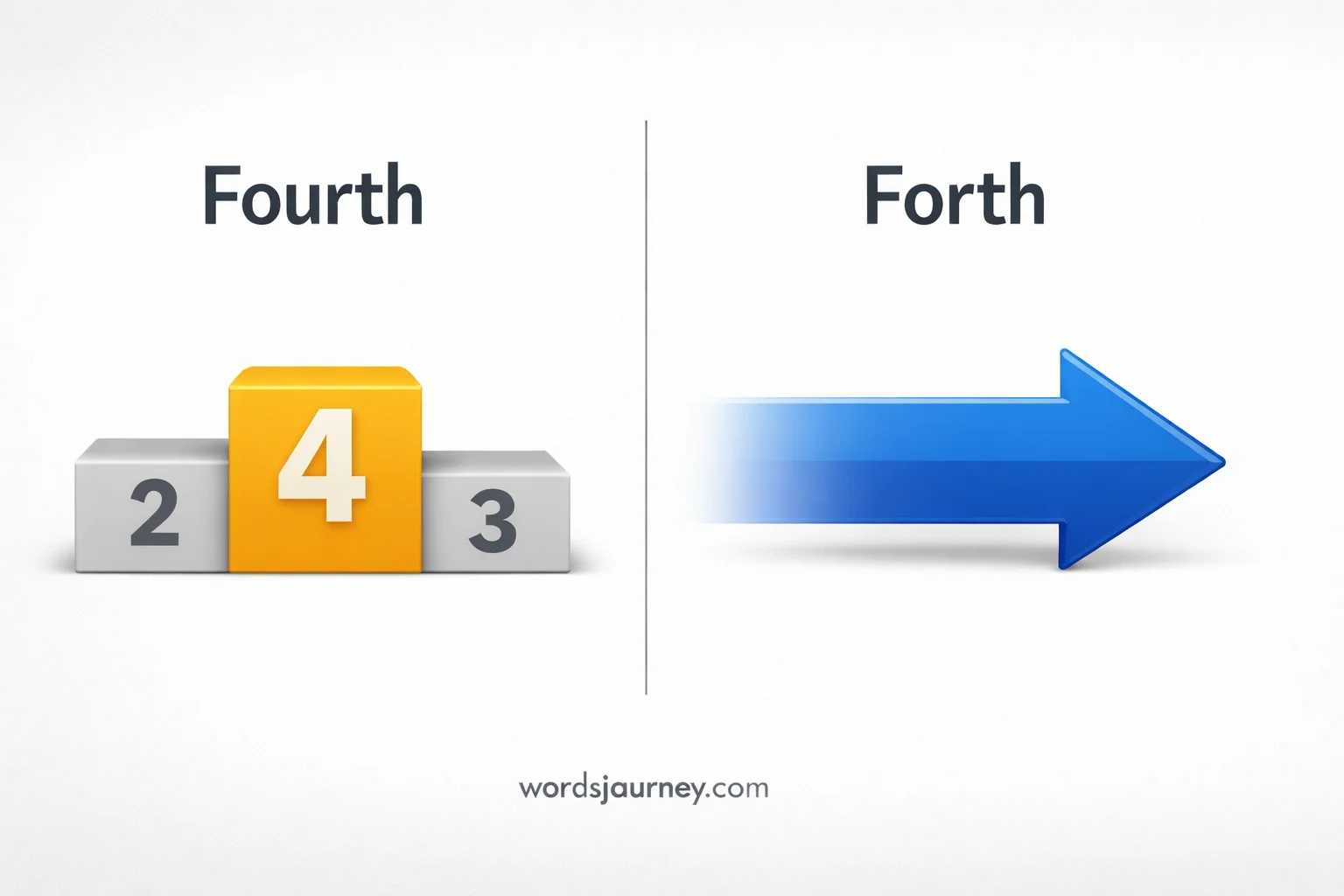
Have you ever sent a calendar invite and paused over a single word? That tiny choice can change meaning, tone, and clarity. The mix-up between Fourth vs Forth trips up even confident writers, especially in business communication, formal writing, and everyday English usage. One word points to order and position.
The other signals movement and progress. When you’re setting meetings, confirming online booking, or planning a project timeline, that difference matters more than it seems.
This guide breaks down the clear difference between fourth and forth with practical examples you can use right away. You’ll see how these words show up in scheduling, time management, project management, and even broadcasting.
We’ll walk through common errors in emails, calendar entries, and meeting notes, then show how to fix them for clean, professional results. You’ll also get quick rules that support consistency across teams and documents.
We’ll briefly note how style guides and regional preferences shape usage, including subtle US vs. UK conventions in professional contexts. By the end, you’ll know when each word fits, how to avoid awkward phrasing, and how to keep your writing crisp across reports, agendas, and client messages.
Clear word choices build trust, save time, and keep your communication moving forward with confidence.
Fourth vs Forth: Quick Answer for Busy Readers
If you just want the short version, here it is:
| Word | What It Means | Part of Speech | Simple Example |
| Fourth | The number after third | Noun / Adjective | “She finished fourth.” |
| Forth | Moving forward or onward | Adverb | “Step forth with confidence.” |
One-line rule:
If you’re talking about a number or position, use fourth.
If you’re talking about movement or continuation, use forth.
That’s the core difference. Now let’s dig deeper so you actually remember it.
What Does “Fourth” Mean? Definition, Usage, and Real Context
Fourth refers to position, order, or sequence. It belongs to the family of ordinal numbers, which includes first, second, third, fourth, and so on.
How “Fourth” Works in English
You’ll see fourth used in a few main ways:
- As an adjective
- “She lives on the fourth floor.”
- “This is the fourth chapter of the book.”
- As a noun
- “He came in fourth in the race.”
- “The Fourth of July is a major US holiday.”
- In dates and events
- “The Fourth of July marks American Independence Day.”
- The US Declaration of Independence was adopted on July 4, 1776.
Common Situations Where “Fourth” Is Correct
- Rankings and competitions
- Floors in buildings
- Steps in instructions
- Chapters, sections, and points
- Dates and national holidays
- Fractions (one-fourth = 1/4)
Examples in Everyday Writing
- “This is my fourth attempt at the exam.”
- “The company ranked fourth in customer satisfaction.”
- “Please turn to the fourth paragraph.”
Typical Mistakes With “Fourth”
Many writers accidentally type forth when they mean fourth, especially in casual writing.
Wrong:
“This is my forth try.”
Right:
“This is my fourth try.”
One missing letter flips the meaning. Readers notice. Editors notice even faster.
What Does “Forth” Mean? Definition, Usage, and Real Context
Forth describes movement forward or progression. It has nothing to do with numbers. Think of direction, continuation, or going ahead.
How “Forth” Functions
- Part of speech: Adverb
- Core idea: Forward motion or onward action
Common Expressions Using “Forth”
These phrases still show up in modern English:
- Go forth
- And so forth
- Back and forth
- Set forth
- Bring forth
Each phrase carries the idea of movement, continuation, or unfolding.
Examples in Natural Sentences
- “She stepped forth to accept the award.”
- “They went back and forth debating the issue.”
- “The report sets forth the main findings.”
Is “Forth” Old-Fashioned?
Some uses of forth feel formal or slightly archaic, especially in dramatic or ceremonial contexts:
“Go forth and prosper.”
Yet phrases like back and forth and and so forth remain everyday language. You’ll hear them in meetings, podcasts, and casual conversations.
Fourth vs Forth: The Key Differences Explained Clearly
The confusion comes from sound and spelling. When spoken quickly, fourth and forth can blur together. In writing, one missing letter changes the meaning.
Side-by-Side Comparison
| Feature | Fourth | Forth |
| Core meaning | Order or position | Forward movement or continuation |
| Part of speech | Noun / Adjective | Adverb |
| Used for | Rankings, dates, sequences | Motion, direction, progression |
| Example | “The fourth step is hardest.” | “Step forth bravely.” |
A Simple Visual Trick
- Four is inside fourth → number
- Forth sounds like forward → movement
Once you lock that in, the mix-up fades away.
Correct vs Incorrect Usage: Real-Life Examples
These mistakes show up constantly in emails, blogs, and student papers.
Common Errors and Fixes
- ❌ “This is my forth warning.”
✅ “This is my fourth warning.” - ❌ “He finished forth in the race.”
✅ “He finished fourth in the race.” - ❌ “Please go fourth and submit your form.”
✅ “Please go forth and submit your form.”
Professional Writing Example
- ❌ “This is our forth quarter report.”
- ✅ “This is our fourth quarter report.”
In business and academic writing, these small errors chip away at credibility. Clear language signals competence.
Why People Confuse Fourth and Forth
This mistake has a few predictable causes:
- Phonetic similarity in spoken English
- Fast typing and skipped letters
- Autocorrect blind spots
- ESL challenges with ordinal numbers
- Habitual errors learned early and repeated
Once a writer forms the habit, the error repeats like a reflex. Awareness is the first fix. Practice locks it in.
Memory Tricks That Actually Work
Here are simple, sticky ways to remember the difference:
Mental Shortcuts
- If it contains four, it’s about a number.
- If it sounds like forward, it’s about movement.
Quick Mnemonic
Four is in fourth.
Forth pushes you forward.
Visual Cue
Picture a big number 4 inside the word fourth.
Picture an arrow pointing forward for forth.
These tiny mental anchors save you time later.
Fourth vs Forth in Professional and Academic Writing
Precision matters. Small word errors stand out more than you expect.
Why This Mistake Hurts Your Credibility
- Editors flag it instantly
- Readers question your attention to detail
- Clients may doubt your professionalism
- Academic reviewers may lower their assessment of your work
Common Phrases Using Fourth and Forth Explained
Some phrases confuse writers because they sound formal or idiomatic.
Phrases With “Fourth”
- Fourth of July
- Fourth wall (a theater and film term)
- Fourth estate (the press or media)
Phrases With “Forth”
- Back and forth
- And so forth
- Set forth
- Bring forth
Quick Clarification
- “So forth” is wrong.
- The correct phrase is “and so forth.”
Mini Quiz: Test Your Understanding
Fill in the blanks:
- She finished ____ in the marathon.
- The teacher asked him to step ____ and present.
- This is the ____ time we’ve had this discussion.
- The argument went back and ____.
- The company set ____ its goals clearly.
Answers
- fourth
- forth
- fourth
- forth
- forth
If you got all five right, your brain has locked it in.
Also Read: Your vs Yours: Mastering the Difference
Related Confusing Word Pairs Worth Mastering
If Fourth vs Forth trips you up, these pairs often cause similar trouble:
- Loose vs Lose
- Then vs Than
- Affect vs Effect
- Gray vs Grey
- Complement vs Compliment
Mastering these builds instant credibility in writing.
Final Verdict: Fourth or Forth?
This isn’t just a spelling issue. It’s a clarity issue. Fourth marks position and order. Forth signals movement and progression. Mix them up, and your meaning stumbles. Use them correctly, and your writing moves with confidence.
Small fixes create big gains. Clean language reads like clear thinking.
Quick Summary Table
| If you mean… | Use this word |
| A number or position | Fourth |
| Forward movement | Forth |
| Rankings or steps | Fourth |
| Direction or progression | Forth |
FAQs: Fourth vs Forth
1. What is the main difference between fourth and forth?
The key difference between fourth and forth lies in meaning and usage. Fourth is an ordinal number that refers to position or order. Forth is an adverb that means forward in time, place, or action. Mixing them can cause confusion in formal writing, business communication, and everyday English usage.
2. Can I use fourth in scheduling and meetings?
Yes. Fourth is commonly used in scheduling, meetings, and calendar entries to show order. Example: “The fourth meeting is scheduled for Friday.” This usage is clear in project management, online booking, and professional planning.
3. Is forth common in business communication?
Yes, but it appears in specific contexts. Forth is used to express movement or progression, often in formal writing or policy statements. Example: “The policy will apply from this date forth.” This phrasing supports clarity in business communication and internal documentation.
4. Do US and UK style guides treat these words differently?
No, US and UK style guides agree on the meanings of fourth and forth. The difference is not regional. What varies is style and tone in professional documents. Following a recognized style guide helps maintain consistency across reports, emails, and published content.
5. Why does confusing fourth vs forth hurt professional writing?
Small word errors can reduce credibility in formal writing. In contexts like broadcasting, business communication, and client-facing messages, clarity matters. Using the correct term improves readability, supports grammar accuracy, and strengthens trust.
6. How can I remember the difference between fourth and forth?
Use this simple cue:
- Fourth = number (think four).
- Forth = forward (think movement). This quick mental link helps prevent mistakes in emails, meetings, and project management notes.
Conclusion
The confusion between Fourth vs Forth may seem minor, but it can quietly undermine clarity in business communication, formal writing, and everyday English usage. One word signals order and position. The other shows movement and progression. Choosing the right term keeps your calendar entries precise, your meetings organized, and your project management updates easy to follow.
As you handle scheduling, online booking, and professional correspondence, small language choices shape how others read your intent. Following basic grammar rules and trusted style guides, whether you write for US or UK audiences, builds consistency and credibility. Master this pair, and your writing moves forward with clarity, confidence, and polish.

Johnson Alex is a language-focused writer and the voice behind WordsJourney. He creates practical, easy-to-understand content that helps readers improve their vocabulary and express ideas with clarity and confidence.