Ever paused mid-sentence wondering whether to write “has” or “have”? You’re not alone. The grammar choice between “Has or Have” shapes clear communication, especially in business communication, emails, and everyday conversations. From scheduling meetings to updating a shared calendar, correct verb agreement keeps your writing precise, professional, and easy to understand. Mastering this small rule strengthens your English usage, improves formal writing, and builds lasting consistency across messages.
In modern workplaces driven by time management, online booking systems, and collaborative project management, grammar mistakes can quietly disrupt meaning. Whether you’re broadcasting announcements, organizing meetings, or managing deadlines, choosing the correct verb form ensures clarity and authority. This guide explores how subject-verb agreement, tense usage, and context determine when to use has or have, helping writers avoid common errors that affect tone and credibility.
You’ll also learn how professional standards and major style guides influence usage, including subtle differences between US and UK English preferences. While both follow similar grammatical rules, regional writing traditions sometimes affect formal communication choices. By the end of this article, you’ll confidently understand the difference between has and have, apply the rule in real situations, and write with accuracy, fluency, and grammatical confidence.
Why “Has or Have” Confuses So Many Writers
English verbs change depending on the subject. That sounds simple until real sentences appear.
Consider these examples:
- She has a meeting today.
- They have a meeting today.
Both sentences describe the same action. Only the subject changes. Yet many writers still mix them up.
The Real Reasons Behind the Confusion
- English contains irregular verb patterns.
- Spoken English sometimes hides grammar rules.
- Writers focus on nearby nouns instead of the true subject.
- Present perfect tense adds another layer of complexity.
Think of verbs as dancers following a partner. The subject leads. The verb must follow.
The Core Difference Between Has vs Have
At its core, the rule is straightforward.
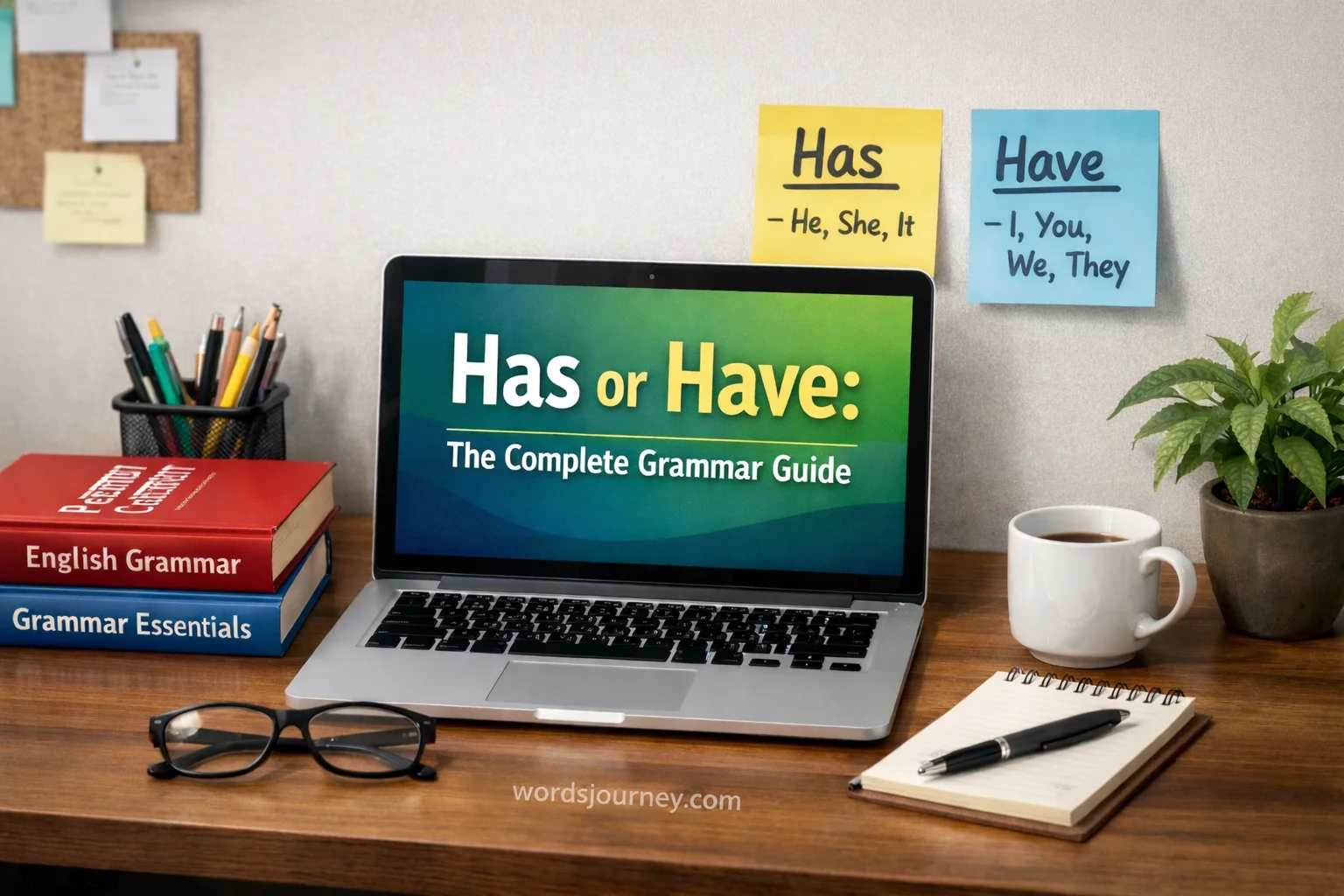
Has → used with singular subjects
Have → used with plural subjects and certain pronouns
Quick Reference Table
| Subject | Correct Verb |
| I | Have |
| You | Have |
| He | Has |
| She | Has |
| It | Has |
| We | Have |
| They | Have |
Simple Memory Trick
HAS hugs ONE person.
HAVE welcomes MANY people.
When you identify the subject first, the decision becomes automatic.
Understanding Subject-Verb Agreement (The Foundation Rule)
Before mastering Has or Have, you must understand subject-verb agreement.
Subject-verb agreement means:
A verb must match its subject in number and person.
Grammar Logic Diagram
Subject → Singular or Plural → Verb Choice
One person/thing → HAS
More than one → HAVE
Why English Uses Different Verb Forms
English verbs evolved from older Germanic language systems. Over centuries, verbs changed to signal who performs the action.
Compare:
- The manager has approved the plan.
- The managers have approved the plan.
One letter completely changes interpretation.
Using “Has” Correctly
When to Use Has
Use has with:
- Third-person singular pronouns
- Singular nouns
- Individual names
- Collective nouns acting as one unit
Examples
- She has excellent leadership skills.
- The dog has a red collar.
- Michael has completed the assignment.
- The company has announced new policies.
Key Insight
If you can replace the subject with he, she, or it, choose has.
Case Study
Incorrect: The list of requirements have changed.
Correct: The list of requirements has changed.
Why? The subject is list, not requirements.
Using “Have” Correctly
When to Use Have
Use have with:
- First person (I)
- Second person (you)
- Plural subjects
- Multiple people
Examples
- I have an idea for the project.
- You have excellent writing skills.
- They have completed their homework.
- We have many options to choose from.
Key Insight
If the subject is I, you, we, they or anything plural, use have.
Has or Have in Present Perfect Tense
The present perfect tense often trips writers up. The formula is:
Subject + has/have + past participle
Examples
- She has arrived at the station.
- They have finished their assignments.
- I have learned a lot this week.
This tense shows that an action is completed with relevance to the present.
Negative Sentences with Has and Have
Making negative statements requires “not”:
- has not → hasn’t
- have not → haven’t
Examples
- He hasn’t called yet.
- We haven’t started the meeting.
- I haven’t finished my essay.
Questions Using Has and Have
To form questions:
Has/Have + subject + past participle?
Examples
- Has she arrived?
- Have you eaten lunch?
- Has the team completed the project?
In spoken English, contractions like hasn’t and haven’t are common.
Has vs Have with Pronouns
| Pronoun | Verb |
| I | Have |
| You | Have |
| He | Has |
| She | Has |
| It | Has |
| We | Have |
| They | Have |
This table is a quick reference to avoid mistakes.
Indefinite Pronouns: The Most Confusing Cases
Some pronouns appear plural but act singular:
- Everyone
- Someone
- Anyone
- Each
- Nobody
✅ Correct: Everyone has a role.
❌ Incorrect: Everyone have a role.
These pronouns always take has in the present tense.
Has or Have with Collective Nouns
Collective nouns like team, family, group, committee can be tricky.
- American English usually treats them as singular:
- The team has won the championship.
- British English may allow plural verbs for emphasis on individuals.
Meaning dictates the verb choice.
Has vs Have in Spoken English
In informal conversation:
- Contractions dominate: I’ve, you’ve, he’s
- Native speakers sometimes omit words:
- She has a car → She’s got a car
- Rules are slightly relaxed but subject-verb agreement still matters in writing
Common Mistakes Writers Make
Mistake #1: Matching the verb to a nearby noun
❌ The list of items have changed.
✅ The list of items has changed.
Mistake #2: Confusing plural nouns ending in “s”
- The news has gone viral (singular, despite the “s”)
Mistake #3: Misusing indefinite pronouns
- Everyone has vs Everyone have
Mistake #4: Present perfect confusion
- They have went → Incorrect
- They have gone → Correct
Has vs Have vs Had
| Verb | Time | Example |
| Has | Present | She has finished the task |
| Have | Present | They have finished the task |
| Had | Past | She had finished before noon |
Knowing had helps understand tense relationships and avoids mixing forms.
Real-World Usage Examples
Business Emails
- She has attached the report for review.
- We have updated the client about the changes.
Academic Writing
- The study has shown significant results.
- Researchers have analyzed multiple datasets.
Social Media Captions
- He has finally reached 10k followers!
- They have just launched a new product.
Quick Decision Guide
Follow this 5-second test:
- Identify the subject
- Is it singular or plural?
- Replace the subject with he/she/it if unsure
- Choose has for singular, have for plural
Decision Flow Example:
- Subject: The team → Replace with “it” → Verb = has
- Subject: The players → Replace with “they” → Verb = have
Advanced Grammar Situations
- Compound subjects with and → plural → have
- Subjects joined by or/nor → verb matches closest subject
- There is/There are constructions → singular vs plural
- Amounts & measurements → singular if treated as a single unit
Examples
- Bread and butter have been served.
- Either the teacher or the students have to attend.
- A pack of wolves has entered the forest.
Practice Exercises
Fill in the blank:
- She ____ finished her homework. (has/have)
- They ____ been to Paris twice. (has/have)
- Everyone ____ a ticket for the event. (has/have)
Correct Answers: 1) has 2) have 3) has
Interactive practice improves memory retention and reinforces proper usage.
Pro Writing Tips to Never Confuse Them Again
- Read sentences aloud – your ears catch mistakes your eyes miss
- Replace the subject with pronouns – he/she/it for singular, they for plural
- Focus on meaning – some plural-looking words are singular
Frequently Asked Questions (FAQs) About “Has or Have”
1. What is the main difference between Has and Have?
The difference depends on subject-verb agreement.
- Has is used with third-person singular subjects such as he, she, it, or singular nouns.
- Have is used with I, you, we, they, and plural nouns.
✅ She has a meeting scheduled. ✅ They have a project deadline today.
Correct usage improves English usage, formal writing, and overall consistency in communication.
2. When should I use Has in business communication?
Use has when referring to a single person, organization, or entity.
Examples:
- The manager has approved the calendar update.
- The company has launched a new online booking system.
Proper grammar strengthens business communication, especially in reports, emails, and professional updates.
3. When is Have the correct choice?
Use have with plural subjects or first and second person pronouns.
Examples:
- We have scheduled multiple meetings.
- You have access to the project management dashboard.
This usage supports clarity in scheduling, time management, and collaborative workplace writing.
4. Do Has and Have change in questions?
Yes. In questions, have/has often move before the subject.
Examples:
- Has she confirmed the meeting?
- Have they updated the calendar?
This structure is common in broadcasting, professional interviews, and formal discussions.
5. Are there differences between US and UK English usage?
Both US and UK English follow the same grammatical rule for has and have. However, regional style guides may differ slightly in tone or collective noun usage:
- US English: The team has decided.
- UK English: The team have decided.
Understanding these preferences improves international formal writing and professional consistency.
6. Why is mastering Has or Have important for professionals?
Correct verb usage ensures:
- Clear project management updates
- Accurate meeting communication
- Professional online booking confirmations
- Stronger written credibility
Small grammar choices create big improvements in clarity.
7. Can grammar mistakes affect professional communication?
Absolutely. Incorrect verb forms can confuse readers, weaken authority, and reduce trust. Clear grammar supports efficient time management, smoother workflows, and confident communication.
Also Read: Whoever or Whomever: Which one is Correct?
Conclusion
Understanding Has or Have may seem like a small grammar lesson, yet it plays a powerful role in effective communication. Whether you’re organizing a calendar, managing meetings, sending professional emails, or handling project management tasks, correct verb agreement ensures clarity and precision. Strong grammar allows ideas to flow smoothly without distracting errors.
Throughout this guide, you’ve learned how subject-verb agreement, context, and sentence structure determine the correct choice. You’ve also seen how modern communication—from business communication to broadcasting and digital collaboration—relies on consistent language use. Applying these rules improves readability, strengthens professionalism, and supports clear English usage in both casual and formal environments.Ultimately, mastering Has or Have builds confidence in writing and speaking. When your grammar stays consistent, your message becomes stronger, more credible, and easier to understand—no matter the audience, platform, or regional style preference. Small grammatical decisions lead to powerful communication results.

Emma Brook is a dedicated writer and language enthusiast at WordsJourney. She’s passionate about helping readers understand words better and use them with confidence in everyday conversations. Her work focuses on alternative phrases, clear meanings, and practical examples that make language feel simple and approachable.
With a friendly, reader-first writing style, Emma breaks down common expressions and explores smarter ways to say things without sounding forced or complicated. Her goal is to make learning words enjoyable, useful, and easy for everyone.