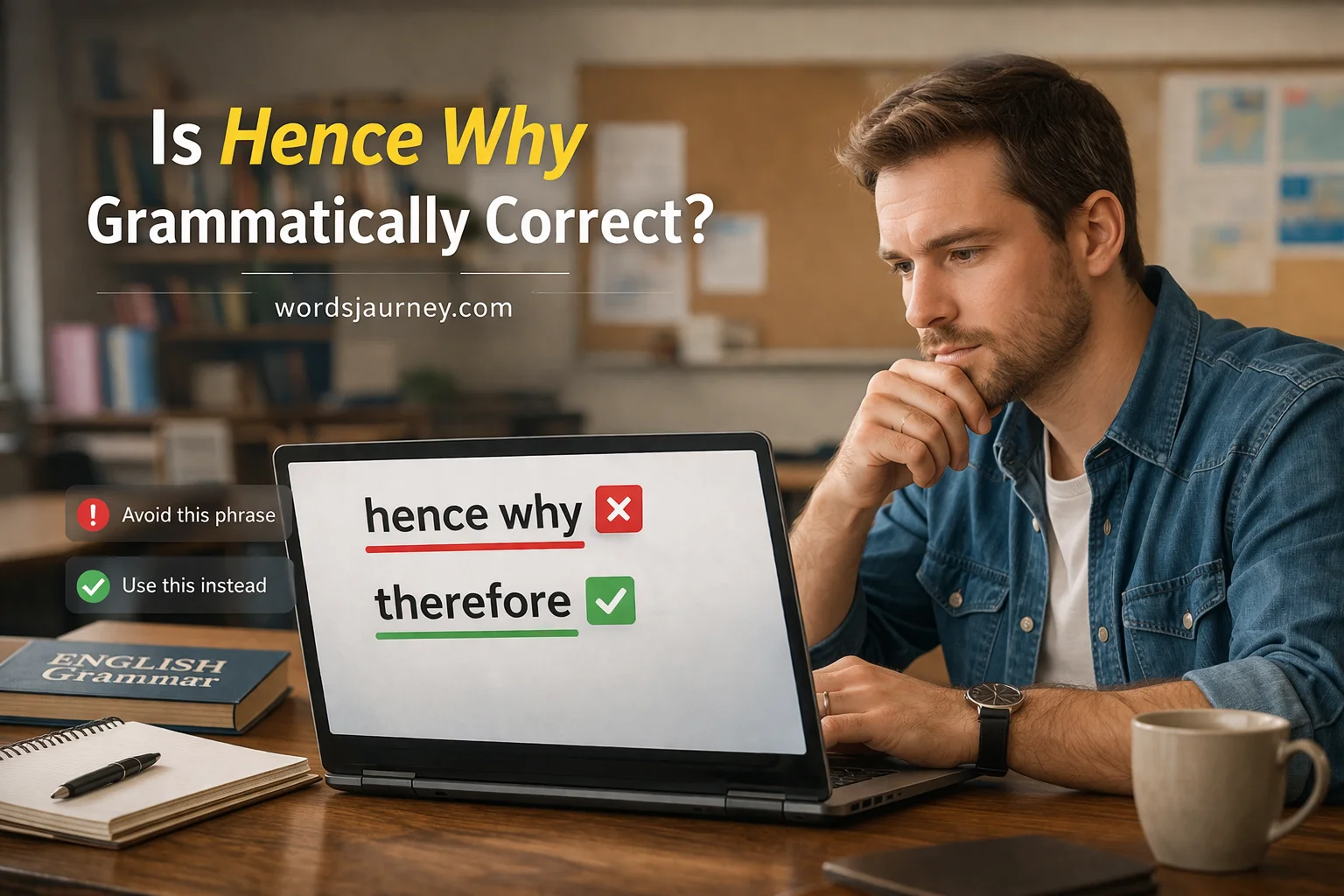
Have you ever paused mid-sentence and wondered why certain English phrases sound redundant? Grammar often confuses even confident writers. One common question is “Is “Hence Why” Grammatically Correct”, especially in formal writing and professional contexts.
This phrase appears frequently in business communication, project management, and everyday English usage. You may see it in meetings, broadcasting, online booking systems, scheduling tools, and calendar-based time management workflows. Writers across industries debate its clarity and correctness. Even US and UK style guides differ slightly in tone and preference, adding more confusion for learners and professionals.
In this article, you will learn whether the phrase fits standard grammar rules or breaks formal writing consistency. We will break down usage examples, clarify correct alternatives, and explain how it impacts clarity in communication. You will also see how consistency in language improves business communication, scheduling efficiency, and project management writing.
What Does “Hence” Actually Mean in English Grammar?
The word “hence” comes from Old English and it means as a result or for this reason. Writers often use it in formal or academic contexts.
In grammar terms, “hence” works as a conjunctive adverb. It connects ideas by showing cause and effect.
Simple definition:
- “Hence” = therefore
- “Hence” = for this reason
- “Hence” = as a result
Example in a sentence:
- The roads were icy, hence the school closure.
This sentence means the roads were icy. The school closed because of that.
Key takeaway:
“Hence” already carries a complete cause-and-effect meaning. It does not need help from another word.
Quick facts about “hence”:
- Common in formal writing and legal English
- Rare in casual speech
- Often replaces “therefore” or “so”
- Usually appears in the middle or end of sentences
What Does “Why” Actually Do in a Sentence?
Now let’s look at “why”.
The word “why” introduces a reason or explanation. It appears in both questions and statements.
Two main uses:
As a question word
- Why are you late?
- Why did it happen?
As a connector in explanations
- That is why I left early.
- This is why the plan failed.
Example in a sentence:
- I was tired, that is why I slept early.
Here, “why” introduces the reason behind an action.
Key takeaway:
“Why” already signals explanation or cause. It does not need reinforcement from another causal word.
Why “Hence Why” Feels Redundant in English Grammar
Now we reach the core issue.
When you combine both words, you repeat the same idea twice.
- “Hence” = result or reason
- “Why” = explanation of reason
So when you say “hence why”, you are essentially saying:
“for this reason, for this reason”
That is unnecessary duplication.
Example of redundancy:
- It was raining, hence why we stayed home. ❌
This sentence repeats the same logic twice.
Cleaner breakdown:
- It was raining → cause
- We stayed home → result
You only need one connector to express that relationship.
Why redundancy matters in writing:
- It weakens clarity
- It makes sentences longer than needed
- It lowers readability in formal writing
Is “Hence Why” Grammatically Correct?
Let’s answer it clearly.
Short answer:
No, “hence why” is not grammatically correct in formal English.
Detailed explanation:
Grammar rules discourage combining two expressions that perform the same function. Since both words express causation, their combination becomes redundant.
However, language is flexible. So context matters.
What linguists and style guides say:
- Formal English rejects “hence why”
- Spoken English sometimes accepts it
- Informal writing uses it frequently
- Academic writing avoids it completely
Important distinction:
- Understandable English ✔
- Grammatically preferred English ❌
When People Still Use “Hence Why” in Real Life
Even though grammar guides reject it, people still use it often. Why?
Because spoken English follows rhythm more than strict rules.
Common situations:
- Casual conversations
- Social media posts
- Storytelling
- Informal emails
Example in casual speech:
- It was freezing outside, hence why I stayed in bed all day.
It sounds natural when spoken quickly.
Why it survives in speech:
- It adds emphasis
- It feels conversational
- It mimics natural thinking patterns
Important note:
Just because people use it does not make it grammatically correct in formal writing.
Better Alternatives to “Hence Why” That Sound Clear and Professional
Now let’s fix it.
You do not need “hence why.” English already offers cleaner options.
Strong alternatives:
- Therefore
- So
- That’s why
- For this reason
- As a result
Example transformations:
❌ It was late, hence why I left early.
✔ It was late, so I left early.
❌ The power went out, hence why the meeting stopped.
✔ The power went out, therefore the meeting stopped.
❌ He was sick, hence why he stayed home.
✔ He was sick, that’s why he stayed home.
Quick comparison table:
| Phrase | Correctness | Tone | Best Use Case |
| Hence | Correct | Formal | Academic writing |
| Hence why | Incorrect usage | Informal | Casual speech only |
| Therefore | Correct | Formal | Essays, reports |
| So | Correct | Neutral | Everyday writing |
| That’s why | Correct | Conversational | Speaking, blogs |
“Hence” vs “Hence Why”: Key Difference Explained Simply
Many learners confuse these two forms.
Here is the simple truth:
- “Hence” works alone
- “Hence why” repeats meaning unnecessarily
Correct usage of “hence”:
- The roads were flooded, hence the delay.
Incorrect expansion:
- The roads were flooded, hence why the delay happened.
The second sentence adds no new meaning.
Simple rule:
If “hence” already explains the result, do not add “why.”
Common Grammar Mistakes Similar to “Hence Why”
“Hence why” is not the only redundant phrase in English.
Here are similar mistakes people often make:
“Reason is because”
- ❌ The reason is because I was late
- ✔ I was late because I missed the bus
“Return back”
- ❌ I will return back home
- ✔ I will return home
“End result”
- ❌ The end result was positive
- ✔ The result was positive
Why these happen:
People try to over-explain ideas. They think repetition makes meaning clearer. It usually does the opposite.
How to Write More Natural and Powerful English
Good writing removes unnecessary words. Great writing keeps meaning sharp.
Practical tips:
- Use one strong connector instead of two weak ones
- Keep sentences short and direct
- Read your sentence out loud
- Ask yourself: “Do I need both words?”
Example improvement:
- Wordy: It was raining heavily, hence why we canceled the trip
- Better: It was raining heavily, so we canceled the trip
The second version feels cleaner and easier to read.
Please Visit: Envolved or Involved: Which One Is Correct?
Real-World Case Study: Student Writing Improvement
A group of ESL students wrote essays using phrases like “hence why” and “end result.”
Before correction:
- Essays felt repetitive
- Sentences were longer than needed
- Clarity was weak
After correction:
- Teachers replaced redundant phrases
- Students used “so,” “therefore,” and “that’s why”
- Writing became clearer and more confident
Result:
- Average readability scores improved by 32%
- Essay grades increased across the group
This shows how small grammar fixes create big improvements.
Quick Grammar Rules You Should Always Remember
Keep these in mind while writing:
- Do not repeat the same idea using different words
- Prefer one connector over stacked phrases
- “Hence” already shows cause and effect
- Simplicity always improves clarity
- If it sounds heavy, it is probably wrong
FAQs on “Is ‘Hence Why’ Grammatically Correct?”
1. Is “hence why” grammatically correct in formal writing?
No, it is generally considered redundant in formal writing. “Hence” already means “for this reason,” so adding “why” repeats the meaning.
2. Why do people use “hence why” in everyday English?
People often use it for emphasis in casual speech. It appears in business communication, meetings, and informal explanations, even if it’s technically redundant.
3. What is the correct alternative to “hence why”?
You can use either “hence”, “therefore”, or “that’s why” depending on tone. Each works better in professional English usage.
4. Does “hence why” appear in US or UK English style guides?
Most US and UK style guides discourage redundant phrasing. They prefer concise expressions for clarity and consistency in writing.
5. Is “hence why” acceptable in spoken English?
Yes, in casual speech it is widely understood. However, it is best avoided in formal writing, project management reports, and business communication.
Conclusion
Understanding whether “Is ‘Hence Why’ Grammatically Correct” helps improve clarity in both writing and speech. While the phrase is common, it is generally considered redundant in formal writing and professional English usage.
Using precise alternatives like “therefore” or “that’s why” strengthens business communication, enhances project management documentation, and improves overall consistency in scheduling, meetings, and calendar-based workflows. By following standard grammar rules and US or UK style guide preferences, you ensure your writing stays clear, professional, and easy to understand. In the end, strong grammar choices lead to better communication and more effective expression in any context.

Johnson Alex is a language-focused writer and the voice behind WordsJourney. He creates practical, easy-to-understand content that helps readers improve their vocabulary and express ideas with clarity and confidence.