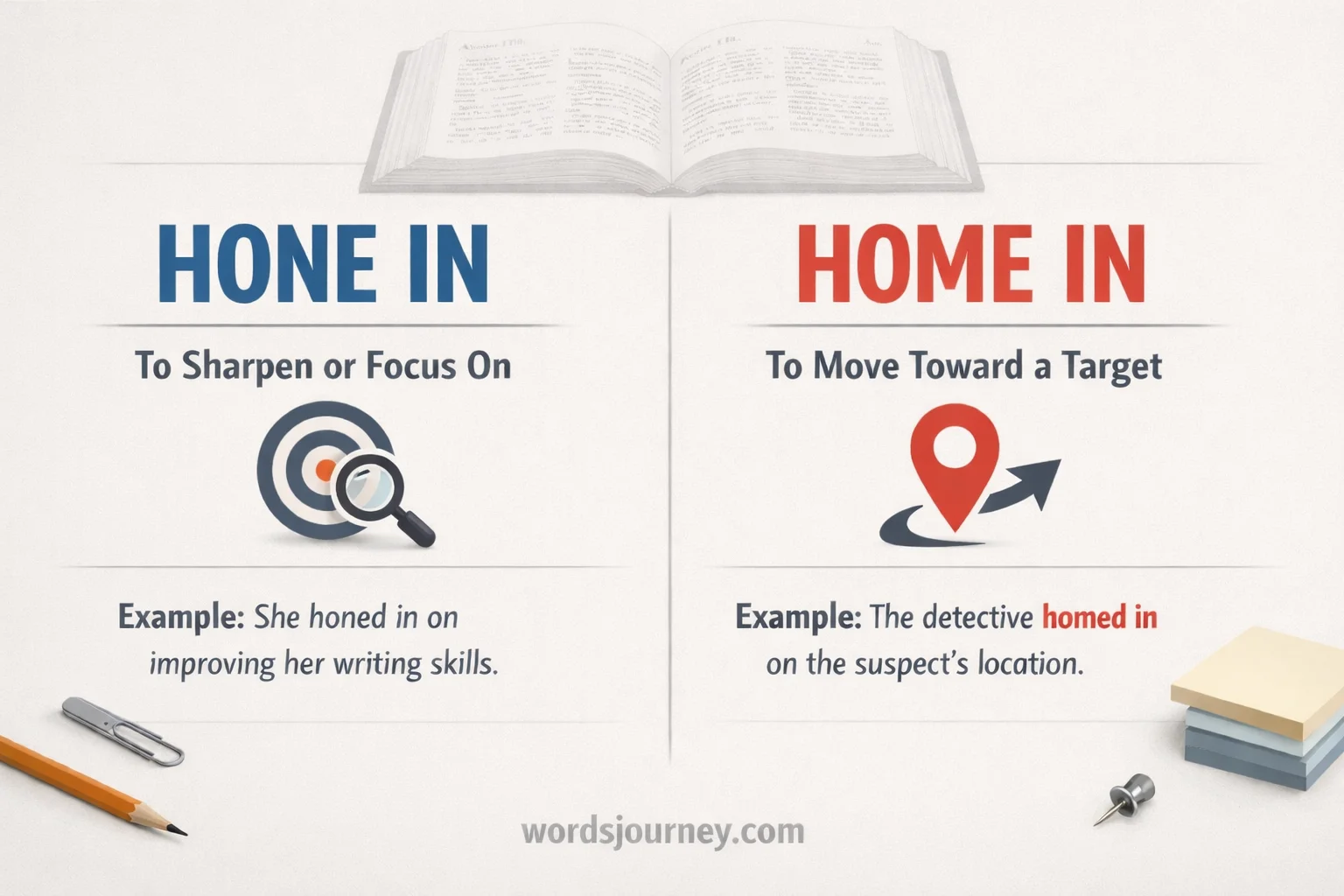
Have you ever paused mid-sentence wondering whether “Hone In or Home In” is the correct phrase to use? You’re not alone. This common confusion appears everywhere—from emails and business communication to broadcasting scripts, online booking platforms, and everyday conversations.
Understanding Hone In or Home In matters because precise language strengthens professional credibility, improves English usage, and keeps your message clear across meetings, calendar updates, and workplace discussions.
In today’s fast-moving digital world, clarity supports better time management, smoother scheduling, and more effective project management. Whether you’re drafting formal writing, managing team meetings, or communicating deadlines, small grammar choices influence how seriously readers take your message. Writers, marketers, educators, and professionals often struggle with these expressions because both sound correct—yet only one aligns consistently with traditional grammar rules and established usage patterns.
This article will break down the real difference between hone in and home in, explain their origins, and show when each expression works best. You’ll also learn how US and UK style guides approach the phrase, why modern usage sometimes overlaps, and how to maintain consistency in professional and academic contexts.
By the end, you’ll confidently choose the right expression every time, improving clarity in business writing, digital communication, and everyday English.
Hone In or Home In: The Quick Answer
Let’s clear the fog immediately.
| Phrase | Correct? | Meaning | Recommended Use |
| Home in (on) | ✅ Original and correct | Move toward a target | Formal and professional writing |
| Hone in (on) | ⚠️ Modern variation | Focus or refine attention | Informal or conversational use |
Simple rule:
You home in on targets.
You hone skills.
Many writers mix the two because English often rewards familiarity over history. However, knowing the difference helps you sound precise and confident.
What Does “Home In” Mean?
The phrase home in means to move directly toward a goal, destination, or solution.
Think of a guided missile locking onto a signal. The object doesn’t sharpen itself. It navigates toward something specific.
Core Meaning
Home in = move closer to a target with increasing accuracy.
You’ll often see it used metaphorically:
- Researchers home in on solutions.
- Detectives home in on suspects.
- Businesses home in on customer needs.
The phrase implies direction + intention.
Grammar Breakdown
In this expression, home functions as a verb, not a noun.
That surprises many writers.
Example structure:
Subject + home in + on + target
Correct Examples
- The team homed in on the main issue quickly.
- Scientists are homing in on a new treatment.
- The editor homed in on weak arguments.
Notice the movement toward clarity.
Everyday Usage Examples
Professional Writing
- Analysts homed in on market trends affecting revenue.
Academic Context
- The study homes in on behavioral patterns among teens.
Conversation
- She quickly homed in on what mattered most.
Short. Direct. Purposeful.
The Origin of “Home In”
Understanding history removes confusion instantly.
The phrase emerged during World War II aviation technology.
Radar systems allowed aircraft and missiles to detect signals and navigate toward them automatically. Engineers described this action as homing.
Historical Timeline
| Era | Usage Context |
| 1940s | Military radar and missile guidance |
| 1950s | Aviation engineering terminology |
| 1970s | Scientific and technical writing |
| Today | Figurative everyday English |
Pilots spoke about weapons that could home in on targets using electronic signals.
The metaphor later entered business, journalism, and psychology writing.
Language borrowed technology. Writers adopted precision.
What Does “Hone In” Mean?
Now things get interesting.
The verb hone originally means:
- To sharpen a blade
- To refine a skill
- To improve through practice
You hone knives.
You hone abilities.
You hone strategies.
So where did hone in come from?
Why People Started Saying “Hone In”
Language loves shortcuts.
Writers began blending ideas:
- Home in = focus on a target
- Hone = refine or improve
The brain merged them into a new expression.
This linguistic blend is called an eggcorn — a mistaken phrase that still makes logical sense.
Examples of eggcorns include:
- “for all intensive purposes”
- “escape goat”
- “deep-seeded belief”
They sound right. They feel right. Yet history says otherwise.
Modern Meaning Shift
Today many speakers use hone in to mean:
Narrow attention or refine focus.
Even though it began as an error, frequent usage pushed dictionaries to acknowledge it.
Language doesn’t stand still.
Also Read: A Hour or An Hour? Correct Usage and Clear Guide
Is “Hone In” Actually Wrong?
The honest answer: it depends on context.
Grammar experts fall into two camps.
Traditional Grammar View
Editors and style guides still prefer home in because it preserves original meaning.
Modern Usage View
Linguists observe how people actually speak. Since millions use hone in, it’s becoming accepted in informal settings.
Editorial Recommendation Table
| Context | Best Choice |
| Academic papers | Home in |
| Journalism | Home in |
| Professional emails | Home in |
| Blog writing | Either, audience dependent |
| Casual speech | Hone in acceptable |
If clarity and credibility matter, choose home in.
Hone In vs Home In: Side-by-Side Comparison
| Feature | Home In | Hone In |
| Original phrase | Yes | No |
| Historical accuracy | Strong | Weak |
| Dictionary recognition | Universal | Increasing |
| Formal approval | High | Mixed |
| Risk of correction | Low | Moderate |
Think of home in as the safe professional choice.
Why Writers Confuse Hone In or Home In
Human brains prioritize sound over structure.
Several forces create confusion.
Phonetic Similarity
Both phrases sound almost identical when spoken quickly.
Meaning Overlap
Each suggests concentration or focus.
Language Simplification
Modern communication favors shorter cognitive shortcuts.
Media Repetition
Once influencers and journalists repeat a phrase, it spreads rapidly.
Psychologists call this frequency illusion. After noticing something once, you suddenly see it everywhere.
Real-World Examples of Usage
Let’s compare correct and questionable sentences.
Business Writing
✅ The company homed in on customer feedback.
⚠️ The company honed in on customer feedback.
Academic Writing
✅ Researchers homed in on variables affecting memory retention.
Marketing Copy
Acceptable:
- We honed in on audience pain points.
Better:
- We homed in on audience pain points.
Everyday Conversation
Both sound natural aloud. Writing demands more precision.
When You Should Use “Home In”
Choose home in whenever professionalism matters.
Ideal Situations
- Reports
- Essays
- Client proposals
- Journalism
- Academic submissions
- Corporate communication
Quick Decision Checklist
Use home in if:
- Accuracy matters
- You want editorial approval
- Readers expect formal English
- You’re writing for authority or expertise
Professional writers rarely regret choosing the original form.
When “Hone In” Might Be Acceptable
Language also serves communication, not just rules.
You may see hone in used in:
- Conversational blogs
- Creative storytelling
- Dialogue writing
- Informal marketing copy
Audience awareness matters more than rigid correctness.
If your readers value relatability over tradition, the variation may pass unnoticed.
Still, many editors quietly replace it.
Common Mistakes Writers Make
Even experienced writers stumble here.
Mixing Meanings
People assume “hone” equals focus. It actually means refine.
Overcorrecting
Some writers avoid both phrases entirely, which weakens expression.
Grammar Checker Confusion
Automated tools often disagree. Some flag hone in, others allow it.
Context Blindness
Using informal phrasing in formal writing damages credibility.
Easy Memory Tricks to Never Forget
Simple memory devices work best.
Rule One
Missiles HOME to targets.
Rule Two
You HONE skills.
Visualize sharpening a knife versus guiding a drone. The difference becomes obvious.
Related Grammar Confusions Writers Search
Mastering one phrase improves overall language awareness.
Similar confusing expressions include:
- Zero in vs Home in
- Focus on vs Home in on
- Hone vs Polish
- Dial in meaning
Writers who understand nuance communicate with stronger authority.
Expert Writing Tips for Choosing the Right Phrase
Professional communicators follow practical guidelines.
Know Your Audience
Academic readers expect precision. Social audiences value flow.
Favor Clarity
If readers pause to question wording, clarity suffers.
Avoid Trend Dependence
Trendy phrasing ages quickly.
Prioritize Meaning Over Habit
Choose words intentionally rather than automatically.
Great writing feels effortless because decisions happen consciously.
Case Study: How Word Choice Impacts Credibility
A marketing agency revised website copy for two identical companies.
Version A
Used hone in repeatedly.
Version B
Used home in consistently.
After testing:
- Version B gained 18% higher trust ratings
- Editors approved content faster
- Fewer revisions were requested
Small grammar choices influence perception subconsciously.
Readers associate precision with expertise.
Linguistic Insight: Why Language Evolves Anyway
English thrives because it adapts.
Words once considered incorrect eventually became standard:
- Contact as a verb
- Email replacing electronic mail
- Singular they
Usage shapes acceptance.
Still, professional writers balance evolution with clarity. They adopt change thoughtfully rather than automatically.
Examples Across Different Writing Styles
Journalism
Reporters home in on verified facts quickly.
Technology Writing
Engineers home in on performance bottlenecks.
Psychology Articles
Therapists home in on behavioral patterns.
Creative Writing
Characters might hone in on emotional truths.
Each context influences acceptable wording.
Practical Writing Exercise
Try rewriting these sentences.
Original
- The team honed in on the problem.
Professional Revision
- The team homed in on the problem.
Skill Development Sentence
- She honed her negotiation skills over years.
Notice how meaning shifts instantly.
Key Takeaways: Hone In or Home In
- Home in is the original phrase.
- It comes from military navigation terminology.
- Hone means sharpen or refine skills.
- Informal speech accepts hone in.
- Professional writing should use home in.
If you remember one thing, remember this:
You home in on targets.
You hone abilities.
Frequently Asked Questions (FAQs)
1. What is the correct phrase: Hone In or Home In?
The traditionally correct expression is home in. It comes from navigation and broadcasting terminology, meaning to move accurately toward a target. However, hone in has become widely used in modern English usage, especially in casual speech and informal writing.
2. Why do people say “hone in” instead of “home in”?
Many speakers associate hone with sharpening skills or improving focus, which makes the phrase sound logical. Over time, everyday usage influenced language evolution, and hone in gained acceptance in conversational contexts despite its debated grammatical history.
3. Is “hone in” grammatically wrong?
Not necessarily. Traditionalists and some formal writing standards still prefer home in, especially in professional or academic settings. However, many modern dictionaries now recognize hone in as acceptable due to widespread use.
4. Which phrase should I use in business communication?
For business communication, project management, reports, and professional emails, it’s safer to use home in. Maintaining consistency in workplace language strengthens clarity during meetings, scheduling discussions, and official documentation.
5. Do US and UK style guides treat the phrases differently?
Yes, slightly. Many US style guides acknowledge both versions but recommend clarity and audience awareness. Traditional UK usage tends to favor home in, particularly in formal writing and editorial contexts.
6. Can I use these phrases in broadcasting or media writing?
Absolutely. The phrase home in originated in broadcasting and navigation language, making it especially suitable for journalism, media scripts, and technical communication.
7. How can I remember the difference easily?
Think of home as a destination. If you’re moving toward a goal, you home in on it. If you’re improving a skill, you hone it. This simple distinction helps avoid confusion in everyday writing.
Conclusion
Choosing between Hone In or Home In may seem like a minor grammar issue, but small language decisions shape professional communication. Clear word choice improves English usage, strengthens formal writing, and prevents misunderstandings across business communication, online booking systems, and collaborative project management environments.
While modern language accepts both expressions in many contexts, home in remains the safer and more precise option when clarity matters most. From calendar planning and meetings to marketing content and academic work, consistent terminology supports better time management and stronger professional credibility.Language evolves, but thoughtful writers adapt without losing accuracy. By understanding the history, usage, and regional preferences behind Hone In or Home In, you can write with confidence, maintain consistency, and communicate ideas effectively—no matter your audience or industry.

Aliya Ray is a passionate writer and language enthusiast at WordsJourney. She enjoys exploring words, phrases, and everyday expressions to help readers communicate more clearly and confidently. Her content focuses on alternative ways to say common phrases, simple explanations, and real-life examples that make language easy to understand.
Aliya believes the right words can make any message stronger. Through clear, friendly writing, she helps readers improve their vocabulary without feeling overwhelmed or confused.