Have you ever paused mid-sentence wondering whether a major event is “about to happen” or whether someone is highly respected in their field? That small hesitation often leads to the classic confusion between “Imminent or Eminent.”
These two words look and sound similar, yet their meanings differ completely. Understanding Imminent or Eminent is essential for clear English usage, especially in business communication, formal writing, and professional emails. A single misplaced word can change the tone of a message, particularly in contexts like meetings, project management updates, or calendar notifications.
In modern workplaces, language precision matters more than ever. Whether you’re writing about an imminent deadline in project management, announcing an imminent broadcast, or describing an eminent expert in your field, choosing the correct term improves clarity and credibility.
The distinction becomes especially important in environments that rely on structured communication such as online booking systems, scheduling platforms, time management tools, and professional calendars. Correct word choice ensures consistency, avoids misunderstandings, and keeps communication polished.
This guide breaks down the difference between “Imminent” and “Eminent” in a simple, practical way. You’ll learn their definitions, pronunciation, real-world examples, and common mistakes. We’ll also explore how these terms appear in business writing, broadcasting, and professional communication, while briefly noting conventions recommended by major style guides in US and UK English.
By the end, you’ll confidently know when to use each word and how to keep your writing clear, precise, and professional.
Imminent vs Eminent — What’s the Difference?
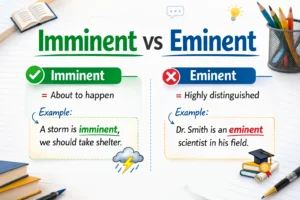
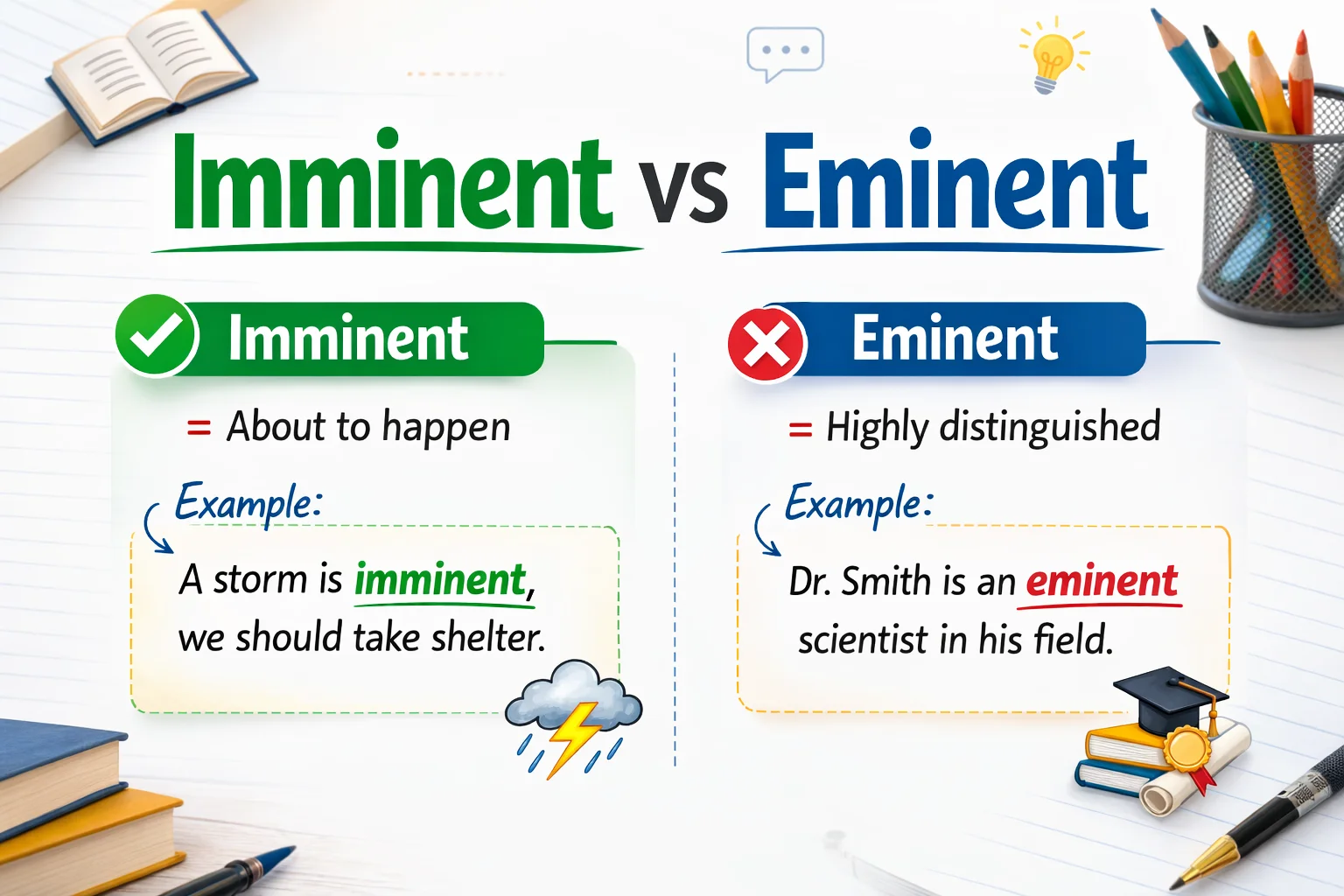
The difference between imminent and eminent is simple once you see their core meanings.
- Imminent refers to something that is about to happen very soon.
- Eminent refers to someone who is respected, famous, or distinguished.
Although the words differ by only one letter, their usage appears in very different contexts.
| Word | Core Meaning | Typical Usage |
| Imminent | About to happen soon | Events or situations |
| Eminent | Highly respected or famous | People and reputation |
For example:
- The storm is imminent.
- She is an eminent researcher in neuroscience.
The first sentence warns about an approaching event. The second sentence praises a respected professional.
Once you remember this distinction, the confusion disappears.
Quick Answer — Imminent vs Eminent
If you want the fast explanation, here it is:
| Word | Meaning | Example |
| Imminent | Something that will happen very soon | An earthquake warning suggests danger is imminent |
| Eminent | A person with high reputation or respect | An eminent judge delivered the keynote |
Key takeaway:
- Imminent = approaching event
- Eminent = respected person
What Does Imminent Mean?
Definition of Imminent
The word imminent means about to happen very soon. It describes events that feel immediate, approaching, or unavoidable.
The term often appears in contexts where urgency or anticipation exists.
Examples include:
- Natural disasters
- Political changes
- Product launches
- Legal actions
- Security warnings
Many dictionaries define imminent as:
“Likely to occur at any moment.”
This sense of urgency explains why journalists and officials use the word frequently.
How “Imminent” Is Used in Sentences
You’ll usually see imminent describing events or situations rather than people.
Examples:
- The storm is imminent, according to meteorologists.
- The company confirmed an imminent product launch.
- Evacuation orders were issued due to an imminent wildfire threat.
- Investors expect an imminent policy change.
- Scientists warned of an imminent volcanic eruption.
Notice how each sentence refers to something approaching quickly.
Common Contexts Where “Imminent” Appears
The word appears most often in situations involving risk, urgency, or major change.
Weather and Natural Disasters
Meteorologists frequently use imminent in warnings.
Examples:
- Imminent hurricanes
- Imminent flooding
- Imminent landslides
Weather alerts often warn citizens that danger is close and unavoidable.
Emergency Situations
Police or emergency responders use the word to communicate immediate threats.
Examples include:
- Imminent danger
- Imminent attack
- Imminent risk
Such warnings signal that action must happen immediately.
Business and Technology
Companies sometimes announce imminent product launches or policy changes.
Examples:
- Imminent software release
- Imminent acquisition announcement
- Imminent regulatory decision
This usage creates anticipation among investors and customers.
Legal and Political Contexts
Governments and courts also use the word frequently.
Examples include:
- Imminent legislation
- Imminent court ruling
- Imminent election result
In these contexts, the word suggests a major development arriving soon.
What Does Eminent Mean?
Definition of Eminent
The word eminent describes someone who is highly respected, famous, or distinguished in their field.
It often refers to individuals with exceptional achievements or authority.
The word comes from the Latin eminere, meaning “to stand out.”
That root explains its modern meaning. An eminent person stands above others because of expertise or influence.
Examples of Eminent in Sentences
Unlike imminent, this word almost always describes people.
Examples include:
- An eminent surgeon led the groundbreaking procedure.
- The university hosted several eminent scholars.
- She became an eminent authority on climate science.
- The conference welcomed eminent economists from around the world.
- An eminent judge delivered the ruling.
Each example highlights prestige, respect, or expertise.
Fields Where the Word “Eminent” Appears
The term appears most often in professional and academic environments.
Academia
Universities frequently describe leading researchers as eminent scholars.
Example fields:
- Physics
- Economics
- Linguistics
- Medicine
Medicine
Top doctors and medical researchers often earn the title eminent physician.
These professionals usually contribute:
- Major research discoveries
- Influential publications
- Innovative treatments
Law
Courts and legal journals refer to respected experts as eminent jurists or eminent legal scholars.
Politics
Political leaders and commentators sometimes refer to eminent statesmen.
This term suggests experience, wisdom, and influence.
Imminent vs Eminent — Key Differences Explained
Because the words look similar, comparing them side by side helps clarify their meaning.
| Feature | Imminent | Eminent |
| Core Meaning | About to happen | Highly respected |
| Used For | Events or situations | People |
| Tone | Urgent or anticipatory | Prestigious |
| Example | Imminent storm | Eminent scientist |
Important distinction
- Imminent relates to time
- Eminent relates to status
This simple rule helps you avoid confusion.
How to Remember the Difference Easily
Memory tricks make confusing words easier to recall.
Memory Trick: Imminent = Immediate
Both words begin with “imm.”
This connection reminds you that imminent events happen immediately or very soon.
Example:
Imminent earthquake warning
Memory Trick: Eminent = Elite
The word eminent resembles elite.
Both describe people who stand above others.
Example:
An eminent professor
Visual Association
You can also visualize the difference:
- Imminent → approaching event
- Eminent → elevated person
One approaches in time. The other rises in reputation.
Common Mistakes People Make
Writers frequently mix up Imminent vs Eminent because they sound similar.
Here are some real examples of mistakes.
| Incorrect | Correct |
| The eminent storm will arrive tonight | The imminent storm will arrive tonight |
| An imminent professor spoke today | An eminent professor spoke today |
| The imminent scientist won a prize | The eminent scientist won a prize |
Notice how the wrong word creates awkward or illogical sentences.
Imminent vs Eminent in Real-World Writing
Understanding how these words appear in real writing improves your vocabulary quickly.
Journalism
News articles often describe imminent threats.
Examples:
- Imminent invasion warnings
- Imminent financial collapse
- Imminent weather disaster
These headlines signal urgent developments.
Academic Writing
Scholarly articles frequently mention eminent researchers.
Examples:
- Eminent linguists
- Eminent physicists
- Eminent historians
The word conveys authority and expertise.
Business Communication
Corporate press releases sometimes use both words.
Example:
- An eminent economist predicts an imminent market shift.
Here the sentence combines status and timing.
Related Words People Often Confuse
Some words closely resemble imminent and eminent. Understanding them prevents further confusion.
| Word | Meaning |
| Immanent | Existing within something |
| Eminence | The state of being famous or respected |
| Imminence | The state of about to happen |
Example Sentences
- Philosophers discuss immanent forces within nature.
- The cardinal spoke from a position of religious eminence.
- Authorities warned of the imminence of danger.
Case Study: When One Letter Changes Meaning
Language mistakes sometimes create humorous results.
Consider this sentence:
Incorrect:
The university invited an imminent scientist to speak.
Readers might wonder whether the scientist is about to occur.
Correct sentence:
The university invited an eminent scientist to speak.
One letter completely changes the message.
Practical Tips for Writers
If you want to avoid confusing Imminent vs Eminent, follow these tips.
Think about the subject
Ask yourself:
- Are you describing an event?
- Or a person’s reputation?
Check for urgency
If the sentence suggests something happening soon, choose imminent.
Examples:
- imminent storm
- imminent change
- imminent decision
Check for prestige
If the sentence praises someone’s expertise or reputation, choose eminent.
Examples:
- eminent author
- eminent professor
- eminent physician
For More Info Please Visit: Crow vs Raven: The Complete Guide to birds
Quick Practice Quiz
Test your understanding.
Fill in the blanks.
- The hurricane is ______ according to meteorologists.
- She is an ______ authority on marine biology.
- The threat of attack seemed ______.
Answers
- imminent
- eminent
- imminent
Frequently Asked Questions (FAQs)
1. What is the main difference between Imminent and Eminent?
The key difference lies in their meaning and usage. Imminent describes something that is about to happen very soon, often used in contexts like deadlines, meetings, project management updates, or broadcasting schedules. In contrast, Eminent refers to a person who is highly respected, famous, or distinguished in a particular field such as science, medicine, or business communication.
Example:
- The imminent deadline requires better time management.
- The conference invited an eminent professor to speak.
2. Can Imminent and Eminent ever be used interchangeably?
No, they cannot be used interchangeably. Even though they look similar, their meanings are entirely different. Using the wrong word can create confusion in formal writing, emails, project reports, or business communication.
- Imminent → Something about to happen soon
- Eminent → Someone well-known or highly respected
Maintaining correct usage ensures clarity and consistency in professional writing.
3. How can I remember the difference easily?
A simple memory trick helps many writers:
- Imminent → Think “Immediate” or “Incoming.” Both relate to something happening soon.
- Eminent → Think “Expert” or “Excellent reputation.”
These quick associations can help you choose the right word when writing emails, meeting summaries, or project management updates.
4. Are these words used differently in US and UK English?
No. Both US and UK style guides use Imminent and Eminent with the same meanings. Major writing authorities such as professional editorial standards and academic grammar guides recommend consistent usage across regions. The difference lies only in context, not in regional spelling or grammar rules.
5. Where are these words commonly used in professional writing?
Both terms frequently appear in formal writing and professional communication. For example:
- Imminent is common in discussions about deadlines, scheduling, broadcasting events, meetings, and project timelines.
- Eminent appears when describing experts, scholars, business leaders, or well-known professionals.
Correct usage improves clarity in business communication, especially in reports, presentations, and online booking or scheduling systems.
Conclusion
Understanding the difference between Imminent or Eminent is a small but powerful step toward stronger English usage and grammar accuracy. While Imminent refers to something about to happen soon, Eminent describes someone highly respected or distinguished. Because the words look and sound alike, they often confuse writers, particularly in formal writing, business communication, and professional emails.
In practical settings like project management updates, calendar scheduling, broadcasting announcements, and meeting invitations, using the correct term improves clarity, professionalism, and consistency. Readers instantly understand whether you’re referring to a coming event or a respected individual, which prevents misunderstandings.By learning this distinction and applying it consistently, you strengthen your communication skills, grammar confidence, and writing precision. Whether you’re drafting a report, managing time-sensitive schedules, or describing an eminent expert, choosing the right word ensures your message remains clear, accurate, and professional.

Johnson Alex is a language-focused writer and the voice behind WordsJourney. He creates practical, easy-to-understand content that helps readers improve their vocabulary and express ideas with clarity and confidence.