Have you ever paused mid-sentence and wondered whether to lay something down or lie down yourself? This common grammar puzzle—“Lay or Lie”—confuses writers, students, and professionals alike. The verbs look simple but their usage often trips people in business communication, formal writing, and everyday conversations. Whether you’re updating a calendar, preparing project management notes, or writing emails about meetings and scheduling, understanding the correct choice improves clarity, consistency, and overall English usage.
The confusion usually appears in fast-paced environments where time management matters. Imagine writing instructions for online booking, documenting tasks in a project management tool, or drafting updates for broadcasting schedules. One small grammar slip can affect the professionalism of your message. That’s why mastering Lay or Lie matters beyond grammar class. It strengthens clear communication, supports accurate documentation, and keeps your business writing polished and precise.
In this guide, you’ll learn the key difference between “Lay” and “Lie,” simple rules for remembering them, and practical examples used in real-world contexts. We’ll also explore how style guides, including US and UK grammar preferences, approach these verbs in formal writing. By the end, you’ll know exactly when to use each verb, avoid common mistakes, and write with greater confidence, accuracy, and consistency.
Lay vs Lie: The Core Difference Explained
The easiest way to understand Lay or Lie involves one simple test:
Does the verb act on something?
If yes, use lay.
If not, use lie.
Let’s break that down.
What “Lay” Means
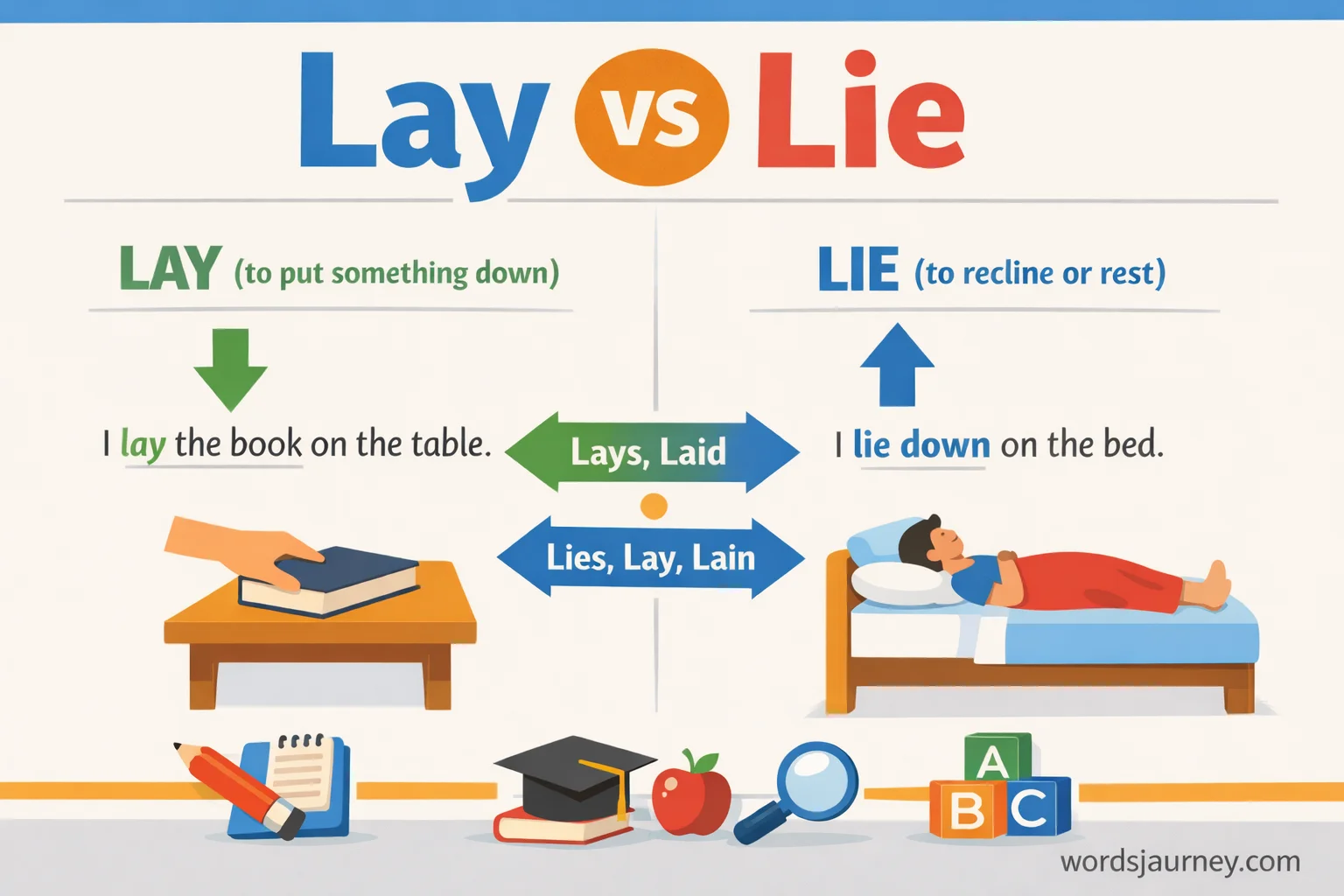
The verb lay means to put or place something down. It always requires a direct object. In other words, something receives the action.
Examples make this clear.
- Please lay the book on the table.
- She lays the baby in the crib.
- He laid the phone beside the laptop.
Notice something important. Each sentence includes an object.
- lay the book
- lays the baby
- laid the phone
Without that object, the sentence feels incomplete.
Key Facts About “Lay”
| Rule | Explanation |
| Lay requires an object | Something must receive the action |
| Lay means to place | You physically put something somewhere |
| Lay is a transitive verb | It acts on an object |
Quick example
She lays the blanket on the couch.
The blanket receives the action.
What “Lie” Means
Now let’s look at lie.
The verb lie means to recline, rest, or remain in a horizontal position. Unlike lay, it does not require an object.
Examples:
- I want to lie down.
- The dog lies on the rug.
- She lay awake all night.
Notice the difference. No object appears after the verb.
The subject performs the action alone.
Key Facts About “Lie”
| Rule | Explanation |
| Lie has no object | The subject performs the action |
| Lie means to recline | Someone rests or stretches out |
| Lie is an intransitive verb | It does not act on anything |
Example:
He lies on the couch after work.
Nothing receives the action.
Quick Rule to Remember Lay vs Lie
Here’s the fastest rule grammar teachers share.
| Verb | Meaning | Needs Object | Example |
| Lay | Put something down | Yes | Lay the keys here |
| Lie | Rest or recline | No | Lie down and relax |
Simple memory trick
- Lay something down
- Lie down yourself
Once you understand that difference, most mistakes disappear.
Verb Forms That Cause Confusion
The real trouble with Lay or Lie comes from verb tenses. Their forms overlap in confusing ways.
For example:
The past tense of lie is lay.
Yes, it sounds strange. That overlap causes most grammar mistakes.
Let’s break down the forms clearly.
Forms of “Lay”
| Tense | Verb Form | Example |
| Present | lay | I lay the phone here |
| Past | laid | She laid the baby down |
| Past Participle | laid | They have laid the carpet |
Example sentences:
- I lay the notebook beside my keyboard.
- Yesterday she laid the keys on the shelf.
- The workers have laid the tiles carefully.
Each sentence contains an object.
Forms of “Lie”
| Tense | Verb Form | Example |
| Present | lie | I lie down after lunch |
| Past | lay | Yesterday I lay on the couch |
| Past Participle | lain | I have lain here for hours |
Examples:
- I lie down when I feel tired.
- Yesterday I lay on the beach.
- I have lain awake all night.
Notice something important.
The past tense lay here has no object.
Why the Past Tense Confuses Everyone
Here’s the confusing part.
| Verb | Present | Past |
| Lie | lie | lay |
| Lay | lay | laid |
Because of this overlap, people often write sentences like:
❌ I am going to lay down.
That sentence sounds common in conversation. However it’s grammatically incorrect.
Correct version:
✔ I am going to lie down.
Understanding the tense pattern fixes most errors.
Lay vs Lie in Everyday Sentences
Real sentences make grammar rules easier to remember.
Below are common situations where Lay or Lie appear in everyday speech.
Examples Using Lay
- Lay the phone on the desk.
- Please lay the blanket here.
- She laid the baby in the crib.
- The chef laid the plates on the table.
- Workers laid the foundation yesterday.
Each sentence includes an object.
Examples Using Lie
- Lie down for a few minutes.
- The dog lies beside the fireplace.
- I lay on the couch yesterday.
- He lies in bed reading novels.
- They have lain in the sun all afternoon.
The subject performs the action alone.
Simple Trick to Remember Lay vs Lie
Grammar rules work better when paired with memory tricks.
Here are three that actually work.
The Object Test
Ask yourself a simple question.
Is something receiving the action?
If yes, choose lay.
Example:
Lay the phone here.
The Recline Rule
If a person or animal rests or reclines, use lie.
Examples:
- Lie on the couch.
- The cat lies on the chair.
The Question Trick
Ask the sentence two questions.
Lay what?
Lie where?
Example:
- Lay the book here.
- Lie on the bed.
This quick mental check prevents mistakes instantly.
Lay vs Lie Diagram (Grammar Visualization)
Understanding grammar visually often makes it easier.
LAY
Subject → Verb → Object
Example
She lays the book on the desk
LIE
Subject → Verb
Example
He lies on the sofa
One verb needs an object. The other doesn’t.
That single difference defines Lay or Lie.
Most Common Lay vs Lie Mistakes
Even native speakers frequently misuse these verbs.
Here are the mistakes you’ll hear most often.
Mistake Example One
Incorrect:
❌ I’m going to lay down for a nap.
Correct:
✔ I’m going to lie down for a nap.
Reason: no object exists.
Mistake Example Two
Incorrect:
❌ The dog laid on the carpet.
Correct:
✔ The dog lay on the carpet.
Reason: past tense of lie is lay.
Mistake Example Three
Incorrect:
❌ Please lie the book on the table.
Correct:
✔ Please lay the book on the table.
Reason: the book receives the action.
Lay vs Lie in Questions
These verbs also appear in questions. Understanding the rule helps avoid confusion.
Examples:
- Did you lay the book there?
- Where did you lie yesterday?
- Have you laid the blanket out?
- Why are you lying on the floor?
Look for the object again.
Lay vs Lie in Continuous and Passive Forms
English verb structures create more variations.
Understanding them helps avoid subtle mistakes.
Continuous Forms
Examples:
- She is laying the table for dinner.
- The dog is lying on the rug.
- He was laying tiles all morning.
Notice the object when using laying.
Passive Voice Examples
Passive constructions appear mostly with lay because objects exist.
Examples:
- The tiles were laid yesterday.
- The carpet was laid carefully.
- The foundation was laid last year.
The subject receives the action in a passive voice.
Lay vs Lie in Idioms and Expressions
English idioms often include Lay or Lie. Understanding these phrases helps you sound more fluent.
Lay the Groundwork
Meaning: prepare the foundation for something.
Example:
The company laid the groundwork for future expansion.
Lay It on the Line
Meaning: speak honestly and directly.
Example:
She laid it on the line during the meeting.
Let Sleeping Dogs Lie
Meaning: avoid restarting old conflicts.
Example:
The argument ended weeks ago. Let sleeping dogs lie.
Lay vs Lie in American vs British Usage
Both American English and British English follow the same grammar rules for these verbs.
However informal speech often bends the rules.
For example, many speakers say:
I’m going to lay down.
Even though grammar guides recommend:
I’m going to lie down.
Quick Lay vs Lie Cheat Sheet
Here’s a simple reference table.
| Situation | Correct Verb |
| Put something down | Lay |
| Someone rests | Lie |
| Past of lie | Lay |
| Past of lay | Laid |
| Past participle of lie | Lain |
Keep this table handy while writing.
Practice Exercises
Testing your knowledge strengthens grammar skills.
Fill in the correct verb.
- Please ___ the notebook on the desk.
- I want to ___ down for a while.
- Yesterday I ___ on the beach all afternoon.
- She has ___ the blanket on the sofa.
Answers:
- lay
- lie
- lay
- laid
Read More: Vice Versa or Visa Versa Meaning, and Usage
Similar Sound and Spelling
Both verbs look and sound similar which increases confusion.
Language experts often point to these reasons when explaining the problem.
Expert Tips to Always Get Lay vs Lie Right
If you want to master these verbs permanently, follow these strategies.
Look for the Object
Ask the question:
Lay what?
If an answer exists, use lay.
Identify the Action
Is someone reclining or resting?
Use lie.
Double Check the Tense
Remember:
- Past of lie = lay
- Past of lay = laid
Practice With Real Sentences
Grammar improves through repetition.
Write your own examples.
Case Study: How Writers Fix Lay vs Lie Errors
Professional editors often correct this mistake in manuscripts.
A study by grammar editors found that lay/lie confusion ranks among the top ten grammar errors in English writing.
Common example from editing:
Original sentence:
After lunch I decided to lay down.
Corrected sentence:
After lunch I decided to lie down.
This single correction improves grammatical accuracy instantly.
What Grammar Experts Say
Language experts frequently address this issue.
The Merriam-Webster Dictionary explains:
“Lay requires an object while lie does not.”
Frequently Asked Questions (FAQs)
1. What is the fundamental difference between Lay or Lie?
The primary distinction lies in sentence structure. The verb “lay” requires a direct object, meaning something must receive the action. In contrast, “lie” does not require an object and refers to a subject reclining or resting.
Examples:
VerbFunctionExampleLayTo place something downPlease lay the documents on the table.LieTo recline or restI need to lie down after a long meeting.
Understanding this structure strengthens accurate English usage and ensures clarity in formal writing.
2. Why are Lay and Lie commonly confused?
The confusion largely stems from their irregular verb forms, particularly in the past tense.
TenseLayLiePresentlayliePastlaidlayPast Participlelaidlain
Because “lay” also appears as the past tense of “lie,” writers often misapply these verbs in everyday communication.
3. Is it correct to say **“lay down” when referring to resting?
In standard grammar, “lay down” requires an object. When referring to resting oneself, “lie down” is the correct expression.
Correct Usage:
- Please lay the files on the desk before the meeting.
- After reviewing the project management schedule, I decided to lie down briefly.
Maintaining this distinction supports professional consistency in business communication.
4. Why does this distinction matter in professional writing?
Correct verb usage contributes to credibility and clarity, particularly in environments where time management, scheduling, and structured communication are essential.
Examples include:
- Preparing meeting agendas
- Updating a calendar or scheduling system
- Writing instructions for online booking platforms
- Documenting workflows in project management tools
- Drafting communications related to broadcasting schedules
Precise grammar ensures messages remain clear, authoritative, and professional.
5. Do US and UK style guides treat these verbs differently?
No significant differences exist between American and British grammar conventions regarding Lay or Lie. Leading authorities such as The Chicago Manual of Style, The AP Stylebook, and Oxford style guidance maintain the same grammatical distinction: “lay” requires an object, while “lie” does not.
This consistency reinforces the importance of mastering the rule for global professional communication.
6. What is a reliable method to remember the rule?
A practical guideline is:
- Lay = place something
- Lie = recline yourself
If a sentence includes an object receiving the action, “lay” is appropriate. If no object appears and the subject is resting, “lie” is correct.
This simple approach promotes consistent and accurate grammar usage.
Conclusion
Understanding the distinction between Lay or Lie is essential for maintaining accuracy, professionalism, and clarity in written communication. While the verbs may appear similar, their grammatical roles differ significantly. “Lay” requires a direct object, indicating that something is being placed, whereas “lie” describes a subject reclining without an object.
This distinction becomes particularly important in contexts involving business communication, scheduling systems, project management documentation, broadcasting instructions, and calendar coordination. Accurate verb usage supports clear messaging, enhances formal writing quality, and ensures consistency across professional documents. Fortunately, the rule is straightforward once understood. By checking for a direct object and remembering the simple principle—lay places something, lie rests—writers can confidently apply the correct verb. Whether following US or UK style guidelines, mastering Lay or Lie strengthens both grammatical precision and professional credibility.

Aliya Ray is a passionate writer and language enthusiast at WordsJourney. She enjoys exploring words, phrases, and everyday expressions to help readers communicate more clearly and confidently. Her content focuses on alternative ways to say common phrases, simple explanations, and real-life examples that make language easy to understand.
Aliya believes the right words can make any message stronger. Through clear, friendly writing, she helps readers improve their vocabulary without feeling overwhelmed or confused.