Ever paused mid-sentence and wondered which word fits “Laying or Lying” especially when you’re writing an email, updating a calendar, or confirming meetings? That tiny choice can shape clarity in business communication, trip up formal writing, and quietly undermine consistency across your content. If you juggle scheduling, time management, or project management, this confusion shows up more often than you’d expect.
This guide breaks down the difference between laying and lying in plain English, with crisp rules and everyday examples. You’ll see how correct English usage improves grammar in broadcasting, sharpens messages in online booking, and keeps your calendar notes clean and professional. We’ll connect the dots to real workflows meetings, task updates, and client messages so the rules stick when you need them most.
We’ll also touch on style guides and regional preferences and a quick note on US vs. UK conventions so your writing stays aligned with your audience. Expect practical tips, memory hooks, and common pitfalls to avoid. By the end, you’ll choose the right form with confidence, protect your voice in formal writing, and keep your communication clear across every channel.
The Core Difference Between Lay and Lie
The heart of the laying or lying confusion sits in one simple rule.
Lay needs an object.
Lie never takes an object.
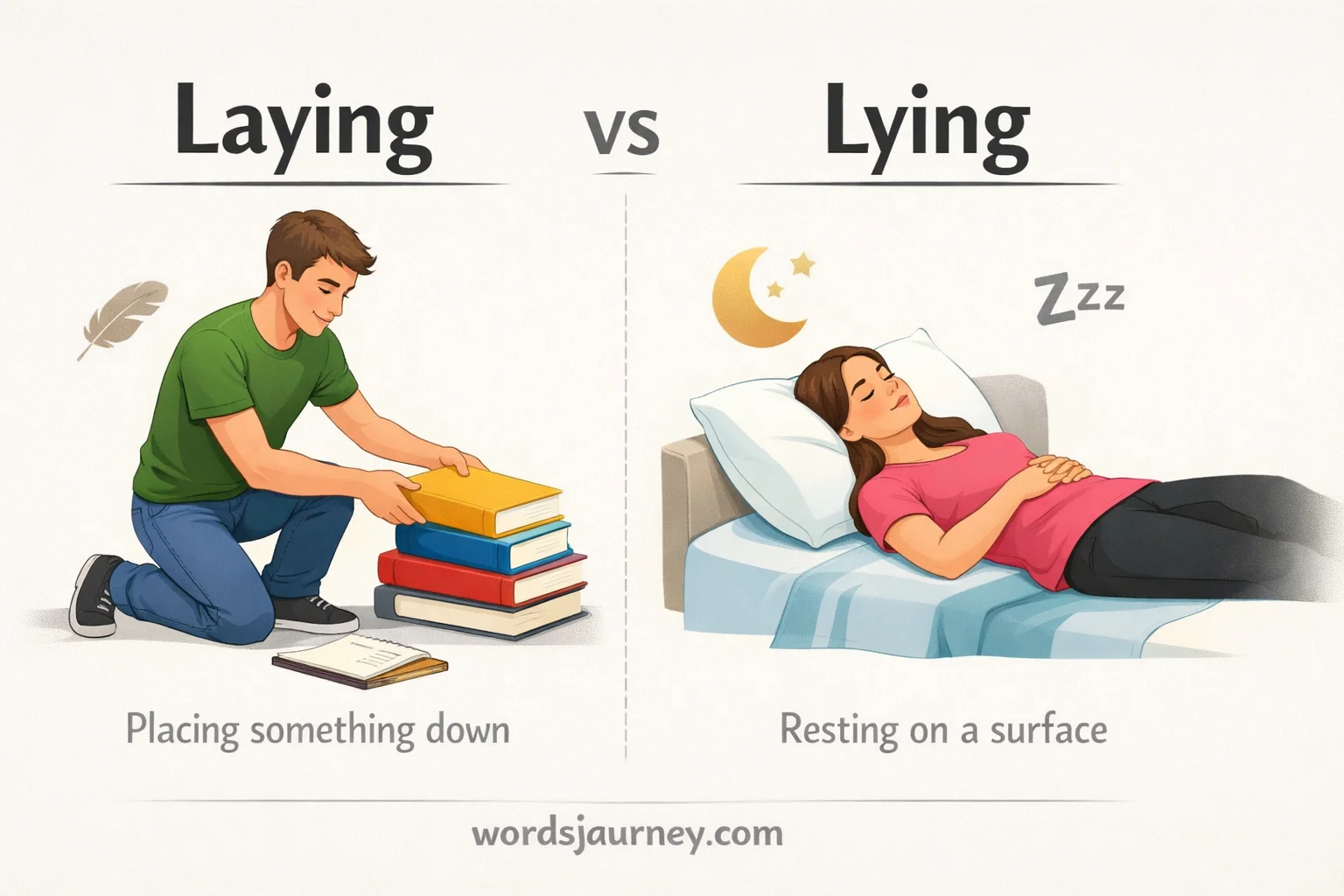
That’s it. If you place something somewhere, you lay it. If a person or animal rests or reclines, they lie.
Think of lay as an action you do to something else.
Think of lie as something you do yourself.
Here’s a clean breakdown.
Key Definitions
- Lay: to put or place something down
- Lie: to recline or rest in a flat position
Core Verb Forms
| Verb | Needs an Object | Present | Past | Present Participle | Past Participle |
| Lay | Yes | lay | laid | laying | laid |
| Lie | No | lie | lay | lying | lain |
This table alone clears up most laying or lying mistakes. Save it. Bookmark it. Come back when doubt creeps in.
Laying or Lying in the Present Tense
This is where daily mistakes explode. People often say “I’m laying down” when they mean “I’m lying down.” The error feels natural because spoken English blurs grammar lines. Writing does not forgive as easily.
When to Use Laying
Use laying when someone places an object.
Correct examples
- She is laying the book on the table.
- He is laying the baby in the crib.
- They are laying tiles in the kitchen.
In each case, the verb acts on an object.
Book. Baby. Tiles.
When to Use Lying
Use lying when no object appears.
Correct examples
- She is lying on the couch.
- The cat is lying in the sun.
- I am lying down to rest.
No object. Just a person or animal resting.
Common Present-Tense Mistakes
People often write:
- ❌ I’m laying down.
- ❌ He’s laying on the bed.
- ❌ The dog is laying on the rug.
Each sentence lacks an object. The correct form is lying.
One-Second Test
Ask one quick question.
Am I placing something?
- Yes → use laying
- No → use lying
That simple test saves time and embarrassment.
Past Tense Confusion: Why This Gets Messy Fast
The past tense turns laying or lying into a grammar maze. Here’s why.
The past tense of lie is lay.
The past tense of lay is laid.
So yesterday, you lay on the couch.
Yesterday, you laid the book down.
Yes, the present of one verb becomes the past of the other. English loves chaos.
Clear Past-Tense Examples
- She lay on the floor after the workout.
- He laid the keys on the counter.
- The dog lay beside the fire.
- They laid the plans carefully.
What Goes Wrong in Real Writing
Writers often flip these forms.
- ❌ She laid on the couch.
- ❌ He lay the phone on the desk.
Both are wrong because they break the object rule.
Quick Fix
If there is an object, use laid.
If there is no object, use lay.
That’s the anchor.
How to Choose the Right Word Fast
You don’t need grammar charts during a busy day. You need a shortcut that works under pressure.
The Object Test
Ask one blunt question:
Is there an object receiving the action?
- Yes → lay, laying, laid
- No → lie, lying, lay
Mini Flow Guide
- Placing something?
- Use laying or laid
- Resting yourself?
- Use lying or lay
Memory Trick
Think of lay as a word that “lays” onto another word.
If another word follows as an object, lay belongs.
No object. No lay.
Real-World Examples in Everyday Contexts
Errors around laying or lying show up everywhere. Let’s clean them up.
At Home
- ❌ I’m laying on the couch.
- ✅ I’m lying on the couch.
- ❌ She was laying in bed all morning.
- ✅ She was lying in bed all morning.
- ❌ He is laying his jacket on the chair.
- ✅ He is laying his jacket on the chair.
At Work
- ❌ The report is laying on your desk.
- ✅ The report is lying on your desk.
- ❌ She was laying in the conference room after lunch.
- ✅ She was lying in the conference room after lunch.
On Social Media
Short captions amplify mistakes.
- ❌ Just laying here, tired.
- ✅ Just lying here, tired.
- ❌ Laying low this weekend.
- ✅ Lying low this weekend.
In Storytelling
- ❌ The hero was laying on the battlefield.
- ✅ The hero was lying on the battlefield.
Why Grammar Tools Still Miss This Error
Spellcheckers catch typos. They struggle with logic. Many tools cannot detect whether a verb needs an object. That blind spot causes false confidence.
Popular tools help with surface-level grammar. They miss deep verb structure.
Automated tools analyze patterns. They do not understand the meaning. That gap explains why laying or lying slips through.
Laying or Lying in Questions and Commands
Questions and commands twist sentence order. The grammar rule stays the same.
Questions
- ❌ Are you laying on the floor?
- ✅ Are you lying on the floor?
- ❌ Is she laying down?
- ✅ Is she lying down?
Commands
Commands often cause confusion because “lay down” sounds natural.
- ❌ Lay down and rest.
- ✅ Lie down and rest.
However, when an object exists, lay fits.
- ✅ Lay the blanket down.
- ✅ Lay the phone on the table.
Common Myths About Laying or Lying
Bad advice spreads fast. Let’s clear out the worst myths.
Myth: Just Memorize It
Memorization without context fails under pressure. The brain forgets lists. It remembers patterns. The object rule sticks because it ties to meaning.
Myth: Everyone Mixes These Up So It Doesn’t Matter
Mistakes affect credibility. Readers notice patterns even when they can’t name the rule. Clear writing builds trust. Sloppy verbs weaken authority.
Myth: Spoken English Doesn’t Count
Speech habits shape writing habits. Fixing laying or lying in writing improves speech too. Over time, the correct form feels natural.
Practice: Test Yourself
Try these real-world sentences. Choose laying or lying. Then check the answers below.
Practice Set
- The child is ____ on the carpet.
- She is ____ the groceries on the counter.
- He ____ in bed all day yesterday.
- They were ____ the foundation for the house.
- The phone is ____ on the desk.
Answer Key
- The child is lying on the carpet.
- She is laying the groceries on the counter.
- He lay in bed all day yesterday.
- They were laying the foundation for the house.
- The phone is lying on the desk.
Each correct answer follows the object rule. No exceptions.
Search Questions People Actually Ask About Laying or Lying
Readers don’t search grammar terms. They search problems.
High-Intent Questions
- Is it laying down or lying down?
- Should I say I was laying in bed or lying in bed?
- What’s the difference between lay, lie, laid, and lain?
- Why do native speakers confuse laying or lying?
Clear Answers
- “Lying down” is correct because no object appears.
- “Lying in bed” works because you aren’t placing anything.
- The four forms exist because English preserves old verb patterns.
- Native speakers learn through speech first, grammar second.
Also Read: Prey vs Pray: Master the Difference and Never Confuse
Quick Reference Cheat Sheet
Save this section for fast recall.
One-Glance Summary
- Lay → needs an object
- Lie → no object
- Laying → placing something
- Lying → resting yourself
- Laid → past of lay
- Lay → past of lie
- Lain → past participle of lie
Example Pairs
- Lay the book down. / Lie down and rest.
- He laid the phone down. / He lay on the couch.
- She is laying the blanket. / She is lying under it.
Real Case Study: How One Verb Hurt Brand Trust
A lifestyle brand ran paid ads with the caption:
“Just laying here, enjoying the calm.”
The ad reached over 200,000 users. Comments flooded in. Many focused on the grammar mistake instead of the product. Engagement shifted from interest to correction. The brand fixed the caption later. The damage had already shaped perception.
Small language choices shape brand voice. Clean grammar signals care and competence.
Conclusion: Master Laying or Lying Without Overthinking
The laying or lying problem looks tricky at first glance. Under the hood, it runs on one clear rule. Objects trigger lay. No object triggers lie. Everything else flows from that logic.
Strong writing rests on small habits. You don’t need to sound stiff or academic. You just need to choose the word that fits the action. Over time, the correct form becomes automatic. Your writing reads smoother. Your voice sounds sharper. Readers trust what you say.
That’s the quiet power of getting one tiny verb right.
FAQs: Laying or Lying
1) What is the basic difference between laying and lying?
Laying is a transitive verb. It needs a direct object—you lay something down. Lying is an intransitive verb. It never takes an object—you lie down yourself.
2) Which is correct: “I’m laying down” or “I’m lying down”?
Use “I’m lying down” when you mean you are resting. Use “I’m laying the files down” when you place something on a surface.
3) Why do people mix them up so often?
Because the past tense of lie is lay, which looks identical to the present tense of lay. This overlap confuses writers in formal writing, business communication, and everyday messages.
4) What are the past forms I should remember?
- Lay → laid → laid (present → past → past participle)
- Lie → lay → lain These forms matter in broadcasting, reports, and polished English usage.
5) Does US vs. UK English change the rule?
No. The grammar rule is the same in both regions. Style guides in the US and UK agree on usage. Only spelling conventions differ, not verb logic.
6) How can I avoid mistakes in work emails and calendars?
Tie the verb to the task. If there’s an object—documents, files, plans—use laying. If it’s about a person resting, use lying. This quick check helps in scheduling, meetings, and project management notes.
7) Can you give quick examples I can reuse?
- Correct: “She is laying the agenda on the table.”
- Correct: “He is lying down before the meeting.”
- Incorrect: “He is laying down.” (No object.)
Conclusion
The choice between laying or lying is small but powerful. One verb places something. The other describes someone resting. When you lock in that distinction, your formal writing gets sharper, your business communication gets clearer, and your notes in calendars, meetings, and project management stay precise.
Use the object test. If there’s a thing being placed, pick laying. If not, choose lying. Keep an eye on tense forms, follow trusted style guides, and stay consistent across US vs. UK contexts. Master this pair once, and your everyday English usage levels up everywhere from broadcasting scripts to online booking copy.

Emma Brook is a dedicated writer and language enthusiast at WordsJourney. She’s passionate about helping readers understand words better and use them with confidence in everyday conversations. Her work focuses on alternative phrases, clear meanings, and practical examples that make language feel simple and approachable.
With a friendly, reader-first writing style, Emma breaks down common expressions and explores smarter ways to say things without sounding forced or complicated. Her goal is to make learning words enjoyable, useful, and easy for everyone.