Have you ever paused while writing and wondered which symbol fits your sentence or calculation? The debate around “Less Than vs Greater Than” might look simple yet it often creates confusion in math, writing and everyday communication. These small symbols shape meaning in data comparisons, schedules and digital systems. Whether you manage a calendar, plan meetings or track numbers in project management, understanding Less Than vs Greater Than helps you express comparisons clearly and avoid costly misunderstandings.
These symbols also appear far beyond basic math lessons. In business communication, online booking systems and broadcasting schedules, comparisons determine priorities, limits and timing. Think about time management, meeting deadlines or setting booking rules like “less than 24 hours notice.” Clear comparisons keep scheduling, calendar organization and project coordination consistent. When used correctly in English usage, grammar explanations and formal writing, these symbols help readers interpret numbers and conditions instantly.
This guide explains the key difference between Less Than vs Greater Than, how each symbol works and when to use them correctly. You’ll learn simple rules, practical examples and real-world applications in meetings, business documentation and data communication. We’ll also touch on style guides and regional preferences, including common US vs UK writing conventions, to ensure accuracy and consistency. By the end, you’ll understand these symbols clearly and apply them confidently in both professional writing and everyday problem-solving.
Understanding Comparison Symbols in Mathematics
Mathematics relies heavily on comparison. Numbers rarely exist in isolation. Instead, they interact. They compete. They form relationships.
Comparison symbols help express those relationships quickly.
Three core symbols appear in basic mathematics:
| Symbol | Name | Meaning | Example |
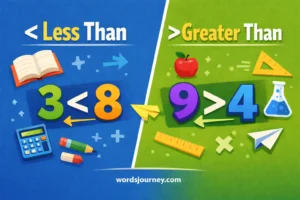
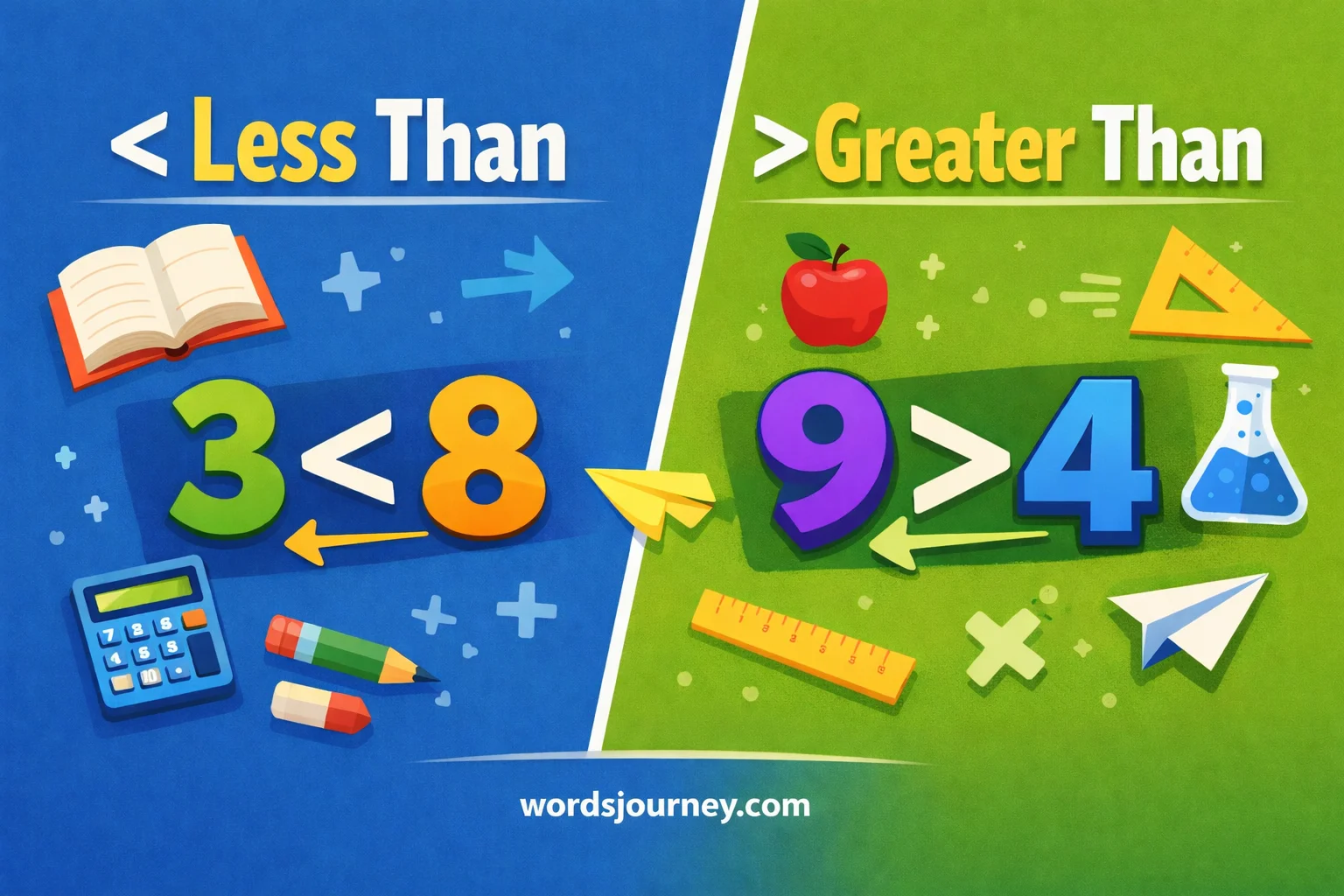
| < | Less Than | Left value is smaller | 3 < 8 |
| > | Greater Than | Left value is larger | 9 > 4 |
| = | Equal To | Both values are the same | 5 = 5 |
These symbols allow mathematicians to describe relationships clearly.
For example:
- 12 > 6 means twelve is larger than six.
- 4 < 10 means four is smaller than ten.
- 7 = 7 means both numbers are identical.
Without comparison symbols, math explanations would become long and messy. Imagine writing:
“Five is smaller than eight.”
Instead, mathematics compresses that idea into 5 < 8.
Simple. Elegant. Universal.
What the Less Than Symbol Means
The less than symbol (<) indicates that the number on the left is smaller than the number on the right.
Example comparisons:
- 2 < 6
- 5 < 9
- 15 < 40
In plain English, these statements mean:
- Two is less than six.
- Five is less than nine.
- Fifteen is less than forty.
The symbol opens toward the larger number.
This rule becomes the key to remembering its direction.
Visual Example
3 < 8
Here, the symbol opens toward 8, which is the larger value.
Real-World Examples of Less Than
Numbers are everywhere in daily life. The less than symbol helps compare them quickly.
Examples include:
- $5 < $10 when comparing prices.
- Age 8 < Age 18 when comparing people.
- Temperature 10°C < 20°C during weather comparisons.
Even technology relies on these comparisons.
For instance, an app may check if battery percentage < 20% to trigger a low-battery warning.
What the Greater Than Symbol Means
The greater than symbol (>) works in the opposite direction. It shows that the number on the left is larger than the number on the right.
Examples include:
- 7 > 4
- 50 > 25
- 100 > 10
In everyday language, these statements read:
- Seven is greater than four.
- Fifty is greater than twenty-five.
- One hundred is greater than ten.
Visual Example
9 > 3
The opening side faces 9, the bigger number.
Real-World Examples of Greater Than
Greater than comparisons appear in many practical situations.
Consider these examples:
- A marathon distance > sprint distance
- Monthly salary > monthly expenses
- Laptop price > smartphone price
Businesses also rely on these comparisons.
For example:
If profit > expenses, the company earns money.
If expenses > revenue, the company loses money.
One symbol can determine whether a business succeeds or fails.
The Core Difference Between Less Than vs Greater Than
Although these symbols look similar, their meaning moves in opposite directions.
The easiest way to understand them is through comparison.
| Feature | Less Than (<) | Greater Than (>) |
| Meaning | Smaller value | Larger value |
| Symbol Direction | Opens toward bigger number | Opens toward bigger number |
| Example | 4 < 9 | 9 > 4 |
| Spoken Form | Four is less than nine | Nine is greater than four |
The rule remains consistent:
The wider side of the symbol always faces the larger number.
Once you remember that principle, confusion disappears.
The Famous Alligator Method
Many teachers use a playful trick called the Alligator Method.
Imagine the comparison symbol as a hungry alligator mouth.
The alligator always wants the bigger meal.
Example
8 > 3
The alligator opens toward 8 because eight is larger.
Children love this method because it turns math into a visual story.
Instead of memorizing abstract rules, they imagine a creature choosing the bigger snack.
Educational experts often recommend visual learning because it strengthens memory.
A study published by the National Science Teaching Association found that visual analogies dramatically improve concept retention.
Using Number Lines to Compare Numbers
Number lines provide another powerful way to understand Less Than vs Greater Than.
A number line arranges numbers from smallest to largest.
0 — 2 — 4 — 6 — 8 — 10
The rule is simple:
- Numbers farther right are greater.
- Numbers farther left are smaller.
Examples:
- 2 < 8
- 10 > 6
- 4 < 7
This method helps beginners visualize number relationships clearly.
It also becomes essential when studying negative numbers.
For example:
-5 < -2
Although both numbers are negative, -2 lies farther right on the number line. Therefore it is greater.
Comparing Large Numbers Correctly
Small numbers are easy to compare. Large numbers require a systematic approach.
The trick lies in place value comparison.
Follow these steps:
Step-by-Step Method
- Compare digits from left to right
- Check place values (thousands, hundreds, tens)
- The number with the higher leading digit is larger
Example Comparisons
| Number Comparison | Result |
| 4,500 vs 4,200 | 4,500 > 4,200 |
| 900 vs 1,000 | 900 < 1,000 |
| 12,000 vs 9,999 | 12,000 > 9,999 |
Notice how the first digit determines the winner.
Even though 900 has three digits, it remains smaller than 1,000.
Place value decides everything.
Comparing Decimals Using Less Than and Greater Than
Decimals often confuse students because the numbers appear similar.
Take this example:
- 0.5
- 0.05
Which is larger?
Many learners assume 0.05 is bigger because it has more digits. That assumption is incorrect.
Let’s convert them:
- 0.5 = 0.50
- 0.05 = 0.05
Now the comparison becomes obvious.
0.50 > 0.05
Decimal Comparison Examples
| Comparison | Result |
| 0.7 vs 0.9 | 0.7 < 0.9 |
| 3.75 vs 3.5 | 3.75 > 3.5 |
| 1.25 vs 1.30 | 1.25 < 1.30 |
The key rule:
Compare decimal digits from left to right just like whole numbers.
Comparing Fractions with Less Than vs Greater Than
Fractions add another layer of complexity. Yet the same comparison logic still applies.
Example
1/4 < 1/2
Why?
Because half a pizza is bigger than a quarter slice.
Three Reliable Fraction Comparison Methods
Common Denominators
Convert fractions to the same denominator.
Example:
1/3 = 2/6
1/2 = 3/6
Now compare:
2/6 < 3/6
Cross Multiplication
Multiply diagonally.
Example:
3/5 ? 2/5
Since denominators match, compare numerators.
3 > 2
So:
3/5 > 2/5
Decimal Conversion
Convert fractions to decimals.
Example:
1/4 = 0.25
1/2 = 0.5
Then compare:
0.25 < 0.5
Using Less Than and Greater Than in Algebra
In algebra, these symbols create inequalities.
Inequalities describe ranges of values rather than exact answers.
Example:
x > 5
This statement means x can be any number greater than five.
Possible solutions include:
- 6
- 10
- 100
- 1,000
Another example:
y < 12
Possible values:
- 11
- 5
- -3
Algebra often combines inequalities with graphs.
Example number line representation:
5 —–>
The arrow shows that all values greater than five are valid solutions.
Real-Life Applications of Less Than vs Greater Than
These comparison symbols extend far beyond classroom math.
They power many everyday systems.
Finance
Financial decisions rely heavily on numerical comparisons.
Examples include:
- Savings > expenses
- Income > debt
- Investment return > inflation
If expenses exceed income, the equation flips.
Expenses > Income
That scenario leads to debt.
Technology and Programming
Computer programs constantly compare numbers.
Programming languages like Python, JavaScript, and C++ use these operators.
Example in code:
if (score > 80) {
grade = “A”;
}
The program checks whether the score exceeds 80.
If true, the student receives an A.
These comparisons power:
- search engines
- financial software
- artificial intelligence
- video games
Data Science
Data analysts constantly compare metrics.
Examples include:
- Revenue > costs
- Clicks > impressions
- Growth rate > last year
Without comparison symbols, analyzing data would become nearly impossible.
Common Mistakes Students Make
Despite their simplicity, students frequently misinterpret these symbols.
Here are the most common errors.
Reversing the Symbols
Incorrect:
7 < 3
Correct:
7 > 3
Seven is larger than three.
Ignoring Place Value
Students sometimes compare numbers incorrectly.
Example mistake:
100 < 99
The correct comparison is:
100 > 99
Even though 99 has two digits, 100 is still larger.
Decimal Misunderstandings
Another common mistake:
0.5 < 0.25
This is incorrect.
The correct comparison is:
0.5 > 0.25
Always convert decimals to equal places when comparing.
Read More: Vice Versa or Visa Versa Meaning, and Usage
Easy Memory Tricks to Remember the Symbols
Simple tricks can eliminate confusion permanently.
The Alligator Trick
The symbol acts like an alligator mouth.
The alligator always eats the larger number.
The Wide Side Rule
The wide side of the symbol faces the bigger number.
Example:
9 > 2
The open side points toward 9.
Alphabet Trick
The word Less begins with L.
The symbol for less than resembles a tilted L.
<
That visual hint helps reinforce the concept.
Practice Examples
Try solving these comparisons.
| Problem | Answer |
| 6 __ 9 | 6 < 9 |
| 12 __ 5 | 12 > 5 |
| 20 __ 20 | 20 = 20 |
| 0.8 __ 0.6 | 0.8 > 0.6 |
| 1/3 __ 1/2 | 1/3 < 1/2 |
Practice strengthens recognition speed.
Over time, these comparisons become automatic.
Quick Summary of Less Than vs Greater Than
| Symbol | Name | Meaning | Example |
| < | Less Than | Smaller value | 4 < 9 |
| > | Greater Than | Larger value | 9 > 4 |
| = | Equal To | Same value | 7 = 7 |
Key rule to remember:
The open side always faces the bigger number.
Case Study: How Comparison Symbols Power Algorithms
Search engines rely heavily on comparison operations.
When ranking pages, algorithms analyze hundreds of signals such as:
- backlinks
- page speed
- content relevance
- engagement metrics
Each factor involves comparisons.
Example logic:
if (pageAuthority > competitorAuthority)
rankHigher();
This simple inequality can influence which website appears first in search results.
In other words, comparison symbols help shape the internet you see every day.
Expert Quote
“Mathematics reveals hidden patterns that help us understand the world.”
— Marcus du Sautoy, Oxford Mathematician
Comparison symbols form the backbone of those patterns.
They allow numbers to communicate relationships instantly.
Frequently Asked Questions (FAQs)
1. What is the main difference between Less Than vs Greater Than?
The difference between Less Than vs Greater Than lies in how they compare numbers. The less than symbol (<) shows that one value is smaller than another, while the greater than symbol (>) shows that one value is larger. For example, 5 < 10 means five is smaller than ten and 10 > 5 means ten is larger than five.
2. How can I easily remember Less Than vs Greater Than symbols?
A common trick is the “open mouth rule.” The open side of the symbol always faces the larger number. Think of it like a hungry mouth that wants the bigger meal. For example, 8 > 3 because eight is larger.
3. Are Less Than and Greater Than used outside mathematics?
Yes. These symbols appear in many real-world contexts such as scheduling rules, time management limits and online booking systems. Businesses may use statements like “appointments must be canceled < 24 hours in advance.” They also appear in data analysis, project management and technical communication.
4. Do style guides mention Less Than vs Greater Than usage?
Most style guides, including common US and UK writing standards, recommend using the symbols mainly in mathematics, technical documents and data tables. In formal writing or grammar explanations, many editors prefer writing the phrase “less than” or “greater than” instead of symbols to maintain clarity and consistency.
5. Why is understanding Less Than vs Greater Than important in business communication?
Clear comparisons help prevent misunderstandings in business communication. These symbols often appear in meeting reports, broadcasting schedules, analytics dashboards and project timelines. Using them correctly ensures accurate calendar planning, task prioritization and data reporting.
6. What is the difference between Less Than and Less Than or Equal To?
The less than symbol (<) means strictly smaller. The less than or equal to symbol (≤) means the value can be smaller or exactly the same. For example, x < 10 means any number below ten, while x ≤ 10 includes ten itself.
Conclusion
Understanding Less Than vs Greater Than is a small skill with a big impact. These symbols appear everywhere—from mathematics and data comparison to business communication, scheduling and digital systems. When you know which symbol to use, your comparisons become clearer and your message stays precise.
In professional environments like project management, online booking platforms and calendar scheduling, even a tiny symbol can change the meaning of a rule or deadline. Correct usage supports better time management, smoother meetings and more accurate broadcasting schedules. It also strengthens consistency in formal writing and English usage.
The key takeaway is simple. Less than (<) shows a smaller value while greater than (>) shows a larger one. Once you understand this basic rule, reading and writing comparisons becomes effortless. Whether you are studying math, writing reports or organizing tasks, mastering Less Than vs Greater Than helps you communicate numbers clearly and confidently.

Aliya Ray is a passionate writer and language enthusiast at WordsJourney. She enjoys exploring words, phrases, and everyday expressions to help readers communicate more clearly and confidently. Her content focuses on alternative ways to say common phrases, simple explanations, and real-life examples that make language easy to understand.
Aliya believes the right words can make any message stronger. Through clear, friendly writing, she helps readers improve their vocabulary without feeling overwhelmed or confused.