Have you ever paused mid-sentence wondering whether to say “lie down” or “lay down”? You’re not alone. The confusion around “Lie Down vs Lay Down” appears everywhere—from casual conversations to business communication, formal writing, and even professional broadcasting scripts. In a world driven by clarity, consistency, and polished English usage, choosing the correct verb matters more than many writers realize. One small grammar decision can influence how your message sounds in emails, presentations, or client interactions.
This guide explains the real difference between these commonly mixed verbs using practical examples connected to everyday work and communication. Whether you’re managing a calendar, planning meetings, handling online booking, or writing updates for project management, precise language improves understanding. Strong grammar supports effective time management and professional credibility. We’ll break down verb structure, usage patterns, and memory tricks so you can confidently apply the right form in both spoken and written English.
You’ll also learn how style guides and regional preferences shape usage. While US and UK English largely agree on the grammatical rules, variations in tone and formal writing expectations can influence choice and context. By the end of this article, you’ll understand not only the grammatical distinction but also how mastering Lie Down vs Lay Down strengthens communication across workplaces, academic settings, and everyday conversations. Clear grammar isn’t about perfection—it’s about communicating with precision and confidence.
The Fastest Way to Understand Lie Down vs Lay Down
When it comes to these two verbs, there’s a one-sentence rule that clears up most confusion:
- Lie = no object. You do it yourself.
- Lay = requires an object. You do it to something else.
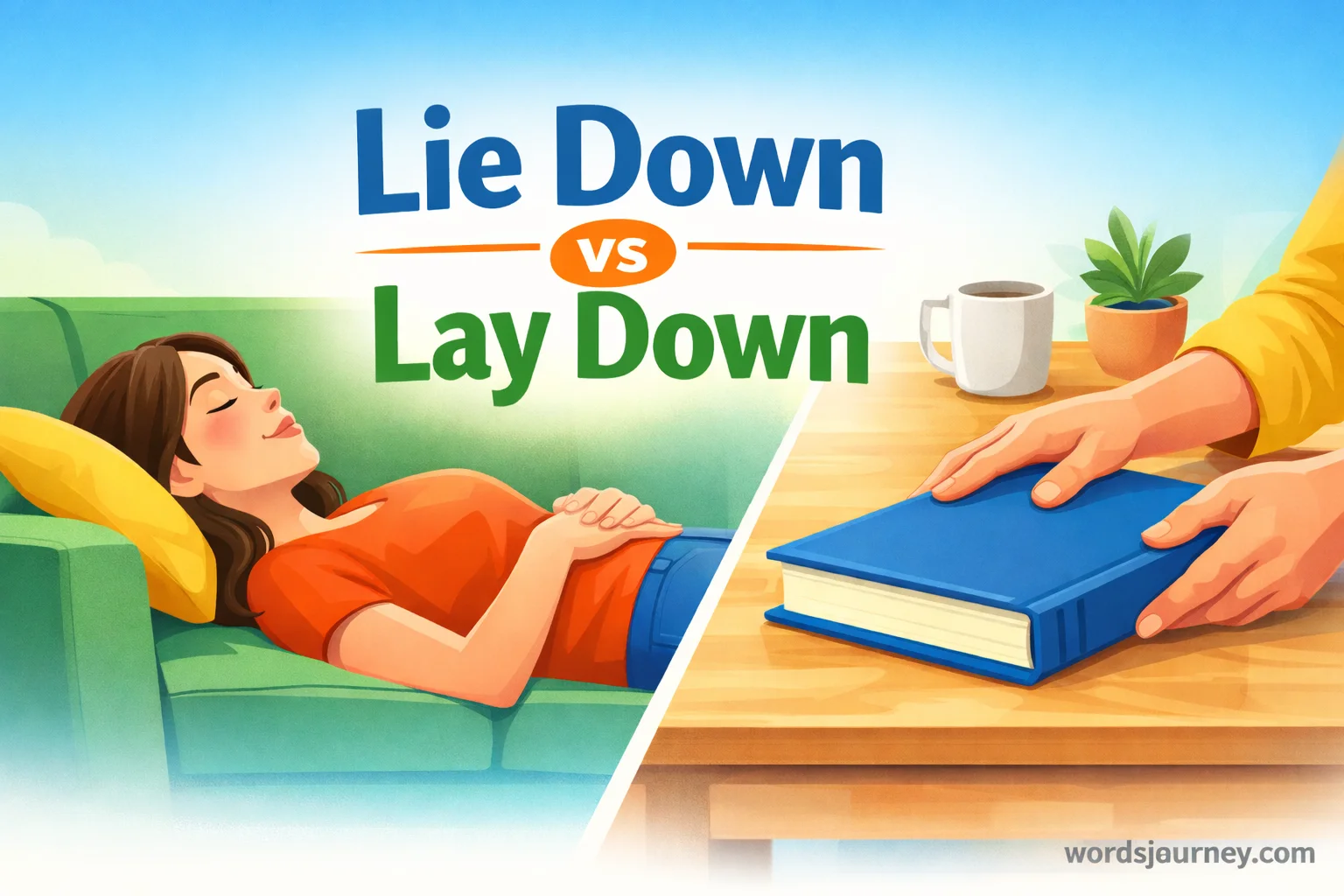
Think of it this way: “You lie yourself down” versus “You lay the book down.” One affects you, the other affects something else.
Quick Memory Trick
A simple way to remember:
- Lie → “I lie down.” You are the object, no extra thing involved.
- Lay → “I lay the keys down.” The keys are the object.
Comparison Table
| Verb | Needs Object? | Meaning | Example |
| Lie | No | Recline or rest | I lie down after work. |
| Lay | Yes | Put or place | I lay the blanket on the bed. |
This table alone can save you from endless confusion in both writing and speech.
What Does “Lie Down” Mean?
Lie down is all about reclining yourself. You don’t move anything else. It’s an action performed by the subject alone.
For example:
- “I feel tired, so I will lie down for a while.”
- “During the yoga class, we all lie down on our mats.”
- “He lies down on the couch every afternoon to read.”
Verb Forms of Lie
| Tense | Form |
| Present | Lie |
| Past | Lay |
| Past Participle | Lain |
| Present Participle | Lying |
Notice the trickiest part: the past tense of lie is lay, which makes this one of the most common errors. People often confuse “lay” the past tense of lie with the present tense of lay.
What Does “Lay Down” Mean?
Lay down always requires an object. It means to place something somewhere. You’re doing something to an item, not yourself.
Examples:
- “Please lay the baby down in the crib.”
- “He laid the plates on the table carefully.”
- “I need to lay my laptop down while I make coffee.”
Verb Forms of Lay
| Tense | Form |
| Present | Lay |
| Past | Laid |
| Past Participle | Laid |
| Present Participle | Laying |
Using lay correctly requires remembering the object. If you can’t point to what is being placed, lie is likely correct.
Why People Confuse Lie and Lay
Even native speakers stumble over these verbs. Why?
- Sound Similarity – “lie” and “lay” sound alike, making them easy to mix up in speech.
- Past Tense Trap – The past tense of lie is lay, identical to the present tense of lay.
- Historical Grammar – Old English used forms differently, and some patterns stuck in modern speech.
Example confusion:
- ❌ “I’m going to lay down for a nap.” (incorrect, no object)
- ✅ “I’m going to lie down for a nap.” (correct)
Lie Down vs Lay Down — Side-by-Side Comparison
| Situation | Correct Verb | Example |
| Resting yourself | Lie | I lie down after lunch. |
| Placing an object | Lay | I lay the book down on the desk. |
| Past tense resting | Lay | Yesterday, I lay down early. |
| Past tense placing | Laid | Yesterday, I laid the keys on the counter. |
This table is your cheat sheet for quick reference. Always check if the action involves another object.
The Object Test (Never Get It Wrong Again)
Here’s a foolproof method to decide between lie and lay:
- Ask: Is something being placed?
- Yes → use lay
- No → use lie
Examples:
- “I lie down every night at 10 PM.” ✅
- “I lay the coat on the chair.” ✅
This simple test works in speech, writing, and even in professional contexts.
Common Mistakes Native Speakers Make
Even fluent speakers get tripped up:
- ❌ “I’m going to lay down now.”
- ❌ “He laid down for a nap yesterday.”
Why? Because the past tense of lie is lay, creating a mental shortcut. Understanding the verb forms helps you speak and write confidently.
Lie vs Lay in Different Tenses
Present Tense
- Lie → I lie down when tired.
- Lay → I lay the cup on the table.
Past Tense
- Lie → I lay down yesterday.
- Lay → I laid the keys on the counter yesterday.
Perfect Tense
- Lie → I have lain here for an hour.
- Lay → I have laid the foundation for the project.
Continuous Forms
- Lie → I am lying down now.
- Lay → I am laying the carpet today.
A simple timeline diagram can help visualize the differences. Remember: object or no object is your ultimate clue.
Lie Down vs Lay Down in Everyday Conversation
The verbs also appear differently depending on context:
- Casual speech – “I’m going to lay down” may sound natural but is technically incorrect.
- Formal writing – Always use lie down when no object is present.
- Professional or academic writing – Stick to proper forms to avoid grammar errors.
Memory Tricks That Actually Work
- Object Rule: Lay = something else is placed, Lie = only you move.
- LAy = Location Added: helps remember lay involves placing an object.
- Visualization: Picture yourself lying on a bed vs laying an object on a table.
- Mini Checklist: Ask: Is there an object? Decide accordingly.
Examples From Real Contexts
At Home
- “I lie down after dinner.”
- “I lay the baby down in the crib.”
At Work
- “I lie down during my break.”
- “I laid the documents on the manager’s desk.”
Medical Context
- “The patient lies down for the examination.”
- “Nurses lay the instruments on a sterile tray.”
Parenting Situations
- “Children lie down for a nap.”
- “Parents lay toys back in the box.”
Travel & Relaxation
- “I lie down on the beach towel.”
- “I laid my backpack under the seat.”
Real-life examples reinforce understanding and make grammar intuitive.
Read More: Wellbeing or Well-Being: Which Spelling Is Correct?
Lie Down vs Lay Down Quiz
Try this mini quiz:
- I ___ down after a long run.
- I ___ the plate on the table.
- Yesterday, she ___ down for a nap.
- They ___ the chairs neatly in the room.
Answers: 1) lie 2) lay 3) lay 4) laid
Interactive practice helps commit these forms to memory.
Related Grammar Confusions
Once you master lie vs lay, you’ll find other similar pairs easier:
- Sit vs Set
- Rise vs Raise
- Lie vs Lying
- Lay vs Laid
Quick Reference Cheat Sheet
- Lie → recline yourself, no object
- Lay → place something, requires an object
- Past tense of lie → lay
- Past tense of lay → laid
- Tip → Ask: “Am I placing something?” If yes, use lay.
Screenshot this cheat sheet, and you’ll never forget the difference.
Frequently Asked Questions (FAQs)
1. What is the main difference between “lie down” and “lay down”?
“Lie down” is an intransitive verb, meaning it does not take a direct object. For example: I need to lie down after a long meeting. “Lay down” is a transitive verb, requiring a direct object: Please lay down the files on my desk.
2. Can “lay” be used as a past tense of “lie”?
Yes. The past tense of “lie” is “lay”. For example: Yesterday, I lay on the couch for an hour. This is often confused with “lay down”, so context is key.
3. Is one form preferred in formal writing or US vs UK English?
Both forms are grammatically correct, but clarity matters. US English often prefers more direct forms, while UK English may allow slightly flexible usage. Always check style guides for professional documents or business communication.
4. How can I remember which one to use?
Think “lie” = no object, “lay” = needs an object. Associating it with everyday actions, like scheduling rest breaks or laying down project plans, helps reinforce the rule.
5. Does this distinction matter in professional contexts like meetings or broadcasting?
Absolutely. Precise usage in formal writing, project management, calendar notes, or broadcast scripts ensures clarity and demonstrates professional consistency.
Conclusion
Mastering the difference between Lie Down vs Lay Down is more than a grammar exercise—it’s a step toward clearer, more professional communication. Understanding when to use each verb ensures your writing and speaking remain accurate, confident, and polished, whether you’re managing a meeting schedule, drafting project updates, or creating formal business content.By internalizing these rules, consulting style guides, and practicing in real-world scenarios, you’ll eliminate confusion and improve English usage across all contexts. Remember, even small grammar adjustments can enhance clarity, credibility, and consistency, making your words count every time.

Emma Brook is a dedicated writer and language enthusiast at WordsJourney. She’s passionate about helping readers understand words better and use them with confidence in everyday conversations. Her work focuses on alternative phrases, clear meanings, and practical examples that make language feel simple and approachable.
With a friendly, reader-first writing style, Emma breaks down common expressions and explores smarter ways to say things without sounding forced or complicated. Her goal is to make learning words enjoyable, useful, and easy for everyone.