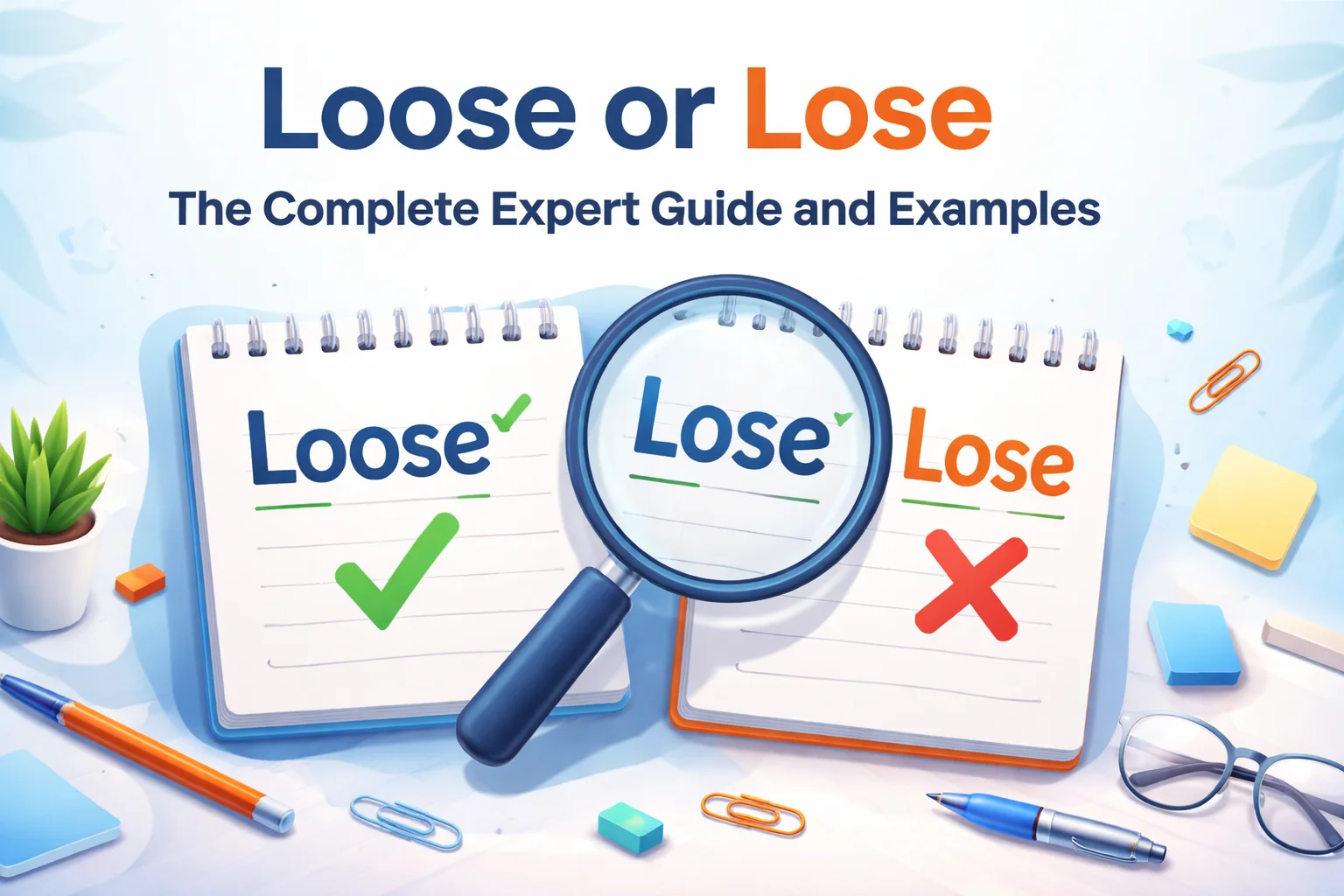
Ever paused mid-sentence wondering whether you should type “Loose or Lose”? You’re not alone. This tiny spelling difference can change meaning completely, especially in English usage, grammar, and formal writing where clarity matters. Whether you’re drafting emails, managing business communication, preparing broadcasting scripts, updating online booking platforms, or organizing meetings and calendar entries, choosing the right word shows confidence, precision, and consistency.
In this guide, we’ll break down the real difference between loose and lose in simple, practical terms. You’ll see how these words appear naturally in everyday tasks like project management, scheduling, and time management, where one wrong letter can shift tone or create confusion. We’ll also touch on style guides and regional preferences (like subtle US vs UK tendencies) so you understand how professional standards influence correct usage.
By the end, you’ll know exactly when to use each word and why it matters in both casual writing and professional contexts. You’ll also gain confidence in your business communication, improve clarity in meetings and digital workflows, and strengthen your formal tone across emails, documents, and content. Let’s clear up the confusion once and for all, in a friendly but expert way, so you never mix up Loose or Lose again.
Loose or Lose – Quick Answer
Before we dig deep, here is the fast and simple explanation you came for.
- Lose means to misplace something, fail to win, or not have something anymore.
It is a verb. - Loose means not tight, not firmly attached, or free-moving.
It is an adjective.
If you want to remember it instantly:
- Lose has one O, because when you lose, something is missing.
- Loose has two O’s, like the open space in something not tight.
That’s the basic idea. Now let’s explore it deeply so you never confuse them again.
Loose or Lose – Understanding “Lose” Completely
Lose Meaning Explained Simply
The word Lose means you no longer have something, or you fail to win, or something slips away.
It always describes an action.
So it is a verb.
You use “lose” when:
- You misplace something
- You fail or get defeated
- Something disappears from your possession
- You no longer keep or maintain a condition
In grammar, “lose” works in several tenses like:
- Lose (present)
- Losing (continuous)
- Lost (past)
Real-World Uses of “Lose”
Whenever something goes away, disappears, fails, or slips out of control, the right word is lose.
Here are situations where people correctly use “lose”:
- Misplacing items
I don’t want to lose my keys again. - Failing to win
Their team may lose the match today. - Emotional loss
People sometimes lose hope during tough times. - Losing control
Don’t lose your temper during arguments. - Losing opportunities
If you delay too much, you may lose your chance. - Losing people
Many people fear they might lose someone they love.
These situations all share one common thing. Something is gone or slipping away.
Common Sentences Using Lose Correctly
Here are practical examples that sound exactly like daily conversation:
- You will lose your wallet if you keep it like that.
- Don’t lose confidence because of one mistake.
- They didn’t want to lose the final round.
- People lose motivation when they don’t see results.
- Never lose faith in yourself.
Lose – Grammar and Tense Table
| Form | Usage | Example |
| Lose | Present | I lose focus sometimes |
| Losing | Continuous | She is losing interest |
| Lost | Past | He lost his phone yesterday |
Notice something important.
There is never a form called “loosed” or “loosing” when referring to losing something. That belongs to “loose,” not “lose.”
Common Mistakes People Make With “Lose”
People often confuse lose vs lost and lose vs loss.
Here’s how to fix that forever.
- Lose = verb (action)
- Lost = past tense of lose
- Loss = noun form
Examples:
- Wrong: I losting my phone
Correct: I am losing my phone - Wrong: I have loss my bag
Correct: I have lost my bag - Wrong: I don’t want to loose the game
Correct: I don’t want to lose the game
When you talk about something gone, use lose.
Loose or Lose – Understanding “Loose” Completely
Loose Meaning Explained Simply
The word Loose means something is not tight, not fixed firmly, or free to move around.
It is NOT an action.
It describes the condition of something.
So Loose is an adjective.
If something wiggles, shifts, moves freely, or does not fit tightly, it is loose.
Real-Life Examples of Loose
You use Loose when talking about physical space, comfort, or flexibility:
- Loose clothes
These jeans are loose on me. - Loose parts
The chair leg is loose and needs fixing. - Loose tooth
Kids usually have loose teeth before new ones grow. - Loose grip
He had a loose grip and dropped the glass. - Loose animals
The dog is loose, close the gate.
It describes a state, shape, fit, or firmness.
Sentences Using Loose Correctly
- My shoes are loose, so I need smaller ones.
- She tied her ponytail loosely so it looked relaxed.
- The lid is loose, tighten it before shaking the bottle.
- There are loose stones on the road, drive carefully.
- The shirt feels loose and comfortable.
Loose – Grammar Role
Loose normally appears as:
- Adjective (main form)
- Loosen (verb)
- Loosely (adverb)
Examples:
- Adjective
This belt is loose. - Verb (Loosen)
Please loosen the bolt. - Adverb (Loosely)
Tie it loosely so it doesn’t hurt.
Common Mistakes with Loose
Many people mistakenly write “lose” when they mean “loose.”
For example:
- Wrong: My shoes are lose
Correct: My shoes are loose - Wrong: The screw is lose
Correct: The screw is loose
The easiest way to remember:
Loose = two O’s = more space = not tight
Loose vs Lose – Key Differences At A Glance
Sometimes the fastest way to understand something is to see it side by side.
Here is the clearest comparison:
| Word | Part of Speech | Meaning | Correct Example | Common Wrong Form |
| Lose | Verb | To misplace, fail, or stop having something | Don’t lose your passport | Loose |
| Loose | Adjective | Not tight, not firmly fixed, free | The lid is loose | Lose |
So if you are describing an action… use lose.
If you are describing condition or tightness… use loose.
Loose vs Lose – Sound Difference
Even pronunciation helps.
- Lose = sounds like “Looz”
- Loose = sounds like “Loos”
They sound similar but not identical.
A small sound difference creates a huge meaning difference.
Loose or Lose – Memory Hacks To Never Forget
If spelling confuses you, these tricks fix it forever.
- Lose → You lose something, so one O disappears.
- Loose → More space, so two O’s stay open and wide.
- Think: “Loose Shoes” (They rhyme and make sense together.)
- Think: “Lose a Game” (Shorter word because something is missing.)
Another funny trick:
Loose has extra O because it has extra space.
These tiny memory tools stick in your brain.
Where People Most Commonly Get Loose or Lose Wrong
Even smart people get this wrong. Here’s where it happens most.
Social Media Mistakes
People type fast and autocorrect doesn’t always help. You see things like:
- Don’t loose hope
- Don’t loose your temper
- I don’t want to loose this opportunity
And all of those are wrong. The correct word is lose in each case because you are talking about something slipping away.
School and Exams
Students often lose marks because they write “loose” instead of “lose” in essays, answers, and English tests. Teachers usually mark it as a spelling error because meaning changes completely.
Professional Writing Errors
Emails, reports, and official documents sometimes contain:
- “Please don’t loose this file”
- “We can’t loose this client”
That looks extremely unprofessional. The right word is always lose in those situations.
Auto-Correct Problems
Sometimes devices change “lose” to “loose” because of typing speed, predictive text, or keyboard errors. So even if your grammar is right, technology can betray you. Always double-check before sending important messages.
Loose or Lose – Common Confusions Cleared
People often mix up phrases. Let’s fix that with clarity.
- Lose Weight or Loose Weight?
Correct: Lose weight
Because weight is something you want to reduce or get rid of, not loosen. - Loose Change or Lose Change?
Correct: Loose change
Coins are loose because they are not fixed or secured in one place. - Lose Hope or Loose Hope?
Correct: Lose hope - Loose Ends or Lose Ends?
Correct: Loose ends
Loose ends literally mean things not tied or completed.
Also Read: Breaker vs Braker: Correct Spelling and Clear Differences
Mini Quiz – Test Yourself
Try answering mentally before checking.
Fill in the blanks:
- Don’t ______ your temper.
- My jacket feels ______.
- We can’t ______ this match.
- The dog is ______, shut the gate.
- I always ______ my keys.
Correct Answers:
- Lose
- Loose
- Lose
- Loose
- Lose
If you got them right, you’re doing great.
Case Study – Why Mixing Loose vs Lose Matters
Imagine a motivational poster saying:
“Don’t Loose Hope”
It sounds wrong, looks uneducated, damages credibility, and confuses meaning. Businesses, teachers, influencers, and professionals lose trust when their writing looks careless.
Now imagine:
Suddenly it feels meaningful, powerful, and correct.
Words matter. Small spelling mistakes change perception immediately.
Expert Tip
Always ask yourself:
- Is something slipping away? → Lose
- Is something not tight? → Loose
If you answer that right, you’ll always choose the correct word.
Practical Table For Daily Usage
| Situation | Correct Word | Example |
| Something disappears | Lose | Don’t lose your phone |
| Not tight | Loose | My ring is loose |
| Failing a game | Lose | They might lose tonight |
| Clothing fit | Loose | These pants are loose |
| Emotional loss | Lose | Don’t lose hope |
| Object part unstable | Loose | The bolt is loose |
| Opportunity gone | Lose | Don’t lose your chance |
| Animal not tied | Loose | The horse is loose |
FAQs About Loose vs Lose
1. What is the main difference between “loose” and “lose”?
Loose is usually an adjective meaning not tight, not fixed, or free to move. Lose is a verb that means to misplace something, fail to win, or be deprived of something.
2. Why do people commonly confuse “loose” and “lose”?
They look and sound somewhat similar, plus they appear often in English usage, business communication, and formal writing. Fast typing, habits, and lack of grammar awareness cause most mistakes.
3. How do I remember when to use “lose”?
Think of lose as the word connected to loss. If you’re talking about missing, failing, or not winning something, lose is correct.
4. How do I remember when to use “loose”?
If something can move, shake, hang freely, or isn’t tight, it’s loose. Clothes, parts, screws, and even loose scheduling all describe flexibility or lack of restriction.
5. Does spelling matter in professional settings like emails or project management?
Absolutely. Using the wrong word can affect credibility, clarity, and professionalism in areas like meetings, time management, calendar planning, online booking, and project management communication.
6. Are there differences in US vs UK usage?
Both regions use loose and lose the same way, but style guides in business and academic writing strongly emphasize accuracy and consistency, meaning mistakes are more noticeable.
7. Can “loose” ever replace “lose”?
No. They are not interchangeable in any formal or informal context. Using the wrong one creates confusion and can change meaning entirely.
Conclusion: Never Confuse “Loose or Lose” Again
Choosing correctly between Loose or Lose may seem small, but it plays a big role in grammar, formal writing, business communication, and everyday English clarity. When you understand the difference, you communicate more confidently, maintain professional tone, and avoid embarrassing mistakes in emails, broadcasting, scheduling, calendar updates, online booking, and project management workflows. Remember: loose describes something not tight, and lose means to misplace or fail to win. With this clarity, your writing stays precise, polished, and consistent across both US and UK contexts. Now you know the difference and you won’t lose confidence or loose credibility again.

Johnson Alex is a language-focused writer and the voice behind WordsJourney. He creates practical, easy-to-understand content that helps readers improve their vocabulary and express ideas with clarity and confidence.