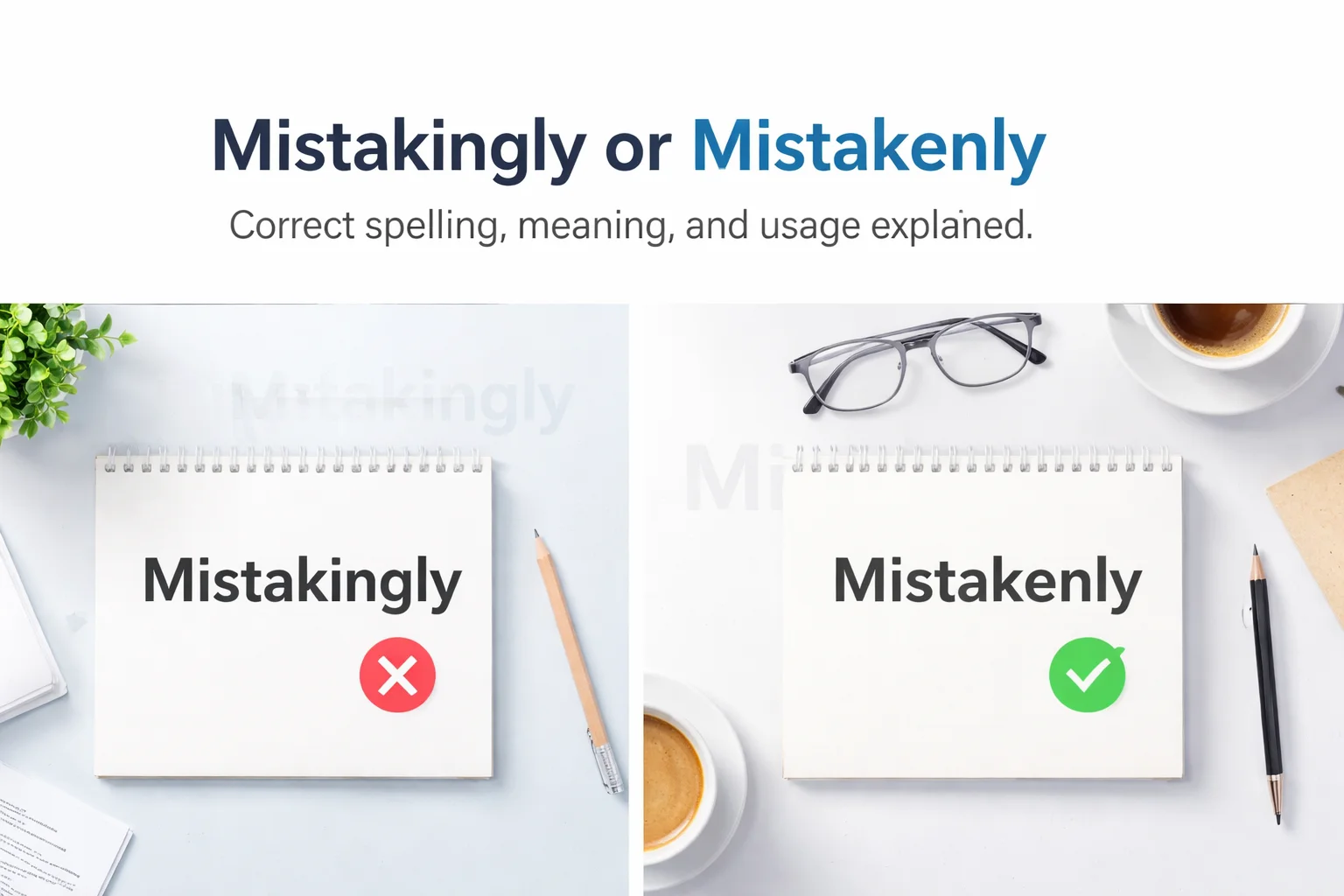
Have you ever typed a sentence quickly and paused, wondering which word looks right? That moment of hesitation often appears when writers face Mistakingly or Mistakenly, a subtle but surprisingly common confusion in modern English usage.
Whether you’re drafting emails, managing business communication, or updating a calendar for meetings, choosing the correct form matters more than most people realize.
This article breaks down the real difference between “mistakingly” and “mistakenly”, explaining which word is grammatically correct and why. You’ll learn how this distinction affects formal writing, professional consistency, and clarity in everyday contexts like project management, time management, online booking, scheduling, and even broadcasting. Clear grammar helps your message land properly, especially when precision drives productivity and trust.
By the end, you’ll know how to use the correct word with confidence, maintain consistency, and communicate more effectively in both professional and casual writing—without second-guessing your grammar again.
Quick Answer: Mistakingly or Mistakenly?
The correct word is mistakenly.
“Mistakingly” might look real. It follows a pattern you’ve seen in other words. But it’s not standard English, and major dictionaries don’t list it as acceptable in formal writing. English speakers use mistakenly almost universally.
Here’s the short version:
Use mistakenly. Avoid mistakingly.
Example:
- ❌ She mistakingly sent the email to the wrong address.
- ✅ She mistakenly sent the email to the wrong address.
Simple. Clear. Right.
What Does Mistakenly Mean?
Let’s break the meaning down.
Mistakenly is an adverb. It describes how something was done—with error or in a wrong way.
- It stems from the adjective mistaken, meaning wrong or in error.
- When you add -ly to an adjective, you usually get an adverb:
happy → happily
quick → quickly
correct → correctly
So:
Mistaken + -ly → Mistakenly
Definition from Leading Dictionaries
Most major dictionaries define mistakenly as:
- In an incorrect or faulty way
- By error; not intentionally
Examples:
- She was mistakenly identified in the photo.
- I mistakenly thought the meeting was tomorrow.
This word tells us how the action happened: by mistake.
Why Mistakingly Looks Real (But Isn’t)
Here’s the trap:
You’ve seen adverbs like:
| Adjective | Adverb |
| willing | willingly |
| knowing | knowingly |
| surprising | surprisingly |
So it feels logical that mistaking → mistakingly could work. But here’s the difference:
- Words like knowing and willing start as adjectives—words that describe a noun.
- Mistaking, however, is a verb form (present participle), not an adjective.
In English, we don’t make adverbs from verbs this way. We form adverbs from adjectives with -ly.
So:
- mistaken (adjective) + ly = mistakenly (correct)
- mistaking (verb form) + ly = mistakingly (wrong)
Grammar Breakdown: Why Mistakenly Wins
To really get this, let’s look at how English transforms words:
Forming Adverbs in English
Most adverbs come from adjectives by adding -ly.
Examples:
| Adjective | Correct Adverb | Wrong Adverb |
| quick | quickly | quickily |
| happy | happily | happly |
| polite | politely | politley |
| mistaken | mistakenly | mistakingly |
Pattern:
Adjective → add -ly → adverb
Why Mistakingly Breaks the Pattern
- Mistaking comes from the verb to mistake.
- English doesn’t turn verbs like this into adverbs.
- The expected source for the adverb is the adjective mistaken.
That’s the grammar rule at work.
Real-World Usage: Usage Trends and Data
To back this up, we can look at real language data. Thanks to tools like Google Books Ngram Viewer and corpus studies, we can see how often people use these words.
Usage Comparison (Estimated Frequency):
| Word | Frequency in Published English (Books, Articles) |
| mistakenly | Very high (standard) |
| mistakingly | Very low (rare and nonstandard) |
You’ll find mistakenly in news articles, books, academic writing, and legal documents. You almost never see mistakingly, and if you do, it’s usually an error.
Case in point:
Many spellcheck systems identify mistakingly as a typo and suggest mistakenly instead.
Correct vs Incorrect: Real Examples You’ll See
Let’s compare some sentences.
Incorrect Usage
- She mistakingly blamed her coworker for the problem.
- The company mistakingly filed the tax documents.
- I mistakingly thought the project was due next week.
Corrected Versions
- She mistakenly blamed her coworker for the problem.
- The company mistakenly filed the tax documents.
- I mistakenly thought the project was due next week.
Why These Matter
Using mistakenly communicates clearly that the action happened by error—not intentionally. That nuance matters in legal writing, journalism, business communication, and academic work.
Why People Use Mistakingly Anyway
I won’t sugarcoat it: mistakingly still shows up. Why?
Here are common reasons:
- It looks logical, especially if you think about verbs ending in -ing.
- Autocorrect sometimes suggests it (especially in informal apps).
- People hear it in speech and assume it’s correct.
- Lack of grammar awareness about how adverbs form from adjectives.
But just because something seems logical doesn’t make it correct.
Is Mistakingly Ever Acceptable?
In formal writing—academic papers, business communication, public speaking scripts—the answer is no.
You want precision. You want credibility. Mistakenly delivers that.
In informal spoken English, people might say mistakingly without really knowing it’s incorrect. But if you write it down, know this:
Informal speech is not a license for grammatical errors in writing.
Even in creative writing, editors often correct mistakingly to mistakenly.
Adverbs That Look Similar (But Are Correct)
Understanding mistakenly helps you avoid other adverb mistakes. Let’s look at some similar words.
| Word | Correct? | Comment |
| mistakenly | ✅ | Standard adverb from mistaken |
| knowingly | ✅ | Adverb from adjective knowing |
| surprisingly | ✅ | Adverb from surprising |
| confusingly | ✅ | Adverb from confusing |
| mistakingly | ❌ | Nonstandard; avoid |
This table helps you see the pattern:
- When the modifier is an adjective, adding -ly usually works.
- When it’s a verb form, -ly often doesn’t make a real adverb.
Memory Tricks: Never Forget Which One to Use
Language rules can feel like a maze. Here’s an easy way to remember this one.
Memory Tip 1: Split the Word
Ask yourself:
- Am I describing how something happened? → adverb
- What’s the base word?
- Mistaken → correct
- Mistaking → wrong
If the root ends in -ed, it’s probably an adjective → add -ly.
Memory Tip 2: Replace It with “Wrongly”
If your sentence still makes sense with wrongly, then mistakenly is right.
Example:
- She wrongly thought… → makes sense
- She incorrectly thought… → makes sense
This confirms you need the adverb form.
Proofreading Tips: Catch This Error Fast
Here’s a quick checklist to spot this mistake every time you edit:
☑ Read each -ly word out loud
☑ Ask: “Is this describing how something happened?”
☑ Check the base word: adjective or verb?
☑ If base word is a verb, think twice
Bonus tip: Add mistakenly to your personal style guide or autocorrect dictionary so you never mistype it again.
Case Studies: Why Precision Matters
Let’s look at a few real-world scenarios where getting this right makes a difference.
Case Study 1: Legal Document
A lawyer writes:
The defendant mistakingly signed the contract.
A judge might read mistakingly as sloppy or unclear. But:
The defendant mistakenly signed the contract.
This version is clear, precise, and professional.
Read More: Worse Case or Worst Case: The Real-World Usage!
Case Study 2: Business Email
An employee writes:
We mistakingly shipped the wrong product.
The recipient might question the sender’s credibility. Using mistakenly signals professionalism.
Case Study 3: Academic Paper
In research writing:
Participants mistakingly interpreted the instructions.
Reviewers will likely flag this error. Using mistakenly strengthens trust in the work.
Synonyms and Alternatives to Mistakenly
Sometimes you might want variety. Here are synonyms you can use instead of mistakenly:
- Incorrectly
- In error
- By accident
- Unintentionally
- Inadvertently
- Erroneously
Use these to avoid repetition in longer writing.
Summary: Remember the Rule
Here’s the golden rule you should internalize:
If you’re describing how something was done by error, use mistakenly.
Avoid:
- mistakingly
- mistaking-ly
- any variant that tries to form an adverb from the verb form
Standards matter. Clarity matters. Your writing will read stronger and cleaner with mistakenly.
Frequently Asked Questions (FAQs)
1. Is “mistakingly” a real word in English?
Yes, mistakingly appears in some dictionaries, but it is rare, outdated, and nonstandard. Most modern writers and editors avoid it, especially in formal writing and business communication.
2. Which is correct: Mistakingly or Mistakenly?
Mistakenly is the correct and preferred word. It is widely accepted across professional, academic, and everyday English usage, while mistakingly is generally discouraged.
3. Why do people confuse mistakingly and mistakenly?
The confusion comes from the verb mistake. Many assume adding -ly directly forms the adverb, but English grammar follows established patterns. Mistakenly comes from the adjective mistaken, making it grammatically sound.
4. Is “mistakenly” correct in US and UK English?
Yes. Mistakenly is standard in both American and British English. Major style guides in both regions recommend it, reinforcing its correctness and consistency.
5. Does this distinction matter in professional contexts?
Definitely. In fields like project management, time management, scheduling, online booking, and calendar planning, clear and correct language improves credibility and reduces misunderstandings.
6. Can “mistakenly” be used in emails, meetings, or broadcasting?
Yes. Mistakenly works perfectly in business emails, meetings, broadcasting, and other professional settings. It sounds natural, polished, and grammatically correct.
Conclusion
When deciding between Mistakingly or Mistakenly, the choice is clear. Mistakenly is the correct, widely accepted, and stylistically appropriate option for modern English usage. While mistakingly may exist in limited references, it lacks support from major style guides and professional standards.
Using mistakenly helps maintain clarity, consistency, and authority—especially in formal writing, business communication, and everyday tasks like scheduling, project management, and online booking. By choosing the right word, you communicate more effectively and avoid unnecessary grammatical doubts.

Johnson Alex is a language-focused writer and the voice behind WordsJourney. He creates practical, easy-to-understand content that helps readers improve their vocabulary and express ideas with clarity and confidence.