Have you ever paused before writing an email, unsure which title fits best? The debate around “Mrs vs Ms” still trips people up in everyday business communication and formal writing. One small word can shape tone, respect, and consistency across emails, meetings, and even broadcasting scripts.
When your calendar fills with calls and your time management gets tight, clarity matters. Getting this right saves friction and keeps your message clean.
This guide breaks down the real difference between Mrs and Ms, with clear rules for modern English usage and grammar. You’ll see how each form works in professional settings like online booking, project management, and team scheduling.
We’ll share practical examples you can use in emails, forms, and public-facing content. No fluff. Just simple guidance you can apply today.
You’ll also learn how style guides and regional preferences (US vs. UK) shape correct usage in formal contexts. That matters when you write policies, send client notes, or manage shared calendars. By the end, you’ll know when to use each title with confidence.
Your writing will sound polished, respectful, and consistent across every channel.
Mrs vs Ms: Why This Choice Still Matters Today
Titles shape first impressions. They hint at how you see the person you’re addressing. In professional settings, that impression forms in seconds. Choose poorly and you risk sounding outdated or overly personal. Choose well and your message lands with quiet confidence.
Mrs vs Ms matters because:
- One title reveals marital status.
- The other protects privacy.
- One leans traditional.
- The other fits modern professional norms.
Language evolves. Etiquette follows. Your writing should too.
What “Mrs” Means and How People Use It
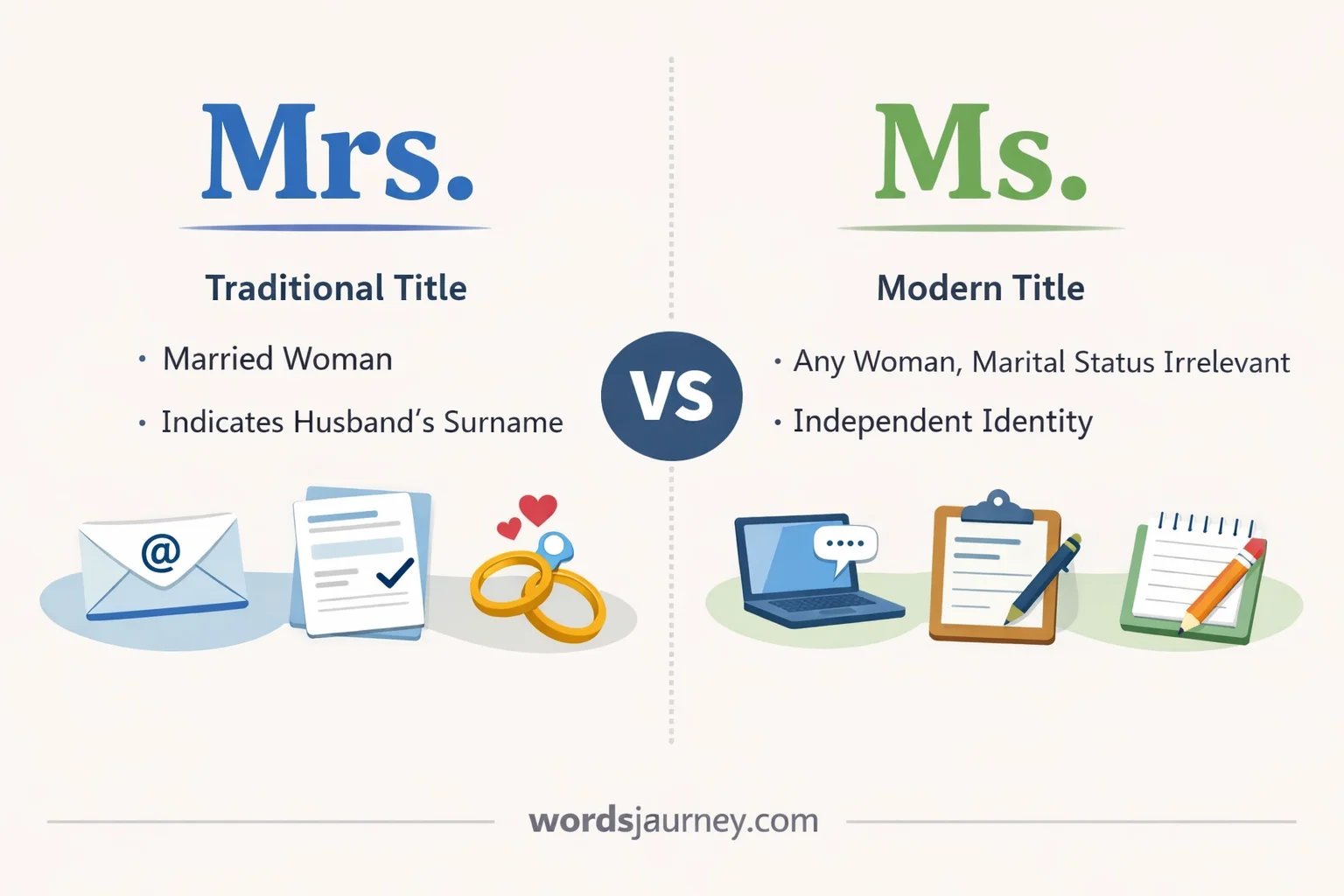
Mrs is a traditional honorific for a married woman. Historically, it tied a woman’s identity to her husband’s surname and social status. That history still shapes how people hear the word today.
Core meaning of Mrs
- Signals marital status
- Often paired with a shared last name
- Common in formal and traditional settings
How “Mrs” sounds in real life
- Warm and respectful in family or community contexts
- Personal in tone
- Traditional, sometimes old-fashioned
Examples of correct usage
- “Please welcome Mrs Taylor to the stage.”
- “The invitation is addressed to Mrs Ahmed.”
When “Mrs” fits
- Wedding invitations and family events
- Formal letters in conservative settings
- When a person clearly states this preference
When “Mrs” can misfire
- Professional emails when status is unknown
- Customer communication
- Public-facing writing
Quick reference
| Situation | Use Mrs? | Why |
| Formal family event | Yes | Matches tradition |
| Professional email to a new client | No | Avoids assumptions |
| Customer support reply | No | Neutral tone works better |
| Known personal preference | Yes | Respect beats rules |
Takeaway: Use Mrs when you know the person prefers it. Otherwise, skip it.
What “Ms” Means and Why It Became the Default
Ms emerged to solve a social problem. People needed a title that didn’t reveal marital status. Over time, Ms became the neutral option for professional and public communication.
Core meaning of Ms
- Does not reveal marital status
- Works for married, unmarried, divorced, or widowed women
- Neutral, modern, widely accepted
Why “Ms” dominates professional writing
- It avoids personal assumptions
- It sounds current and respectful
- It aligns with inclusive language norms
Examples of correct usage
- “Dear Ms Jordan,”
- “Ms Rivera will lead the project.”
Practical wins with Ms
| Context | Why Ms Works |
| Job applications | Keeps focus on qualifications |
| Professional emails | Neutral and safe |
| Public communication | Inclusive tone |
| Unknown marital status | Avoids awkwardness |
Bottom line: When in doubt, Ms is the safest choice.
Mrs vs Ms: The Differences That Actually Matter
The difference goes beyond spelling. Each title sends a subtle signal about values and assumptions.
Side-by-side comparison
| Feature | Mrs | Ms |
| Marital status | Indicates married | Does not indicate status |
| Tone | Traditional | Modern and neutral |
| Professional use | Less common today | Standard in many workplaces |
| Risk of offense | Higher if assumed incorrectly | Very low |
| Privacy | Reveals personal information | Protects personal information |
What readers pick up
- Mrs can feel personal
- Ms feels professional
Small words. Big implications.
How to Choose Between Mrs vs Ms in Real Life
Use a simple decision framework. It saves time and spares feelings.
The easy rules
- Use Ms when:
- You don’t know marital status
- You’re writing professionally
- You want a neutral tone
- Use Mrs when:
- The person prefers it
- The context is personal or traditional
- You’ve confirmed marital status
Decision cheat sheet
| Scenario | Best Choice |
| Cold email to a client | Ms |
| Formal letter to a known contact | Their preference |
| Public newsletter | Ms |
| Wedding invitation | Mrs (if preferred) |
Example in practice
- Safer: “Hello Ms Carter, thanks for reaching out.”
- Risky: “Hello Mrs Carter, thanks for reaching out.”
Mrs vs Ms in Professional Writing and Business Communication
Professional writing values clarity and respect. Ms checks both boxes.
Why businesses default to Ms
- Reduces bias
- Avoids awkward follow-ups
- Aligns with HR and DEI guidelines
Email examples
Good
Dear Ms Nguyen,
Thanks for the update. We’ll review the proposal today.
Risky
Dear Mrs Nguyen,
Thanks for the update. We’ll review the proposal today.
Resume and cover letter etiquette
- Skip titles when possible
- If a title is required, choose Ms
Business communication tips
- Mirror the title the person uses in their email signature
- When unsure, ask politely or default to Ms
- Keep tone professional and neutral
For More Click here: Premise or Premises: Ultimate Guide to Use Each Word
Cultural Differences and Global Usage of Mrs vs Ms
Titles vary across cultures. What sounds polite in one region can sound stiff in another.
General trends
- US, UK, Canada: Ms is common in professional settings
- Traditional communities: Mrs may still signal respect
- International business: Ms avoids cultural missteps
Why Ms travels better
- Less tied to social norms
- Easier for global teams
- Reduces cultural friction
Best practice for international communication
- Default to Ms
- Follow the person’s stated preference
- Avoid assumptions based on names or customs
Common Mistakes People Make With Mrs and Ms
Mistakes happen. Most come from assumptions.
Frequent errors
- Assuming marital status
- Switching titles mid-conversation
- Using Mrs in professional cold outreach
- Treating Ms as informal
Mistake vs fix
| Mistake | Better Choice |
| Assuming “Mrs” for a new contact | Use “Ms” |
| Switching Ms to Mrs after marriage | Follow stated preference |
| Using titles on resumes | Skip titles or use Ms |
| Ignoring email signatures | Mirror the sender |
Pro tip: Let people define how they want to be addressed. It builds instant goodwill.
What Style Guides and Experts Recommend About Mrs vs Ms
Modern style guides lean toward Ms as the default. They emphasize respect and neutrality.
Consensus from editors and etiquette experts
- Use Ms when status is unknown
- Avoid guessing
- Prioritize the person’s stated preference
Quote worth remembering
“Titles should reflect respect, not assumptions.”
That single line saves countless awkward moments.
How to Ask Someone Which Title They Prefer
Asking feels awkward until you try it. Then it feels normal.
Polite ways to ask
- “What title do you prefer?”
- “Do you go by Ms or Mrs?”
- “How would you like to be addressed?”
When to ask
- On forms
- In onboarding emails
- During first professional interactions
Why asking works
- It shows respect
- It avoids mistakes
- It builds trust early
Mrs vs Ms in Forms, Surveys, and Online Profiles
Forms shape user experience. Poor title options frustrate users. Good options earn trust.
Best practices for forms
- Offer Ms as a neutral option
- Avoid forcing marital status
- Include a no title option
- Allow people to skip titles
Form design checklist
| Feature | Why It Helps |
| Neutral default | Reduces friction |
| Optional title field | Respects privacy |
| Clear labels | Improves UX |
| Consistent formatting | Builds trust |
UX insight
- Forms that avoid unnecessary personal data often convert better.
- Less friction means higher completion rates.
Real-Life Case Studies: Mrs vs Ms in Action
Case study: Business email misstep
A sales rep opened cold emails with “Mrs.” Response rates dropped. After switching to Ms, replies increased and tone improved. The change reduced perceived assumptions and improved trust.
Lesson
- Neutral language boosts engagement.
Case study: Customer support tone shift
A support team trained agents to default to Ms. Customer satisfaction scores rose. Fewer users corrected the title.
Lesson
- Small language choices affect customer experience.
Case study: Form redesign
A SaaS company removed forced title fields. Completion rates increased. Users reported feeling respected.
Lesson
- Respectful design improves outcomes.
Mrs vs Ms at a Glance
Fast takeaways
- Ms is the modern default
- Mrs fits traditional and personal contexts
- When unsure, choose Ms
- Follow stated preferences
- Neutral language builds trust
One-sentence rule
If you don’t know what to use, Ms won’t let you down.
FAQs: Mrs vs Ms
1. What is the main difference between Mrs and Ms?
The core difference between Mrs vs Ms lies in marital status. Mrs traditionally refers to a married woman, while Ms is a neutral title that does not indicate marital status. In modern English usage, Ms is widely accepted in formal writing and business communication because it respects privacy and promotes consistency.
2. Is Ms more appropriate than Mrs in professional communication?
Yes, Ms is often the safer choice in professional contexts. In emails, meetings, online booking forms, and official documents, Ms avoids assumptions and aligns with inclusive grammar standards. Many organizations adopt Ms in project management tools and shared calendars to maintain respectful and neutral language.
3. Should I use Mrs or Ms in emails and scheduling tools?
When handling scheduling, time management, or client-facing calendar invites, Ms is generally preferred unless a person has clearly stated they use Mrs. This approach improves clarity in business communication and prevents awkward mistakes in professional workflows.
4. What do style guides recommend for Mrs vs Ms?
Most modern style guides recommend Ms as the default in formal contexts. This is true in both US vs. UK usage, though US corporate writing tends to favor Ms more strongly in formal writing and public communication. UK usage also accepts Ms widely, especially in professional and academic settings.
5. Is it wrong to use Mrs today?
No, Mrs is not wrong. It is still correct when a woman prefers that title or uses it publicly. The key is consistency and respect for personal preference. In broadcasting, official records, and formal documents, always follow the individual’s stated preference when available.
6. How does correct title usage improve business communication?
Using the correct title builds trust and professionalism. It reduces friction in emails, meetings, and client interactions. Clear grammar and respectful English usage also improve your brand voice across project management platforms, online booking systems, and public-facing content.
Conclusion: Choosing Between Mrs vs Ms with Confidence
The choice between Mrs vs Ms may seem small, but it carries real weight in modern business communication and formal writing. The right title improves clarity, supports consistency, and shows respect for personal identity. In fast-moving workflows shaped by scheduling, time management, and shared calendars, small language choices prevent confusion and save time.
As a practical rule, default to Ms in professional contexts unless a preference is clearly stated. This approach aligns with modern grammar, common style guides, and regional norms across US vs. UK usage.
Whether you’re writing emails, managing online booking forms, leading meetings, or working inside project management tools, choosing the right title keeps your communication polished and professional. Mastering details like Mrs vs Ms sharpens your overall English usage. It also elevates how you present yourself across emails, documents, and even broadcasting scripts. Small choices create strong impressions. When you get them right, your writing sounds confident, respectful, and ready for any professional setting.

Emma Brook is a dedicated writer and language enthusiast at WordsJourney. She’s passionate about helping readers understand words better and use them with confidence in everyday conversations. Her work focuses on alternative phrases, clear meanings, and practical examples that make language feel simple and approachable.
With a friendly, reader-first writing style, Emma breaks down common expressions and explores smarter ways to say things without sounding forced or complicated. Her goal is to make learning words enjoyable, useful, and easy for everyone.