Have you ever paused mid-sentence, unsure whether to use “Neither Nor or Neither Or” in your writing? Many professionals struggle with this subtle but important distinction, especially in business communication, formal writing, and project management contexts. Choosing the wrong form can disrupt clarity in emails, meetings, and scheduling messages, making time management and calendar organization more complicated than necessary.
Understanding the correct usage of Neither Nor or Neither Or isn’t just a matter of grammar—it’s about maintaining consistency and professionalism across all forms of written communication. From online booking confirmations to broadcasting announcements, using the right expression ensures your audience interprets your meaning precisely. Even style guides and regional preferences, such as US versus UK English, weigh in on this choice, reinforcing the importance of careful usage.
In this article, we’ll break down the differences between Neither Nor or Neither Or, highlighting common mistakes and providing practical examples. You’ll gain clarity on English usage rules, grammar best practices, and strategies for smooth, formal writing in everyday and professional scenarios. By the end, your writing will be sharper, more consistent, and perfectly suited for business communication, meetings, and project management documentation.
Understanding ‘Neither…Nor’
“Neither…nor” is a correlative conjunction used to link two negative alternatives. It helps you express that both options are not true or do not happen. Think of it as the negative version of “either…or.”
Basic Structure
| Structure | Example |
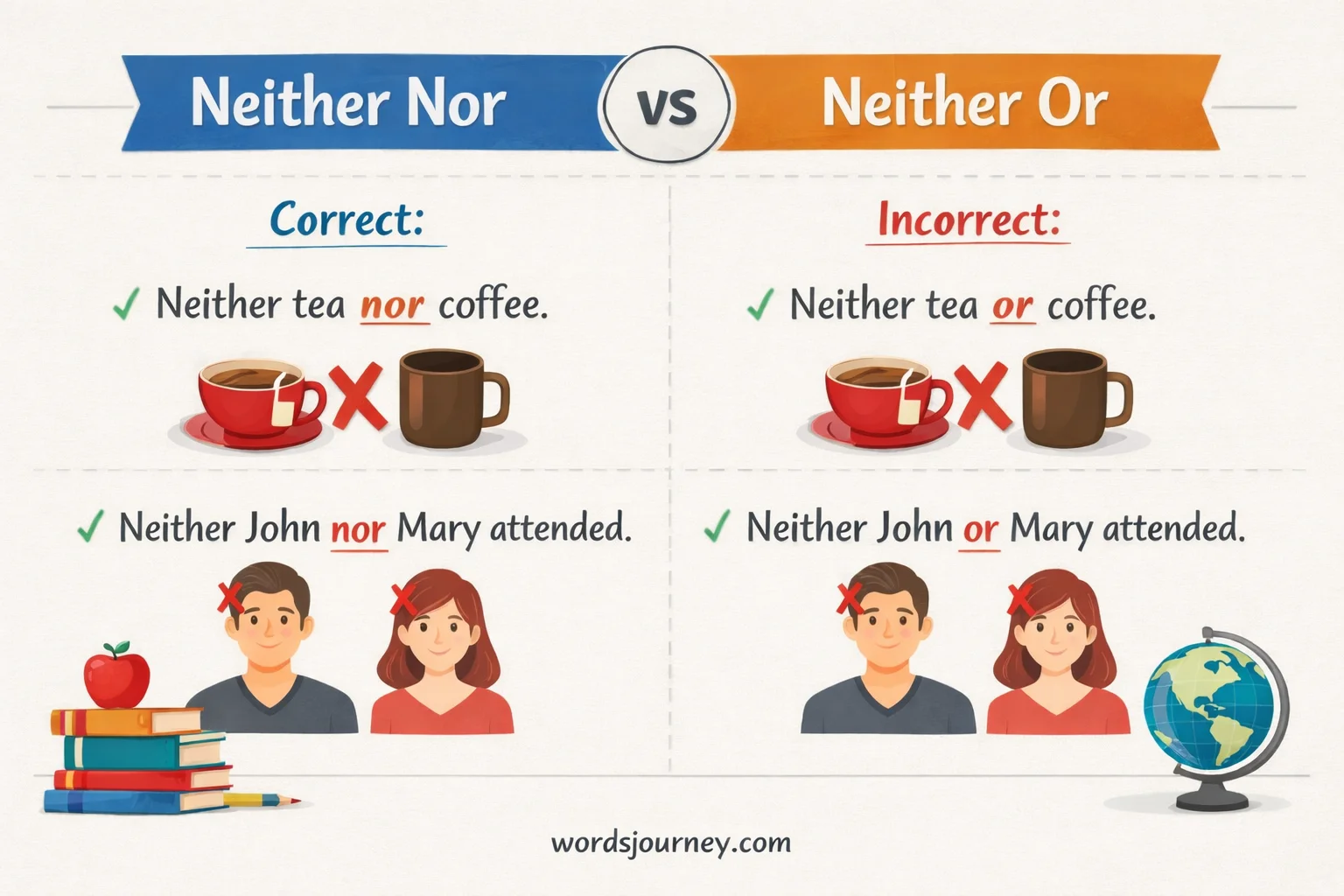
| Neither + singular/plural noun/verb + nor + singular/plural noun/verb | Neither John nor Mary attended the meeting. |
| Neither + adjective/adverb + nor + adjective/adverb | She is neither smart nor careful. |
Rule: Always pair neither with nor—never with or.- Verb agreement: The verb usually agrees with the closest subject.
- Example: Neither the manager nor the employees are responsible.
- Example: Neither the employees nor the manager is responsible.
Why It Matters
Using neither…nor correctly improves clarity and professionalism in your writing. It avoids ambiguity about which options are being negated and makes your sentences grammatically sound.
Why ‘Neither…Or’ Is Incorrect
Many people mistakenly write “neither…or”. You might see:
“Neither John or Mary attended the meeting.”
This is grammatically incorrect. English requires neither to pair with nor, not or. Using “or” instead of “nor” breaks the correlative structure and can confuse readers.
Common Mistakes
| Incorrect | Correct | Explanation |
| Neither John or Mary attended. | Neither John nor Mary attended. | “Nor” must pair with “neither.” |
| She likes neither tea or coffee. | She likes neither tea nor coffee. | Both items are negated; “nor” is mandatory. |
Impact: Misusing it can make your writing look careless, especially in formal or professional contexts.
Advanced Grammar Rules
Neither…Nor with Compound Subjects
When you use neither…nor with compound subjects, the verb agrees with the closest subject.
- Example: Neither the manager nor the employees are responsible.
- Example: Neither the employees nor the manager is responsible.
Neither…Nor with Tenses
Keep tenses consistent. If the first clause is in past tense, the second should match.
- Example: Neither John nor Mary attended the meeting yesterday.
- Wrong: Neither John nor Mary attends the meeting yesterday.
Neither…Nor with Adjectives and Adverbs
You can pair adjectives and adverbs with neither…nor.
- Example: The movie was neither interesting nor entertaining.
- Example: She arrived neither early nor late.
Formal vs Informal Writing
- In formal writing, stick strictly to neither…nor.
- In casual speech, some might incorrectly say “neither…or,” but this is still frowned upon in professional contexts.
Common Confusions & How to Avoid Them
Neither vs Not Either
People often confuse neither with not either.
- Neither option works. → Both options do not work. ✅
- Not either option works. → Grammatically possible but less common; sounds awkward.
Neither…Nor vs Either…Or
| Structure | Example | Meaning |
| Neither…Nor | Neither tea nor coffee is available. | Both options are negative. |
| Either…Or | Either tea or coffee is available. | One of the two is positive/possible. |
Tip: Remember the negative is neither…nor; the positive is either…or.
Real-World Examples
Literature & Journalism
- “Neither rain nor snow nor heat nor gloom of night stays these couriers from the swift completion of their appointed rounds.” – Famous US Postal Service motto.
- News headline example: “Neither the mayor nor the council responded to the inquiry.”
American vs British English
- In both American and British English, neither…nor is correct.
- “Neither…or” is widely considered an error in both variants.
Exercises for Practice
Fill-in-the-blank:
- She likes _________ tea _________ coffee.
- _________ John _________ Mary attended the meeting.
- The plan was _________ practical _________ safe.
Correct the mistake:
- Neither the manager or the team was ready.
- She is neither happy or sad about the outcome.
Mini Quiz:
- True or False: You can say “neither…or” in formal writing.
- Multiple Choice: Which is correct?
- a) Neither cat or dog is allowed.
- b) Neither cat nor dog is allowed.
For More Visit: Fourth vs Forth: The Real Difference and Correct Usage
Frequently Asked Questions (FAQs)
Q1: Which is correct, “Neither Nor” or “Neither Or”?
A: The correct standard usage is “Neither…Nor”. The form “Neither Or” is considered grammatically incorrect in formal writing and professional communication.
Q2: Can I use “Neither Nor” in US and UK English?
A: Yes, “Neither…Nor” is universally accepted in both US and UK English, though some style guides may provide examples specific to one region.
Q3: Is “Neither Nor” suitable for business emails and project management?
A: Absolutely. Using “Neither…Nor” correctly ensures clarity, professionalism, and consistency in business communication, meetings, and calendar scheduling.
Q4: Can “Neither Nor” be used in casual writing or online content?
A: Yes, it can be used in casual contexts, but it’s best paired with formal sentence structure to maintain readability, especially in broadcasting announcements or online booking communications.
Q5: Are there common mistakes to watch for?
A: The most frequent errors include using “Neither Or” or omitting “neither” and “nor” altogether. Always pair them correctly to avoid confusion in English usage and grammar consistency.
Conclusion
Mastering “Neither Nor or Neither Or” is a small but powerful step toward clearer and more professional writing. By consistently using “Neither…Nor”, you enhance business communication, streamline project management updates, and avoid misinterpretations in meetings or online scheduling messages.
Understanding this distinction also reinforces good grammar habits, ensures regional English consistency, and strengthens your overall written voice. Whether you’re drafting formal emails, preparing broadcast content, or managing calendar and online bookings, correct usage makes your communication precise and authoritative.
Next time you face a choice between “Neither Nor or Neither Or”, you’ll know exactly which form to use—and your writing will reflect confidence, clarity, and professionalism.

Aliya Ray is a passionate writer and language enthusiast at WordsJourney. She enjoys exploring words, phrases, and everyday expressions to help readers communicate more clearly and confidently. Her content focuses on alternative ways to say common phrases, simple explanations, and real-life examples that make language easy to understand.
Aliya believes the right words can make any message stronger. Through clear, friendly writing, she helps readers improve their vocabulary without feeling overwhelmed or confused.