Have you ever paused mid-email, calendar invite, or chat message wondering which version looks right one word or two? That small moment of doubt sits at the heart of Nevermind vs Never Mind, a surprisingly common confusion in modern English usage.
Whether you’re rescheduling meetings, updating a shared calendar, or replying quickly during online booking or broadcasting tasks, this choice affects clarity, tone, and professionalism more than most people realize.
In this article, you’ll learn the real grammatical difference between “nevermind” and “never mind,” how context changes meaning, and why consistency matters in business communication, formal writing, and everyday workflows like project management and time management.
We’ll break down when each form fits best, how native speakers actually use them in meetings and messages, and why the wrong choice can sound careless or overly casual in professional settings.
To keep things authoritative and practical, we’ll also touch on style guides and regional preferences, including subtle differences between US and UK English. By the end, you’ll know exactly which form to use, when to use it, and how to stay consistent across emails, scheduling tools, and collaborative documents.
If precision matters in your writing and it usually does understanding Nevermind vs Never Mind is a small fix with a big impact.
The Short Answer (For Skimmers)
Here’s the truth in plain English:
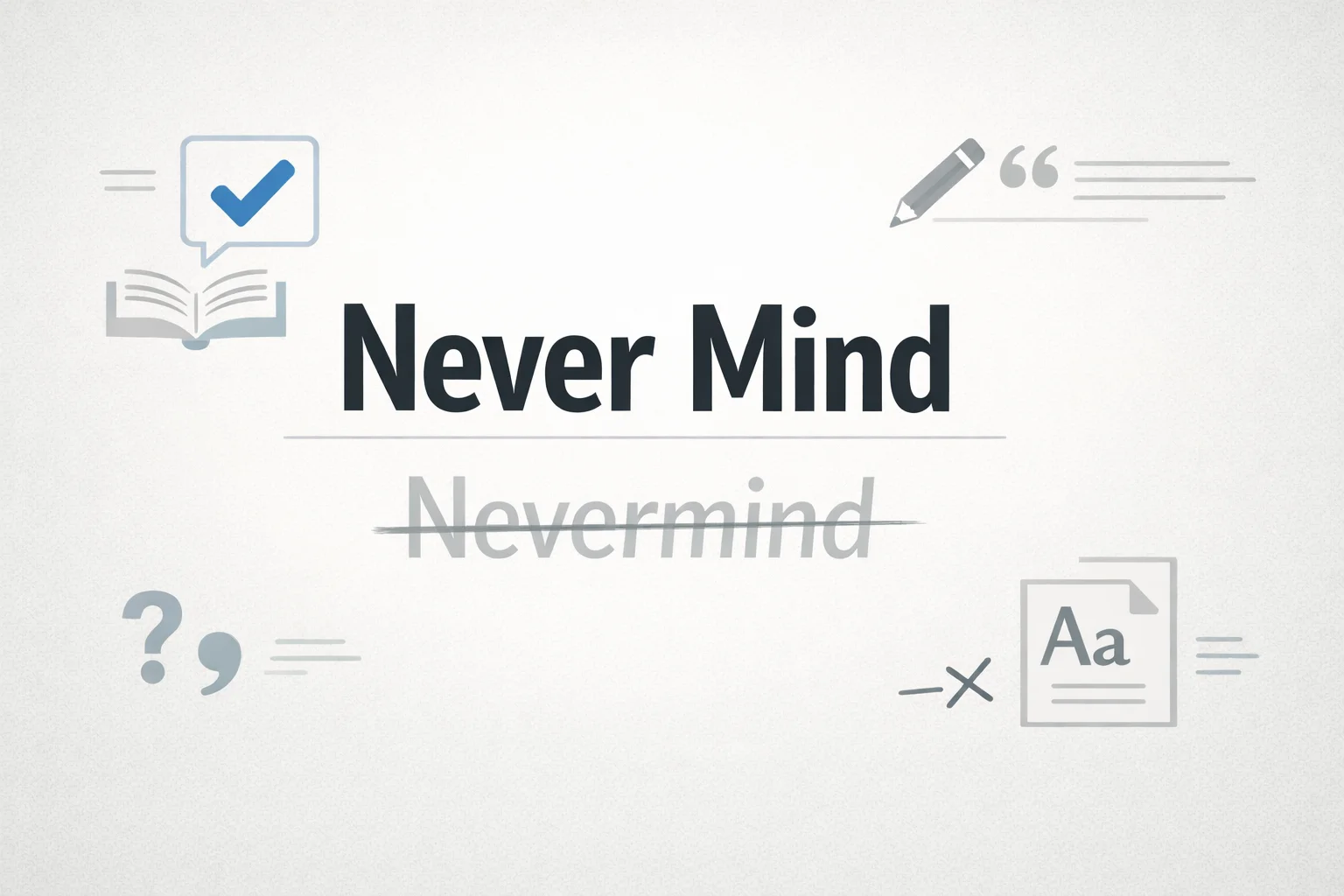
Never mind is the correct and standard form.
Nevermind is informal and nonstandard.
If you’re writing anything formal, academic, professional, always use “never mind.”
“Nevermind” shows up in casual writing, pop culture, and branding, but it doesn’t follow standard grammar rules.
Now let’s explain why.
What Does “Never Mind” Mean?
Never mind is a two-word verb phrase. It tells someone to ignore something, forget a request, or stop worrying about an issue.
People use it when:
- They change their mind
- The issue no longer matters
- They don’t want to continue the conversation
It often carries a casual or dismissive tone, but the grammar stays correct.
Common meanings of “never mind”
- Forget it
- Don’t worry about it
- It’s no longer important
- I’ve changed my mind
Real examples of correct usage
- Never mind, I figured it out.
- If you can’t come, never mind.
- Never mind what he said earlier.
- I’ll handle it myself. Never mind.
You’ll hear it constantly in spoken English, but you’ll also see it in books, journalism, and professional writing.
Why “Never Mind” Is Standard English
Grammar experts agree on this point. Never mind functions as a verb phrase, similar to:
- Give up
- Calm down
- Hold on
These phrases stay separate because each word still carries meaning. “Never” modifies “mind.” They don’t fuse into a single grammatical unit.
What Does “Nevermind” Mean?
Here’s where things get tricky.
Nevermind exists, but not as standard grammar. It appears mainly in:
- Informal texting
- Online chat
- Pop culture
- Song titles
- Branding
People use it because it feels natural. English has lots of compound words, so writers assume this one followed the same path.
It didn’t.
Why people still write “nevermind”
- Autocorrect doesn’t always flag it
- Informal writing dominates online spaces
- People see it often and assume it’s correct
- One famous album reinforced the spelling
That doesn’t make it grammatically correct. It just makes it common.
Nevermind vs Never Mind: Side-by-Side Comparison
| Feature | Never Mind | Nevermind |
| Grammar status | Standard English | Nonstandard |
| Dictionary acceptance | Yes | Limited or informal |
| Professional writing | Correct | Not recommended |
| Academic use | Correct | Incorrect |
| Casual texting | Acceptable | Common |
| SEO writing | Preferred | Risky |
If clarity and credibility matter, never mind always wins.
Grammar Rules Behind the Difference
English forms compound words slowly. Some phrases merge over time. Others never do.
For example:
- Any time → anytime (both accepted, context matters)
- All right → alright (still debated)
- Never mind → never mind (never merged officially)
Why? Because “mind” still acts as a verb here. You’re literally telling someone not to mind something.
That grammatical function keeps the words separate.
Is “Nevermind” Ever Correct?
Here’s the honest answer: sometimes, but only in limited contexts.
When “nevermind” appears intentionally
- Album titles
- Song lyrics
- Brand names
- Creative dialogue
- Stylized social media writing
The most famous example is Nirvana’s 1991 album Nevermind. That spelling was a deliberate stylistic choice, not a grammar endorsement.
In creative or branded contexts, rules bend. In standard writing, they don’t.
Never Mind in Formal Writing
In professional or academic contexts, there’s no debate.
Always use never mind in:
- Business emails
- Academic essays
- Research papers
- Legal documents
- Blog posts meant to rank
Using “nevermind” in these settings looks careless. It signals weak language control, even if the rest of the writing is solid.
Example
❌ Nevermind the earlier email.
✅ Never mind the earlier email.
That single space changes how polished the sentence feels.
Never Mind in Casual Speech and Texting
In texting, rules loosen. People prioritize speed over structure.
You’ll often see:
- nevermind
- nvm
- nm
These shortcuts work in casual chat. They don’t belong in polished writing.
Think of it like wearing sneakers. Fine at home. Wrong at a formal event.
Common Mistakes People Make
Many writers stumble here, even experienced ones.
Frequent errors
- Using nevermind in resumes
- Mixing both forms in one article
- Assuming popularity equals correctness
- Trusting autocorrect blindly
Consistency matters. Pick the correct form and stick to it.
How to Remember the Difference (Easy Tricks)
If you want a quick test, try this.
The replacement test
Replace “never mind” with:
- forget it
- don’t worry about it
If it fits, you need two words.
Simple memory rule
If the writing matters, add the space.
That rule alone will save you 99 percent of the time.
American vs British English: Does It Change?
No.
Both American English and British English treat never mind the same way.
You’ll see the same guidance from:
- AP Style
- Chicago Manual of Style
- Oxford
- Cambridge
Regional spelling doesn’t change the rule.
Also Read: Yea or Nay: The Complete Guide and Deciding
What Style Guides Say
Style guides exist to remove doubt.
- AP Stylebook: uses never mind
- Chicago Manual of Style: treats it as a verb phrase
- Oxford Style Manual: keeps it as two words
Professional writers follow these guides for a reason. They protect clarity.
Real-World Usage Examples
Correct
- Never mind, we’ll talk later.
- I was going to ask, but never mind.
- Never mind the cost. Focus on value.
Incorrect (in formal writing)
- Nevermind the delay.
- Nevermind what I said earlier.
The difference looks small. The impact isn’t.
Case Study: Why Editors Care
In content editing workflows, grammar mistakes affect trust. Editors often flag “nevermind” immediately because it signals casual writing in a serious context.
Several SEO agencies report higher rejection rates for guest posts containing basic grammar errors. This is one of them.
Small details shape big impressions.
FAQs: Nevermind vs Never Mind
Is “nevermind” one word or two?
Both forms exist, but they serve different purposes. “Never mind” (two words) is the grammatically standard form in formal writing, business communication, and professional English usage. “Nevermind” (one word) is informal and appears mostly in casual speech, chat messages, or pop culture references.
Which form is correct in formal writing?
In formal writing, academic work, legal documents, and professional emails, “never mind” is the correct and preferred choice. Most major style guides, including those followed in US and UK English, recommend the two-word form for clarity and consistency.
Can I use “nevermind” in business communication?
It’s best to avoid “nevermind” in business communication, meetings, scheduling updates, project management tools, or calendar notes. Using “never mind” helps maintain a polished, professional tone, especially in client-facing or executive-level writing.
Does US vs. UK English affect the choice?
Not significantly. Both US and UK English favor “never mind” in standard usage. The one-word form appears informally in both regions, but it’s not considered correct in formal contexts on either side of the Atlantic.
Why does this distinction matter in daily work?
In fast-paced environments involving time management, online booking, broadcasting schedules, or meeting coordination, small language choices signal attention to detail. Consistent grammar builds trust, reduces ambiguity, and strengthens your professional voice.
Conclusion
The debate over Nevermind vs Never Mind may seem minor, but it reflects a bigger truth about effective communication. “Never mind” remains the grammatically sound, professional choice for formal writing, business communication, and structured environments like scheduling, calendars, and project management systems. “Nevermind,” while common in casual conversation, doesn’t carry the same authority or clarity.
By understanding the difference and applying it consistently, you sharpen your English usage and present yourself as precise, credible, and detail-oriented. Whether you’re managing meetings, updating timelines, or writing polished emails, choosing the right form ensures your message lands exactly as intended: clear, confident, and professional.

Emma Brook is a dedicated writer and language enthusiast at WordsJourney. She’s passionate about helping readers understand words better and use them with confidence in everyday conversations. Her work focuses on alternative phrases, clear meanings, and practical examples that make language feel simple and approachable.
With a friendly, reader-first writing style, Emma breaks down common expressions and explores smarter ways to say things without sounding forced or complicated. Her goal is to make learning words enjoyable, useful, and easy for everyone.