Have you ever paused mid-sentence, wondering whether to use “onto or into”? Though these tiny prepositions seem interchangeable, choosing the wrong one can subtly shift meaning and confuse readers. In business communication, formal writing, or even casual emails, knowing when to use onto versus into ensures clarity, professionalism, and grammatical precision.
Understanding the difference between onto or into isn’t just a grammar lesson—it’s a tool for effective time management and scheduling. Whether you’re adding tasks onto a calendar, moving items into a project folder, or organizing online bookings, these words guide readers through actions and directions seamlessly. Even in broadcasting or meetings, the correct preposition maintains clarity and consistency, helping your audience follow instructions without second-guessing.
This article explores the subtle nuances of onto or into, highlighting examples in both US and UK English usage. From project management contexts to everyday English usage, you’ll learn when each preposition fits naturally, why style guides matter, and how to keep your writing polished. By the end, you’ll confidently navigate these prepositions, improving your grammar, consistency, and overall communication skills.
Quick Answer: Onto vs Into in One Simple Rule
Before diving deeper, here’s the simplest way to remember the difference:
| Word | Meaning | Example |
| Into | Movement from outside to inside | She walked into the room |
| Onto | Movement toward a surface | He climbed onto the roof |
Key takeaway:
- Into = inside something
- Onto = on top of something
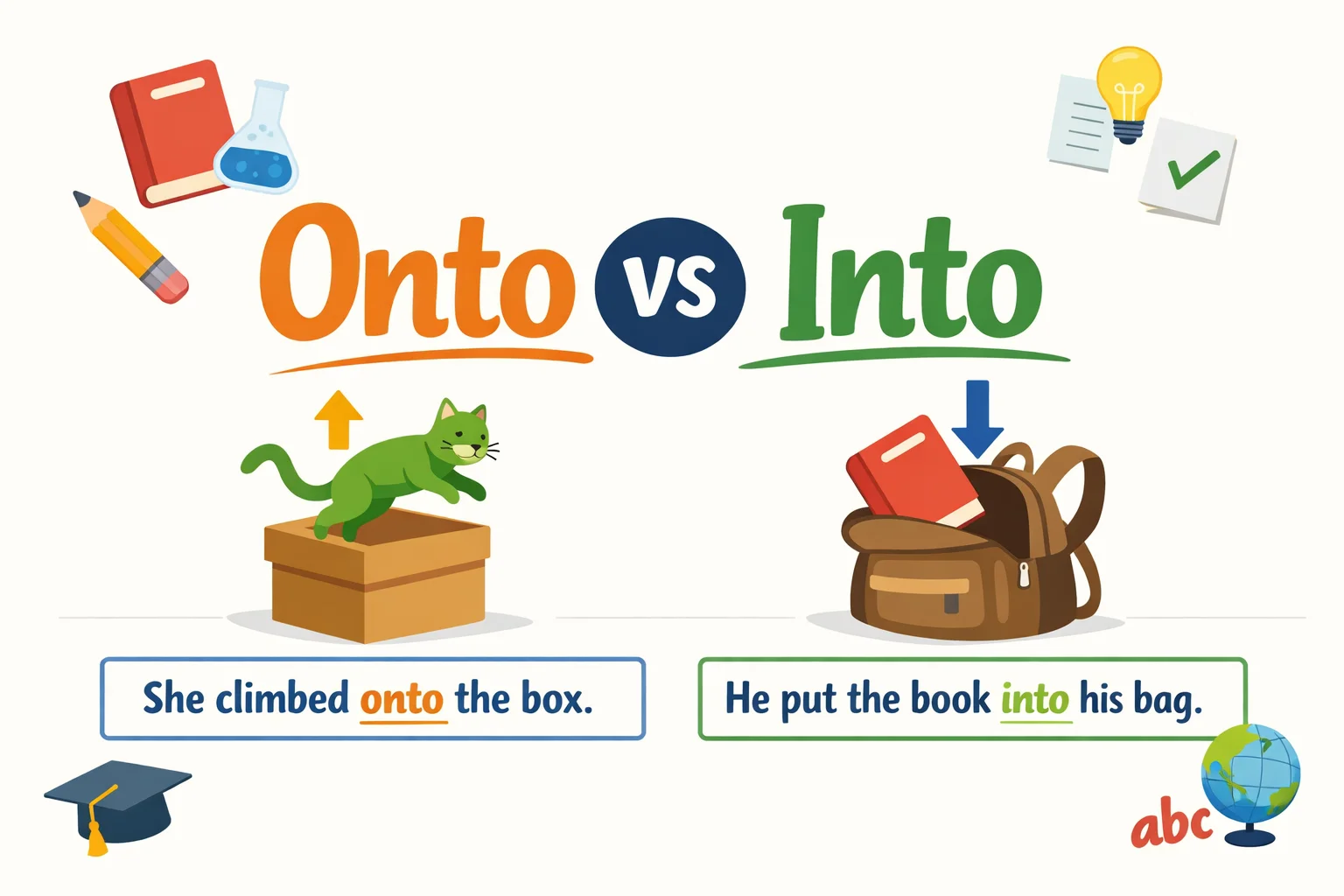
Think of it as “container vs surface”. Anything going inside uses into, anything landing on top uses onto.
What Does “Into” Mean?
Into is a preposition that indicates movement from the outside toward the inside of a space, object, or concept.
Common Uses of Into
- Physical movement into a space
- Example: She walked into the office and waved at everyone.
- Transformation
- Example: The caterpillar turned into a butterfly.
- Deep interest or involvement
- Example: He’s really into photography.
- Mathematical expressions (less common but valid in older English usage)
- Example: Five into six equals thirty.
Using into incorrectly can confuse readers because it always implies entry or absorption. For instance, “jumped into the table” is grammatically incorrect because a table isn’t a container.
What Does “Onto” Mean?
Onto indicates movement toward a surface or on top of something. Think of it as the preposition for placement, climbing, or positioning.
Common Uses of Onto
- Physical movement onto a surface
- Example: The cat jumped onto the sofa.
- Climbing or stepping up
- Example: She climbed onto the stage before the speech.
- Positioning or placing something on top
- Example: He placed the book onto the shelf.
Unlike into, onto does not imply entering a container—it’s strictly about surfaces or platforms.
The Core Difference Between Onto and Into
To clarify further, consider this visual explanation:
INTO → Inside something
Person → Room
Ball → Box
Water → Bottle
ONTO → On top of something
Cat → Table
Climber → Roof
Book → Shelf
Comparison Table
| Feature | Into | Onto |
| Direction | Inside something | On top of something |
| Movement Type | Entry | Surface placement |
| Example | Walk into the store | Step onto the platform |
Tip: Whenever you’re unsure, ask: “Is it going inside or onto the surface?”
Into vs Onto With Real-Life Examples
Here are practical examples showing correct usage:
| Sentence | Correct Word |
| She walked ___ the building | Into |
| The dog jumped ___ the couch | Onto |
| The car drove ___ the garage | Into |
| The actor stepped ___ the stage | Onto |
Mini Story Example
Lucy grabbed her backpack and ran into the classroom. The teacher climbed onto the podium and began speaking. A ball rolled onto the floor, and Lucy kicked it into the trash bin.
Notice how each action fits the surface vs container rule perfectly.
When “Into” Does Not Mean Physical Movement
Into also appears in non-literal contexts.
Transformation
- Example: Water turned into ice.
- Example: Ideas can turn into action with discipline.
Interest or Enthusiasm
- Example: She’s really into yoga.
- Example: He isn’t into video games anymore.
Mathematical or Figurative Expressions
- Example: Five into six equals thirty (traditional phrasing).
Understanding this prevents confusion when “into” appears outside of physical movement.
When “Onto” Appears in Phrasal Verbs
Several verbs pair naturally with onto, often conveying a figurative or idiomatic meaning:
- Hold onto – Keep possession or grip
- Example: Hold onto your ticket for entry.
- Move onto – Transition to the next topic or stage
- Example: Let’s move onto the next subject.
- Latch onto – Understand or adopt quickly
- Example: The student latched onto the concept immediately.
- Catch onto – Grasp or understand
- Example: She caught onto the joke instantly.
Recognizing these helps avoid confusing them with literal physical movement.
Onto vs On To: Important Grammar Difference
Many learners confuse onto (one word) with on to (two words). This is a major distinction often overlooked.
Onto (One Word)
- Indicates movement toward a surface.
- Example: The cat jumped onto the bed.
On To (Two Words)
- Part of a verb phrase, not movement to a surface.
- Example: Let’s move on to the next topic.
Quick Table:
| Phrase | Meaning |
| Onto | Movement to a surface |
| On to | Part of a verb phrase or continuation |
Remember: If it’s a verb + preposition combination → likely “on to.”
Into vs In To: Another Common Confusion
Similarly, into is often confused with in to.
Into
- A single preposition indicating movement inside.
- Example: She ran into the park.
In To
- Part of a verb phrase where “in” belongs to the verb.
- Example: She logged in to the system.
Quick Comparison Table:
| Phrase | Function | Example |
| Into | Movement inside | She jumped into the pool |
| In to | Verb phrase + preposition | She signed in to the meeting |
Common Mistakes Writers Make
Mistake 1: Using “Into” instead of “Onto”
- Incorrect: The cat jumped into the table.
- Correct: The cat jumped onto the table.
Mistake 2: Confusing “Onto” with “On to”
- Incorrect: Let’s go onto the next topic.
- Correct: Let’s move on to the next topic.
Mistake 3: Mixing “Into” and “In to”
- Incorrect: She logged into the website.
- Correct: She logged in to the website (if “in” belongs to “logged in”).
Avoiding these mistakes requires thinking about movement direction and verb phrases.
Easy Memory Tricks
Trick #1: The Surface Rule
- Ask: “Is it landing on top of something?” → Use onto.
Trick #2: The Container Rule
- Ask: “Is it going inside?” → Use into.
Trick #3: Ask One Question
- Is the object inside or on top? This simple test fixes 90% of errors.
Also Read: Follow Up or Follow-Up: The Complete Grammar Guide
Practice Sentences (Mini Quiz)
Fill in the blanks with onto or into:
- The child climbed ___ the chair.
- She walked ___ the classroom.
- The dog jumped ___ the car.
- Pour the water ___ the glass.
Answers:
- Onto
- Into
- Onto
- Into
Expert Tips for Using Onto and Into Correctly
- Always identify the direction of movement.
- Determine whether the object is a surface or a container.
- Watch for phrasal verbs that change the meaning.
- Read sentences aloud to catch errors.
- Use tables and examples as visual aids to reinforce memory.
“Prepositions are tricky, but once you master the logic, your English will flow naturally.” – Grammar Expert
Frequently Asked Questions (FAQs)
1. What is the main difference between “onto” and “into”?
“Onto” implies movement toward a surface or position on top of something, while “into” indicates movement inside or within an enclosed space. Example: She climbed onto the roof vs. He walked into the room.
2. Can “onto” and “into” be used interchangeably?
No, using them interchangeably can create confusion. Onto emphasizes placement on a surface, and into emphasizes entry or penetration. Correct usage ensures clarity in formal writing and business communication.
3. Are there regional differences in using “onto” or “into”?
Both US and UK English follow the same general rules. Minor stylistic preferences exist, but grammar and meaning remain consistent across regions.
4. How do “onto” and “into” relate to project management or scheduling?
In contexts like calendar management, task delegation, or online booking, onto is often used for adding items to a list or board, while into describes moving resources inside a specific project folder or category.
5. How can I remember which one to use?
Think of “onto” as on top and “into” as inside. Visualizing the action helps in broadcasting, meetings, and everyday English usage, ensuring your writing remains clear and professional.
Conclusion
Mastering onto or into may seem minor, but it dramatically improves English usage, grammar, and formal writing. These small prepositions guide readers through actions, locations, and directions, making your communication precise and professional. Whether you’re managing schedules, calendars, or projects, choosing the right preposition maintains clarity and consistency.
By understanding the nuances of onto versus into, you’ll write with confidence, avoid ambiguity, and enhance your business communication. Remember: a simple preposition can make a big difference in formal writing, online content, and everyday interactions. Apply these insights, and your sentences will not only be correct but also polished and engaging.

Johnson Alex is a language-focused writer and the voice behind WordsJourney. He creates practical, easy-to-understand content that helps readers improve their vocabulary and express ideas with clarity and confidence.