Have you ever paused mid-sentence, unsure which word fits—peek or peak? That split-second doubt is exactly why Peek vs Peak trips up so many writers. These two look alike, sound alike, yet mean entirely different things. Getting them right builds clarity, boosts confidence, and sharpens your English usage in everyday writing.
In professional settings, small word choices carry real weight. A single mix-up can blur meaning in business communication, confuse emails, or weaken formal writing. When you’re handling scheduling, time management, online booking, or coordinating meetings on a shared calendar, precise language keeps teams aligned. The same is true in broadcasting and project management, where clear wording protects consistency and prevents avoidable errors.
This guide breaks down the true difference between peek and peak, with simple definitions, real examples, and memory tips you can use right away. We’ll also touch on how major style guides and regional preferences (US vs. UK) approach usage, so your writing stays polished across contexts. By the end, you’ll choose the right word with ease—and your message will land exactly where you intend.
Peek vs Peak: Quick Comparison Table
Before diving deep, look at the difference side by side.
| Word | Part of Speech | Core Meaning | Common Contexts | Example |
| Peek | Verb / Noun | A quick or secret look | Curiosity, surprise, secrecy | She took a peek inside |
| Peak | Noun / Verb / Adjective | The highest point or maximum level | Mountains, performance, success | He reached his peak |
If you remember one thing, remember this:
- Peek = look
- Peak = highest point
Simple. But context adds layers. Let’s explore them.
What Does “Peek” Mean? Definition and Usage
Core Meaning of Peek
The word peek means to look quickly or secretly.
Think of a child peeking at birthday gifts. Or someone peeking through curtains during a storm. The action is brief. Sometimes playful. Often curious.
Peek as a Verb
Most commonly, peek works as a verb.
Examples:
- Don’t peek at your exam answers.
- She peeked through the door.
- I peeked at the clock.
Notice how the action involves a quick glance.
Peek as a Noun
Peek can also function as a noun.
- Take a peek.
- Have a quick peek.
- Sneak a peek.
In these cases, it describes the act of looking.
Common Collocations with Peek
You’ll often see peek paired with specific verbs:
- Take a peek
- Sneak a peek
- Have a peek
- Peek inside
- Peek at something
“Take a peek” remains the most common phrase in modern English.
If you write “take a peak,” you’re literally telling someone to grab a mountain.
What Does “Peak” Mean? Definition and Usage
While peek relates to sight, peak relates to height or intensity.
Peak as a Noun
As a noun, peak means the highest point of something.
That could be:
- A mountain peak
- The peak of a roof
- The peak of success
- The peak of a wave
- Peak traffic hours
Example:
- Mount Everest is Earth’s highest peak at 29,032 feet.
Peak as a Verb
Peak can also mean to reach the highest point.
- Sales peaked in December.
- His performance peaked in his 30s.
- The temperature peaked at 104°F.
Here, peak describes a climax.
Peak as an Adjective
Peak also works as an adjective.
- Peak performance
- Peak condition
- Peak season
- Peak hours
For example:
- Airlines raise ticket prices during peak season.
- Athletes train hard to reach peak condition.
Notice how peak always relates to maximum level or height.
Peek vs Peak: The Core Difference
Here’s the simplest way to remember:
- If you’re looking, use peek.
- If you’re talking about a high point, use peak.
Visual Memory Trick
Look at the letters:
- Peek has two E’s. Think of them as two eyes.
- Peak has an A. Think of Apex, which also starts with A.
That mental image sticks.
Why Writers Confuse Peek and Peak
They’re homophones. That means they sound the same.
English contains thousands of homophones:
- Their / There / They’re
- Your / You’re
- Accept / Except
Peek and peak fall into this category.
Spellcheck won’t save you because both words are correct English words. Context determines correctness.
That’s where careful editing matters.
Common Mistakes in Peek vs Peak Usage
Let’s look at real-world errors.
Incorrect vs Correct Examples
| Incorrect | Correct |
| Take a peak at this | Take a peek at this |
| Sneak a peak | Sneak a peek |
| Peek performance | Peak performance |
| The mountain peek | The mountain peak |
These mistakes often appear in:
- Blog posts
- Social media captions
- Product descriptions
- Student essays
- Marketing copy
Even professional websites sometimes publish “take a peak.”
That one-letter error instantly weakens authority.
Real-World Contexts: When to Use Peek vs Peak
In Casual Writing
Texting a friend?
“Take a peek at this meme.”
That works.
In Professional Emails
Sending a draft to your manager?
“Please take a peek at the attached report.”
Clear. Polished.
In Marketing Copy
“Get a sneak peek of our new collection.”
Notice that e-commerce brands often use this phrase to build anticipation.
In Business Reports
“Revenue peaked in Q4.”
Now peak fits.
Context drives everything.
Peek vs Peak in Popular Phrases
Some phrases are fixed. Memorize them.
With Peek
- Sneak a peek
- Take a peek
- Peek inside
- Peek behind the scenes
With Peak
- At its peak
- Peak condition
- Peak season
- Peak hours
- Peak performance
You wouldn’t say “sneak a peak” because you’re not sneaking a mountain.
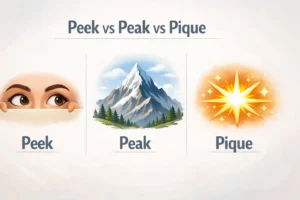
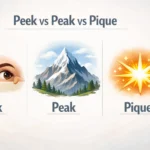
Bonus Clarity: Peek vs Peak vs Pique
Another troublemaker joins the party: pique.
Now you have three homophones.
What Does Pique Mean?
Pique means to stimulate interest or curiosity.
- The article piqued my interest.
- His comment piqued her curiosity.
Comparison Table
| Word | Meaning | Example |
| Peek | Quick look | Take a peek |
| Peak | Highest point | Sales peaked |
| Pique | Stimulate interest | Piqued my curiosity |
Most common mistake:
- ❌ It peaked my interest
- ✅ It piqued my interest
If you mix these up in formal writing, readers notice.
Case Study: A Marketing Headline Mistake
A mid-sized e-commerce brand once launched a campaign with this headline:
“Get a Sneak Peak of Our Summer Collection.”
The campaign ran for three weeks.
Customers pointed out the error on social media. Engagement shifted from excitement to mockery. The brand quietly corrected the spelling.
One misplaced vowel changed perception.
That’s how small grammar errors affect brand authority.
Memory Tricks That Actually Work
Forget memorizing dictionary definitions. Use associations.
Trick One: Eyes for Peek
Two E’s look like two eyes.
Peek = look.
Trick Two: A for Apex
Peak has A.
Apex means highest point.
Trick Three: Mountains Have Peaks
Think mountain peak.
You can’t climb a peek.
These mental anchors prevent confusion instantly.
Editing Checklist for Peek vs Peak
Before publishing, ask:
- Am I describing looking?
- Am I describing height or maximum level?
- Does the phrase sound familiar?
- Would replacing it with “highest point” still make sense?
If yes, use peak.
If no, use peek.
Advanced Usage: Figurative Meaning of Peak
Peak isn’t just physical.
You’ll see it in:
- Emotional peak
- Peak productivity
- Peak efficiency
- Peak demand
Economists often describe “peak demand” during electricity surges. Energy companies build systems around peak load data.
In sports science, trainers measure “peak output” to track athlete performance.
Peak implies measurable maximum.
Peek never does.
Linguistic Origins of Peek and Peak
Understanding origin helps memory.
- Peak comes from the Middle English word “pek,” referring to a pointed hill.
- Peek likely emerged later, related to the concept of peering.
Different roots. Different meanings.
They only sound alike.
Practice Section: Test Yourself
Choose the correct word.
- Take a ___ at the document.
- The stock price ___ last month.
- She ___ through the window.
- He reached his career ___.
Answers:
- Peek
- Peaked
- Peeked
- Peak
If you answered correctly, you’re already improving.
Mini Quiz for Reinforcement
Fill in the blank:
“Ticket prices increase during ___ travel season.”
Correct answer: Peak.
Now:
“Let me ___ at your phone screen.”
Correct answer: Peek.
Repetition builds mastery.
Common Grammar Myth About Peek vs Peak
Some believe peak always relates to mountains.
Not true.
It applies to:
- Markets
- Performance
- Traffic
- Energy use
- Emotional intensity
Peak describes the highest measurable or conceptual point.
Professional Writing Tip
When in doubt, rewrite the sentence.
Instead of:
“Take a peak.”
Write:
“Take a quick look.”
Clarity wins.
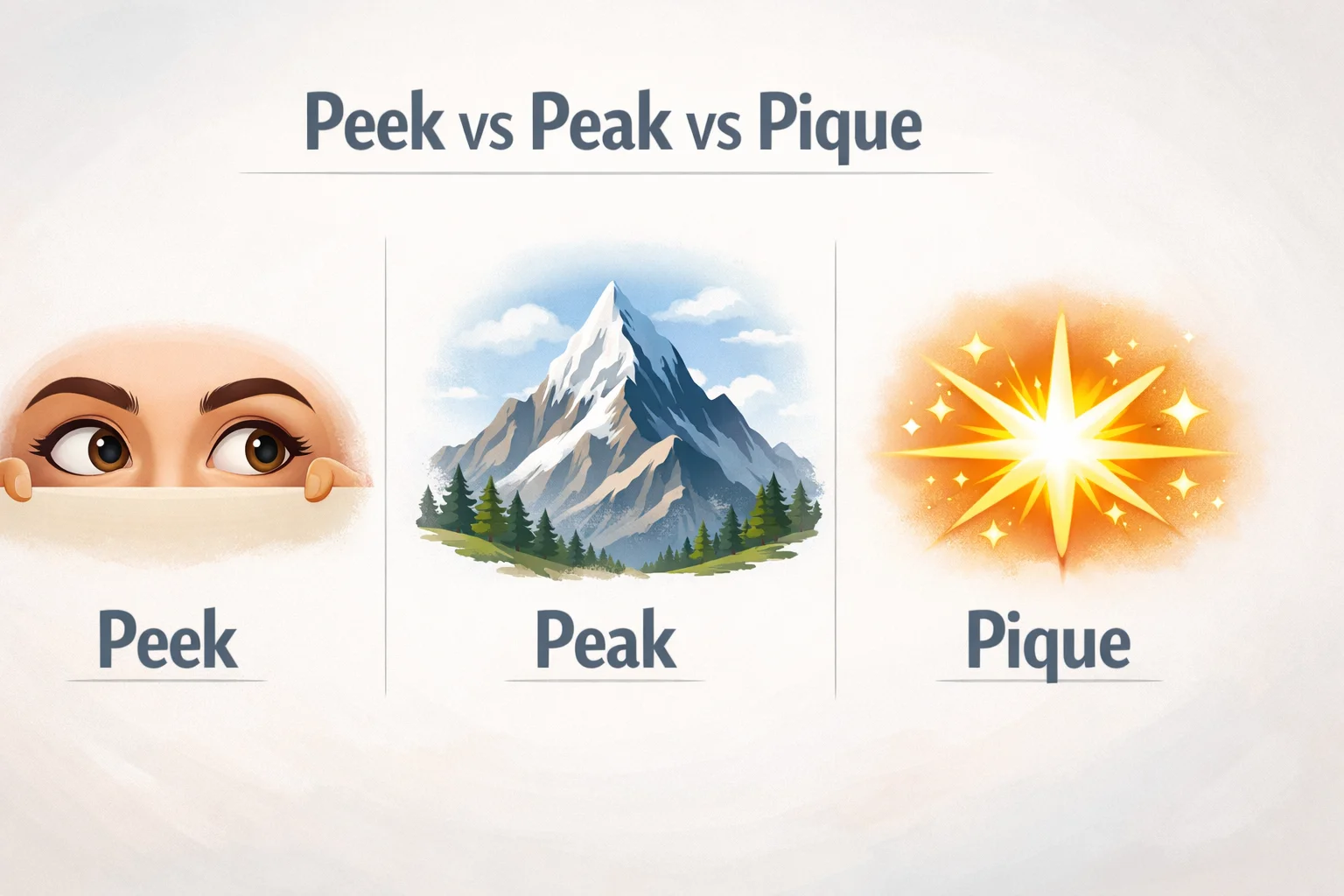
Quick Reference Diagram
Think of it like this:
Peek → Eyes → Looking
Peak → Mountain → Highest Point
Pique → Spark → Interest
Three words. Three meanings. No confusion.
Why Homophones Cause Errors
English evolved from multiple language families. Words merged from:
- Germanic roots
- Latin influence
- French vocabulary
That’s why identical sounds often carry different meanings.
Peek vs peak isn’t unusual. It’s part of English complexity.
FAQs: Peek vs Peak
1. What is the main difference between Peek vs Peak?
The core difference in Peek vs Peak is meaning and usage. Peek means to take a quick look or glance. Peak refers to the highest point, a top level, or a moment of maximum intensity. Mixing them up can confuse readers and weaken English usage in formal writing and business communication.
2. Can Peek vs Peak be used in business communication?
Yes, but with care. In business communication, clarity matters.
- Use peek when referring to a brief look, such as “Take a peek at the report.”
- Use peak when talking about performance, demand, or timing, such as “Sales reached their peak in Q4.” Correct usage improves consistency across emails, reports, and project management updates.
3. How does Peek vs Peak affect scheduling and time management?
In scheduling and time management, precision avoids confusion. For example:
- “Book meetings during peak hours.”
- “Take a quick peek at your calendar before confirming.” Clear word choice supports smooth online booking, better meetings, and fewer misunderstandings in team workflows.
4. Are there US vs. UK differences in Peek vs Peak usage?
There’s no difference in meaning between US and UK English for peek and peak. Both regions follow the same definitions. However, style guides in both regions emphasize consistency and correct word choice, especially in formal writing, broadcasting, and professional documents.
5. How can I remember when to use Peek vs Peak?
Try this simple memory trick:
- Peek has two E’s, like eyes—you use your eyes to look.
- Peak has an A, like apex—the highest point. These quick associations help improve long-term accuracy in grammar and everyday English usage.
Conclusion: Mastering Peek vs Peak
Understanding the difference between Peek vs Peak is a small change with a big payoff. When you choose the right word, your writing becomes clearer, more professional, and easier to trust. This matters in everything from casual emails to formal writing, from business communication to project management documentation.
As your work involves scheduling, time management, online booking, or coordinating meetings on a shared calendar, precise language prevents confusion and keeps workflows smooth. The same clarity strengthens broadcasting messages and supports long-term consistency across teams and platforms.Make accurate word choice a habit. With a few practical rules and examples, peek and peak will never trip you up again. Write with intention, follow trusted style guides, and stay mindful of context. Your readers—and your results—will thank you.

Johnson Alex is a language-focused writer and the voice behind WordsJourney. He creates practical, easy-to-understand content that helps readers improve their vocabulary and express ideas with clarity and confidence.