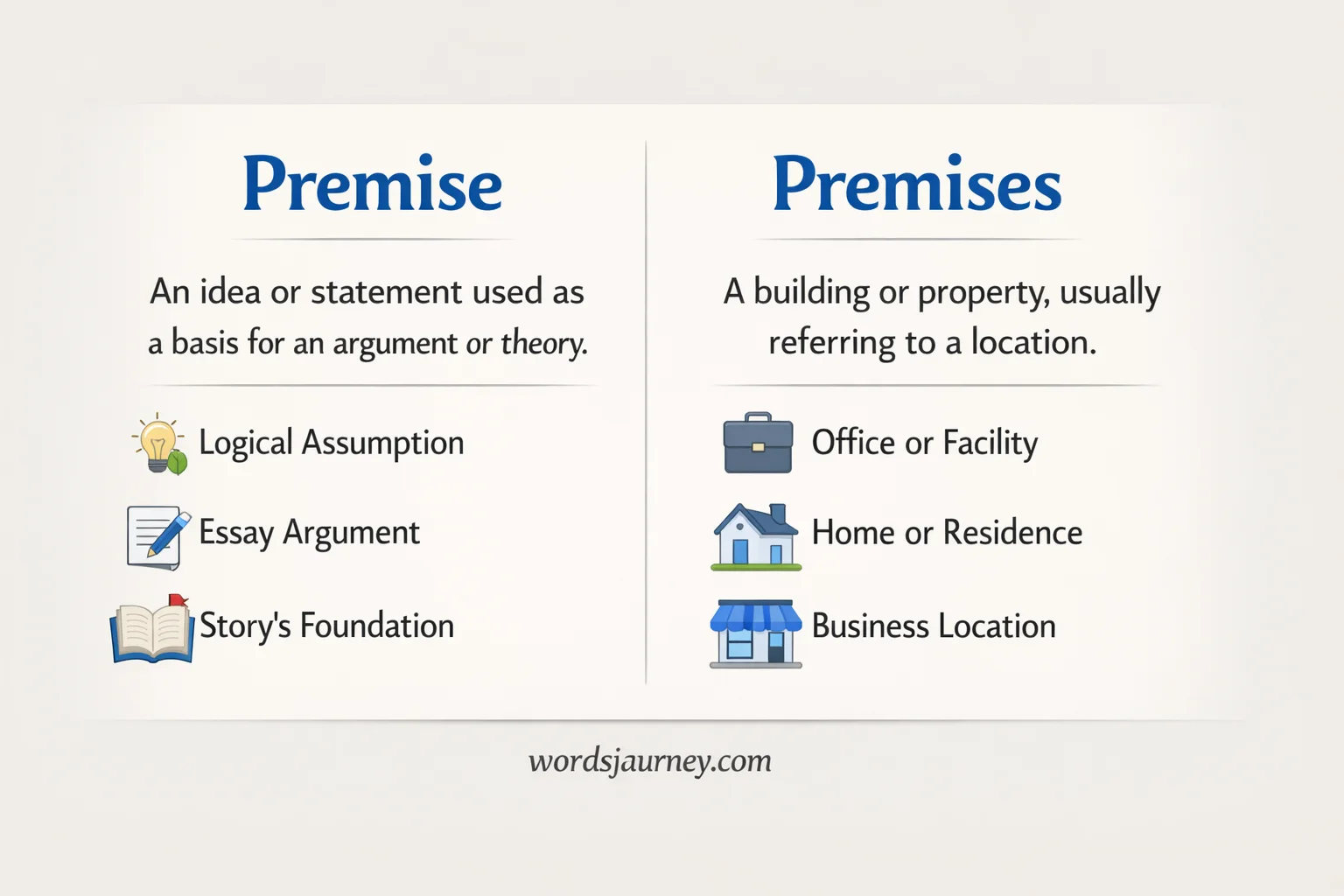
Ever paused mid-email and wondered whether to write “Premise or Premises”? You’re not alone. This tiny choice can trip up business communication, formal writing, and everyday English usage, especially when you’re juggling meetings, a packed calendar, and tight time management.
The difference seems small, yet it shapes clarity in project management notes, broadcasting scripts, and client messages. Get it right, and your writing sounds polished. Miss it, and your message loses precision.
In this guide, you’ll learn the clear difference between singular and plural forms, when each fits best, and how context changes meaning. We’ll show practical examples from online booking, scheduling, and team workflows so you can apply the rules fast.
You’ll also see how consistency improves readability across emails, agendas, and documentation. The goal is simple: write with confidence, avoid awkward phrasing, and keep your message sharp.
We’ll also touch on style guides and regional preferences to add authority and nuance. While US vs. UK usage is mostly aligned here, formal standards can shape tone and consistency in professional settings.
By the end, you’ll have quick rules, clean examples, and a repeatable habit for choosing the right form every time no second-guessing, no friction, just clear, credible writing.
Premise or Premises: Why This Pair Trips Up So Many Writers
The confusion around premise or premises comes from how English handles singular and plural nouns. Most words change clearly when they become plural. Add an “s” and move on. With premise, the plural premises also appears in legal and formal contexts that feel singular. That overlap messes with people’s instincts.
Here’s why the problem sticks:
- Premise often appears in logic and storytelling.
- Premises shows up in law, real estate, and formal arguments.
- Both words look and sound similar in fast reading.
- Many writers treat “premises” like a singular noun.
That last point causes the most trouble. You’ll see phrases like “the premises is flawed,” which breaks basic grammar rules. Once you lock in the number, the problem disappears.
What Does “Premise” Mean? The Singular Form Explained
A premise is a single idea or statement that supports a conclusion. Think of it as one brick in a wall. By itself, it may not prove much. Together with other bricks, it forms something solid.
Core meanings of premise
Premise carries a few related meanings depending on context:
- In logic: a statement that supports a conclusion
- In writing and storytelling: the central idea behind a story
- In everyday use: a starting point for a discussion
Examples of premise in natural sentences
- “The premise of the novel hooks you from page one.”
- “That premise supports the author’s main claim.”
- “Your premise needs evidence to stand up.”
Context vs meaning
| Context | Meaning of Premise | Example |
| Logic | A supporting statement | “This premise leads to the conclusion.” |
| Writing | Core story idea | “The premise drives the plot.” |
| Debate | Starting assumption | “The premise shapes the argument.” |
A good rule helps here. If you can replace the word with “one idea”, you probably need premise.
What Does “Premises” Mean? The Plural Form Explained
Premises is simply the plural of premise. It refers to two or more supporting statements. This form appears most often in logic, academic writing, and legal arguments.
What “premises” usually signals
- Multiple reasons supporting one conclusion
- A structured argument with several supports
- Formal or analytical writing
Examples of premises in action
- “The premises support the final conclusion.”
- “Her argument rests on shaky premises.”
- “These premises don’t align with the data.”
How multiple premises work together
Premise 1 ──┐
├──> Conclusion
Premise 2 ──┘
Each premise adds weight. If one fails, the argument weakens. When several collapse, the whole case falls apart.
Premise vs Premises: A Clear Side-by-Side Comparison
This quick table locks in the difference between premise or premises.
| Feature | Premise | Premises |
| Number | Singular | Plural |
| Basic Meaning | One supporting idea | Two or more supporting ideas |
| Common Fields | Writing, storytelling, logic | Logic, law, academic writing |
| Example | “The premise feels thin.” | “The premises feel weak.” |
Plain-English takeaway
- One supporting idea? Use premise.
- More than one? Use premises.
That’s it. No hidden trick.
Premise or Premises in Logic and Critical Thinking
Logic treats premises as the backbone of reasoning. Strong premises lead to strong conclusions. Weak premises lead to bad decisions.
How premises support conclusions
Here’s a simple argument:
- Premise: All humans need water to survive.
- Premise: Alex is human.
- Conclusion: Alex needs water to survive.
Both premises work together. Remove one and the conclusion loses force.
Deductive vs inductive reasoning
| Type | How Premises Work | Example |
| Deductive | Premises guarantee the conclusion | “All mammals breathe. Dogs are mammals.” |
| Inductive | Premises suggest the conclusion | “Most dogs bark. This dog will likely bark.” |
Strong reasoning depends on clear premises. Vague or false premises create shaky outcomes.
Quote: “Bad reasoning rarely fails at the conclusion. It fails at the premises.”
Premise or Premises in Writing, Film, and Storytelling
In creative work, premise means the core idea behind a story. It answers one question. What is this story really about?
Premise vs plot vs theme
| Term | What It Covers |
| Premise | Central idea or situation |
| Plot | What happens in the story |
| Theme | Deeper message or meaning |
Examples of strong premises
- A teacher cooks meth to pay medical bills.
- A theme park revives dinosaurs with genetic science.
- A time traveler tries to fix one tragic mistake.
Each premise feels tight and focused. It gives the story direction before the plot unfolds.
What makes a strong premise
- Clear conflict
- Built-in stakes
- Obvious tension
- Room for growth
Checklist for testing a premise
- Does it spark curiosity?
- Can it sustain a full story?
- Does it hint at conflict?
A strong premise acts like a compass. It guides every creative choice that follows.
Common Mistakes With Premise or Premises
Writers stumble over the same errors again and again. Spotting them helps you avoid easy slip-ups.
Frequent errors
- Treating premises as singular
- Swapping premise for summary
- Using premise when describing a topic
- Mixing verb agreement
Before and after corrections
| Wrong Sentence | Corrected Version |
| “The premises is flawed.” | “The premises are flawed.” |
| “The premise explain the theory.” | “The premise explains the theory.” |
| “The premise of the essay is facts.” | “The main idea of the essay is facts.” |
The fix usually comes down to number agreement. Match your verb to your noun.
For More Please Visit: Winner or Winer: The Real Difference and Common Mistakes
Is “Premises” Ever Singular? The Grammar Trap Explained
You’ll sometimes hear people talk about “the premises” as if it were one place or concept. This comes from legal language, where premises can refer to a property or location. Even then, the word stays plural in form.
Why the confusion sticks
- Legal writing uses premises for physical property
- People hear it used like a singular idea
- Grammar rules stay the same
The rule that never changes
Premises always takes plural verbs.
- Correct: “The premises are secure.”
- Incorrect: “The premises is secure.”
Stick to the grammar rule and you’ll never go wrong.
Premise vs Assumption vs Hypothesis vs Thesis
These words often travel together. They don’t mean the same thing.
| Term | What It Means | Typical Use Case |
| Premise | Supporting statement in an argument | Logic, debate |
| Assumption | Belief taken without proof | Persuasion, reasoning |
| Hypothesis | Testable prediction | Science, research |
| Thesis | Main claim or position | Essays, academic work |
Quick examples
- Premise: This product saves time.
- Assumption: People value convenience.
- Hypothesis: Users will adopt the app faster.
- Thesis: The app improves productivity.
Each word plays a different role in thinking and writing.
How to Choose Premise or Premises in Real Writing
Use this simple decision guide while editing.
Quick rule of thumb
- Count the supporting ideas.
- One idea equals premise.
- Two or more equals premises.
Editing checklist
- Identify each supporting statement
- Check verb agreement
- Replace vague wording
- Read the sentence aloud
Everyday examples
- Blog post: “The premise needs clearer evidence.”
- Essay: “The premises don’t support the claim.”
- Email: “That premise makes sense to me.”
Small checks like these prevent sloppy mistakes.
Mini Practice: Test Your Understanding
Fill in the blanks
- The _______ behind the story grabs attention.
- The argument relies on weak _______.
Answers
- Premise
- Premises
Practice builds muscle memory. After a few edits, your eye will catch mistakes on its own.
FAQs: Premise or Premises
1) What is the difference between “premise” and “premises”?
Premise is the singular form. It refers to one building, property, or location, or a single statement in logic or argument. Premises is the plural form. It refers to multiple buildings, rooms, or properties, or more than one supporting statement. In formal writing and business communication, choosing the right form keeps meaning precise and avoids confusion.
2) Is “premises” always plural in English usage?
Yes, premises is grammatically plural, even when people casually use it for one location. In grammar and formal writing, treat premises as plural with plural verbs. Example:
- ✔️ The premises are open for meetings.
- ❌ The premises is open.
3) When should I use “premise” in professional contexts?
Use premise when you mean a single location or one core idea. This is common in project management, broadcasting briefs, and business communication where clarity matters. Example:
- The premise of the campaign is simple and clear.
4) How does this affect scheduling and online booking content?
In scheduling, online booking, and calendar workflows, precision avoids mix-ups. Use premise for one office or venue. Use premises for multiple sites or a facility with several buildings. This improves clarity in meetings, confirmations, and time management workflows.
5) Are there US vs. UK differences for “premise” and “premises”?
There’s no major US vs. UK difference in meaning. Both follow the same grammar rules. However, style guides in both regions stress consistency in professional documents, contracts, and reports. Pick the correct form and keep it consistent across your content.
6) Can “premises” refer to a single building?
In casual speech, people say premises for one place. In formal writing and English usage, that’s discouraged. If you mean one location, use premise. This keeps your writing accurate and professional.
7) Why does this distinction matter in business communication?
Small grammar choices affect credibility. Clear usage improves emails, policies, project management notes, and broadcasting scripts. It also prevents confusion when coordinating meetings, locations, and access details across teams.
✅ Conclusion
Choosing between Premise or Premises isn’t just a grammar detail. It’s a clarity decision that shapes formal writing, business communication, and everyday English usage.
When you use the singular and plural forms correctly, your messages read cleanly and carry authority whether you’re managing meetings, updating a calendar, confirming online booking, or aligning teams in project management.
Follow the simple rules, stay consistent, and respect basic style guide standards across US and UK contexts. Do that, and your writing becomes easier to trust, easier to read, and easier to act on. Clear language saves time, reduces friction, and helps your ideas land exactly where they should.

Aliya Ray is a passionate writer and language enthusiast at WordsJourney. She enjoys exploring words, phrases, and everyday expressions to help readers communicate more clearly and confidently. Her content focuses on alternative ways to say common phrases, simple explanations, and real-life examples that make language easy to understand.
Aliya believes the right words can make any message stronger. Through clear, friendly writing, she helps readers improve their vocabulary without feeling overwhelmed or confused.