Have you ever paused mid-sentence and wondered whether to write “Prey or Pray”?
It’s a subtle yet significant distinction that can change your message entirely. Understanding the difference is crucial, whether you’re crafting formal writing, scheduling business communications, or managing online bookings where clarity and professionalism matter. Misusing these words can affect grammar, consistency, and even your credibility in emails, meetings, or project updates.
In this article, we’ll break down the nuances of Prey or Pray, providing practical examples and tips for correct usage.
You’ll see how mastering this simple pair enhances not only your English usage but also your broader time management and project management skills. From calendar scheduling to broadcasting messages, knowing which word fits ensures your writing communicates precisely what you intend.
Whether you follow US or UK style guides, this guide will make your decision effortless. We’ll cover real-world applications, from formal writing to casual online communications, helping you maintain professionalism while keeping your tone natural.
By the end, you’ll confidently distinguish Prey from Pray, improving both your language accuracy and your overall communication effectiveness.
Understanding the Core Meaning
What Does “Prey” Mean?
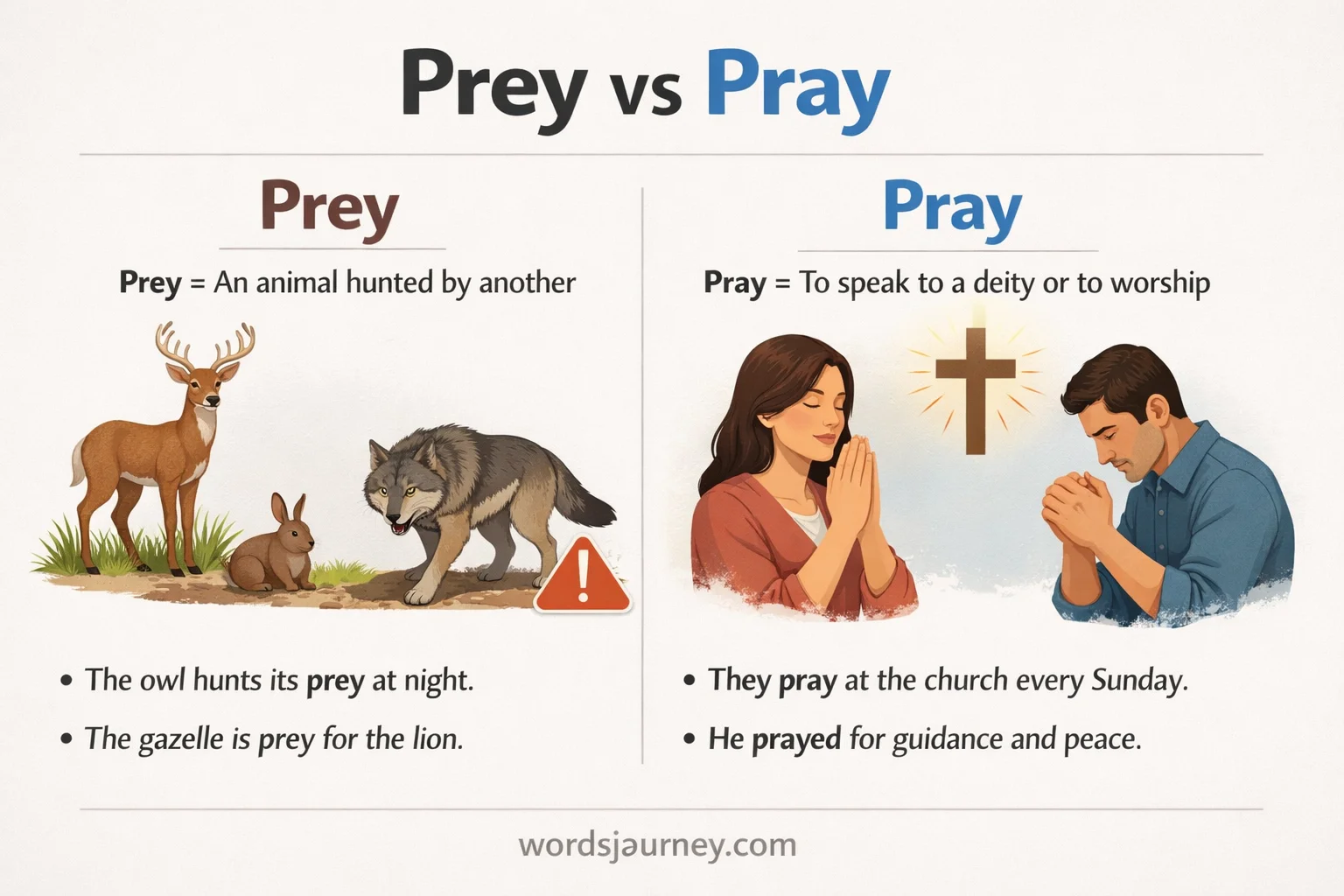
Prey refers to someone or something that is hunted, attacked, or victimized. It can be a noun or a verb.
- As a noun: It represents the target of a predator.
- Example: The rabbit is prey for the fox.
- As a verb: It means to attack, exploit, or victimize.
- Example: Scammers often prey on the elderly.
Origins: The word comes from the Latin praeda, meaning “booty or spoil,” which later evolved into Middle English prei.
Common contexts: Wildlife, danger, psychological vulnerability, and metaphorical usage.
What Does “Pray” Mean?
Pray is a verb meaning to speak to a deity, ask for help, or give thanks.
- As a verb:
- Example: I pray for my family’s health every night.
- Religious or spiritual contexts: People pray in churches, mosques, temples, or silently at home.
- Figurative usage: Sometimes “pray” is used in polite expressions or hopes, e.g., I pray you understand my point.
Origins: The word stems from Old French preier, from Latin precari, meaning “to ask or entreat.”
Key Differences Between Prey and Pray
Understanding the difference is easier when you compare them side by side:
| Feature | Prey | Pray |
| Part of Speech | Noun / Verb | Verb |
| Meaning | Victim, hunted, exploited | Speak to a deity, ask, hope |
| Usage Context | Nature, danger, figurative vulnerability | Religion, hope, gratitude |
| Example Sentence | The deer became prey to the lion. | We pray for peace in the world. |
| Memory Tip | Think predator and prey | P-R-A-Y for spiritual conversation |
The main takeaway: Prey is about being hunted, Pray is about asking or hoping.
Correct Usage in Sentences
Let’s see prey vs pray in real-life sentences so you can spot the difference instantly.
Prey in Sentences
- Small animals often fall prey to larger predators.
- She was prey to fear before her big presentation.
- Hackers prey on weak passwords and outdated security.
Pray in Sentences
- Every morning, he prays for his family’s health.
- We pray that justice will prevail.
- I pray you forgive me for my mistake.
Notice the nuance: “prey” often implies danger, while “pray” implies hope or supplication.
Memory Tricks & Mnemonics
Here are some simple ways to remember the difference:
- Prey = animal → Think of a lion chasing its prey.
- Pray = talk to God → P-R-A-Y can remind you of spiritual conversation.
- Visual analogy: Prey runs, Pray kneels.
Quick tip list:
- If the word involves being hunted or attacked, it’s prey.
- If the word involves asking, hoping, or talking to a deity, it’s pray.
- Say the sentence out loud; context usually reveals the correct word.
Common Idioms & Phrases
Both words appear in idiomatic expressions, which are often misused.
Prey Idioms:
- Fall prey to something → “She fell prey to misinformation.”
- Prey on someone’s weakness → “Fraudsters prey on elderly victims.”
Pray Idioms:
- Pray for mercy → “The villagers prayed for mercy during the storm.”
- Pray tell (polite old-fashioned way to ask someone to explain) → “Pray tell, what happened yesterday?”
Using the wrong word in an idiom can completely change the meaning, so double-check context.
Grammar & Spelling Insights
Even native speakers sometimes get confused because prey and pray are homophones.
- Prey can function as a noun or verb.
- Pray is only a verb.
- Spellcheck often won’t catch the mistake because both words are spelled correctly.
- Context is key: Ask yourself, “Am I talking about danger or hope?”
Example of common mistake:
- Wrong: He fell pray to the scheme.
- Correct: He fell prey to the scheme.
Also Read: Mr or Mrs Understanding the Correct Usage
Real-Life Examples & Case Studies
Case Study 1: Social Media Misuse
On Twitter, thousands of posts confuse prey vs pray. For example:
- Incorrect: I pray for the poor bunny.
- Correct: The poor bunny fell prey to a fox.
This small error changes the sentence’s meaning from compassion to vulnerability.
Case Study 2: Journalism
News headlines sometimes misreport stories due to homophone errors:
- Incorrect: “Tourists pray to scammers online.”
- Correct: “Tourists fall prey to scammers online.”
The first headline reads as if tourists are praying to scammers, which is absurd.
Impact
Using the wrong word reduces credibility, confuses readers, and can even be embarrassing in professional writing.
FAQs: Prey or Pray
1. What is the difference between “Prey” and “Pray”?
Prey refers to an animal hunted for food or metaphorically someone being targeted, while Pray means to communicate with a deity, usually in worship or request. Correct usage depends entirely on context.
2. Can “Prey” be used in business communication?
Rarely. In professional writing, “prey” might appear metaphorically, such as in marketing strategies (“don’t let competitors prey on your weaknesses”), but it’s not common in formal writing or online bookings.
3. How do I remember when to use “Pray”?
Think of spiritual or polite requests. If the sentence involves hope, wishes, or divine communication, Pray is the correct choice.
4. Does style guide choice (US vs UK) affect Prey or Pray?
No. Both US and UK grammar rules treat “Prey” and “Pray” the same way. The difference lies purely in context, not regional spelling or style.
5. How does knowing this difference improve my writing?
Using the right word ensures clarity, consistency, and professionalism across emails, meetings, project management updates, and broadcast messages. It prevents misunderstandings and strengthens your English usage.
Conclusion
Mastering Prey or Pray may seem minor, but it has a major impact on communication precision. From formal writing to business emails, choosing the correct word maintains credibility and enhances your professional tone. By understanding context and meaning, you can confidently navigate sentences, whether scheduling meetings, managing calendars, or crafting online content.
Remember, Prey targets, while Pray petitions. Keeping this simple distinction in mind ensures consistent grammar, smooth communication, and stronger engagement with your readers or audience. With practice, you’ll never hesitate again when this common pair arises, making your writing both accurate and effective.

Johnson Alex is a language-focused writer and the voice behind WordsJourney. He creates practical, easy-to-understand content that helps readers improve their vocabulary and express ideas with clarity and confidence.