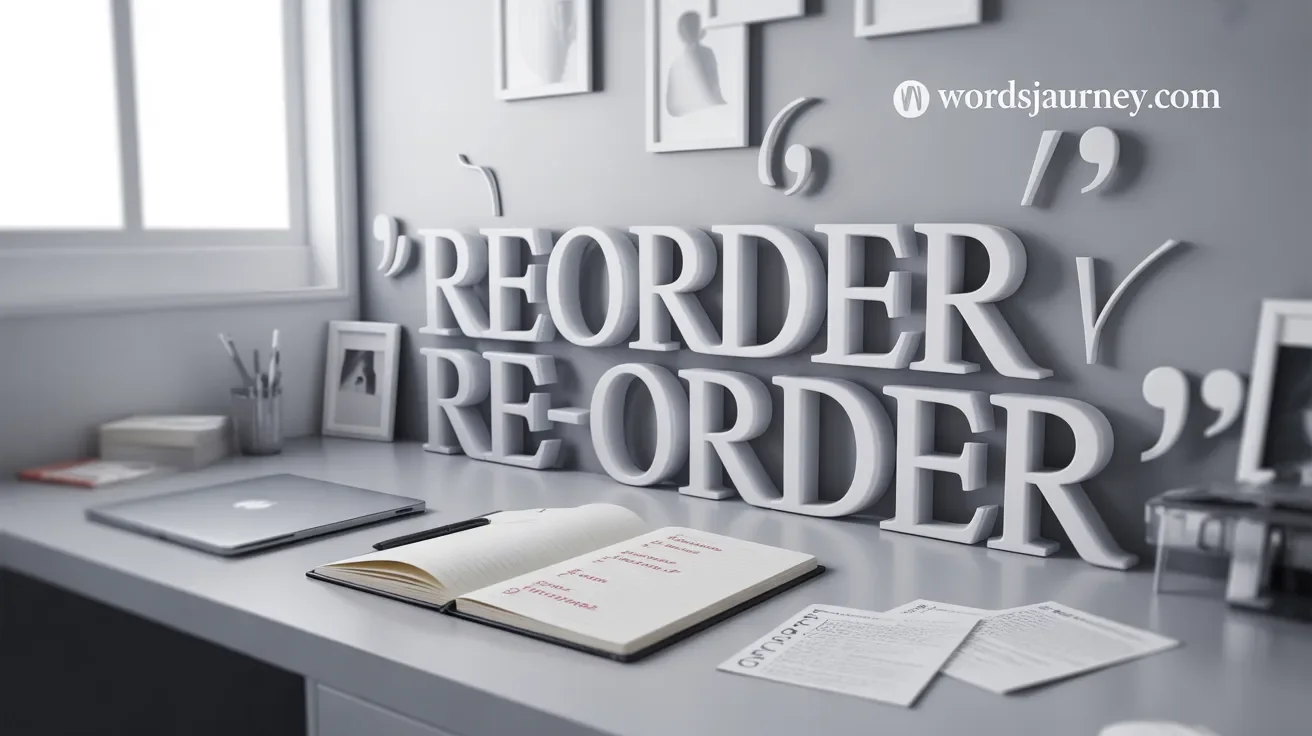
Reorder or Re-order English can feel tricky, especially hyphens, writers, One common question they face is should you write reorder re-order At first glance tiny hyphens may look harmless but can change word’s meaning readability professionalism.
Hyphen rules tricky figure out seems like different phrases following the article will help know whether it’s one two where hyphenated form comes into play. Reorder should always be written as word according all correctly because re- prefix group root doesn’t begin letter e wrong words use phrases.
Reorder or Re-order? The Simple Answer You Can Trust
Let’s get straight to it.
In modern American English:
- “Reorder” is the correct and preferred form
- “Re-order” is usually unnecessary
However, there’s a twist. English loves exceptions, and hyphens sometimes show up for clarity or style.
Think of it like this:
If your sentence doesn’t get confusing without the hyphen, skip it.
That’s the rule most style guides follow today.
Reorder or Re-order? Why This Tiny Hyphen Causes Big Confusion
You’re not alone if this has tripped you up.
Three reasons cause most confusion:
- Old grammar rules still circulate online
- British and American usage sometimes differ
- Writers overuse hyphens “just in case”
Here’s the truth. English has been steadily removing hyphens for decades. Words that once needed hyphens now stand strong alone.
For example:
- e-mail → email
- re-write → rewrite
- re-order → reorder
Language evolves. Hyphens often disappear over time.
Understanding Prefixes in Reorder or Re-order Usage
To understand this rule, you need to understand prefixes.
A prefix attaches to the beginning of a word and changes meaning.
The prefix “re-” usually means:
- again
- back
- once more
So when you write:
- redo → do again
- rewrite → write again
- reorder → order again
Notice something important? No hyphen is needed in most cases.
Why?
Because readers already recognize the structure. The word stays clear without extra punctuation.
When the Hyphen IS Needed in Reorder or Re-order Cases
Now here’s where things get interesting. Hyphens are not dead. They just work less often.
You SHOULD use a hyphen when:
Clarity Breaks Down Without It
Sometimes a word changes meaning without a hyphen.
Examples:
- re-sign (sign again) vs resign (quit)
- re-cover (cover again) vs recover (heal)
Without a hyphen, confusion hits fast.
Double Vowels Make Reading Hard
When letters collide, readability suffers.
Examples:
- re-enter
- re-elect
- re-evaluate
Try saying “reelect” quickly. It feels awkward. The hyphen fixes that.
Precision Matters in Formal Writing
Legal, academic, and technical writing sometimes keeps hyphens.
Why?
Because clarity matters more than style.
A contract, for example, cannot afford ambiguity.
Why “Reorder” Wins in Modern American English
Let’s be clear.
“Reorder” dominates modern usage.
It works better because:
- It reads faster
- It looks cleaner
- It matches digital writing standards
- It avoids unnecessary punctuation
Most major dictionaries and writing standards support this.
Here’s a simple breakdown:
| Form | Status in American English | Reason |
| reorder | ✅ Preferred | Clean and standard |
| re-order | ⚠️ Rare use | Only for clarity cases |
If you’re writing for blogs, business, “reorder” is your safest choice.
Reorder or Re-order in Real-World Writing Examples
Let’s see how this works in real sentences.
- You can reorder items in your shopping cart.
- The system will reorder inventory automatically.
- Customers may reorder previous purchases anytime.
Now compare:
- You can re-order items in your shopping cart. (less common today)
The meaning stays the same. The hyphen adds nothing useful in most cases.
That’s why modern writing drops it.
American vs British English in Reorder or Re-order Usage
English changes depending on geography.
American English:
- Prefers simplification
- Drops hyphens faster
- Uses “reorder” almost always
British English:
- Sometimes retains hyphens longer
- More flexible in older publications
Still, even in British usage today:
👉 “reorder” is widely accepted and often preferred.
So the gap between the two is shrinking.
What Style Guides Say About Reorder or Re-order
Professional writing follows style guides. Let’s break it down.
AP Style (Associated Press)
- Avoid hyphens unless needed for clarity
- Prefers modern closed compounds
Chicago Manual of Style
- Allows hyphens when ambiguity exists
- Otherwise favors closed forms
Oxford Style (British influence)
- Slightly more tolerant of hyphens
- Still evolving toward simplification
A common principle across all guides:
Use hyphens only when they improve understanding.
Common Mistakes Writers Make with Reorder or Re-order
Even good writers slip up. Here’s what goes wrong most often.
Overusing hyphens
Some writers think hyphens make writing “correct.” They don’t.
Copying inconsistent sources
Online content often mixes both forms. That spreads confusion.
Switching styles mid-document
One paragraph uses “reorder.” Another uses “re-order.” That looks unprofessional.
Consistency matters more than perfection.
Simple Decision Guide for Reorder or Re-order Usage
Here’s a quick mental checklist you can use while writing:
Ask yourself:
- Does the word become unclear without a hyphen?
- Does it create a confusing double vowel?
- Does meaning change without it?
If the answer is no, then:
👉 Write “reorder”
Simple. Fast. Reliable.
Related Words That Follow the Same Reorder or Re-order Rule
This rule doesn’t stop at one word.
You’ll see the same pattern here:
- reorder vs re-order
- rewrite vs re-write
- reenter vs re-enter
- reevaluate vs re-evaluate
- reapply vs re-apply
Notice the trend?
Modern English prefers closed compounds.
Hyphens only show up when needed for clarity.
Read More: Soo vs. So: And How to Use Each Correctly
Case Study: Why Businesses Prefer “Reorder”
Let’s look at real-world usage in e-commerce.
Imagine a shopping platform.
Scenario:
A customer wants to buy something again.
Most systems use:
- “Reorder past items”
- “Reorder now”
- “Quick reorder”
Why?
Because UI design values speed and clarity. A hyphen slows scanning. It also takes extra visual space.
Even major platforms prefer the simplified version because it improves user experience.
In short:
👉 Cleaner text leads to faster decisions.
The Big Picture: Why the Hyphen in Reorder or Re-order Is Fading
Language always moves toward efficiency.
English keeps dropping unnecessary punctuation over time.
Think about it:
- e-mail became email
- to-day became today
- re-order became reorder
The pattern is clear. Simpler wins.
And writing gets easier because of it.
FAQs
1. Is it “reorder” or “re-order”?
It is always “reorder” as one word in modern English.
2. Why is “re-order” considered wrong?
Because the prefix “re-” is joined directly to the root word when it does not start with the letter “e,” so no hyphen is needed.
3. Does a hyphen change meaning here?
In this case, yes. A hyphen makes it look incorrect and breaks standard writing rules, affecting readability and correctness.
Conclusion
Understanding reorder or re-order is simple once you know the rule. In standard English writing, reorder is always correct because the re- prefix attaches directly to the root word. Using a hyphen is unnecessary and goes against style guidelines. Keeping it one word improves clarity, readability, and professionalism in your writing.

Johnson Alex is a language-focused writer and the voice behind WordsJourney. He creates practical, easy-to-understand content that helps readers improve their vocabulary and express ideas with clarity and confidence.