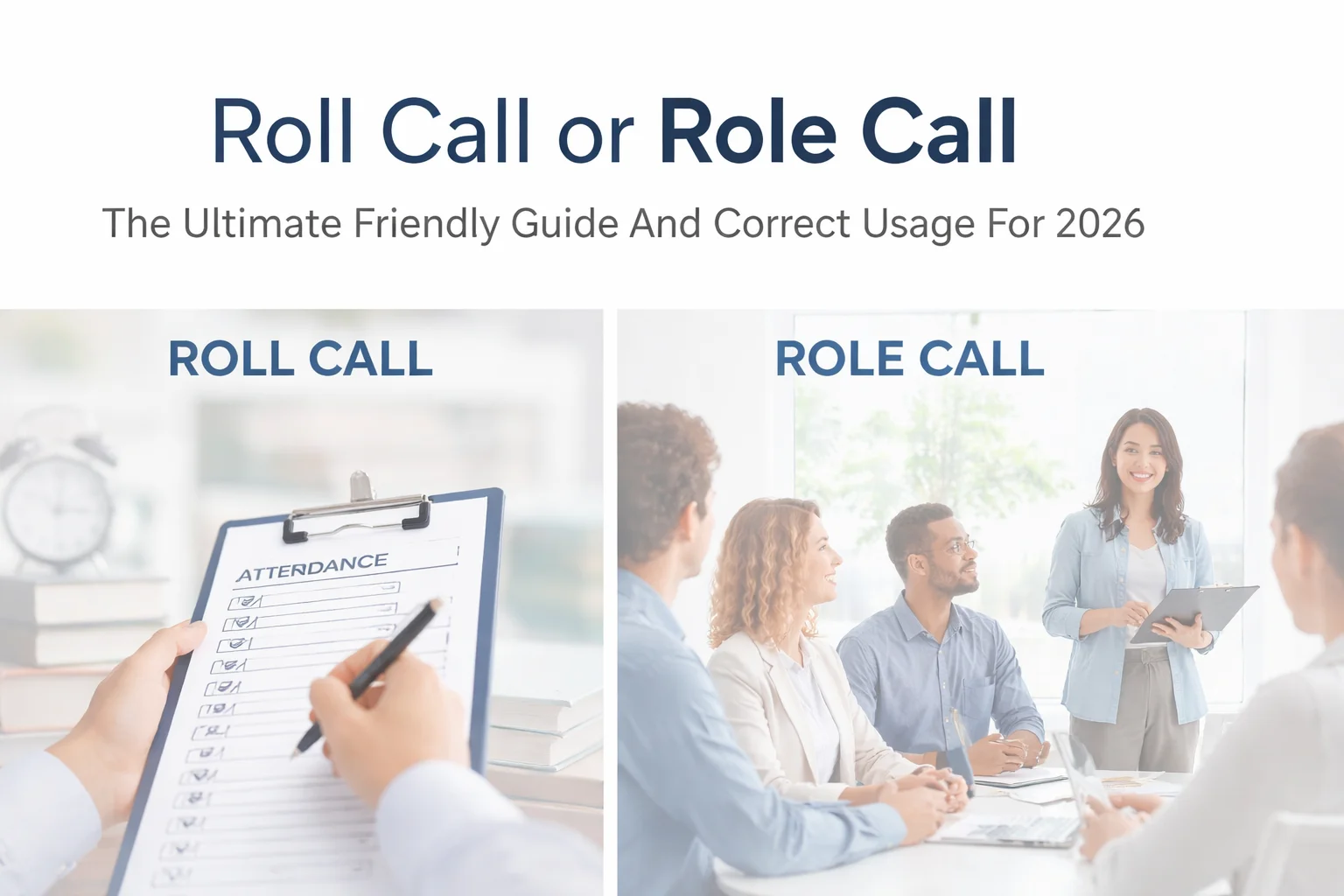
Have you ever paused mid-sentence wondering whether to write “Roll Call or Role Call”? You’re not alone. Many writers, teachers, professionals, and even broadcasters debate this confusing pair in everyday business communication, meetings, and broadcasting contexts.
When accuracy matters in English usage, grammar, and formal writing, choosing the right phrase is essential for credibility, clarity, and consistency.
In this article, you’ll discover what each expression truly means, how it connects with real-life scheduling, time management, calendar organization, and even project management or online booking situations.
We’ll explain where the phrase is used in education, government, corporate environments, and broadcasting, while keeping the tone friendly, practical, and highly informative. You’ll also see why the correct term matters when communicating instructions, documenting attendance, or coordinating important meetings.
We’ll briefly look at US vs. UK style guides, modern grammar recommendations, and regional preferences to give you authoritative guidance that works in professional writing. By the end, you’ll know exactly when to use the correct term, how to avoid embarrassing mistakes, and how to maintain polished, confident, and effective communication.
Let’s clear up the confusion once and for all and make “Roll Call or Role Call” easy to understand.
Roll Call or Role Call – Quick Answer First
Let us make this simple. The correct phrase is:
“Roll Call” is correct. “Role Call” is incorrect.
Roll Call means calling out a list of names to check attendance or presence. It comes from the historical meaning of “roll” which refers to a list of registered names written on a scroll or register.
“Role Call” looks logical because we use the word “role” to describe someone’s duty or position. However it does not create a valid phrase in English. You will never see it accepted in professional, academic, or standardized writing.
So yes. If you want to sound correct, educated, and confident:
- Use Roll Call
- Avoid Role Call
Now let us dive deeper. Understanding makes memory stronger.
Why People Get Confused Between Roll Call And Role Call
Confusion happens because roll and role sound exactly the same when spoken. They are homophones. When words share the same pronunciation, the brain often guesses the spelling based on logic. Since “role” means responsibility or position, many people assume “Role Call” might refer to calling out people based on their roles.
Another reason confusion spreads:
- Social media posts repeat incorrect spelling
- Autocorrect sometimes replaces “roll” with “role”
- People rarely check grammar in casual conversations
- Spoken English hides spelling mistakes
Even major bloggers and forums sometimes get it wrong. That is why guides like this matter. Clarity saves you from embarrassing mistakes in emails, essays, exams, and professional writing.
Meaning Of Roll Call – Clear, Practical, And Real
Roll Call refers to calling names from a list to check who is present and who is absent. It confirms attendance. The phrase appears in structured environments where accountability matters.
What Roll Call Truly Means
Roll Call means:
- A systematic attendance check
- A formal confirmation of who is present
- A way to verify participation or presence
It is not casual. It is organized. It is purposeful.
Where You Hear Roll Call In Real Life
You will hear Roll Call in many environments. Let us break it down.
Schools And Classrooms
Teachers use roll call daily to:
- Mark attendance
- Confirm which students are present
- Track participation
- Maintain discipline and order
Example:
“The teacher began a roll call before the test.”
Workplace Meetings
Businesses use roll call during:
- Official meetings
- Virtual conferences
- Corporate briefings
- Compliance records
Example:
“The manager started a roll call to ensure all department heads attended.”
Military And Law Enforcement
In strict disciplined environments, roll call is serious. It tracks duty, presence, readiness, and accountability.
Used in:
- Morning formations
- Patrol briefings
- Duty assignments
- Emergency response
Example:
“Soldiers lined up for roll call at 0600 hours.”
Events And Public Gatherings
Organizers conduct roll call to:
- Confirm registered participants
- Prevent confusion
- Maintain order
Example:
“The event coordinator took roll call before assigning seats.”
Correct Usage Examples Of Roll Call
Use these examples as memory anchors.
- “Let us begin the roll call before we start the meeting.”
- “The captain conducted a roll call to ensure everyone reported for duty.”
- “Roll call happens every morning at school.”
- “We finished the roll call then moved on to the agenda.”
Notice something. The phrase always connects with attendance, presence, and verification.
Is Role Call Ever Correct?
Short answer again. No. It is not grammatically correct in standard English.
However, let us understand why people feel tempted to use it. The word role refers to:
- A person’s function
- A responsibility
- A character played by an actor
- A professional position
So the mind falsely creates “Role Call” as:
A call to check people’s roles
But that phrase does not exist formally in the English language.
If you want to refer to positions or responsibilities, you simply say:
- Assign roles
- Define roles
- Clarify roles
- Role distribution
- Role assignment
Never “role call”.
Examples Of Incorrect Usage (Avoid These)
Here are wrong examples people mistakenly write:
- ❌ “The teacher did role call this morning.”
- ❌ “We will begin role call now.”
- ❌ “Police officers attend daily role call.”
None of these are acceptable in proper writing.
Understanding Roll vs Role – Clear Comparison
It helps when you compare both words separately.
Meaning Of Roll
Roll can mean:
- A list or register of names
- To move in a circular motion
- A piece of bread
- An official record
Meaning Of Role
Role means:
- A character in a movie or drama
- A responsibility
- A duty
- A position someone holds
Comparison Table: Roll vs Role
| Word | Meaning | Example |
| Roll | List or attendance register | “Your name is on the roll.” |
| Roll | Movement | “Roll the ball.” |
| Roll | Food item | “Pass me a bread roll.” |
| Role | Job or responsibility | “He plays a leadership role.” |
| Role | Acting character | “Her role in the movie was powerful.” |
Grammar Logic – Why Roll Call Makes Sense
In older English, the term “roll” referred to a scroll of paper that recorded names. The phrase “call” meant calling those names aloud. So Roll Call literally meant:
Calling names from the roll.
Over time, schools, parliaments, military forces, and organizations adopted it. The meaning stayed consistent. Because of this strong historical root, the phrase never changes. English holds on to tradition aggressively here.
That is why grammar experts, dictionaries, educational boards, and professional institutions agree:
Roll Call is the only correct form.
Memory Tricks To Always Remember Roll Call
Let us make it impossible for you to forget.
Trick 1: ROLL = LIST
If it deals with attendance, list, or register, think:
Roll = list of names
So Roll Call means calling names from the list.
Trick 2: Movie Roles Have Characters
If you think of acting, drama, or responsibility, that is role, not roll.
Example memory link:
Actors play roles. Teachers take roll.
Trick 3: One Word Always Appears In Schools
Schools take attendance. Schools use roll call. Schools do not deal with acting roles.
That makes it easier to remember.
Where You Commonly See The Phrase Roll Call
You will come across Roll Call in many structured settings.
- Schools and universities
- Government meetings
- Military formations
- Police briefings
- Corporate boardrooms
- Official assemblies
- Court environments
- Parliamentary sessions
Roll Call exists because presence matters. Attendance affects responsibility, accountability, and records.
Roll Call Compared To Similar Expressions
Sometimes Roll Call gets confused with related phrases. Let us clear that too.
| Phrase | Meaning | When To Use |
| Roll Call | Checking attendance by calling names | Formal settings |
| Headcount | Counting number of people | Informal or quick count |
| Attendance Check | Confirming who is present | Schools and meetings |
| Calling Names | Casual calling of people | Informal situations |
Roll Call sounds formal and structured. Headcount sounds quicker and more casual. Attendance check sounds neutral. Choosing the right expression improves clarity.
Professional Writing Tips For Roll Call
If you write professionally, accuracy matters. Employers, clients, teachers, and examiners expect precision.
Use Roll Call correctly in:
- Academic essays
- Official documents
- Workplace communication
- Reports
- Journalism
- Legal documents
- Government writing
Avoid role call completely because it weakens professionalism.
Common Mistakes To Avoid
Many people fall into predictable traps. Watch out for these.
- Do not trust autocorrect blindly
- Do not assume logic defines spelling
- Do not copy social media grammar
- Do not mix “role” and “roll” carelessly
- Do not use Role Call in any formal context
Accuracy builds credibility. Mistakes create a poor impression.
Quick Reference Table – Roll Call vs Role Call
| Phrase | Correct | Meaning | Usage |
| Roll Call | ✅ Yes | Calling names to check presence | Schools, Military, Workplaces |
| Role Call | ❌ No | Incorrect phrase | Do not use |
| Roll | ✅ Yes | List, movement, bread | Multiple meanings |
| Role | ✅ Yes | Duty, responsibility, character | Jobs, Acting |
Mini Case Study – Real World Effects Of Using The Wrong Phrase
Imagine a business proposal that says:
“We will perform a role call to confirm executive presence.”
A professional reader may immediately question writing quality. It damages perception. Communication mistakes affect credibility. On the other hand:
“We will perform a roll call to confirm executive presence.”
This sounds polished, accurate, and confident.
Language influences trust. Correct usage creates authority.
Also Read: Perfect vs Prefect: Perfect Usage and Real Examples For 2026
Helpful Examples In Different Contexts
Formal Context
“Roll call will begin at 9 AM.”
Educational Context
“Teachers complete roll calls before starting lessons.”
Military Context
“Every soldier must report for roll call without delay.”
Corporate Context
“The HR department conducts roll calls during compliance meetings.”
FAQs About “Roll Call or Role Call”
1. Which is grammatically correct, “Roll Call” or “Role Call”?
The correct term is “Roll Call.” It refers to calling out a list of names to check presence, usually in classrooms, meetings, government sessions, broadcasting settings, and professional gatherings. “Role Call” is considered incorrect in standard grammar and formal writing.
2. What does “Roll Call” actually mean?
Roll Call means taking attendance by calling names from an official list or register. It’s widely used in schools, corporate meetings, military sessions, broadcasting, and other environments where attendance tracking, scheduling, or time management matters.
3. Why do people confuse “Roll Call” with “Role Call”?
The confusion happens because “Roll” and “Role” sound the same, but they have different meanings. “Roll” relates to a list or record. “Role” relates to duties or responsibilities in business communication, project management, or team assignments.
4. Is “Role Call” ever correct in English usage?
No. Role Call is not correct in standard English grammar. Even in informal writing, it is considered a spelling mistake. Style guides, especially American and British grammar references, recognize only “Roll Call.”
5. Do US and UK English differ in using “Roll Call”?
Both US and UK English prefer “Roll Call.” However, wording around meetings or attendance may vary slightly depending on institutional style, but the phrase remains universally accepted and understood.
6. Can “Roll Call” be used in digital or online contexts?
Yes. Modern workplaces use the term in online booking systems, virtual classrooms, remote work meetings, broadcasting schedules, and calendar tools where attendance or participant confirmation is required.
7. Where is “Roll Call” commonly used today?
You’ll see it in schools, government assemblies, corporate meetings, broadcasting studios, webinars, military settings, and anywhere attendance, accountability, or time management plays a key role.
Conclusion
Choosing between “Roll Call or Role Call” shouldn’t be confusing anymore. The correct term is Roll Call, and it has a clear purpose—tracking attendance, ensuring accountability, improving scheduling, and supporting smooth business communication across classrooms, workplaces, broadcasting environments, and formal meetings.
Understanding this small yet important distinction strengthens your grammar, sharpens your English usage, and helps you maintain professionalism and consistency in every message you write.
Whether you’re preparing documents, organizing a calendar, managing a team, or writing with authority, using the right phrase shows attention to detail and linguistic confidence.

Emma Brook is a dedicated writer and language enthusiast at WordsJourney. She’s passionate about helping readers understand words better and use them with confidence in everyday conversations. Her work focuses on alternative phrases, clear meanings, and practical examples that make language feel simple and approachable.
With a friendly, reader-first writing style, Emma breaks down common expressions and explores smarter ways to say things without sounding forced or complicated. Her goal is to make learning words enjoyable, useful, and easy for everyone.