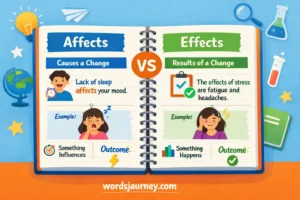
Have you ever paused mid-email or meeting invite, wondering which phrase sounds right? That moment of doubt often appears when writers face Take Affect vs Take Effect, a pair that looks similar but works very differently in English usage.
In professional contexts—like business communication, formal writing, or even a quick note about a schedule change—choosing the wrong one can subtly weaken your message. This article opens with that exact confusion and clears it up, simply and confidently.
At first glance, the difference between take affect and take effect may seem minor, but it has real consequences in grammar, meaning, and clarity. Whether you’re writing about scheduling, time management, online booking systems, broadcasting announcements, or changes to meetings, calendars, and project management plans, precision matters.
We’ll explore what each phrase means, how it functions in a sentence, and why consistency is critical when communicating timelines, policies, or updates that must be understood correctly.
The Short Answer (If You’re in a Hurry)
“Take effect” is correct.
“Take affect” is almost always wrong.
You use take effect when something begins to work or produce a result. Laws take effect. Medicines take effect. Rules take effect.
The phrase take affect only works in rare psychological contexts. Most writers never need it.
Why “Take Affect” and “Take Effect” Are Confusing
At first glance, the confusion makes sense.
- Affect and effect sound exactly the same.
- Both words relate to change or influence.
- English uses them as different parts of speech.
- Spellcheck often ignores the error.
That mix creates a perfect storm. Writers hear “take effect” spoken aloud, assume the spelling, and move on. Unfortunately, the wrong version slips through far more often than people realize.
What makes this tricky is that English learners and native speakers struggle equally. This isn’t about skill. It’s about exposure and habit.
What “Take Effect” Actually Means
Take effect means to start working or to begin producing an intended result.
It’s an idiomatic phrase. That means you can’t break it apart and translate it word by word. You have to learn it as a unit.
Core Meaning in Plain English
When something takes effect, it moves from inactive to active.
The change might be instant or gradual. What matters is that the process has begun.
Common Real-World Uses of “Take Effect”
You’ll see take effect in serious, practical contexts where timing matters.
Laws and Government Policies
New laws don’t apply immediately. They often have a start date.
Examples:
- The new tax law will take effect on January 1.
- The policy changes took effect after the vote passed.
Medicine and Health
Doctors talk about how long treatments take to work.
Examples:
- The pain medication should take effect within 30 minutes.
- The vaccine took effect gradually over several weeks.
Rules, Systems, and Processes
Workplace rules, software updates, and procedures rely on timing.
Examples:
- The updated policy will take effect tomorrow.
- The system changes took effect after the restart.
Correct Usage of “Take Effect” With Clear Examples
To really lock this in, it helps to see natural sentence patterns.
Everyday Examples
- The caffeine didn’t take effect until after lunch.
- The new routine finally took effect last week.
- The apology didn’t take effect the way he hoped.
Professional and Business Examples
- The contract terms take effect once both parties sign.
- The restructuring plan took effect in Q3.
- Cost-cutting measures will take effect immediately.
Legal and Technical Examples
- The amendment takes effect upon publication.
- Emergency regulations took effect overnight.
- The security patch takes effect after installation.
Notice something important. Writers don’t explain the phrase. They assume readers understand it. That’s because take effect is standard, accepted English.
Is “Take Affect” Ever Correct?
Yes, but only in rare and highly specific cases.
This is where many explanations go wrong. They either say “never” or drown readers in theory. The truth sits in the middle.
Understanding “Affect” as a Noun
Most people learn affect as a verb meaning to influence.
Example:
- Stress can affect your health.
But in psychology, affect also works as a noun.
Psychological Definition of Affect
In clinical psychology, affect refers to a person’s observable emotional state.
Examples:
- Flat affect
- Blunted affect
- Emotional affect
In this narrow field, a psychologist might write something like:
- The medication began to take affect in the patient.
Even here, many professionals prefer alternative phrasing to avoid confusion.
Why Most Writers Should Avoid “Take Affect”
Outside academic psychology, take affect looks like a mistake. Editors flag it. Readers doubt it. Search engines don’t favor it.
Unless you’re writing a clinical paper and know exactly what you’re doing, don’t use it.
Take Affect vs Take Effect: Side-by-Side Comparison
| Phrase | Correct? | Meaning | When to Use |
| Take effect | Yes | Begin to work or produce a result | Laws, medicine, rules, changes |
| Take affect | Rarely | Emotional state (psychology noun) | Clinical or academic psychology |
This table alone saves hours of confusion.
Common Mistakes Writers Make
Even strong writers fall into these traps.
Mistake 1: Writing What Sounds Right
Speech hides spelling errors. Writing exposes them.
Mistake 2: Assuming Both Are Interchangeable
They aren’t. One works. One usually doesn’t.
Mistake 3: Trusting Spellcheck Blindly
Spellcheck sees real words and moves on. It doesn’t understand context.
Mistake 4: Overthinking Grammar Rules
You don’t need a grammar degree here. You need a simple rule.
Simple Memory Tricks That Actually Work
Forget long explanations. Use tools your brain likes.
Trick 1: Effect Equals End Result
If something produces a result, it takes effect.
Trick 2: Swap the Phrase
Replace the phrase with “start working.”
- The law will start working tomorrow.
- The law will take effect tomorrow.
If it works, you’ve got the right phrase.
Trick 3: Remember Professional Usage
Doctors, lawyers, and journalists use take effect, not take affect.
Take Effect vs Similar Phrases
English offers close cousins that sometimes fit better.
Take Effect vs Come Into Effect
- Take effect emphasizes function.
- Come into effect emphasizes timing.
Both are correct. American English favors take effect.
Take Effect vs Go Into Effect
- Go into effect sounds more formal.
- Take effect sounds natural and direct.
Take Effect vs Have an Effect
- Take effect = start working.
- Have an effect = cause impact.
Example:
- The policy took effect last year and had an effect on prices.
Read More: Vender vs Vendor: Which Is Correct in 2026?
Real-World Examples From News, Law, and Medicine
You’ll notice a pattern if you pay attention.
Government and Law
Major outlets consistently use take effect when reporting timelines.
Example:
- The regulation will take effect after a 60-day review period.
Healthcare
Medical journals rely on precise language.
Example:
- The treatment took effect within two weeks.
Business and Technology
Corporate communication avoids ambiguity.
Example:
- The update takes effect after deployment.
Professionals choose clarity every time.
Case Study: A Small Phrase, Big Consequences
A consulting firm published a white paper announcing new compliance rules. The document repeatedly used “take affect.”
The result:
- Readers questioned expertise.
- Editors flagged the language.
- The firm issued a revision.
One phrase triggered unnecessary doubt.
Quotes From Language Experts
“When something begins to operate, it takes effect. That usage has been standard for centuries.”
— Bryan A. Garner, legal lexicographer
“Errors involving affect and effect are among the most common in modern English.”
— Merriam-Webster Usage Notes
These aren’t style preferences. They’re established norms.
Quick Editing Checklist
Before you publish, run through this list.
- Did you mean “start working”?
- Are you describing a rule, law, or change?
- Are you writing outside clinical psychology?
If yes, use take effect.
Frequently Asked Questions (FAQs)
1. Is “take affect” ever correct in standard English?
In most cases, no. The phrase “take affect” is almost always incorrect in standard English usage. The correct expression is “take effect,” which means something begins to work or become active. While affect can function as a verb in rare psychological or literary contexts, it does not fit naturally after the verb take in modern formal writing.
2. What does “take effect” actually mean?
Take effect means to start producing results or to become operative. It is commonly used in professional and technical contexts such as business communication, project management, broadcasting, and policy updates. Example:
- The new meeting schedule will take effect on Monday.
3. Why is “take affect” such a common mistake?
The confusion comes from the similarity between affect and effect, both in spelling and pronunciation. Since affect is often taught as a verb and effect as a noun, writers sometimes assume “take affect” follows the same logic. In reality, “take effect” is a fixed, correct phrase, and consistency matters—especially in grammar and formal writing.
4. Is “take effect” used differently in US vs. UK English?
No. Both US and UK English style guides agree that “take effect” is the correct and standard form. There is no regional variation here, making it a safe and authoritative choice in international business communication, online booking notices, and official announcements.
5. Where is “take effect” commonly used in real life?
You’ll often see take effect in contexts involving time management and activation points, such as:
- Calendars and scheduling updates
- Online booking systems
- Meetings and event planning
- Project management timelines
- Broadcasting or public notices
Using the correct phrase ensures clarity and professionalism.
6. How can I remember the correct usage easily?
A simple trick:
- If you mean “start working” or “become active,” always use take effect. If you replace the phrase with begin or start, and the sentence still makes sense, take effect is correct.
Conclusion
The confusion around Take Affect vs Take Effect is small but significant. In clear, professional communication—especially when discussing scheduling, meetings, calendars, or project management—using the wrong phrase can reduce clarity and credibility. The good news is simple: “take effect” is the correct and accepted expression in both US and UK English.
By understanding this distinction and applying it consistently, you strengthen your grammar, improve your formal writing, and communicate with confidence in every context—from internal emails to public announcements. Language precision isn’t about sounding complicated; it’s about being understood. And when something is supposed to start, change, or apply, now you know exactly which phrase to use—every time.

Aliya Ray is a passionate writer and language enthusiast at WordsJourney. She enjoys exploring words, phrases, and everyday expressions to help readers communicate more clearly and confidently. Her content focuses on alternative ways to say common phrases, simple explanations, and real-life examples that make language easy to understand.
Aliya believes the right words can make any message stronger. Through clear, friendly writing, she helps readers improve their vocabulary without feeling overwhelmed or confused.