Ever paused mid-sentence and wondered which spelling looks right Through or Thru? You’re not alone. This tiny choice shows up everywhere, from emails and formal writing to online booking forms and quick notes in your calendar.
In everyday English usage, the difference feels small, yet it can shape clarity, tone, and consistency across your writing.
In modern business communication, word choice affects how messages land. Think about scheduling a series of meetings, managing deadlines in project management, or coordinating time management across teams.
The spelling you choose can signal professionalism in reports, smooth broadcasting scripts, and clean copy for websites and booking pages. Small details build trust, especially when readers scan fast and expect precision.
This guide breaks down when to use through and when thru makes sense, with clear rules, examples, and common pitfalls. You’ll also see how major style guides and regional preferences (US vs. UK) treat each form, so your writing stays polished across contexts.
By the end, you’ll write with confidence, keep your tone consistent, and avoid those tiny errors that quietly undermine credibility.
Through vs Thru: A Quick Comparison
Before diving into detailed explanations, let’s look at the main differences in a clear table:
| Feature | Through | Thru |
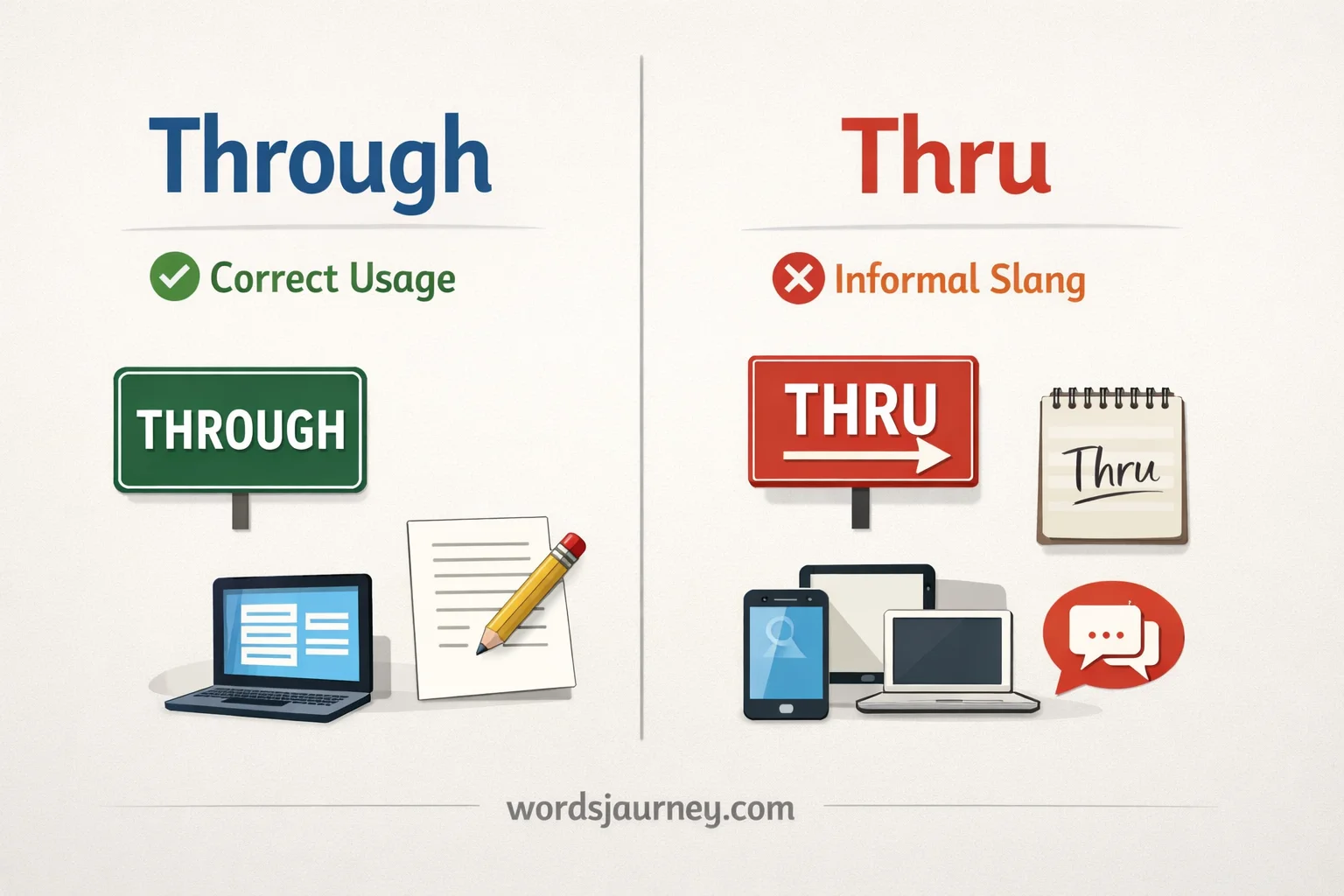
| Form | Standard spelling | Informal spelling |
| Accepted in | Formal and informal writing | Informal, signage, branding |
| Dictionary use | Fully recognized | Recognized as informal/variant |
| Common places | Books, blogs, academic work | Drive-thru, texts, signs |
| Tone | Professional, neutral | Casual, conversational |
This table shows why through dominates professional writing, while thru thrives in signage, casual communication, and branding.
What Does “Through” Mean?
Through is versatile. It has three main functions: movement, completion, and continuation.
Movement from one side to another
- Example: “She walked through the forest on a sunny morning.”
- Usage: Whenever you describe physically moving across a space, through is correct.
Completion of a process or task
- Example: “He read through the contract before signing it.”
- Usage: Ideal for professional, academic, or official contexts where clarity matters.
Continuation over time or effort
- Example: “They got through a tough week at work.”
- Usage: Works for figurative or emotional “passages,” such as challenges or experiences.
Common collocations:
- Go through
- Work through
- Look through
- Get through
Pro tip: Using through in these contexts signals professionalism, attention to detail, and credibility.
What Does “Thru” Mean?
Thru is an informal, simplified spelling of through, mostly used in casual contexts. It first appeared in the 20th century and has become standard for signage, branding, and digital shorthand.
Where “thru” appears:
- Drive-thru restaurants: “Grab your coffee at the drive-thru.”
- Road signs: “Keep right for the thru lane.”
- Branding and marketing: “Watch our walk-thru demo online.”
- Texting or informal writing: “I’ll see you thru the week.”
When to avoid “thru”
- Academic papers
- Professional emails
- Official documents
Rule of thumb: If your goal is casual readability, convenience, or branding, thru works. Otherwise, stick with through.
Style Guides on Through vs Thru
Professional writing consistently favors through, while thru is flagged as informal.
Major style guides:
- AP Stylebook: Always use through, unless part of an official name or signage.
- Chicago Manual of Style: Recommends through for all formal and informal prose.
- Merriam-Webster Dictionary: Recognizes thru as informal, mainly for signs.
Practical takeaway:
- Academic writing → through
- Business emails → through
- Advertising or casual signage → thru can be acceptable
Using thru incorrectly in professional settings can subtly damage credibility, while proper usage of through conveys clarity and authority.
Common Mistakes Writers Make
Even experienced writers make errors. Watch for these pitfalls:
- Using thru in professional emails or essays
- Mixing through and thru in the same piece
- Assuming thru is always incorrect
- Overusing through in signage or branding where thru would be natural
Quick fixes:
- Professional audience → through
- Casual audience or signage → thru
- When in doubt → default to through
Memory Tricks to Avoid Confusion
Try this simple visualization:
- Through = long, formal road → standard spelling for writing
- Thru = shortcut lane → casual, signage, branding
By associating thru with brevity and through with formality, you’ll instinctively pick the right word.
Through or Thru in Signs, Branding, and Pop Culture
Brands and signage often favor thru for space, speed, and modern appeal.
Examples:
- Drive-thru windows at fast food chains
- Walk-thru demos in tech stores
- Push-thru buttons in elevators
Case Study: McDonald’s Drive-Thru
McDonald’s uses thru on signs and menus, signaling quick service. Their corporate communications, however, consistently use through, maintaining a professional image. This shows how context and audience dictate correct usage.
Also Read: Winner or Winer: The Real Difference and Common Mistakes
Quick Decision Guide: Which One Should You Use?
Decision checklist:
- Writing articles, blogs, or essays → through
- Creating signage, buttons, or brand phrases → thru
- Unsure? → Default to through
Consistency is key. Once you choose the correct form for a context, stick with it throughout your writing.
Bonus: Related Commonly Confused Words
Other words frequently misused in writing include:
- Then vs Than
- Your vs You’re
- Affect vs Effect
- Lose vs Loose
- Where vs Were
FAQs: Through or Thru
1. What is the difference between “through” and “thru”?
Through is the standard, formal spelling used in writing, especially in grammar-conscious contexts, business communication, and project management documents. Thru is an informal, simplified version, commonly seen in US signage, quick notes, and casual online booking instructions.
2. Can I use “thru” in professional emails or reports?
Generally, it’s best to stick with through in formal writing, meetings agendas, and broadcasting scripts. Thru is acceptable in informal contexts or where brevity is needed, such as calendar reminders or time-sensitive instructions.
3. Is “thru” accepted internationally?
Thru is mostly a US convention. In UK English, through is preferred in all contexts. Using thru outside casual US settings may appear unprofessional or incorrect.
4. Does using “thru” affect clarity?
Sometimes. While readers usually understand thru, overuse in project management notes, scheduling instructions, or formal correspondence can reduce perceived professionalism and affect consistency in documents.
5. How do style guides treat “through” and “thru”?
Major style guides like AP, Chicago, and Oxford recommend through for formal and written English. Thru may be used in signage, advertising, or informal time management notes, but avoid it in official reports or communications.
Conclusion
Choosing between through or thru may seem trivial, but the right spelling impacts clarity, professionalism, and reader trust. Through remains the safe choice for formal writing, business communication, and internationally recognized English usage. Thru, on the other hand, offers a concise, casual alternative suited for US signage, quick calendar notes, and online booking forms.By understanding context, audience, and style guide preferences, you can confidently decide which form fits your writing. Whether managing meetings, projects, or everyday correspondence, mastering this subtle difference ensures your writing is both consistent and polished.

Emma Brook is a dedicated writer and language enthusiast at WordsJourney. She’s passionate about helping readers understand words better and use them with confidence in everyday conversations. Her work focuses on alternative phrases, clear meanings, and practical examples that make language feel simple and approachable.
With a friendly, reader-first writing style, Emma breaks down common expressions and explores smarter ways to say things without sounding forced or complicated. Her goal is to make learning words enjoyable, useful, and easy for everyone.