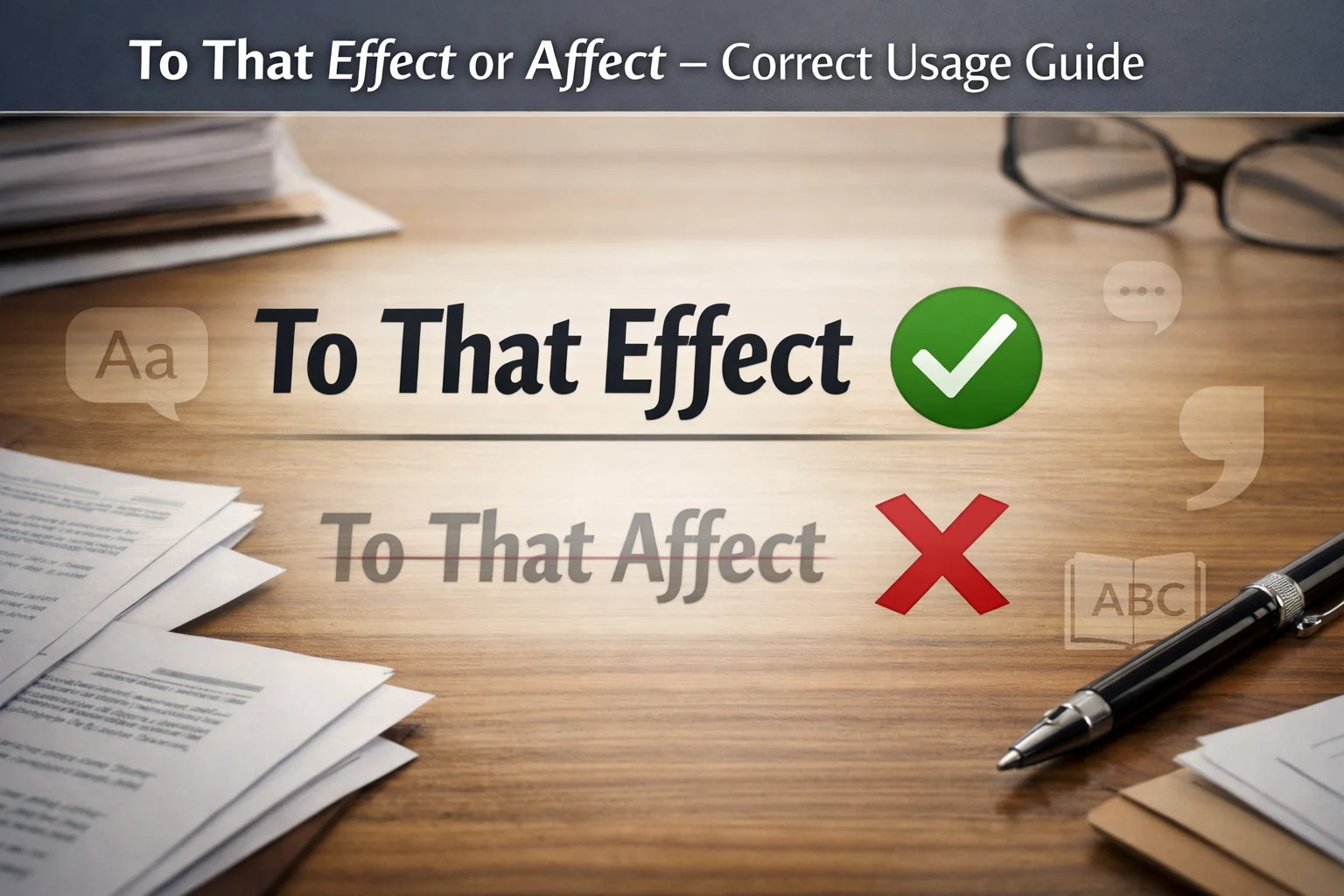
Have you ever paused mid-email, wondering which phrase actually fits your sentence? That moment of doubt usually leads straight to “To That Effect or Affect.” The confusion is common, especially in business communication, where clarity matters as much as credibility.
In fast-paced environments shaped by scheduling, meetings, and calendar coordination, a single word choice can subtly change meaning and tone.
This article breaks down the difference between to that effect and to that affect in plain, practical terms. You’ll learn how each phrase functions in real-world contexts like formal writing, broadcasting, project management, and online booking confirmations.
We’ll also connect the usage to core English usage and grammar rules, so you can apply them confidently in emails, reports, and time-sensitive updates tied to time management and professional workflows.
We’ll also touch on what major style guides recommend and note minor US vs. UK preferences to keep your writing polished and consistent. By the end, you’ll know not just which phrase is correct, but why it works in specific situations.
That understanding builds consistency, improves precision, and helps your writing sound intentional rather than uncertain.
The Core Difference Between Effect and Affect
Before diving into the phrase itself, you need to understand the foundational difference between effect and affect. Everything else builds on this distinction.
Affect: The Verb That Signals Influence
In modern English, affect is almost always a verb.
It means:
- To influence something
- To change something
- To have an impact on something
Examples:
- Lack of sleep can affect your concentration.
- Rising interest rates affect housing demand.
- Stress can affect your immune system.
In each case, affect describes an action. Something is influencing.
Key point: Affect answers the question: What is causing change?
Effect: The Noun That Describes the Result
Effect is most often a noun.
It means:
- A result
- An outcome
- A consequence
Examples:
- The new policy had an immediate effect.
- Exercise has a positive effect on mental health.
- The announcement created a ripple effect across markets.
Here, effect refers to what happened because of something else.
Key point: Effect answers the question: What happened as a result?
Why This Matters for “To That Effect or Affect”
The phrase “to that effect” refers to a result, meaning, or outcome. It never describes influence or action. That alone should raise a red flag if you’re tempted to write “to that affect.”
What “To That Effect” Actually Means
To that effect is an idiomatic phrase used to paraphrase or summarize what someone said without quoting them exactly. It often appears in professional, formal, or semi-formal writing.
Examples:
- The manager gave instructions to that effect.
- She sent a memo to that effect, clarifying the team’s priorities.
- The report made statements to that effect, hinting at budget cuts.
It implies: “This is what was meant” or “This is the general idea.” It does not describe an action or influence—that’s why using affect here is grammatically incorrect.
Is “To That Affect” Ever Correct?
The short answer is no.
To that affect is grammatically wrong. It is almost always a misspelling or a mishearing of the correct phrase.
Common reasons for the mistake include:
- Confusing the verb affect with the noun effect
- Hearing the phrase in speech and writing it phonetically
- Relying on spellcheck, which often misses this idiom
Even experienced writers make this mistake, but it is considered incorrect in all formal and professional contexts.
Side-by-Side Comparison Table
| Phrase | Correct? | Meaning | Common Contexts |
| To that effect | ✅ Yes | Refers to the intended meaning or result | Business, academic, legal, journalism |
| To that affect | ❌ No | Incorrect usage | Often informal writing mistakes |
Common Sentences People Get Wrong
Here are real-world examples where the mistake happens and how to fix it.
Incorrect:
- He said something to that affect about the new policy.
Corrected:
- He said something to that effect about the new policy.
Incorrect:
- The CEO issued a statement to that affect.
Corrected:
- The CEO issued a statement to that effect.
Tip: If you can replace the phrase with “meaning this” or “in essence”, it’s almost always effect, not affect.
Simple Memory Tricks That Actually Work
- Substitution Trick – Replace the phrase with “meaning this” or “in essence.” If it makes sense, use effect.
- Sound Association – Think “effect” = “end result,” which matches the idea of a summary or conclusion.
- Rewrite Test – If you can rephrase the sentence without changing its meaning and it still works with effect, you’re safe.
These practical methods beat memorizing long, confusing grammar rules.
When to Use “To That Effect” vs Similar Phrases
Sometimes people confuse to that effect with similar expressions. Here’s how to keep them straight:
To That End
Refers to purpose or goal, not result.
- Example: We need better planning. To that end, we’ve created a new workflow.
In Effect
Means “in practice” or “essentially.”
- Example: The new law is, in effect, mandatory for all businesses.
With That Effect
Rare and mostly literary; not interchangeable with “to that effect.”
Real-World Usage Examples
Business Email:
- Please prepare the presentation to that effect, summarizing the quarterly results.
Journalism:
- The spokesperson made statements to that effect during the press briefing.
Legal Document:
- The contract includes clauses to that effect, clarifying responsibilities of both parties.
Academic Writing:
- The author’s notes suggest to that effect that climate change affects migratory patterns.
These examples show how effect works naturally in professional writing.
Also Read: Lefty or Leftie: Correct Meaning, Usage, Tone, and Examples
Why This Mistake Hurts Credibility
Using to that affect signals carelessness. Readers and editors notice instantly. In professional settings, repeated mistakes can:
- Reduce perceived authority
- Hurt credibility in reports, articles, or emails
- Negatively impact SEO and readability
Even subtle errors like this can subconsciously affect trust.
Quick Self-Test: Spot the Error
Decide whether the sentence is correct or incorrect:
- The memo contained instructions to that effect. ✅
- She responded to that affect quickly. ❌
- His speech hinted to that effect at the upcoming changes. ✅
- The teacher gave directions to that affect. ❌
Answer: Always use effect. If it summarizes meaning, that’s the correct choice.
FAQs: To That Effect or Affect
1. Is “to that effect” or “to that affect” grammatically correct?
“To that effect” is the grammatically correct and commonly accepted phrase in English usage. It means with a similar meaning or implication. “To that affect” is almost always incorrect in formal writing, business communication, and everyday usage.
2. Why do people confuse “effect” and “affect”?
The confusion comes from the broader grammar rule where affect is usually a verb and effect is usually a noun. In this specific phrase, effect refers to meaning or result, which is why to that effect is correct.
3. Can “to that affect” ever be correct?
In modern English, no. Major style guides and editors consider to that affect an error. You won’t see it recommended in professional contexts like broadcasting, project management, or legal and academic writing.
4. Is “to that effect” appropriate for business emails and meetings?
Yes. To that effect is widely used in business communication, especially in emails related to meetings, scheduling, online booking, and calendar updates. It signals that something was said or decided in a similar way, without quoting it word for word.
5. Does US vs. UK English change the correct usage?
No. Both US and UK English follow the same rule here. To that effect is standard across regions, making it a safe choice for international communication.
6. How can I remember the correct phrase?
Think of effect as a result or meaning. If you’re referring to what someone implied or concluded, to that effect will always be the right choice.
Conclusion
The choice between to that effect or affect may look small, but it has a big impact on clarity and professionalism. The correct phrase is to that effect, and it works consistently across formal writing, business communication, and everyday professional scenarios.
Whether you’re managing projects, confirming schedules, coordinating meetings, or writing for broadcasting, using the right phrase strengthens precision and trust. Mastering details like this improves overall time management, enhances consistency, and helps your writing sound confident, polished, and intentional.

Emma Brook is a dedicated writer and language enthusiast at WordsJourney. She’s passionate about helping readers understand words better and use them with confidence in everyday conversations. Her work focuses on alternative phrases, clear meanings, and practical examples that make language feel simple and approachable.
With a friendly, reader-first writing style, Emma breaks down common expressions and explores smarter ways to say things without sounding forced or complicated. Her goal is to make learning words enjoyable, useful, and easy for everyone.