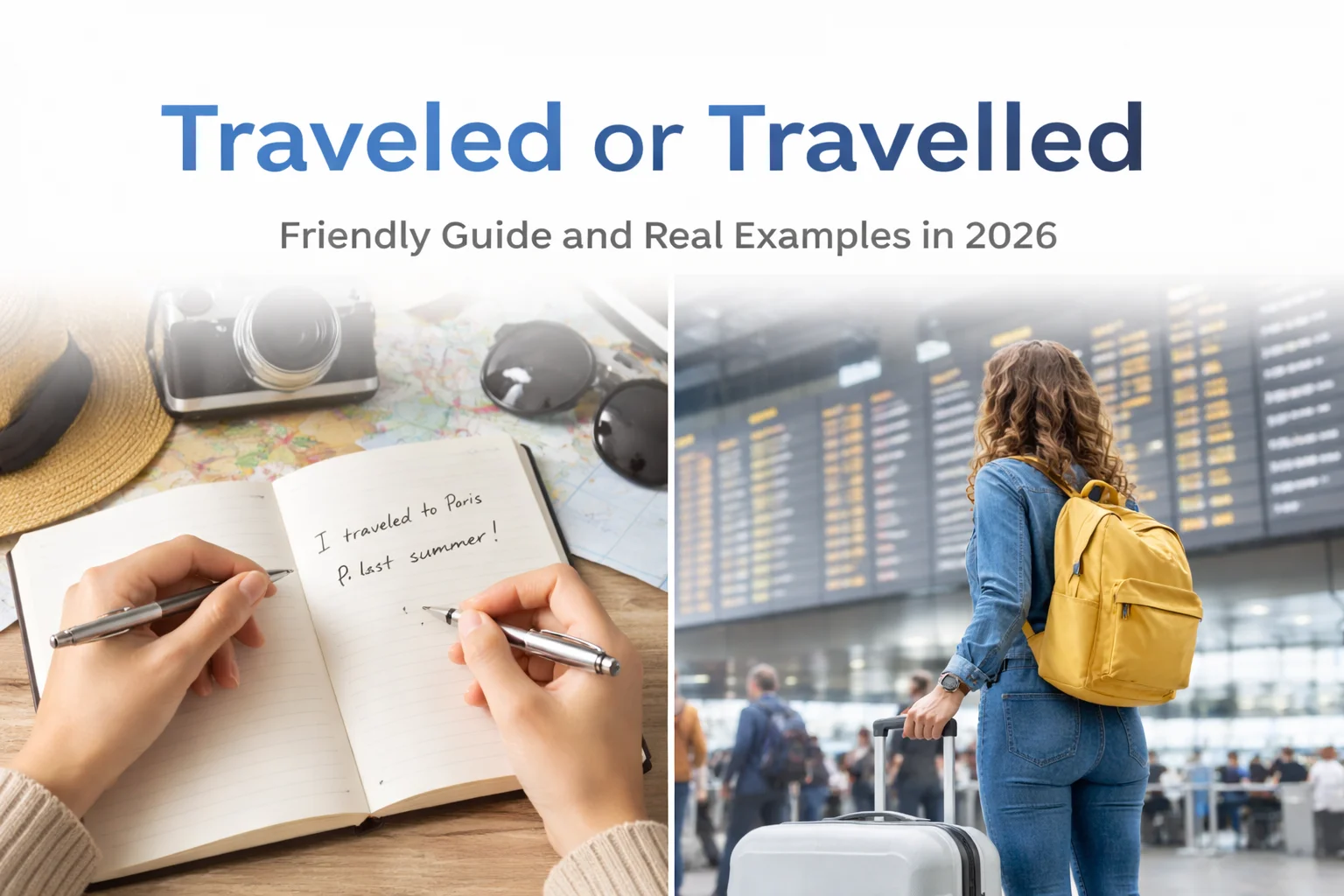
Ever paused mid-sentence and wondered whether “Traveled or Travelled” is the correct spelling? You’re not alone. This simple word often causes confusion in formal writing, business communication, broadcasting, project management, and even online booking systems where accuracy matters.
So if you care about English usage, grammar, and consistency, this guide will help you get it right without overthinking it.
The difference isn’t random; it’s based on regional preferences, style traditions, and major style guides. American English typically prefers “traveled”, while British English, Canadian, Australian, and many Commonwealth regions lean toward “travelled.” That’s the same logic you’ll see with terms like “color/colour” and “center/centre.”
Understanding this distinction becomes essential when writing emails, scheduling meetings, setting calendar reminders, drafting professional documents, or preparing content for a global audience.
In this article, you’ll learn when to use each form, how time management, audience, and purpose affect your choice, and why choosing the right spelling enhances clarity and professionalism. We’ll explore usage in everyday contexts, business settings, publishing, and education.
By the end, you’ll confidently decide between Traveled or Travelled, maintain tone consistency, and strengthen your credibility—whether you’re writing for the US, UK, or an international readership.
Quick Answer — Is It Traveled or Travelled?
Let’s make this easy.
Both traveled and travelled are correct.
The difference depends on where you are and what style of English you use:
- Traveled = American English spelling
- Travelled = British English spelling
So if you’re writing for the United States, stick with traveled.
If you’re writing for the United Kingdom, use travelled.
It’s not about right versus wrong.
It’s about regional language standards and being consistent with them.
Why Two Spellings Exist: The Real Reason Behind This Confusion
English didn’t just magically split into American and British forms for fun. There’s actually a historical and practical reason.
When Noah Webster created the American dictionary, he simplified several British spellings to make them easier and more logical. That’s why American English often has shorter spellings:
- colour → color
- honour → honor
- travelling → traveling
- travelled → traveled
British English kept its traditional spellings, while American English moved toward simplified forms.
Over time, both versions became standard in their regions. Today, both are accepted and recognized by major dictionaries like:
- Merriam-Webster
- Oxford Dictionary
- Cambridge Dictionary
So the difference is real, historical, and meaningful.
Regional Usage Breakdown — Where Each Spelling Is Used
If you write for a global audience, it helps to know where each spelling appears most commonly.
American English — Traveled
Used in:
- United States
- Some parts of Latin America
- Philippines (American English influence)
- International business and tech writing often prefer American standards
Example:
- I traveled to New York last summer.
British English — Travelled
Used in:
- United Kingdom
- Canada
- Australia
- New Zealand
- Ireland
- South Africa
Example:
- She travelled across Europe for six months.
American readers expect traveled, while British readers expect travelled. When you choose correctly, your writing feels natural to your audience.
Grammar Rules: Past Tense, Past Participle, and More
The word travel is a verb, and like every verb, it changes with tense. Fortunately, the spelling rule stays exactly the same no matter which form you use.
Past Tense
- American: traveled
- British: travelled
Past Participle
- American: have traveled
- British: have travelled
Continuous Forms
Yes, the rule applies here too.
- American: traveling
- British: travelling
So if you choose American English, be consistent.
If you choose British English, stick with it.
Why Does British English Double the “L”?
Here’s the part that finally makes everything click.
British English doubles consonants in many words before adding endings like:
- ed
- ing
American English doesn’t always do that.
Also Read: Girlie or Girly: The Correct Spelling and Real-World Usage
Here’s a simple comparison table:
| Base Word | American English | British English |
| Travel | Traveled | Travelled |
| Cancel | Canceled | Cancelled |
| Label | Labeled | Labelled |
| Marvel | Marveled | Marvelled |
Seeing it side by side helps, doesn’t it?
British English tends to follow the rule:
If a word ends with a vowel + single consonant, double the consonant when adding endings.
American English decided life is stressful enough, so it simplified things.
Which Should You Use in Formal Writing?
It depends on your audience and writing purpose.
Academic Writing
- US universities expect traveled
- UK, Canada, Australia, and Europe prefer travelled
Business & Corporate Writing
Most multinational companies follow American English, especially in tech, marketing, and international communication. However, UK companies stick to British spelling.
Content Writing & Blogging
Choose based on:
- Your audience location
- Your brand language style
Golden Rule
Be consistent.
Never mix traveled and travelled in the same document. It looks careless.
Does Using the “Wrong” One Cause Problems?
Honestly, yes sometimes.
You might face:
- Grammar checker alerts
- Lower writing credibility
- Reader confusion
- Academic penalties
- Branding inconsistency
Imagine a business website saying:
Our team travelled the world and traveled across industries.
That looks sloppy. Readers notice. Teachers notice. Employers notice. Editors definitely notice.
Consistency shows professionalism.
Real-World Examples for Everyday Writing
Let’s make this practical with examples you’ll actually use.
Emails
- American: I traveled to Chicago last week for the meeting.
- British: I travelled to London last week for the meeting.
Academic Writing
- American: Researchers who traveled across multiple countries observed…
- British: Researchers who travelled across multiple countries observed…
Storytelling
- American: He traveled alone, chasing adventure.
- British: He travelled alone, chasing adventure.
Social Media Caption
- American: Just traveled to my dream destination!
- British: Just travelled to my dream destination!
Short, clear, natural.
Google Trends & Usage Popularity
If you look at global search behavior:
- “Traveled” dominates in the United States.
- “Travelled” dominates in the UK, Canada, and Australia.
- Globally, traveled appears slightly more often online because American English dominates digital content.
But both spellings are strong, respected, and widely used.
Common Mistakes People Make
People often:
- Mix spellings in one article
- Switch styles unconsciously
- Think one is “wrong”
- Rely blindly on autocorrect
- Ignore audience language standards
Avoid these. They hurt trust and professionalism.
Simple Memory Trick to Remember
Here’s an easy way to lock it in your brain.
If it has USA, it has a single letter
→ Traveled
If it has UK, it has extra tradition
→ Travelled
Or even simpler:
“American English likes shorter words.”
Done. You’ll remember it forever.
Case Study: Students & Professionals Get This Wrong a Lot
Many IELTS and TOEFL students panic about this spelling. Here’s what matters:
- IELTS (British-based exam):
Travelled is correct. - TOEFL (American exam):
Traveled is correct.
Writers and bloggers also face branding issues. A travel blogger writing for a US audience should always use traveled. A UK travel magazine must use travelled.
Companies that switched spelling styles saw:
- Reduced reader trust
- Lower content quality perception
- Brand inconsistency complaints
That’s how powerful one letter can be.
Frequently Asked Questions
1. Which spelling is correct: Traveled or Travelled?
Both are correct. “Traveled” is preferred in American English, while “Travelled” is standard in British, Canadian, Australian, and Commonwealth English. The choice depends on your audience and regional style guide.
2. Is “Travelled” wrong in the United States?
It’s not “wrong,” but it’s not commonly used. Most American dictionaries, academic writing standards, and professional style guides recommend “traveled.”
3. Why does British English double the “L”?
British spelling often doubles consonants before adding suffixes, especially in words ending with a single vowel + consonant. That’s why you see similar patterns in words like “cancelled,” “modelled,” and “labelled.”
4. Do grammar and spelling affect professionalism in business writing?
Absolutely. Correct and consistent spelling improves credibility, business communication, and formal writing. It also supports clarity in emails, proposals, project management, scheduling, and meetings.
5. Which spelling should I use for academic or publishing work?
Follow the required style guide or the region of your institution or publication.
- US publications: use traveled
- UK/Commonwealth publications: use travelled
6. Does spelling consistency matter in digital tools like calendars or project software?
Yes. Maintaining consistent spelling improves professional branding, avoids confusion in online booking, enhances broadcasting scripts, and keeps calendar and time management entries clear and uniform.
Conclusion
Choosing between “Traveled or Travelled” isn’t about right or wrong—it’s about where you’re writing, who you’re writing for, and how consistent you want your language to be. American English favors traveled, while British and Commonwealth English prefer travelled. When you align your spelling with the correct regional standard, you strengthen clarity, authority, and professionalism in everything from business communication and formal writing to broadcasting, project management, online booking, and time management workflows.
Whether you’re drafting an email, preparing academic work, updating a calendar entry, or publishing global content, understanding this distinction helps you communicate confidently and effectively. So next time you pause and wonder which form to choose, remember the rule, match your audience, and write with consistency. That’s how great writers—and smart professionals—make language work for them.

Johnson Alex is a language-focused writer and the voice behind WordsJourney. He creates practical, easy-to-understand content that helps readers improve their vocabulary and express ideas with clarity and confidence.