Have you ever paused mid-sentence, wondering whether to write “verses” or versus”? This common confusion can trip up even seasoned writers, especially in formal writing, business communication, and English usage. Understanding the subtle differences between Verses vs Versus is essential for clarity, whether you’re drafting a project management update, scheduling meetings, or posting online content. Small mistakes in grammar or consistency can make your writing appear less professional, even in casual calendar notes or online booking confirmations.
In this guide, we’ll explore the precise meanings and contexts of verses and versus, highlighting their correct usage in broadcasting, formal writing, and everyday communication. We’ll also touch on style preferences, including US vs UK conventions, so your writing aligns with the appropriate standard. From time management emails to presentation slides, knowing the right term ensures your message is both clear and authoritative.
By the end of this article, you’ll confidently distinguish Verses vs Versus and apply them correctly across multiple scenarios. Whether you’re managing meetings, calendars, or projects, this knowledge enhances your writing accuracy, professional tone, and reader comprehension. Let’s break down the differences, examples, and practical tips so every sentence you write is precise and polished.
What Does “Verses” Mean?
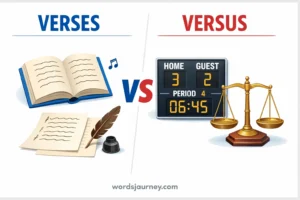
The word “verses” comes from the Latin word versus, meaning “a line or row.” Today, it mostly refers to lines in poetry, songs, or religious texts. When you talk about verses, you’re invoking rhythm, structure, and sometimes deep meaning.
Examples in Context
- Poetry: “The poem contains twelve verses, each more moving than the last.”
- Scripture: “Psalm 23 has some of the most quoted verses in the Bible.”
- Songwriting: “She wrote the verses first, then created the chorus.”
Common Mistakes
Many people incorrectly use verses in sports, legal, or comparison contexts. Writing “Yankees verses Red Sox” is wrong. That’s where versus belongs.
Table: Verses vs Similar Words
| Word | Meaning | Example |
| Verse | Line of poetry or song | She memorized every verse. |
| Stanza | Group of verses | The poem has four stanzas. |
| Line | Single sentence in poetry/music | The first line sets the tone. |
What Does “Versus” Mean?
Versus, often abbreviated as vs, shows opposition, contrast, or comparison. It appears in sports, debates, and legal cases. Unlike verses, it’s not artistic or poetic—it’s confrontational.
Usage Scenarios
- Sports: “Lakers vs Celtics was an unforgettable match.”
- Legal Cases: “Brown v. Board of Education changed American education forever.”
- Debates/Comparisons: “Nature vs Nurture has been debated for centuries.”
Pronunciation Tips
Say it as “VER-sus.” Avoid elongating the “u” sound or pronouncing it like “verses.”
Common Mistakes
People often mix it with verses in informal writing. A simple trick: if you’re pitting two things against each other, it’s versus, not verses.
Table: Versus vs Similar Words
| Word | Meaning | Example |
| Versus | Against or compared to | Cats versus dogs: which is better? |
| Against | Direct opposition | He played against his rival team. |
| Compared to | Neutral comparison | Apples compared to oranges differ in taste. |
Key Differences Between Verses and Versus
Understanding these two words isn’t just about memorization—it’s about context. The difference can be summarized quickly:
| Feature | Verses | Versus |
| Meaning | Lines of poetry or scripture | Against, compared to |
| Context | Literature, music, religious texts | Sports, law, debates, comparisons |
| Pronunciation | vur-siz | vur-sus |
| Common Mistakes | Using in comparisons or sports | Using in poetry or songs |
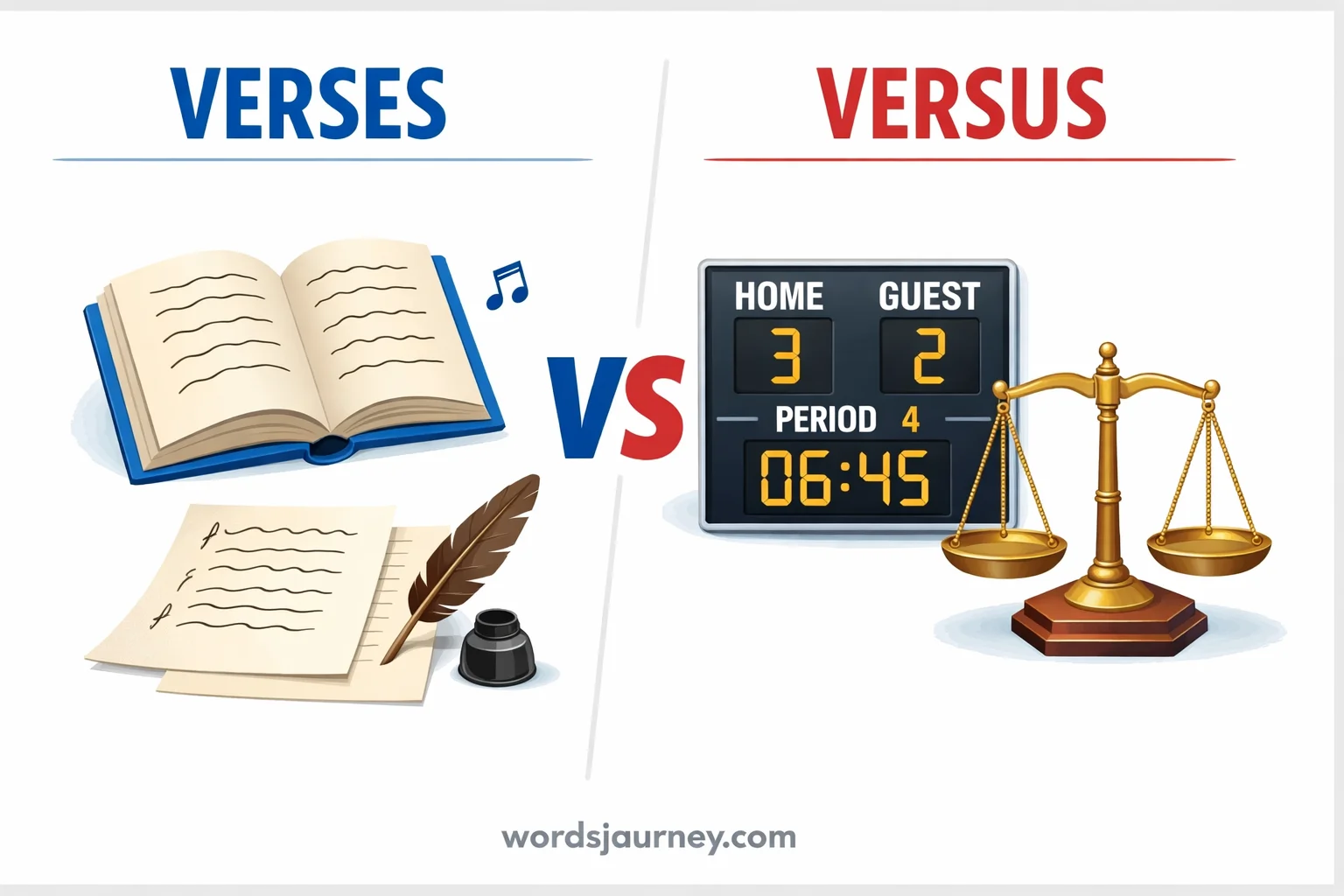
Memory Tip: “Verse rhymes, versus fights.” This simple line can save you from mixing them up.
Common Mistakes and How to Avoid Them
Even native English speakers confuse these words. Let’s tackle the most common errors:
- Mistake #1: Writing “verses” when you mean “versus”.
- Incorrect: “Yankees verses Red Sox.”
- Correct: “Yankees vs Red Sox.”
- Mistake #2: Misusing abbreviations in legal or sports contexts.
- Legal: “v.” vs “vs.”
- Sports: “vs.” only
- Mistake #3: Mispronouncing verses and versus.
- Remember: verses = vur-siz, versus = vur-sus
Tips to Avoid Mistakes
- Ask yourself: “Am I writing about poetry/song or a comparison/opposition?”
- Double-check context and meaning.
- Use mnemonic tricks: “Verse rhymes, versus fights.”
Examples in Real-Life Sentences
Seeing the words in context is the easiest way to remember their usage:
- Poetry: “Each verse of the song tells a story.”
- Sports: “Patriots vs Giants will be broadcast live.”
- Debates: “Freedom versus security is a classic societal debate.”
- Scripture: “The verses in Proverbs teach wisdom and patience.”
These examples show how each word functions in its natural environment, making misuse less likely.
When to Use Abbreviations
Abbreviations like vs. or v. are practical but context-sensitive:
| Context | Full Form | Abbreviation | Example |
| Sports | Versus | vs. | Lakers vs Celtics |
| Legal | Versus | v. | Brown v. Board of Education |
| Academic/Essay | Versus | vs. | Nature vs Nurture |
Pro Tip: Avoid “versus” in poetry or religious texts even if abbreviated; it just doesn’t fit.
Quick Memory Tricks
Here are a few simple strategies to remember which word to use:
- Verse rhymes, versus fights.
- Verses = lines, Versus = confrontations.
- Use visual icons:
- 📜 → Verse
- ⚔️ → Versus
These tricks make writing more confident and error-free.
Also Read: Rhythm or Rythm: Meaning and Usage
Case Studies and Real-Life Observations
- Poetry Example: Shakespeare’s Sonnet 18 has lines like:
“Shall I compare thee to a summer’s day? Thou art more lovely and more temperate.” Each line counts as a verse. Miswriting it as “versus” would confuse readers. - Legal Example: Brown v. Board of Education (1954) was a landmark US Supreme Court case. “v.” is the accepted abbreviation for “versus” in legal contexts. Writing “verses” here would be completely wrong.
- Sports Example: The rivalry Lakers vs Celtics is widely recognized. Even media outlets consistently use “vs” to denote competition.
- Academic Example: Nature vs Nurture debate spans psychology, sociology, and biology. Using “verses” here would make the statement nonsensical.
These case studies show real-life consequences of misusing these words.
Frequently Asked Questions (FAQs)
1. What is the difference between “verses” and “versus”?
Verses refers to lines of poetry or song lyrics, while versus (often abbreviated as vs.) indicates a comparison, conflict, or competition between two entities.
2. Can I use “versus” in formal writing?
Yes. Versus is widely accepted in formal writing, business communication, legal documents, and sports contexts. Just ensure proper punctuation and consistency.
3. How do US and UK style guides treat “versus”?
In the US, it is common to abbreviate as vs.; in the UK, writers often prefer spelling it out as versus. Both are correct, but consistency within a document is key.
4. Are “verses” and “versus” pronounced differently?
Yes. Verses is pronounced /vɜːrsɪz/, while versus is /ˈvɜːrsəs/. Pronunciation helps clarify meaning, especially in broadcasting or presentations.
5. When should I use “verses” in business communication?
Mostly when quoting or referencing poetry, lyrics, or creative content. In emails, calendars, or project updates, “versus” is almost always the correct choice.
Conclusion
Mastering the difference between Verses vs Versus is crucial for accurate English usage, professional writing, and clear communication. Whether you’re managing meetings, scheduling projects, or creating content, using the correct term ensures your message is precise, authoritative, and consistent.
Remember: Verses = poetry or lyrics, Versus = comparison, conflict, or opposition. Pay attention to style guide preferences, regional variations, and the context of your writing. With practice, distinguishing these terms becomes second nature, saving time and avoiding confusion in formal writing, broadcasting, or online communication.Clear, consistent usage of Verses vs Versus not only strengthens your grammar but also enhances your professional credibility across all platforms.

Aliya Ray is a passionate writer and language enthusiast at WordsJourney. She enjoys exploring words, phrases, and everyday expressions to help readers communicate more clearly and confidently. Her content focuses on alternative ways to say common phrases, simple explanations, and real-life examples that make language easy to understand.
Aliya believes the right words can make any message stronger. Through clear, friendly writing, she helps readers improve their vocabulary without feeling overwhelmed or confused.