Have you ever paused mid-email, unsure whether to type “where” or “were”? That tiny choice can change meaning fast and it shows up everywhere from business communication and formal writing to everyday English usage.
In this guide to Where or Were, you’ll learn how to spot the difference instantly, write with confidence, and keep your message clear in meetings, broadcasting, and client updates.
We’ll break down the grammar rules behind each word, then show how context does the heavy lifting. You’ll see practical examples from project management, online booking, and calendar invites, where clarity supports time management and smooth scheduling.
Short tips and quick checks help you stay consistent when drafting agendas, sharing updates, or confirming details across teams.
To keep your writing sharp, we’ll also touch on style guides and light regional preferences (US vs. UK) that shape consistency in professional documents.
By the end, you’ll have a simple framework for choosing the right word every time, plus easy habits that strengthen tone, precision, and trust in modern workplace communication.
Why “Where or Were” Confuses Even Fluent Writers
The confusion comes from sound and speed. In fast speech, where and were can blur together. Autocorrect does not help. Predictive text guesses wrong. Busy writers skim their own sentences and miss small slips.
There’s also a learning trap. Many people memorize rules in school yet never practice them in real contexts. Over time, the rule fades. The habit remains.
Common triggers that cause errors
- Fast typing on phones and tablets
- Voice-to-text that mishears words
- Reading more than writing
- Copying casual writing styles from social media
Why this matters
- Grammar errors reduce trust in professional writing
- Clear language boosts comprehension
- Clean copy supports SEO and user engagement
A reader decides fast whether to trust your words. Clean choices build that trust.
The Core Difference Between Where and Were
Let’s lock in the difference with plain language.
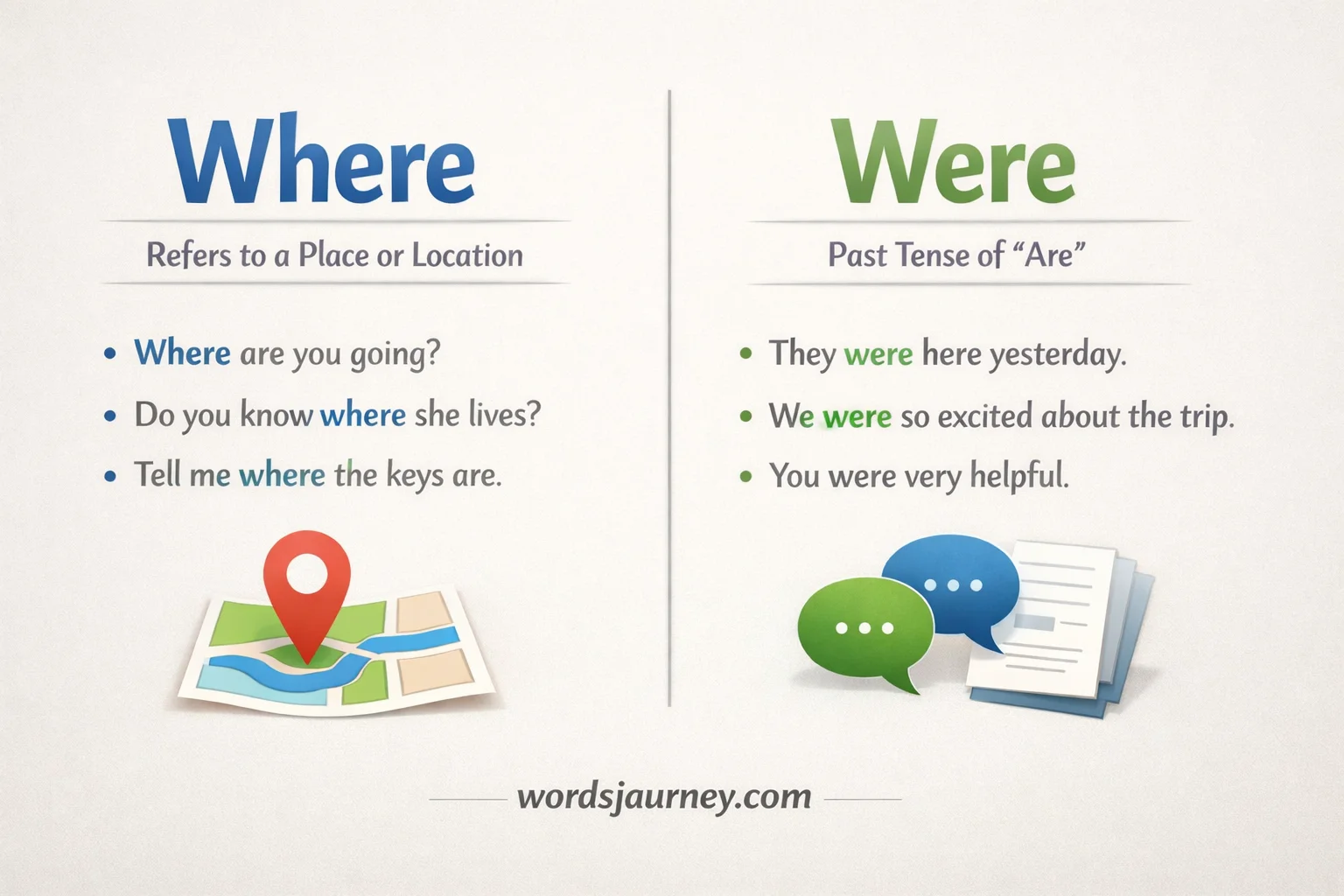
Where points to a place, position, or situation.
Were states a past condition or state of being.
One word describes location or context. The other works as a verb. Mixing them changes meaning.
Quick contrast
- Where = location or situation
- Were = past tense of are or a hypothetical form of be
At a glance
| Word | Role in a sentence | What it refers to |
| Where | Adverb or conjunction | Place, point, situation |
| Were | Verb (past tense or subjunctive) | State or condition |
What Does Where Mean? Meaning, Function, and Real Usage
Where helps you point. It anchors a sentence to a place or a context. It can introduce questions, define locations, or link ideas.
Core uses of where
- Asking about a location
- Describing a place
- Connecting a clause to a setting
Everyday examples
- Where did you park the car?
- This café is where we first met.
- The phase where growth slows can feel frustrating.
How where works in sentences
- Questions: Where are the keys?
- Relative clauses: The park where we run feels calm.
- Descriptions: This is where ideas take shape.
Pro tip
If you can replace the word with “in which place” or “in which situation,” you likely need where.
What Does Were Mean? Past Tense and Hypothetical Use
Were does the work of a verb. It tells you about a past state. It also appears in unreal or hypothetical situations.
Two main roles of were
- Past tense of are for plural subjects
- Subjunctive form for hypotheticals
Clear examples
- They were late to the meeting.
- The lights were off when we arrived.
- If I were you, I’d double-check that email.
Why “If I were” sounds odd yet works
English uses were for imagined states that do not match reality. It signals distance from fact.
Common confusion
People say “If I was you” in casual speech. Formal writing favors If I were you. Both appear in modern English. The latter stays safer in polished writing.
Where vs Were Side-by-Side Comparison
Use this table as a fast check while writing.
| Feature | Where | Were |
| Part of speech | Adverb or conjunction | Verb |
| Main function | Shows place or situation | Shows past or unreal state |
| Example | This is where I learned to code. | They were ready to leave. |
| Swap test | Replace with “in which place” | Replace with “are” in past |
| Common error | Used as a verb | Used to point to a place |
Most Common Mistakes People Make and Why They Happen
Errors follow patterns. Spot them and you’ll fix them faster.
Top mistakes
- Writing “This is were I grew up.”
- Typing “Where they happy?” instead of “Were they happy?”
- Letting autocorrect choose the wrong word
- Skimming drafts and missing short words
Why these errors stick
- Homophones blur in speech
- Short words slip past spellcheck
- Writers trust their first instinct
How to beat the habit
- Pause on short words during edits
- Read sentences out loud
- Use the swap test before you publish
Memory Tricks That Actually Work
Tiny checks save big edits later.
The swap test
- Replace where with “in which place.”
- Replace were with “are” in past tense.
If the sentence still makes sense, you picked the right word.
The verb check
- Ask: Does this word act like a verb?
- If yes, choose were.
The location cue
- If the sentence points to a place or setting, choose where.
One-line rule
- Where shows place.
- Were shows state.
Real-World Examples From Modern English
Mistakes appear in daily writing. Here’s how to fix them.
Incorrect vs correct pairs
- ❌ This is were I found the bug.
✅ This is where I found the bug. - ❌ Where you tired after work?
✅ Were you tired after work? - ❌ The room where quiet.
✅ The room were quiet.
Workplace emails
- “The file is where you left it.”
- “We were ready to launch last Friday.”
Content writing
Clean grammar keeps readers focused. Search engines reward clarity. Clean copy wins trust.
Where or Were in Questions, Statements, and Complex Sentences
Long sentences hide small errors. Break them down.
Questions
- Where did the meeting move?
- Were you able to join?
Embedded clauses
- This is the point where momentum builds.
- The team were confident they could ship on time.
How to self-check long lines
- Find the verb.
- Ask what the word does.
- Apply the swap test.
How This Mistake Affects Credibility and Clarity
Readers judge fast. Tiny errors signal carelessness. Clear language signals care.
Real impacts
- Recruiters skim resumes
- Editors filter pitches
- Customers scan product pages
What strong writing does
- Builds trust
- Improves comprehension
- Lifts engagement and dwell time
Quick Practice Section With Answers
Try these fast checks.
Fill in the blanks
- This is the café ___ we met.
- They ___ excited about the launch.
- ___ did you leave the charger?
- If she ___ here, she’d help.
Answers
- where
- were
- Where
- were
Why these work
Each choice matches the word’s role. Location uses where. State or hypothetical uses were.
Related Word Pairs People Often Confuse
Master one pair and others fall into place.
Frequent mix-ups
- There / their / they’re
- Your / you’re
- Then / than
- Its / it’s
Also Read: Capital or Capitol: The Complete and Practical Guide
Final Summary: How to Never Mix Up Where or Were Again
Lock in these takeaways.
- Where points to place or situation
- Were acts as a verb for past or unreal states
- Use the swap test before you publish
- Read short words out loud during edits
Clean grammar does not slow you down. It speeds trust.
FAQs: Where or Were
1. What is the basic difference between where and were?
Where refers to place or location. Were is a past-tense form of “to be.” Example: “Where were the files saved?” blends both correctly.
2. How can I avoid mixing up where and were in business communication?
Pause and ask a quick question:
- Are you talking about location? Use where.
- Are you talking about past state or action? Use were. This habit improves clarity in meetings, project management notes, and formal writing.
3. Does regional English (US vs. UK) affect the usage of where and were?
No. Where and were follow the same grammar rules in both US and UK English. Style guides may differ on punctuation and tone, but word choice stays consistent.
4. Why do these mistakes appear often in emails and online booking messages?
Fast typing, time management pressure, and autocorrect cause slips. Clear calendar invites, scheduling notes, and online booking confirmations benefit from a quick proofread.
5. Can using the wrong word affect professional credibility?
Yes. Small errors can distract readers in business communication and broadcasting. Consistent, accurate English usage builds trust and keeps messages professional.
6. Are there memory tricks to remember the difference?
Try this:
- Where = place (both start with wh-).
- Were = time (past state). Linking sound and meaning improves consistency.
Conclusion
Choosing between Where or Were seems minor, yet it shapes meaning and credibility. Where points to location, while were signals a past state or action. That single-letter difference matters in formal writing, quick emails, and everyday business communication.
When you’re managing meetings, sending calendar updates, or confirming online booking, clarity saves time and prevents confusion. Simple checks, brief proofreading, and steady habits support better time management and smoother project management across teams.
Stick to clear grammar rules, follow trusted style guides, and stay consistent across US and UK conventions. Do that, and your writing stays precise, professional, and easy to trust—every time.

Emma Brook is a dedicated writer and language enthusiast at WordsJourney. She’s passionate about helping readers understand words better and use them with confidence in everyday conversations. Her work focuses on alternative phrases, clear meanings, and practical examples that make language feel simple and approachable.
With a friendly, reader-first writing style, Emma breaks down common expressions and explores smarter ways to say things without sounding forced or complicated. Her goal is to make learning words enjoyable, useful, and easy for everyone.