Many writers pause when they see whomever and whoever. This tricky grammar pair often trips up students, professionals, and even native speakers, so people search this keyword late at night to avoid embarrassing mistakes in emails, essays, and formal writing. The good news is there’s a clear, simple explanation to learn, and over time, you will know how to choose the right word every time, making deciding between them easy, with no guessing, no confusion, only confident, correct writing.
Here’s the easiest way I teach it. Associate the letter m with him. Replace the word in the sentence to see if it still makes sense. If yes, use the object pronoun whomever; if not, use whoever instead.
This trick works. Remember subject forms like he, she, and they versus object forms like him, her, and them. Similarly, knowing the difference between who and whom helps, since these roots are interrogative, relate to a person, and although they may look interchangeable, they serve different functions in sentences.
When choosing between whomever and whoever, context matters. You can give a document to whomever in a department, yet say whoever wrote a poem should win a prize. They mean whichever person, either the performer of an action like whoever threw something, or the receiver.
They fulfill roles similar to who and whom. The substitution trick is more useful for advanced sentences than those you simply see in textbooks. The common debate of whomever versus whoever, or vs, continues because most often these words are used wrong. Don’t entirely blame graduates of the English language who mistakenly think the latter version is more formal. That assertion is incorrect.
These two are among many abused terms. It seems like a struggle for a lot of the educated. While reviewing meaning, usage, and function, keep in mind that placement mainly depends on structure.
Whoever or Whomever: The Quick Rule You Actually Need
If you’re in a hurry, here’s the short answer:
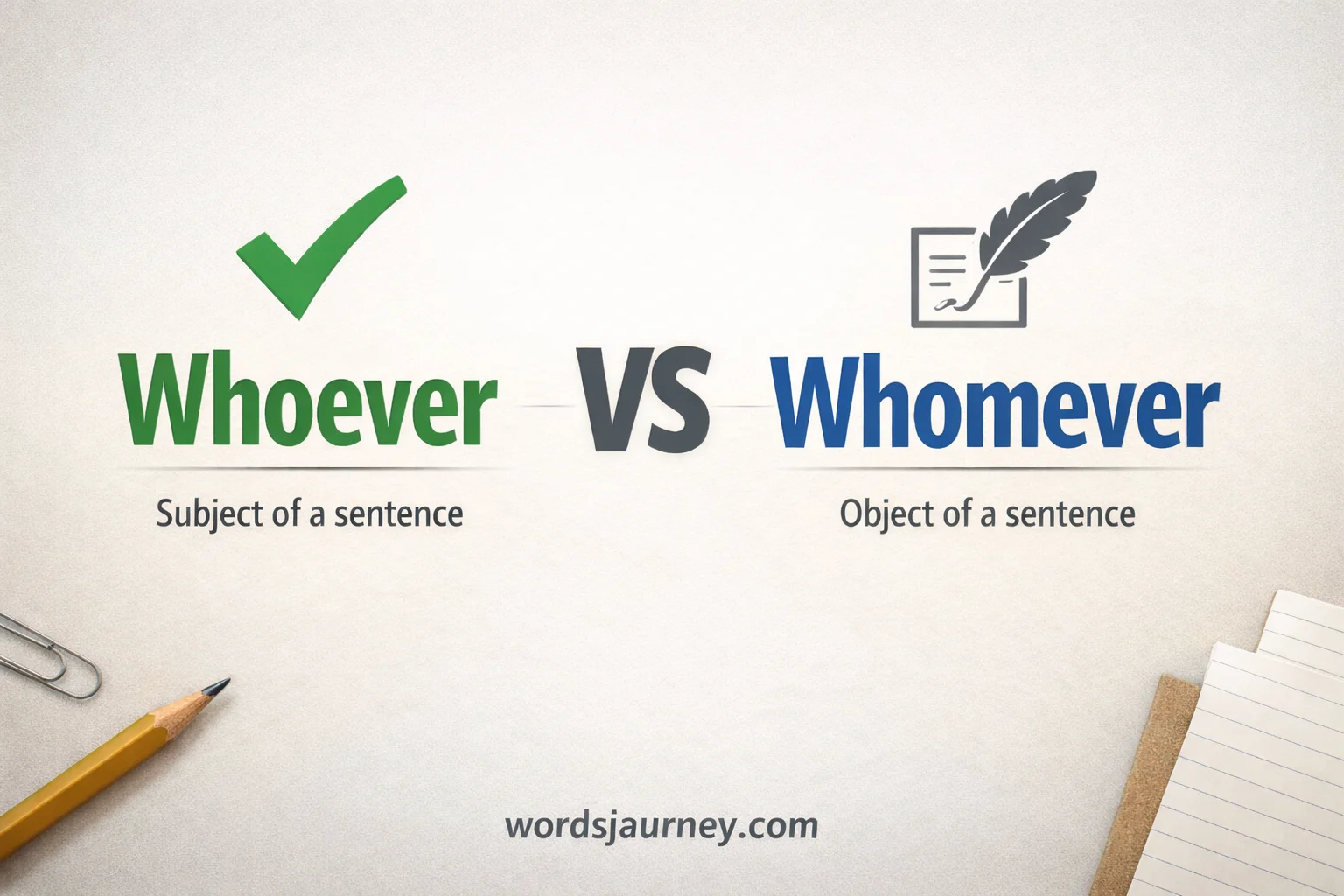
- Use whoever when it functions as a subject
- Use whomever when it functions as an object
- The verb inside the clause decides the case
Simple. But here’s where writers trip up: the pronoun belongs to its own clause, not the main sentence.
Look at this table:
| Sentence | Correct Form | Why |
| Give it to whoever calls first. | whoever | Subject of “calls” |
| Hire whomever you prefer. | whomever | Object of “prefer” |
| Invite whoever wants to join. | whoever | Subject of “wants” |
| Support whomever you believe in. | whomever | Object of “believe in” |
If you remember nothing else, remember this:
The verb inside the clause controls the choice.
Understanding the Core Grammar Behind Whoever or Whomever
Before you memorize tricks, understand the structure.
Subject vs Object: The Real Foundation
A subject performs an action.
An object receives an action.
Quick examples:
- She runs.
- The dog chased him.
- They admire her.
Now connect that to whoever vs whomever:
- Whoever wins gets the prize.
- Choose whomever you trust.
In the first sentence, “whoever” performs the action. In the second, “whomever” receives the action.
If you can identify subject and object roles, you already understand 80 percent of this rule.
The Clause Rule Most Articles Ignore
Here’s what many explanations miss:
The pronoun belongs to its own clause.
Consider:
Give the award to whoever deserves it.
At first glance, “to” might trick you. You might think you need “whomever” because it follows a preposition.
But break it apart:
- Main clause: Give the award
- Prepositional phrase: to [whoever deserves it]
- Embedded clause: whoever deserves it
Inside that clause:
- “Whoever” performs the action “deserves”
That makes it the subject. So whoever is correct.
This is the turning point. Once you isolate the clause, confusion disappears.
How to Choose Whoever or Whomever Step by Step
Instead of guessing, follow this method.
Step One: Find the Clause
Locate the full mini-sentence containing whoever or whomever.
Example:
Hire whoever you think is qualified.
Clause: whoever you think is qualified
Step Two: Ignore the Rest
Block out the main sentence. Focus only on the clause.
Step Three: Replace with “He” or “Him”
Test the clause:
You think he is qualified.
Not: You think him is qualified.
“He” works. So use whoever.
Step Four: Choose Confidently
Final answer:
Hire whoever you think is qualified.
Advanced Structures That Confuse Writers
Now let’s go deeper. These cases separate average grammar knowledge from real mastery.
Prepositions and Whoever or Whomever
Prepositions mislead writers more than anything else.
Words like:
- to
- for
- with
- from
- about
Example:
Give it to whoever arrives first.
You might think “to” demands “whomever.” It doesn’t.
Why?
Because inside the clause:
- Whoever arrives first.
“Whoever” performs the action “arrives.”
So it stays whoever.
Compare With This:
Give it to whomever you choose.
Clause: whomever you choose
“You choose him” works.
“You choose he” does not.
So whomever is correct.
Interruptions and Parenthetical Phrases
Complex sentences can disguise structure.
Example:
Award the scholarship to whoever, in your opinion, shows the most promise.
Ignore the interruption:
Whoever shows the most promise.
Still the subject. Still whoever.
Parenthetical phrases don’t change grammatical function.
Complex Embedded Clauses
Let’s analyze something trickier:
Send the report to whoever you believe will review it.
Clause: whoever you believe will review it.
Now isolate the deepest clause:
Whoever will review it.
“Whoever” performs “will review.” That makes it subject.
Correct answer: whoever.
For More Please Visit: Alot or A Lot: The Ultimate Guide for Perfect Usage
Formal Writing vs Modern Usage
Language evolves. So does usage.
In modern American English:
- Whoever appears far more often.
- Whomever sounds formal or legal.
According to Google Ngram data trends, “whomever” has declined significantly in published works over the last century while “whoever” remains steady.
Many style guides acknowledge this shift.
The Associated Press Stylebook advises writers to prefer simpler constructions when possible. Legal writing still uses “whomever” more frequently because precision matters in contracts.
In everyday writing, clarity beats technical stiffness.
Common Mistakes With Whoever or Whomever
Let’s examine where writers go wrong.
Overcorrection
People use “whomever” to sound smarter.
Example:
Give the prize to whomever finishes first.
Incorrect.
Inside the clause:
Whomever finishes first.
“Finishes” needs a subject.
“Him finishes” makes no sense.
Correct version:
Give the prize to whoever finishes first.
Being Fooled by Prepositions
This is the biggest trap.
Remember:
Prepositions don’t control the pronoun inside its clause.
The verb does.
Letting the Main Clause Interfere
Example:
We will support whoever you nominate.
Main verb: support
Embedded clause: whoever you nominate
Inside the clause:
You nominate him.
So it should be whomever, right?
No. Because the clause actually functions as a fused relative clause. The pronoun is both object of nominate and subject of an implied verb.
But in modern usage, grammar authorities accept:
We will support whoever you nominate.
Why?
Because in practical English, fused relative constructions simplify case distinctions.
This is where theory and usage intersect.
Side-by-Side Comparison Table: Whoever vs Whomever
| Structure Type | Example | Correct Form | Why |
| Subject clause | Whoever calls first wins. | whoever | Performs action |
| Object clause | Choose whomever you prefer. | whomever | Receives action |
| After preposition + subject clause | Give it to whoever asks. | whoever | Subject of “asks” |
| After preposition + object clause | Give it to whomever you invite. | whomever | Object of “invite” |
| Complex clause | Hire whoever you believe is best. | whoever | Subject of “is” |
Case Study: Legal Contract Language
Legal documents often use “whomever” precisely.
Example clause:
Payment shall be made to whomever the board designates.
Why?
Because in contracts, clarity outweighs conversational tone. Ambiguity creates liability.
In corporate governance documents, lawyers prefer strict object case forms.
However, many modern business documents simplify:
Payment will go to whoever the board designates.
Courts focus on intent more than pronoun form.
Memory Tricks That Actually Work
Forget gimmicks. Use structure.
The He/Him Test
Replace with:
- he → whoever
- him → whomever
The Clause Isolation Trick
Ignore everything outside the clause.
Focus only on that mini-sentence.
The Verb Control Rule
Ask:
Which verb governs the pronoun?
Not the main verb.
The embedded verb.
Real-World Examples From Published Writing
In journalism:
The award goes to whoever earns the most votes.
Newsrooms favor clarity over formality.
In academic prose:
The committee may appoint whomever it considers qualified.
Formal contexts still preserve object case.
Even prominent speeches lean informal. Consider modern political speeches archived by the Library of Congress. Contemporary transcripts overwhelmingly use “whoever” in public addresses.
Language trends toward simplification.
Is Whomever Disappearing?
Not entirely. But it’s shrinking.
Corpus studies show:
- “Whomever” appears far less frequently in modern fiction.
- Academic and legal texts retain it.
- Conversational English rarely uses it.
The shift mirrors what happened to “whom.” Case distinctions in English continue to simplify over time.
Yet grammar rules still apply in formal contexts.
Practical Usage Guide for Modern Writers
Here’s when to confidently use each form.
Use Whoever When:
- It acts as subject
- The clause contains its own verb
- You want natural conversational tone
- The sentence sounds awkward with “him”
Use Whomever When:
- It clearly functions as object
- You’re writing formal or legal text
- The “him” test works cleanly
- Precision matters more than tone
Quick Diagnostic Checklist
Before you finalize your sentence, ask:
- What is the full clause?
- Which verb controls the pronoun?
- Does “he” or “him” fit?
- Does the sentence sound natural?
If you answer those four questions, you’ll rarely get it wrong.
FAQs About Whoever or Whomever:
Q1: When should I use Whoever or Whomever?
Use whoever for the subject of a sentence (like he, she, they) and whomever for the object (like him, her, them). The substitution trick makes it easy to decide.
Q2: Are Whoever and Whomever interchangeable?
No. Although they look similar and are both interrogative pronouns, they serve different functions in sentences. Using them wrong can confuse even educated writers.
Q3: How do I check if I used it correctly?
Replace the word with him/her. If it makes sense, whomever is correct; if not, use whoever. This trick works in formal writing, emails, and essays.
Q4: What is the easiest way to remember the difference?
Associate the letter m in whomever with him, and remember the roots like who and whom. This helps in deciding between them confidently.
Q5: Can advanced sentences confuse the choice?
Yes. In more advanced sentences, placement and context matter. Reviewing meaning, usage, and function ensures correct usage without guessing or confusion.
Conclusion:
Mastering Whoever or Whomever comes down to understanding roles, placement, and function. By substituting, associating, and remembering the roots, writers can avoid embarrassing mistakes. With practice, this tricky grammar pair becomes easy, letting you choose the right word confidently every time in formal writing, emails, or everyday communication.

Emma Brook is a dedicated writer and language enthusiast at WordsJourney. She’s passionate about helping readers understand words better and use them with confidence in everyday conversations. Her work focuses on alternative phrases, clear meanings, and practical examples that make language feel simple and approachable.
With a friendly, reader-first writing style, Emma breaks down common expressions and explores smarter ways to say things without sounding forced or complicated. Her goal is to make learning words enjoyable, useful, and easy for everyone.