Have you ever paused mid-sentence and wondered whether to write “whose” or “who’s”? This small choice trips up even confident writers.
The confusion around “Whose vs Who’s” appears everywhere from emails and business communication to online booking forms, broadcasting scripts, and everyday messages. Because clear English usage matters in meetings, scheduling, and project management, knowing the difference helps you write with confidence and professionalism.
In modern workplaces, clear grammar supports effective time management and smooth calendar coordination. Imagine sending a meeting invite that reads, “Who’s responsibility is the presentation?” It instantly looks unpolished.
Understanding possessive pronouns, contractions, and grammar rules ensures your formal writing remains accurate and consistent. Whether you’re writing reports, updating a project management dashboard, or drafting a quick message about scheduling, correct grammar improves clarity and credibility.
This guide breaks down “Whose vs Who’s” in a simple, practical way. You’ll learn the core grammar difference, see clear examples, and understand how the words function in professional communication and everyday writing. We’ll also briefly note how major style authorities like the AP Stylebook, Chicago Manual of Style, and regional preferences in US and UK English approach these forms.
By the end, you’ll confidently choose the right word every time bringing greater consistency, accuracy, and clarity to your writing.
Whose vs Who’s: Quick Summary
Before diving deeper, here is the fastest way to understand the difference.
| Word | Meaning | Grammar Role | Example |
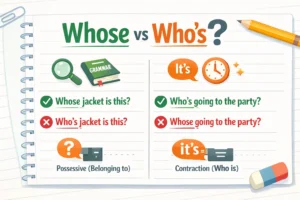
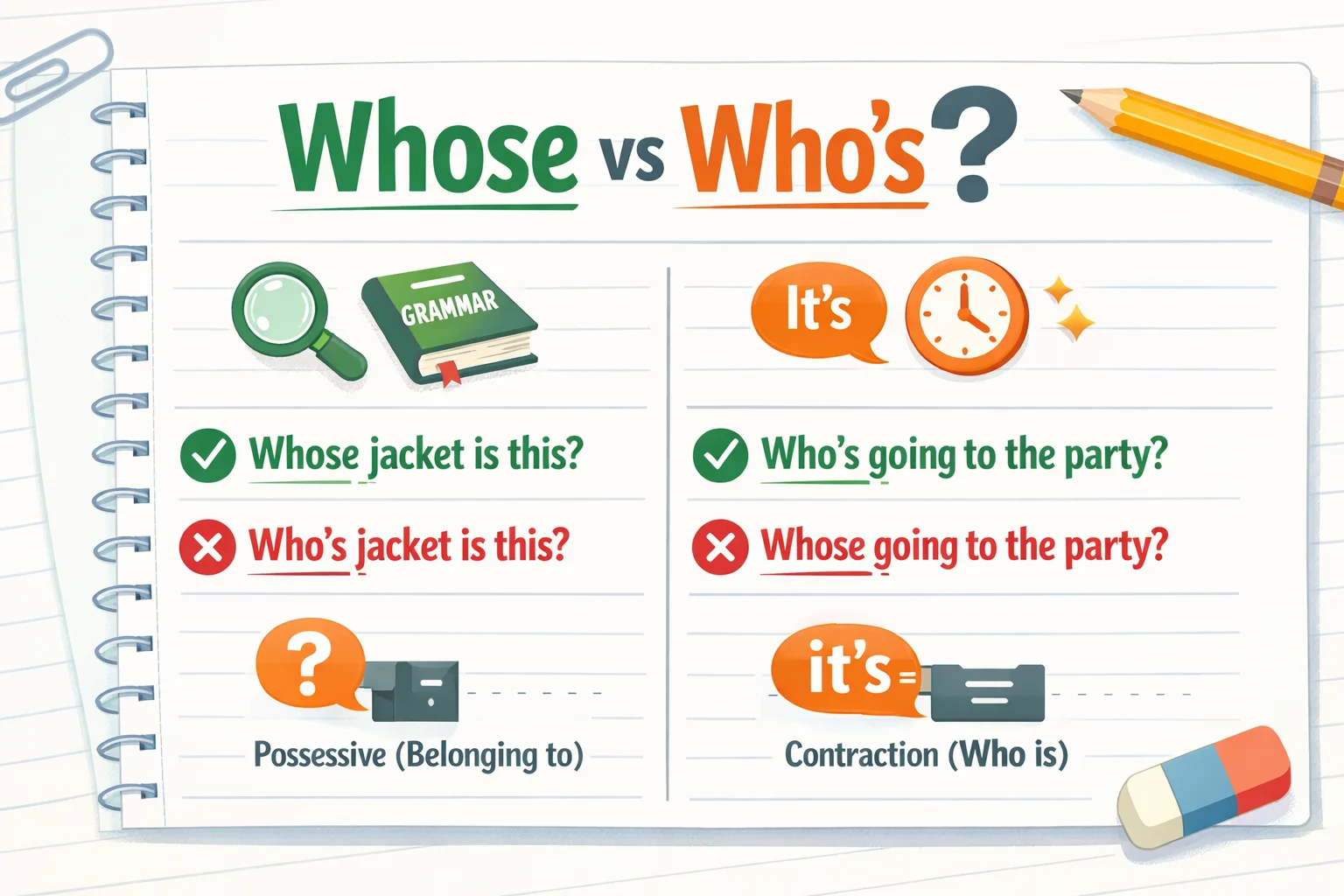
| Whose | Shows ownership | Possessive pronoun/determiner | Whose book is this? |
| Who’s | Short for “who is” or “who has” | Contraction | Who’s coming to dinner? |
The simple rule
If the sentence can expand to “who is” or “who has,” the correct word is who’s.
If the sentence asks about ownership or possession, use whose.
Example:
- Who’s calling you? → Who is calling you
- Whose phone is ringing? → Possession
Even though the words sound identical, their functions remain completely different.
What Does “Whose” Mean?
The word whose shows possession or ownership. It functions as a possessive pronoun or determiner.
Think of it as the question form of ownership.
Instead of saying:
This is someone’s book.
You ask:
Whose book is this?
Core function of “whose”
The word helps identify who owns something.
Examples
- Whose jacket is on the chair?
- Whose idea started this project?
- Do you know whose keys these are?
Each sentence asks about the owner of something.
Sentence structure
Most sentences follow this pattern:
Whose + noun
Examples:
- Whose laptop is on the desk?
- Whose shoes are by the door?
Because the word describes possession, it usually appears before a noun.
Understanding “Who’s”
The word who’s is a contraction. It combines two words into one.
It can represent:
- Who is
- Who has
Apostrophes often signal contractions in English.
Examples include:
- Don’t → Do not
- It’s → It is
- They’re → They are
- Who’s → Who is / Who has
Examples of “who’s” in sentences
- Who’s coming to the meeting today?
- Who’s finished the report?
- Do you know who’s speaking tonight?
Let’s expand one example.
Who’s coming to dinner?
Expanded version:
Who is coming to dinner?
The sentence still makes perfect sense.
That confirms who’s is correct.
Key Difference Between Whose and Who’s
Although the words sound identical, they represent completely different grammar roles.
| Feature | Whose | Who’s |
| Meaning | Possession | Who is / Who has |
| Grammar Type | Possessive pronoun | Contraction |
| Apostrophe | No | Yes |
| Example | Whose bag is this? | Who’s calling you? |
Simple comparison
- Whose = ownership
- Who’s = who is / who has
Once you remember this distinction, the confusion disappears.
Why Apostrophes Cause Confusion
Many people learn that apostrophes show possession.
Examples include:
- Sarah’s book
- The dog’s toy
- The teacher’s desk
However English contains exceptions.
Pronouns such as his, hers, yours, theirs, and whose show possession without apostrophes.
That’s why whose never uses one.
Compare these examples
| Possessive Pronoun | Example |
| His | His phone rang |
| Their | Their house is large |
| Whose | Whose car is outside? |
Because whose behaves like these pronouns, it doesn’t need an apostrophe.
Common Mistakes Writers Make
Even experienced writers confuse these words occasionally. The mistakes usually follow predictable patterns.
Using “who’s” to show possession
Incorrect:
Who’s backpack is on the floor?
Correct:
Whose backpack is on the floor?
The sentence refers to ownership so whose is required.
Using “whose” instead of “who’s”
Incorrect:
Whose going to lead the meeting?
Correct:
Who’s going to lead the meeting?
Expanded version:
Who is going to lead the meeting?
The contraction works perfectly.
Confusing similar grammar pairs
Writers who struggle with whose vs who’s often mix up similar pairs.
Examples include:
| Confusing Pair | Correct Meaning |
| Your vs You’re | Possession vs You are |
| Its vs It’s | Possession vs It is |
| Their vs They’re | Possession vs They are |
| Whose vs Who’s | Possession vs Who is |
Understanding one pair makes the others easier to master.
The Best Trick to Remember the Difference
The easiest method is called the expansion test.
Step one
Replace who’s with:
- who is
- who has
Step two
Check whether the sentence still makes sense.
If it works, who’s is correct.
If it doesn’t, use whose.
Example one
Sentence:
Who’s cooking dinner tonight?
Expanded:
Who is cooking dinner tonight?
The sentence still works.
Correct answer: Who’s
Example two
Sentence:
Whose laptop is this?
Expanded:
Who is laptop is this?
The sentence makes no sense.
Correct answer: Whose
Read More: Elude vs Allude: Master the Difference
Using Whose in Relative Clauses
The word whose often appears in relative clauses. These clauses provide extra information about a noun.
Example:
The student whose laptop broke missed the presentation.
The clause whose laptop broke describes the student.
Structure
noun + whose + possession
Examples:
- The author whose novel won an award
- The neighbor whose dog barks loudly
- The teacher whose class inspires students
Although older grammar rules discouraged using whose for objects, modern English accepts it.
Example:
The company whose products dominate the market
This sentence sounds natural and widely accepted today.
Real-World Examples of Whose vs Who’s
Let’s examine how these words appear in everyday situations.
Everyday conversation
- Whose turn is it to cook tonight?
- Who’s bringing snacks to the party?
Workplace communication
- Whose report needs editing?
- Who’s presenting the quarterly results?
Academic writing
- The scientist whose research changed medicine
- The professor who’s giving tomorrow’s lecture
Real-life usage confirms how frequently these two words appear.
Case Study: A Common Workplace Mistake
Imagine a manager sends this email:
“Who’s responsibility is the marketing report?”
The sentence contains a grammar mistake.
Correct version:
Whose responsibility is the marketing report?
Why it matters:
- Professional writing shapes workplace credibility
- Small grammar mistakes affect clarity
- Correct wording improves communication
Many companies emphasize grammar in training materials for this exact reason.
How Grammar Experts Explain the Rule
Language experts consistently highlight the contraction rule.
According to the Purdue Online Writing Lab, one of the most respected writing resources:
“Who’s is a contraction for who is or who has, while whose indicates possession.”
This short explanation summarizes the entire grammar rule.
Practice Exercises
Practice helps cement grammar rules. Try choosing the correct word in each sentence.
Exercise
- ___ car is parked outside?
- ___ going to the concert tonight?
- Do you know ___ jacket this is?
- ___ finished the assignment already?
Answers
- Whose
- Who’s
- Whose
- Who’s
Reading the sentences aloud also helps reinforce the correct choice.
Quick Grammar Checklist
Whenever you feel unsure, ask yourself three simple questions.
Grammar decision checklist
- Does the sentence show ownership? → Use whose
- Can it expand to who is or who has? → Use who’s
- Does the sentence pass the expansion test?
Following this checklist prevents almost every mistake.
Similar Grammar Confusions
English contains many pairs that confuse writers because they sound identical.
Learning Whose vs Who’s prepares you for these pairs as well.
| Word Pair | Meaning Difference |
| Your vs You’re | Possession vs You are |
| Its vs It’s | Possession vs It is |
| There vs Their vs They’re | Place vs Possession vs Contraction |
| Then vs Than | Time vs Comparison |
Writers who master these pairs produce noticeably clearer sentences.
Why Grammar Accuracy Matters
Some people dismiss grammar rules as unimportant. However clear grammar provides real advantages.
Benefits of correct grammar
- Improves professional credibility
- Strengthens academic writing
- Enhances reader trust
- Prevents misinterpretation
Even small details like whose vs who’s influence how readers perceive your writing.
Memory Tips That Actually Work
If grammar rules feel overwhelming, try these simple memory tricks.
Trick one: The apostrophe test
If you see an apostrophe, ask:
Does this stand for two words?
If yes, the word is a contraction.
Trick two: Ownership clue
If something belongs to someone, use whose.
Example:
Whose notebook is this?
Trick three: Replace the word
Always try the who is / who has substitution.
If it works, choose who’s.
Frequently Asked Questions (FAQs) about Whose vs Who’s
1. What is the difference between “whose” and “who’s”?
- Whose is a possessive pronoun, used to indicate ownership (e.g., “Whose laptop is this?”).
- Who’s is a contraction of “who is” or “who has” (e.g., “Who’s leading the meeting today?”).
2. Can “who’s” ever show possession?
- No. Who’s only represents a contraction. Using it to indicate possession is grammatically incorrect in formal writing or business communication.
3. How do I remember the difference?
- Replace who’s with who is or who has. If the sentence still makes sense, use who’s. Otherwise, whose is correct.
- Example: “Who’s attending the webinar?” ✅ (“Who is attending the webinar?”)
- Example: “Whose calendar is blocked for the meeting?” ✅ (Possession, not “who is”)
4. Is there a US vs UK English preference?
- Both forms exist in US and UK English, but contractions like who’s are often more common in informal US writing, while formal UK style guides may favor spelling out who is in professional documents.
5. Why does correct usage matter in professional settings?
- Using whose or who’s correctly enhances clarity, consistency, and credibility in emails, project management tools, scheduling notifications, and broadcasting scripts.
Conclusion
Mastering the difference between “Whose vs Who’s” is a small but impactful step toward effective communication. Whether you’re drafting a meeting invite, updating an online booking system, or writing a formal report, knowing which word to use ensures your writing is clear, professional, and grammatically correct.
By remembering that whose shows possession and who’s is a contraction of “who is” or “who has”, you can avoid common pitfalls and maintain consistency across all your documents. Clear grammar not only strengthens your professional image but also makes collaboration, calendar coordination, and project management smoother.Next time you’re unsure, pause and ask: “Am I indicating ownership, or am I contracting who is?” That simple check will keep your writing sharp, accurate, and impressively polished.

Aliya Ray is a passionate writer and language enthusiast at WordsJourney. She enjoys exploring words, phrases, and everyday expressions to help readers communicate more clearly and confidently. Her content focuses on alternative ways to say common phrases, simple explanations, and real-life examples that make language easy to understand.
Aliya believes the right words can make any message stronger. Through clear, friendly writing, she helps readers improve their vocabulary without feeling overwhelmed or confused.