Have you ever paused mid-email, wondering whether to write “your” or yours”?
This small choice can subtly change tone, clarity, and professionalism in business communication. From scheduling meetings to confirming online bookings, knowing the correct form ensures your message reads smoothly and avoids awkward misunderstandings. Understanding the difference is essential not just for grammar but also for project management, calendar coordination, and formal writing across industries.
Mastering your or yours also strengthens English usage in everyday tasks. Whether you’re drafting an invitation, composing a broadcasting announcement, or updating a team calendar, the wrong choice can look careless.
Regional style guides, including US vs. UK preferences, influence subtle nuances, making consistency vital. Professionals who prioritize correctness gain credibility in time management and communication workflows.
This article will guide you through the differences between your and yours, explain proper usage in multiple contexts, and provide practical tips for maintaining grammar precision. You’ll learn how to seamlessly apply these forms in meetings, emails, project plans, and other professional settings, improving clarity and style.
By the end, choosing the right word will feel intuitive, elevating both your writing confidence and your professional polish.
Understanding the Basics
Before diving into usage rules, it’s important to grasp the basic difference between your and yours.
What is “Your”?
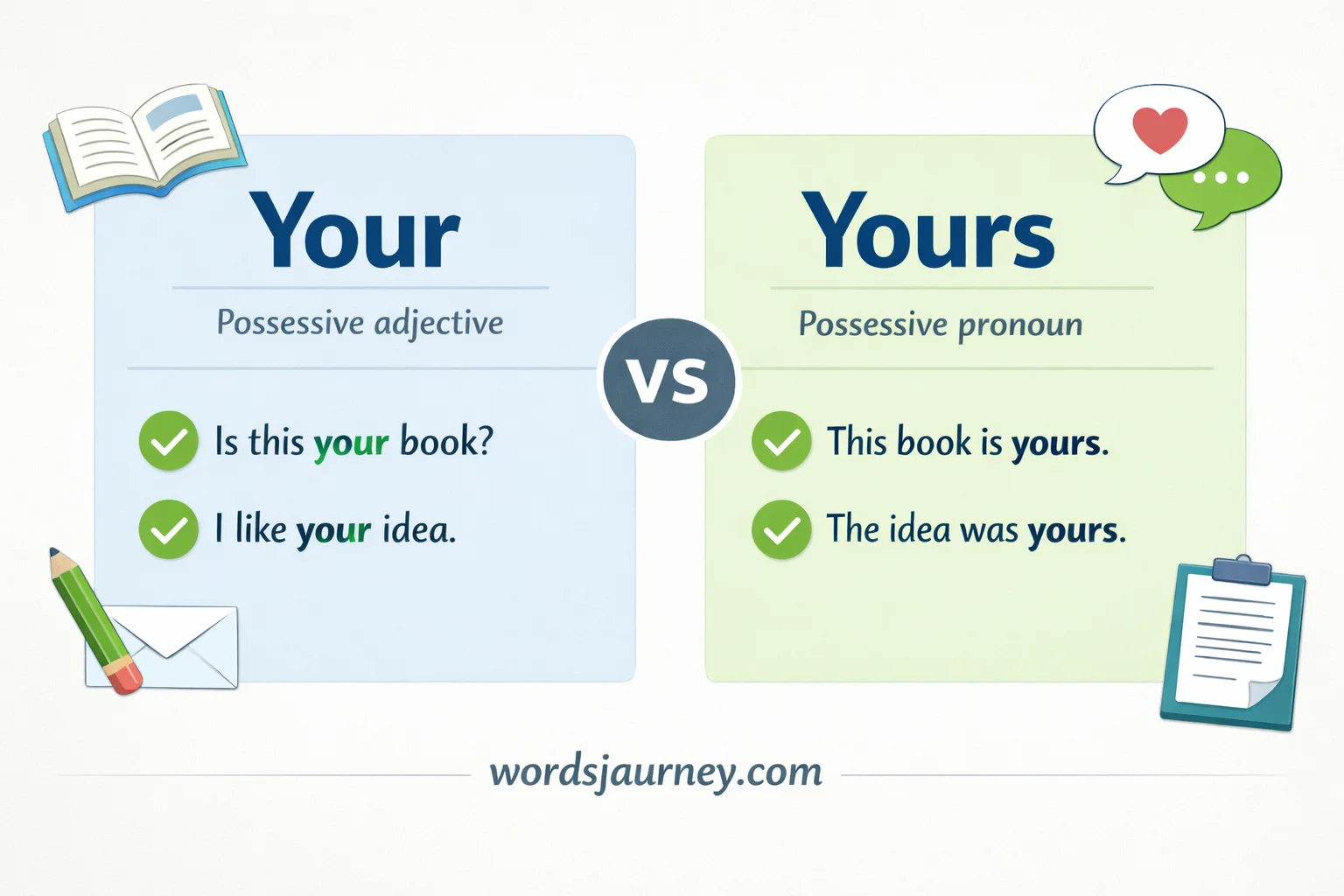
Your is a possessive adjective. That means it describes ownership but must always appear before a noun. It cannot stand alone.
| Word | Type | Example |
| Your | Possessive adjective | Is this your book? |
| Your | Possessive adjective | I love your idea. |
Notice how your always modifies a noun. You cannot say “This is your” without a following noun—it would feel incomplete.
What is “Yours”?
Yours is a possessive pronoun. Unlike your, it replaces a noun and can stand alone.
| Word | Type | Example |
| Yours | Possessive pronoun | This book is yours. |
| Yours | Possessive pronoun | The choice is yours. |
Think of yours as the replacement for your + noun. Where the noun is obvious, yours does the work for you.
Quick Tip: Your modifies nouns; yours replaces them.
Rules of Usage
To avoid mistakes, follow these simple rules:
Rule 1: Your + Noun
Use your before a noun to show ownership.
Examples:
- Your phone is ringing.
- Did you bring your backpack?
- I admire your determination.
Notice that in every case, your is directly tied to the noun that follows.
Rule 2: Yours Stands Alone
Use yours when the noun is already understood.
Examples:
- Is this pen yours?
- The red car is yours.
- That victory is yours.
If you tried replacing “yours” with your, the sentence would be incomplete: “That victory is your” sounds wrong, right?
Rule 3: Formal vs Informal Contexts
Both your and yours work in professional, casual, and academic writing. The key is placement and context.
Professional example:
- “Please review your report by Friday.”
Casual example:
- “Is this seat yours?”
Even in social media posts, correct usage can enhance clarity and credibility.
Common Mistakes to Avoid
Even fluent English speakers slip up with these words. Here are the most frequent errors:
- Your vs You’re
- Incorrect: “Your going to love this.”
- Correct: “You’re going to love this.”
- Misplacing “yours” before a noun
- Incorrect: “This is yours book.”
- Correct: “This book is yours.”
- Overusing one form where the other fits
- Incorrect: “I like your’s.”
- Correct: “I like yours.”
| Mistake | Example | Corrected Version |
| Your vs You’re | Your amazing | You’re amazing |
| Yours before noun | Yours car is red | Your car is red |
| Incorrect apostrophe | I like your’s | I like yours |
Pro Tip: Remember, yours never takes an apostrophe.
Quick Memory Tricks
To make remembering easier, try these techniques:
- Trick 1: If it’s followed by a noun → use your.
- Example: your bag, your idea, your homework
- Trick 2: If it can stand alone → use yours.
- Example: This is yours. That pen is yours.
- Trick 3: Replace with “mine” to see if yours fits.
- Example: That book is mine → That book is yours ✅
These memory hacks save time and prevent common mistakes.
Examples in Real-Life Context
Emails
Professional communication requires precision. Using your and yours correctly avoids confusion and maintains credibility.
Example:
- “I’ve attached your report for review. Please let me know if any sections are unclear. The final draft is yours to submit.”
Notice how your modifies the noun “report,” while yours replaces it in the second sentence.
Text Messages
Even in casual chats, correct usage improves readability.
- “Is this jacket yours or mine?”
- “Don’t forget your homework tonight!”
Social Media
Writers, bloggers, and influencers often make mistakes online. Proper usage reflects professionalism and authority.
- Correct: “Your support means the world to me.”
- Correct: “This giveaway is yours if you follow the rules.”
Advanced Tips
Using “Yours Truly” and “All Yours”
- Yours truly is a formal sign-off in letters.
- Example: “Sincerely, yours truly, Jane Smith.”
- All yours is informal and emphasizes ownership or responsibility.
- Example: “The project is all yours now.”
Tone Differences
Subtle shifts in tone exist between your and yours:
- Your feels direct and descriptive.
- Example: “Your work is impressive.”
- Yours can sound reflective or personal.
- Example: “The success is yours to enjoy.”
Regional Variations
- No major regional differences exist in standard English usage, but tone and formality can vary in professional vs casual contexts.
Also Read: Mr or Mrs Understanding the Correct Usage
Practice Exercises
Testing your knowledge helps solidify learning.
Fill-in-the-blank:
- Is this ___ pen? (your/yours)
- The victory is ___. (your/yours)
- I love ___ attitude. (your/yours)
- This book is ___. (your/yours)
Answers: 1. yours 2. yours 3. your 4. yours
Multiple-choice examples:
- Which is correct?
- Your amazing → ❌
- You’re amazing → ✅
- Which is correct?
- That jacket is your → ❌
- That jacket is yours → ✅
Practicing these regularly improves instinctive usage.
FAQs: Your or Yours
1. What is the difference between “your” and “yours”?
Your is a possessive adjective used before a noun, e.g., “Is this your calendar?” Yours is a possessive pronoun that replaces the noun, e.g., “This calendar is yours.”
2. Can I use “yours” at the end of an email?
Yes. Yours often appears in formal email closings, such as “Yours sincerely” or “Yours faithfully”, depending on regional conventions (UK vs. US).
3. Is “your” ever correct at the end of a sentence?
No. Your always needs a noun after it. Ending a sentence with “your” is grammatically incorrect.
4. Which style guide should I follow for professional writing?
For US English, The Chicago Manual of Style is preferred; for UK English, follow Oxford or Collins style. Consistency across emails, reports, and project management documents is key.
5. How can I remember the difference?
Think of “your” as an adjective describing something and “yours” as a standalone pronoun. If a noun follows, use your. If not, use yours.
Conclusion
Choosing between your or yours may seem small, but it reflects attention to detail, professionalism, and clarity in your writing. Correct usage ensures smoother business communication, better time management, and precise project coordination. By understanding the difference, following style guides, and applying these forms consistently in emails, meetings, calendars, and broadcasts, you strengthen both your grammar skills and your professional credibility.
Next time you draft a message or update a team schedule, you’ll confidently know whether your or yours fits best—making your writing polished, clear, and effective.

Johnson Alex is a language-focused writer and the voice behind WordsJourney. He creates practical, easy-to-understand content that helps readers improve their vocabulary and express ideas with clarity and confidence.