Ever paused mid-email to wonder if you wrote breath or breathe? That tiny letter can change meaning fast. In this guide to Breath or Breathe, you’ll learn the clear difference, see simple examples, and avoid the mix-ups that sneak into everyday writing. If your words show up in business communication, formal writing, or quick chats, this one choice shapes how professional you sound.
We’ll break down English usage and grammar in plain terms. You’ll see how each word works in real sentences, plus memory tips you can use on the fly. This matters when you’re sending updates about meetings, setting a calendar, or coordinating project management across teams. Clean word choices support consistency in emails, broadcasting notes, and online booking confirmations, especially when time management and scheduling are tight.
We’ll also note how style guides and regional preferences (US vs. UK) treat these forms, so your writing stays aligned across documents. By the end, you’ll have a fast checklist for choosing the right word every time. Expect practical rules, quick examples, and common pitfalls to dodge. Your writing will read smoother, land clearer, and sound more confident.
Breath or Breathe: The Core Difference
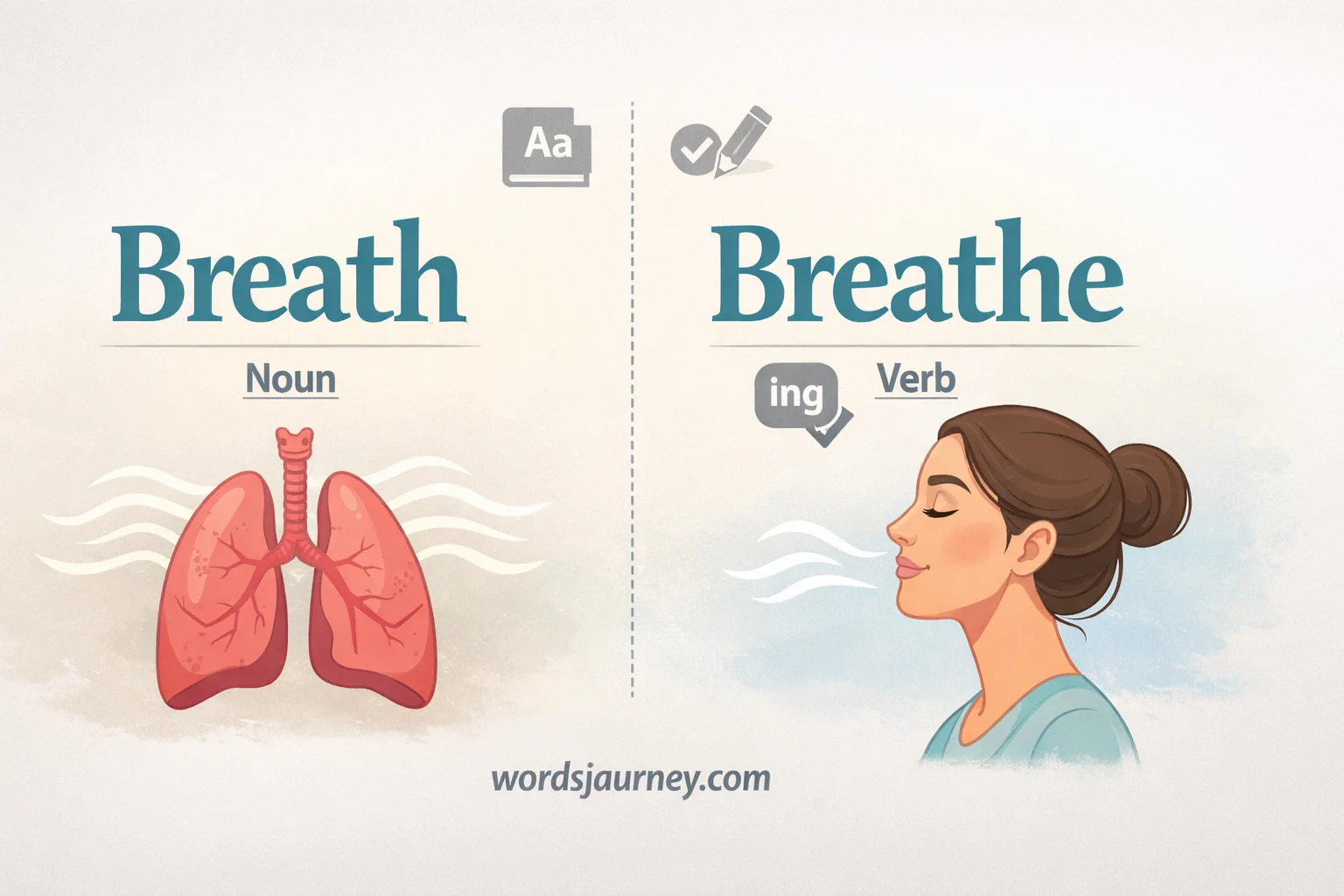
Let’s start with the heart of the confusion. Breath and breathe look almost the same. They sound similar. They relate to the same human action. Yet they play very different roles in a sentence.
Here’s the simple rule:
- Breath is a noun.
- Breathe is a verb.
That’s it. One names the thing. The other names the action.
Breath vs Breathe at a Glance
| Feature | Breath | Breathe |
| Part of speech | Noun | Verb |
| Meaning | The air you take in | The act of inhaling and exhaling |
| Pronunciation | “breth” (short vowel sound) | “bree-th” (long vowel sound) |
| Example | Take a deep breath | Try to breathe slowly |
| Common collocations | hold your breath, out of breath | breathe in, breathe deeply |
If you can swap the word with “air” and the sentence still works, you probably need breath. If the sentence describes an action someone performs, you need breathe.
What Does “Breath” Mean?
Breath names the air that moves in and out of your lungs. It also appears in phrases that describe smell, speech, emotion, and physical effort. Since breath is a noun, it often follows articles like a, an, or the.
Common Meanings of Breath
- The air inhaled or exhaled
- A brief pause or rest
- A trace of smell or scent
- A soft hint of speech or emotion
Natural Examples of “Breath” in Context
- Take a deep breath before you speak.
- After the sprint, he stood there out of breath.
- She caught her breath and kept going.
- There was a hint of mint on his breath.
Common Phrases That Always Use “Breath”
Some expressions lock the noun form in place. You can’t swap in breathe here.
- Hold your breath
- Catch your breath
- Out of breath
- Bad breath
- Under your breath
These phrases show up everywhere. You’ll hear them in gyms, classrooms, hospitals, and everyday chat. Learning them as fixed chunks helps you avoid mistakes later.
What Does “Breathe” Mean?
Breathe describes the action of pulling air into your lungs and pushing it back out. It also carries emotional weight. People use it when talking about calm, panic, relief, and focus. Since breathe is a verb, it often pairs with adverbs or particles.
Common Meanings of Breathe
- To inhale and exhale
- To relax or regain calm
- To create space or ease in a tense moment
Natural Examples of “Breathe” in Context
- Try to breathe slowly during the exam.
- She paused to breathe before replying.
- It helps to breathe in through your nose.
- When panic rises, breathe and reset.
Common Patterns With “Breathe”
- Breathe in
- Breathe out
- Breathe deeply
- Breathe freely
These patterns show up in health guides, fitness plans, and mindfulness advice. You’ll also see them in medical writing. Accuracy matters there. One wrong letter can change the meaning.
Pronunciation: Why Breath and Breathe Sound Different
Spelling isn’t the only clue. The vowel sound changes too.
- Breath uses a short vowel sound: breth
- Breathe stretches the vowel: bree-th
That longer sound often signals a verb in English. Think of pairs like:
- Bath (noun) vs bathe (verb)
- Breath (noun) vs breathe (verb)
Once you hear that pattern, your ear starts to guide your spelling.
Memory Tricks to Never Mix Them Up Again
Tiny hooks make a big difference. Here are a few that stick.
- Breath has no E because the air leaves your mouth fast.
- Breathe ends in E because the action takes time.
- If you can add “in” or “out,” you need breathe.
- If you can add “a,” you need breath.
Try this quick check:
Can you say “a ___”?
If yes, use breath.
If no, use breathe.
“A breathe” sounds wrong. “A breath” sounds right. Your ear already knows the answer.
Common Mistakes With Breath or Breathe
Even careful writers slip up here. Spellcheck won’t always save you. Both words exist. Your editor won’t flag the error if the spelling matches a real word.
Frequent Errors in Real Writing
- ❌ Take a deep breathe
- ❌ Just breath and relax
- ❌ I can’t catch my breathe
Corrected Versions
- ✅ Take a deep breath
- ✅ Just breathe and relax
- ✅ I can’t catch my breath
Why These Errors Happen
- The words look nearly identical.
- They sound similar in fast speech.
- Autocorrect misses context.
- People write quickly and skim later.
A Simple Editing Check
Read the sentence aloud.
Ask one question: Is this a thing or an action?
That one pause saves you from most mistakes.
Breath or Breathe in Idioms and Everyday Speech
English loves fixed phrases. Many idioms use breath and never change form.
Idioms With Breath
- Don’t hold your breath
- Take my breath away
- Under your breath
- One breath at a time
Why Idioms Matter
Idioms lock grammar in place. You can’t bend them without sounding off. If someone says “don’t hold your breathe,” it sticks out. Readers notice. Small errors add friction. Smooth writing keeps attention where it belongs.
Also Read: Donor or Donar: Which One Is Correct and Why
Breath or Breathe in Health and Medical Writing
In health content, clarity isn’t just nice to have. It matters. Doctors, trainers, and therapists use both words in specific ways. Mixing them can blur meaning.
How Each Word Appears in Health Contexts
- Breath often refers to measurement or condition
- shortness of breath
- bad breath
- steady breath
- Breathe refers to patient action
- breathe deeply
- breathe through the nose
- breathe slowly during pain
Case Study: Breathing Exercises for Stress
Many wellness guides recommend paced breathing. The language matters.
“Take a slow breath in through your nose.
Then breathe out through your mouth for six seconds.”
Notice how the noun names the unit of air. The verb names the action. That distinction keeps instructions clear.
Useful Facts About Breathing
- The average adult takes 12 to 20 breaths per minute at rest.
- Slow breathing can lower heart rate and blood pressure.
- Controlled breathing activates the parasympathetic nervous system.
Breath or Breathe in Writing
If you publish content, small grammar slips can quietly hurt results. Search engines track engagement. Readers bounce when content feels sloppy. The breath or breathe mix-up looks minor. It still signals carelessness.
Why This Error Hurts Credibility
- It breaks the flow for sharp readers.
- It weakens authority in educational content.
- It looks unpolished in professional writing.
Quick Editing Checklist for Writers
- Scan for breath and breathe before publishing.
- Replace each with air or inhale/exhale to test grammar.
- Read the sentence out loud.
- Check headings and image captions too.
A clean page reads smoother. It also ranks better over time.
Quick Quiz: Test Your Understanding
Fill in the blanks. Don’t overthink it.
- Take a deep ______ and relax.
- Try to ______ slowly during the stretch.
- I lost my ______ after the sprint.
- Remember to ______ in through your nose.
- His words came out in one sharp ______.
Answers
- breath
- breathe
- breath
- breathe
- breath
If you got all five right, the pattern has clicked.
Side-by-Side Sentence Corrections
Here’s a fast visual guide to common errors.
| Incorrect | Correct |
| Take a deep breathe | Take a deep breath |
| Just breath and relax | Just breathe and relax |
| I can’t catch my breathe | I can’t catch my breath |
| Pause and take a breathe | Pause and take a breath |
| Learn to breath deeply | Learn to breathe deeply |
Keep this table handy while editing. Patterns become obvious with repetition.
Printable Cheat Sheet
Breath (noun)
- a breath
- hold your breath
- out of breath
Breathe (verb)
- breathe in
- breathe out
- breathe deeply
Stick this near your desk. After a week, you won’t need it.
FAQs: Breath or Breathe
1) What is the main difference between breath and breathe?
The key difference is part of speech. Breath is a noun that names the air you inhale or exhale. Breathe is a verb that describes the action of inhaling and exhaling. This distinction drives correct English usage in formal writing and everyday communication.
2) How do I remember when to use breath vs. breathe?
Try this quick memory trick: breathe has an “e” at the end for “exhale”—it signals action. If you can replace the word with “air,” use breath. These cues help maintain consistency in emails, reports, and business communication.
3) Are breath and breathe used differently in US vs. UK English?
No. US and UK style guides treat both forms the same. The spelling and meaning do not change by region. What varies is how strictly teams enforce grammar standards in documentation and broadcasting scripts.
4) Why does this mistake matter in professional writing?
Small errors weaken clarity and trust. In meetings, calendar invites, and online booking messages, precision improves credibility. Clean word choice supports project management, smoother time management, and clearer scheduling across teams.
5) Can grammar tools catch this error reliably?
Many tools flag misuse, but context can fool them. A quick manual check helps. Read the sentence aloud. If it describes an action, choose breathe. If it names air, choose breath. This habit improves formal writing accuracy.
Conclusion
Choosing between breath and breathe looks small, yet it shapes meaning fast. One names the air. The other marks the action. Mastering this pair sharpens grammar, strengthens English usage, and boosts consistency across professional messages.
In real workflows—business communication, online booking, broadcasting, and daily meetings—clear language saves time and prevents confusion. Add a quick check to your writing routine, follow style guides, and keep regional norms in mind when needed. Nail this detail, and your words land with calm, clarity, and confidence.

Aliya Ray is a passionate writer and language enthusiast at WordsJourney. She enjoys exploring words, phrases, and everyday expressions to help readers communicate more clearly and confidently. Her content focuses on alternative ways to say common phrases, simple explanations, and real-life examples that make language easy to understand.
Aliya believes the right words can make any message stronger. Through clear, friendly writing, she helps readers improve their vocabulary without feeling overwhelmed or confused.