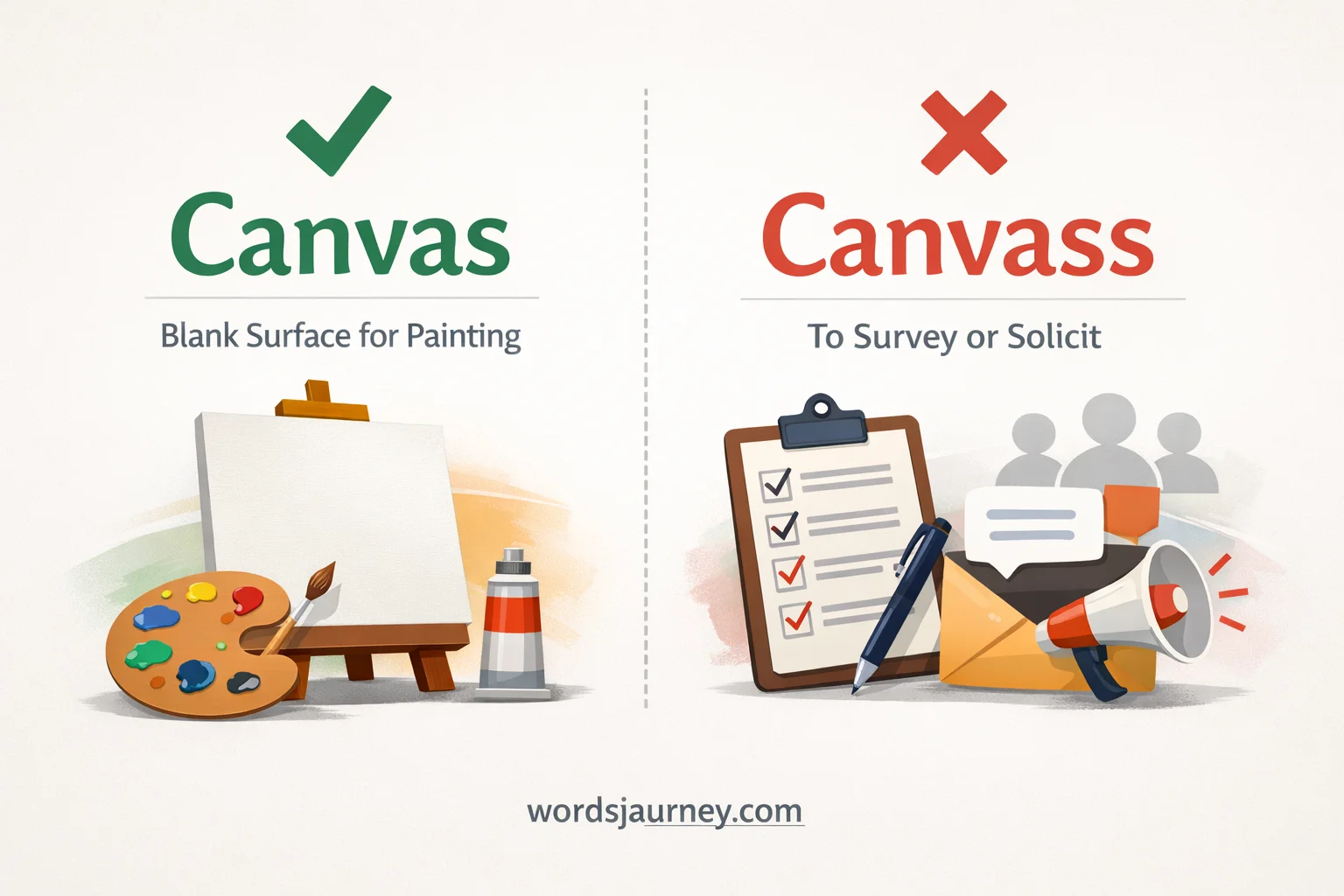
Struggling with the difference between canvas and canvass? You’re not alone. This common grammar mistake can hurt your professional credibility. Learn the correct usage, see real examples, and never confuse them again.
Have you ever stopped mid-sentence, unsure whether to type canvas or canvass? You’re not alone. This tiny spelling choice is one of the most overlooked yet easily fixable errors in professional writing. Using the wrong word can confuse your reader, weaken your message, and quietly undermine your authority in emails, reports, or project updates.
In this complete guide to canvas vs. canvass, you’ll learn:
- Clear definitions of each word with side‑by‑side examples
- Memory tricks to lock the difference in place
- US vs. UK preferences for added precision
- Real‑world scenarios in business, scheduling, and team communication
Whether you’re drafting a meeting summary, updating a calendar, or writing a formal report, choosing the right word matters. Canvas refers to a surface, framework, or platform. Canvass means to survey, gather opinions, or solicit feedback. One letter changes everything.
By the end of this article, you’ll write with confidence, avoid embarrassing mix‑ups, and sharpen your English usage where it counts most.
Quick Answer: Canvas vs Canvass in One Glance
For busy readers, here’s a fast reference table. It’s an easy way to check which word fits your sentence before you type it.
| Word | Part of Speech | Core Meaning | Common Contexts | Example Sentence |
| Canvas | Noun (sometimes verb) | A type of fabric or a surface for art | Art, tents, bags, sails | The artist stretched the canvas across the frame. |
| Canvass | Verb | To ask people for opinions, votes, or support | Politics, surveys, research | Volunteers canvassed the neighborhood for votes. |
What Does “Canvas” Mean?
Definition of Canvas
Canvas is a strong, heavy-duty fabric traditionally made from cotton or linen. It’s durable, flexible, and often used as a surface for painting or for making products that need toughness. The word has roots in the Latin cannabis, meaning hemp, which was once the primary material for canvas fabric.
When used as a verb, it means to cover with canvas, though this use is far less common today.
Common Uses of Canvas
Canvas is everywhere, from everyday items to specialized products. Here’s where you’ll see it most often:
- Art and painting: stretched on frames for oil or acrylic paintings.
- Outdoor gear: tents, sails, and tarps.
- Fashion and accessories: tote bags, backpacks, shoes.
- Home décor: wall coverings, upholstery.
Examples in Sentences
- The painter primed the canvas before starting the portrait.
- She bought a sturdy canvas backpack for her hiking trip.
- The boat’s canvas sail flapped in the wind.
What Does “Canvass” Mean?
Definition of Canvass
Canvass is a verb meaning to seek support, opinions, votes, or business. It comes from the Middle English canvasen, meaning to sift or examine carefully, which evolved into asking or promoting directly.
Unlike canvas, canvass is always about communication or persuasion, not a physical object.
Common Situations Where Canvass Is Used
You’ll mostly see canvass in professional, political, and research contexts:
- Political campaigns: asking people for votes or support.
- Market research: surveying potential customers.
- Community outreach: gathering feedback or raising awareness.
- Fundraising or charity campaigns.
Examples in Sentences
- Volunteers went door-to-door to canvass for the local election.
- The marketing team plans to canvass customers about the new product line.
- Students canvassed opinions for their research project.
Where Do “Canvas” and “Canvass” Come From?
- Canvas comes from the Latin cannabis (hemp), the plant originally used to make the fabric.
- Canvass comes from the Old French canevas (meaning “to sift” or “examine”), which evolved into the modern sense of gathering opinions.
Understanding the roots makes the difference easier to remember.
Canvas vs Canvass: Key Differences
Here’s a quick comparison that makes it easier to remember:
| Feature | Canvas | Canvass |
| Meaning | Fabric or art surface | To ask, survey, or gather opinions |
| Part of Speech | Noun (sometimes verb) | Verb |
| Typical Fields | Art, design, products, materials | Politics, research, outreach |
| Spelling Clue | One “s” | Double “s” |
A simple trick: Canvas has one “s” like a single surface. Canvass has two “s” like speaking to multiple people.
Read More: Heard vs Herd vs Hurd: Examples, and Easy Memory Tricks
Easy Memory Tricks
Here are some mnemonics and tips to make sure you never confuse these words:
- Canvas → One S → Single surface for art
- Canvass → Double S → Survey several people
- Imagine an artist painting on a single canvas versus politicians asking support from multiple people.
- Visual associations: picture a tote bag (canvas) vs a door-to-door team (canvass).
Common Mistakes People Make
Even experienced writers sometimes stumble. Here are the top errors:
- Writing “canvass shoes” instead of “canvas shoes”
- Saying “canvas voters” instead of “canvass voters”
- Relying on spellcheck, which might not catch context
- Mispronouncing, which can make the error sound correct in speech
Also Read: In Effect vs In Affect: Master the Difference
Canvas vs Canvass in Professional Writing
Business and Marketing Context
- Canvass is crucial in campaigns and surveys. For example, a sales team might canvass clients for feedback before launching a product.
- Canvas is used in product descriptions: “High-quality canvas tote bag suitable for daily use.”
Academic and Research Writing
- Always use canvass when referring to data collection: “Researchers canvassed students for opinions about the new curriculum.”
- Canvas appears in art history or design discussions.
Creative and Artistic Writing
- Use canvas for literal or metaphorical surfaces: “Her dreams stretched across an infinite canvas.”
- Canvass rarely appears unless describing outreach or influence.
Practical Examples: Canvas vs Canvass in Context
- Marketing: The team canvassed 500 customers to gauge interest.
- Art: The painter prepared a fresh canvas for the landscape.
- Politics: Volunteers canvassed the neighborhood for voter registration.
- Retail: The store sells durable canvas backpacks perfect for school.
Real-World Scenarios: Canvas vs. Canvass in Emails & Calendars
Wrong: “I’ll canvas the team for availability by 2 PM.”
Right: “I’ll canvass the team for availability by 2 PM.”
Wrong: “Let’s use this project as a blank canvass for ideas.”
Right: “Let’s use this project as a blank canvas for ideas.”
Calendar note example:
✔ “Canvass stakeholders for Q3 priorities”
✔ “Prepare canvas mockups for client review”
Quick Practice Section
Test yourself with these fill-in-the-blank examples:
- The volunteers will _______ the area tomorrow.
- She bought a _______ bag for everyday use.
- The artist stretched the _______ before painting.
- The campaign team plans to _______ voters about the new policy.
Answers:
- Canvass
- Canvas
- Canvas
- Canvass
Related Commonly Confused Word Pairs
Learning canvas vs canvass also helps you notice similar tricky pairs:
- Breath vs Breathe
- Affect vs Effect
- Stationary vs Stationery
- Then vs Than
- Lose vs Loose
FAQs: Canvas or Canvass
Q1: What is the main difference between canvas and canvass?
The difference is simple but important. Canvas is a noun that refers to a material, surface, or framework (like an artist’s canvas or a business model canvas). Canvass is a verb that means to survey, ask for opinions, or gather feedback. Mixing them up can confuse readers and weaken formal writing.
Q2: Can “canvas” ever be used as a verb?
In standard English usage, canvas is primarily a noun. Some informal contexts stretch it as a verb, but most style guides recommend using canvass for actions like polling or collecting responses. Sticking to this rule improves consistency in business communication and professional documents.
Q3: How does this confusion affect professional writing?
Small errors can create friction in meetings, project management updates, and broadcasting scripts. If a note says you will “canvas the team,” readers may picture a platform instead of a survey. Clear word choice supports time management, smoother scheduling, and cleaner calendar coordination.
Q4: Are there US vs. UK differences in usage?
No major differences exist between US and UK English here. Both follow the same rule: canvas for the material or framework, canvass for the action of surveying. Most major style guides align on this point, which helps maintain cross-regional clarity.
Q5: Any quick memory trick to avoid mistakes?
Yes. Think of canvass with two “s” letters as seeking support or surveying people. Canvas has one “s” and refers to a surface or structure. This small cue helps during fast-paced online booking workflows, emails, and reports.
Conclusion
The difference between Canvas or Canvass looks minor, but it carries real weight in professional writing. When your words guide meetings, shape project management updates, or support clear business communication, precision matters. Choosing the right term protects meaning and strengthens your message.
By learning the definitions, spotting common traps, and following basic style guide principles, you build consistency across emails, documents, and shared workflows. This habit supports better time management, cleaner scheduling, and fewer misunderstandings on your calendar.Treat this pair as a quick win for confident grammar and polished English usage. Mastering small distinctions like this helps your writing feel professional, trustworthy, and easy to follow every single time.

Emma Brook is a dedicated writer and language enthusiast at WordsJourney. She’s passionate about helping readers understand words better and use them with confidence in everyday conversations. Her work focuses on alternative phrases, clear meanings, and practical examples that make language feel simple and approachable.
With a friendly, reader-first writing style, Emma breaks down common expressions and explores smarter ways to say things without sounding forced or complicated. Her goal is to make learning words enjoyable, useful, and easy for everyone.