Ever paused while writing and wondered whether it should be “imbed” or “embed”? The confusion behind Imbed vs. Embed is more common than you might think, especially in formal writing, business communication, and digital content creation.
Both forms appear in older and modern English usage, but only one is widely accepted in today’s professional standards. Understanding this difference is important for clear grammar, strong readability, and consistent writing across emails, reports, and online content.
In modern workflows like project management, scheduling, calendar coordination, meetings, online booking systems, and even broadcasting, precise language plays a key role. Writers, marketers, and professionals rely on correct terminology to maintain trust and clarity in communication.
This article breaks down “Imbed vs. Embed” in a simple and practical way, focusing on real-world usage rather than theory.
You’ll learn how major style guides, including differences in US vs. UK English, treat these terms and where each version may still appear. By the end, you’ll clearly understand which spelling is preferred in modern writing and how to use it confidently in professional and digital contexts.
What Does “Embed” Mean?
The verb embed means to place something firmly, deeply, or securely inside something else.
You can embed:
- A video into a webpage
- A quote into an article
- A file into software
- An idea into someone’s mind
- A journalist within a military unit
The word works in both literal and figurative situations. That flexibility helped it become incredibly common in modern English.
Simple Definition of Embed
Embed means to fix, insert, or place something firmly within another thing.
The term appears everywhere today because digital technology depends heavily on embedded content.
For example:
- Websites embed videos
- Apps embed code
- Social platforms embed posts
- Businesses embed tracking pixels
Without realizing it, you probably encounter embedded content dozens of times daily.
What Does “Imbed” Mean?
Here’s where things become interesting.
Imbed means exactly the same thing as embed.
There’s no major difference in definition. The confusion exists because English historically allowed both spellings.
However, modern English strongly favors embed.
Is “Imbed” Wrong?
Not technically.
Major dictionaries still recognize imbed as a legitimate variant spelling. Still, very few professional writers choose it today.
That means:
- You can use “imbed”
- Most editors won’t prefer it
- Readers may assume it’s a typo
- Technology platforms almost always use “embed”
Think of it like older spellings that slowly faded from mainstream usage. They still exist, but they no longer drive modern communication.
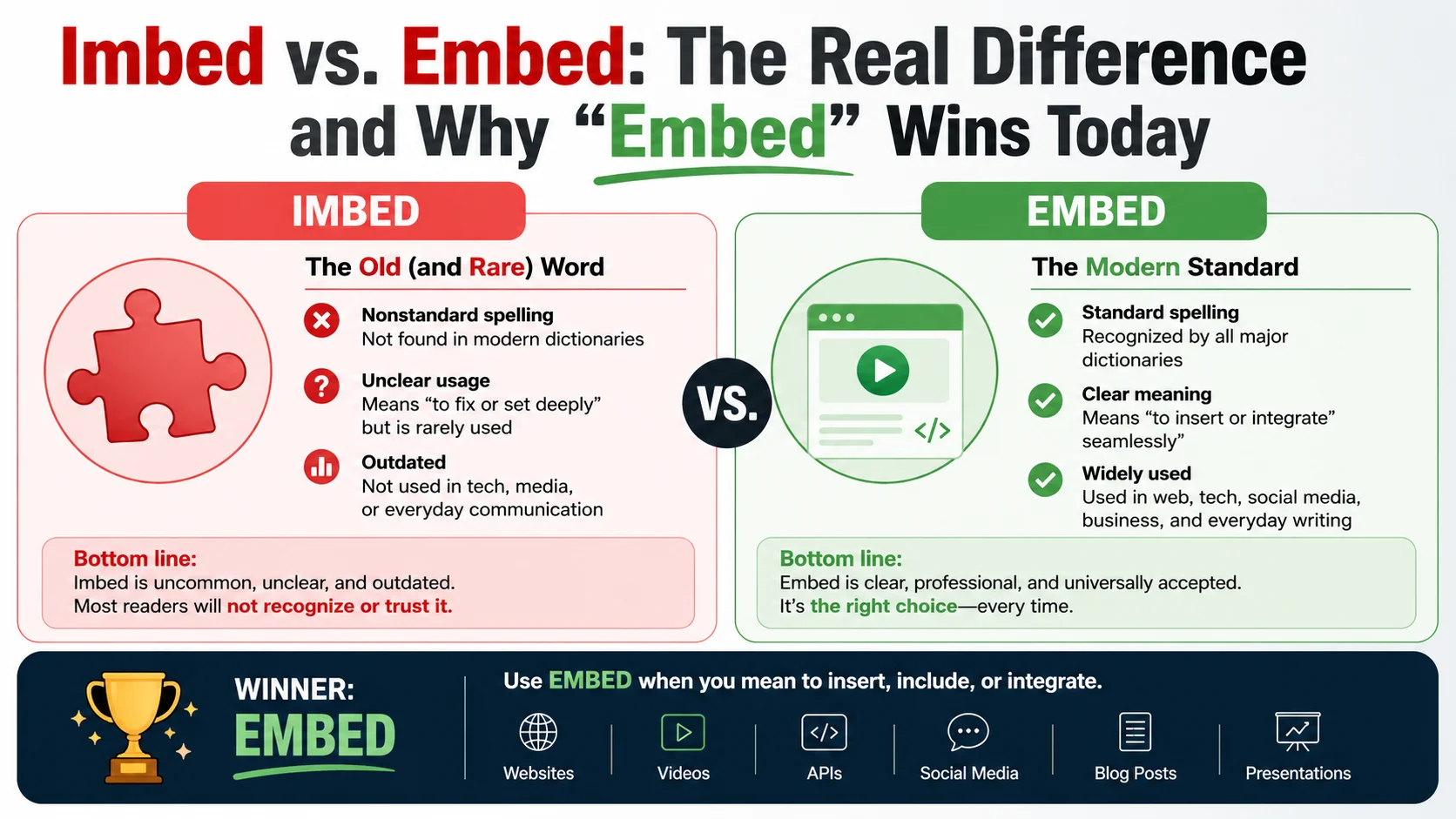
Imbed vs. Embed: Quick Comparison
Here’s the simplest way to understand the difference.
| Feature | Embed | Imbed |
| Standard modern spelling | Yes | Rare |
| Common in technology | Very common | Almost never |
| Preferred by editors | Yes | No |
| Accepted by dictionaries | Yes | Yes |
| Used in academic writing | Frequently | Rarely |
| Seen in software platforms | Constantly | Almost never |
| Looks natural to modern readers | Yes | Usually no |
If you want one practical rule, remember this:
Use “embed” in almost every situation.
That single decision will keep your writing modern, polished, and professional.
Why “Embed” Became More Popular
Language changes constantly. Words compete with each other until one version eventually dominates.
That’s exactly what happened with embed.
Simpler Spellings Usually Win
English often removes unnecessary letters over time.
For example:
- Musick → Music
- Publick → Public
- Shew → Show
The same trend helped “embed” outperform “imbed.”
Writers naturally preferred the cleaner version.
Technology Accelerated the Shift
The internet practically sealed the victory for “embed.”
Why?
Because digital platforms standardized the term.
You constantly see phrases like:
- Embed code
- Embedded video
- Embedded tweet
- Embedded system
- Embedded media
Major platforms reinforced the spelling every day.
For example:
- YouTube uses “embed”
- WordPress uses “embed”
- HTML documentation uses “embed”
- Web developers use “embed”
Once technology adopts a standard term, it spreads rapidly.
Embed in Technology and Digital Media
This is where the word truly exploded in popularity.
If you work online even casually, you’ve seen embedded content everywhere.
What Is Embedded Content?
Embedded content refers to media or functionality inserted directly into another platform.
Instead of redirecting users elsewhere, embedded elements appear inside the existing page.
Examples include:
- Videos
- Maps
- Social media posts
- Audio players
- Forms
- Ads
- Interactive widgets
Example of Embedded Content
Imagine reading a news article about a football match.
Instead of linking to YouTube separately, the article displays the video directly inside the webpage.
That video is embedded.
This improves:
- User experience
- Engagement time
- Accessibility
- Website interaction
Common Types of Embedded Media
Embedded Videos
YouTube made embedding mainstream.
Website owners can paste a small HTML snippet and instantly display a playable video.
Example:
<iframe src=”video-link”></iframe>
That tiny code snippet powers millions of websites daily.
Embedded Social Posts
Platforms like:
- X
- TikTok
allow users to embed posts directly into articles.
This helps journalists show original content without screenshots.
Embedded Maps
Businesses frequently embed maps onto contact pages.
Benefits include:
- Easier navigation
- Better user experience
- Increased local trust
- Improved mobile usability
Embedded Forms
Companies embed:
- Surveys
- Email signups
- Contact forms
- Payment systems
This keeps users on the same page while collecting information efficiently.
What Is an Embedded System?
Outside digital publishing, the word has a completely different meaning.
An embedded system is a specialized computer system built into a larger machine.
Unlike standard computers, embedded systems usually perform one dedicated task.
Examples of Embedded Systems
| Device | Embedded Function |
| Smartwatch | Fitness tracking |
| Microwave | Timer control |
| Car | Engine monitoring |
| ATM | Transaction processing |
| Smart TV | Streaming software |
| Washing machine | Cycle automation |
These systems quietly power modern life.
Most people interact with embedded systems constantly without realizing it.
Grammar Rules for Embed
Grammar confusion usually appears when people write past tense forms.
Let’s simplify everything.
| Tense | Correct Form |
| Present | Embed |
| Past | Embedded |
| Continuous | Embedding |
| Past Participle | Embedded |
Can You Say “Imbedded”?
Technically yes.
But modern English overwhelmingly prefers:
- Embedded
- Embedding
The form imbedded now sounds outdated to many readers.
That’s why most professional editors avoid it entirely.
Why Writers Prefer “Embed”
Professional writing values:
- Clarity
- Consistency
- Familiarity
“Embed” checks every box.
Readers instantly recognize it because they encounter it constantly online.
Meanwhile, “imbed” often causes hesitation.
Even a split-second pause hurts readability.
Good writing flows naturally. Strong writers avoid anything that interrupts that flow.
Embed vs. Imbed in Dictionaries
Interestingly, dictionaries still acknowledge both spellings.
However, they don’t treat them equally.
Dictionary Treatment Comparison
| Dictionary | Preferred Entry |
| Merriam-Webster | Embed |
| Cambridge Dictionary | Embed |
| Oxford English Dictionary | Embed |
| Collins Dictionary | Embed |
Most list “imbed” merely as a secondary variant.
That distinction matters.
It tells you which version dominates actual usage.
Real-World Usage Statistics
If you search modern websites, the difference becomes massive.
Google Search Trends
“Embed” appears dramatically more often than “imbed.”
Technology websites especially favor “embed” almost exclusively.
Industries using “embed” heavily:
- Software development
- Digital marketing
- Education
- Publishing
- Web design
- Cybersecurity
- Journalism
Common Mistakes Writers Make
Small language mistakes can weaken otherwise strong writing.
Here are the most common errors surrounding embed and imbed.
Assuming “Imbed” Is More Formal
Some writers mistakenly believe “imbed” sounds more academic.
Actually, the opposite happens today.
Modern academic writing strongly prefers “embed.”
Mixing Spellings in the Same Article
Consistency matters.
Switching between:
- Embed
- Imbed
- Embedded
- Imbedded
creates unnecessary confusion.
Choose one version and stay consistent.
Professional recommendation:
Always use “embed.”
Confusing Embed With Insert
These words overlap but don’t always mean the same thing.
Insert
Usually temporary or loose placement.
Embed
Suggests deeper integration or permanent placement.
For example:
- You insert a photo into a document
- You embed a video into a webpage
The second implies functional integration.
Embed in Everyday Language
The word isn’t limited to technology.
People also use it metaphorically.
Common Figurative Examples
- “That memory remained embedded in his mind.”
- “Fear became embedded in the culture.”
- “The tradition is deeply embedded in society.”
In these cases, embed suggests something deeply rooted.
That emotional depth makes the word especially powerful in writing.
Historical Background of Imbed and Embed
English spelling wasn’t always standardized.
Centuries ago, writers frequently spelled words differently.
Both “imbed” and “embed” emerged from similar linguistic roots.
Over time:
- Publishing standards evolved
- Dictionaries became more influential
- Educational systems standardized spelling
Eventually, “embed” became dominant.
This pattern appears throughout English history.
Case Study: How Technology Eliminated “Imbed”
Let’s look at a practical example.
Early Publishing Era
Older printed texts occasionally used “imbed.”
Readers accepted both versions because spelling standards varied widely.
Rise of Computing
Then software companies standardized technical vocabulary.
Computer manuals repeatedly used:
- Embed object
- Embedded software
- Embedded system
This consistency shaped global usage.
Millions of programmers, writers, and educators adopted the same spelling.
Eventually, “imbed” became increasingly rare.
Examples of Correct Usage
Sometimes examples teach faster than explanations.
Professional Examples
Marketing
- “The company embedded tracking software into the website.”
Journalism
- “The reporter embedded with military forces overseas.”
Education
- “Teachers embed interactive videos into online lessons.”
Technology
- “Developers embed JavaScript directly into webpages.”
Casual Conversation Examples
- “That song is embedded in my memory.”
- “The nail became embedded in the wall.”
- “She embedded the image into the presentation.”
These examples sound smooth because modern readers recognize the spelling instantly.
Why “Embed” Sounds More Natural Today
Language familiarity matters enormously.
Readers process familiar patterns faster.
Because people constantly encounter:
- Embedded tweets
- Embedded videos
- Embedded systems
their brains naturally accept “embed” more easily.
“Imbed” interrupts that familiarity.
Even if technically correct, it feels unusual.
And unusual wording often weakens readability.
Should You Ever Use “Imbed”?
In most situations, no.
Still, there are a few exceptions.
Situations Where “Imbed” Might Appear
Historical Documents
Older publications sometimes use it.
Stylistic Preference
A few writers intentionally preserve older spellings.
Legacy Technical Manuals
Older documentation occasionally contains “imbed.”
Even then, modern editors usually update it.
Embed vs. Imbed in Academic Writing
Academic institutions strongly favor standardized spelling.
That means:
- Embed
- Embedded
- Embedding
appear far more frequently in journals and research papers.
Using “imbed” in formal writing may distract reviewers unnecessarily.
When clarity matters, standard spelling always wins.
Also Read more: “Runt of the Litter” Meaning, Origin, and Examples
The Psychology Behind Familiar Words
People trust familiar language.
That trust affects:
- Readability
- Credibility
- Authority
- Engagement
A reader may not consciously notice “imbed,” yet it can still feel slightly off.
That subtle discomfort matters online where attention spans remain extremely short.
Strong writing removes friction.
Using “embed” helps accomplish that.
Quick Memory Trick
If you forget which version to use, remember this:
You “embed” videos online.
You almost never “imbed” them.
Since technology constantly reinforces the standard spelling, the correct choice becomes easier to remember.
Expert Writing Recommendation
Professional editors, SEO strategists, educators, and developers overwhelmingly recommend:
- Embed
- Embedded
- Embedding
Using these versions keeps your writing:
- Modern
- Professional
- Clear
- Search-friendly
Simple choices often create the biggest improvements.
Frequently Asked Questions About Imbed vs. Embed
Frequently Asked Questions (FAQs)
1. What is the correct spelling: imbed or embed?
The most widely accepted modern spelling is “embed.” It is preferred in formal writing, digital content, and professional communication.
2. Is “imbed” wrong in English grammar?
No, “imbed” is not technically wrong, but it is considered outdated. Most modern style guides recommend using “embed” instead.
3. Why do both spellings exist?
Both forms come from historical English usage. Over time, “embed” became the standard in US and UK English usage.
4. Where is the word “embed” commonly used today? I
t is widely used in business communication, broadcasting, project management, online booking systems, and digital content integration.
5. Does US and UK English treat imbed vs embed differently?
Both US vs UK style guides now largely prefer “embed.” “Imbed” may still appear in older British or American texts.
6. Can I use “imbed” in formal writing?
It is better to avoid it in formal writing. Using “embed” ensures better consistency, clarity, and professionalism.
Conclusion
Understanding Imbed vs. Embed is essential for anyone working with modern English content, especially in business communication, project management, and digital platforms. While both spellings exist, “embed” is the clear standard in today’s grammar and writing practices.
Choosing the correct form improves consistency, enhances professional credibility. Whether you are managing meetings, handling scheduling, or creating online content, using “embed” ensures your writing aligns with current English usage and global style expectations. In short, stick with “embed” for clarity, accuracy, and modern communication standards.

Aliya Ray is a passionate writer and language enthusiast at WordsJourney. She enjoys exploring words, phrases, and everyday expressions to help readers communicate more clearly and confidently. Her content focuses on alternative ways to say common phrases, simple explanations, and real-life examples that make language easy to understand.
Aliya believes the right words can make any message stronger. Through clear, friendly writing, she helps readers improve their vocabulary without feeling overwhelmed or confused.